Desk-Russie: When the Russian Ship Shtandart and La Rochelle Defy European Sanctions, 28/09/2025
At the heart of the Bassin des Chalutiers, a timeless three-masted ship draws attention and fascinates passers-by. The Shtandart is a…
Desk-Russie: When the Russian Ship Shtandart and La Rochelle Defy European Sanctions, 28/09/2025
At the heart of the Bassin des Chalutiers, a timeless three-masted ship draws attention and fascinates passers-by. The Shtandart is a Russian vessel under sanctions, definitively banned from access to European ports by the Court of Justice of the EU. Yet it floats within an apparent local legality. But behind its postcard-like appearance lies a web of influence networks and complicity reaching into the very core of the French state apparatus. A situation that tests Brussels’ authority and raises questions about La Rochelle’s responsibility.
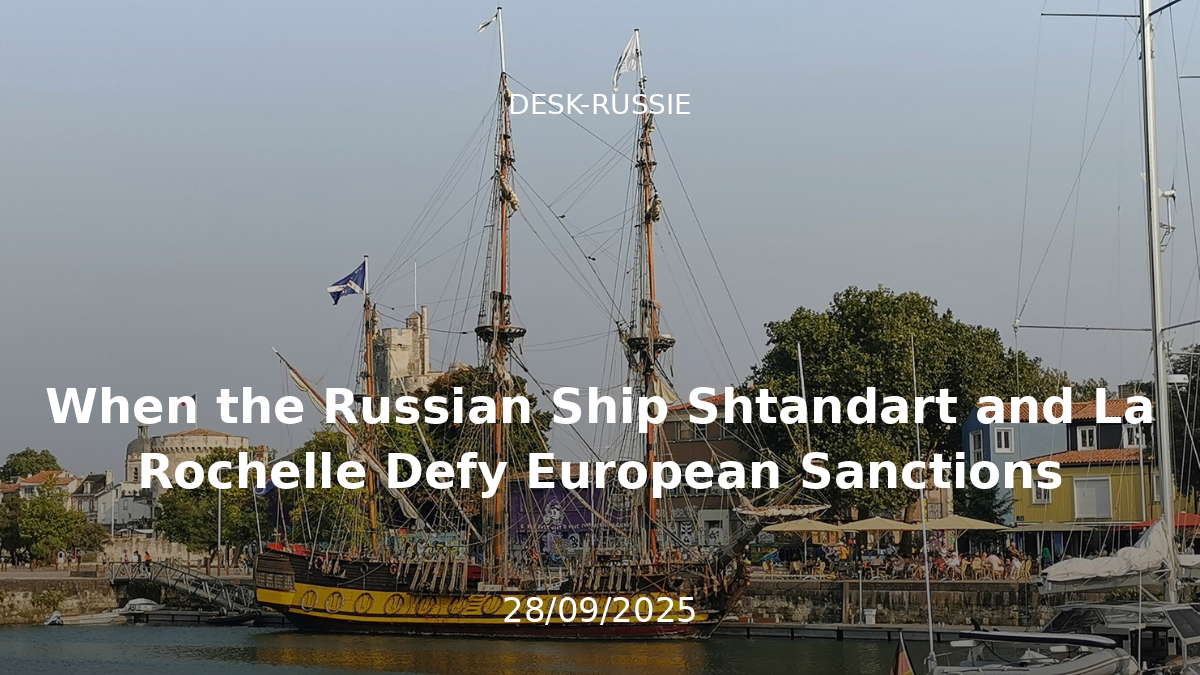
The Shtandart in the Bassin des Chalutiers, La Rochelle, 11 September 2025 // No Shtandart in Europe
This paper is an English version of the French article published on Desk-Russie
By Bernard Grua 28 September 2025
The Bassin des Chalutiers: a maritime stage
On this 11 September 2025, the Bassin des Chalutiers awakens beneath a changing sky. A few boats glide slowly across the water, while the vessels of the floating museum and pleasure sailboats are gently rocked by the lapping waves. Yet in the middle of this everyday scene, one three-masted ship captures every gaze. Dark, adorned with gilding and exuberant Baroque sculptures, it flies multicolored flags fluttering in the wind. Passers-by stop, take photographs, and some climb aboard. For them, the *Shtandart* is merely a charming backdrop, a living maritime memory.
Behind this veneer, however, lies a heavier story, where the shadow of geopolitics intertwines with maritime culture. The Shtandart, MMSI 518999255, launched in 1999, is a replica of Peter the Great’s first frigate, emblematic of the founding of the Russian navy in the 18th century. The vessel also carries a significant ideological burden. After once flying the Russian naval jack at the top of the main mast, it now frequently hoists a large imperial flag. A gesture whose symbolic significance is considerable.
The Court of Justice of the EU has ruled, La Rochelle persists
On 22 August 2025, the Court of Justice of the European Union (CJEU) ruled in case T-446/24: the Shtandart has been subject, since their publication, to the sanctions of the 5th package as defined in Article 3ea of Regulation (EU) No 833/2014. Historical replicas benefit from no exception. This judgment leaves no room for ambiguity and enshrines Europe’s consistent position. It confirms the clarification issued by the *European Council on 24 June 2024, order №2403878 of the Administrative Court of Rennes, and ruling №496439 of the Conseil d’État*. As the highest court of the Union, the CJEU has thus given this judgment definitive authority. Any national tolerance now constitutes a blatant illegality, with no possible appeal.
And yet, in La Rochelle, nothing changes. Since 2022, the Shtandart has made the Bassin des Chalutiers its regular base. Since 6 June 2024, the Russian private yacht has been registered under a Cook Islands flag of convenience. It benefits from a berth at the honorary quay, electricity, water, infrastructure, and cultural visibility that other European ports, more respectful of the rule of law, systematically refuse it.
A striking contrast
Everywhere else in Europe, the doors have closed. Spain banned the vessel from entering its territorial waters as early as 2024. The major international tour planned for summer 2025 had to be cut short. The embassies of Ukraine in Ireland and the United Kingdom intervened, and those countries blocked the Shtandart during its stopovers. The same occurred in Norway and Denmark, while the vessel resorted to several practices associated with the Russian shadow fleet. In France, the prefectures of Finistère, Côtes-d’Armor, Ille-et-Vilaine, and Manche also issued clear prohibition orders.
Amid this unanimous front, La Rochelle stands out as an exception. Far from being turned away, the Russian outlaw even finds a permanent base there. Such an anomaly is not merely a local detail. It sends a signal of complacency to Moscow and directly challenges European decisions. Why and how has such a situation been made possible?

The Shtandart and the Irish Coast Guard, Killiney Bay, 8 July 2025. Photo: Fletcher Thompson // No Shtandart in Europe

On 11 July 2024, a French maritime gendarmerie patrol vessel denied the Shtandart access to Brest harbour. Photo: Frédéric Chauveau de Villoutrey // No Shtandart in Europe
Local networks and state complicity
Behind this irregularity stand identified actors. Patrice Bernier, harbour master, played a key role in welcoming and protecting the vessel. Together with Michel Balique, president of the association *Amis des Grands Voiliers, he built a network of allies in maritime and institutional circles. Confidential emails were publicly shared by Vladimir Martus, captain and hidden owner of the Shtandart, and by one of his lawyers. They reveal the activation of complicity at the heart of the French state apparatus, including the [DGAMPA](https://bernardgrua.net/2025/05/15/passe-droits-du-shtandart/#15-juillet-2022-passe-droit-confirme-d-eric-banel-directeur-general-des-affaires-maritimes-de-la-peche-et-de-l-aquaculture), the [DNRED](https://bernardgrua.net/2025/05/15/passe-droits-du-shtandart/#23-janvier-2023-passe-droit-confirme-de-la-direction-nationale-du-renseignement-et-des-enquetes-douanieres-dnred), and the [SGMer](https://bernardgrua.net/2025/05/15/passe-droits-du-shtandart/#16-avril-2024-demande-de-changement-de-pavillon-et-passe-droit-confirme-par-eric-turquet-de-beauregard-secretariat-general-de-la-mer-sgmer). This enabled them to keep the Shtandart* moored despite European and national prohibitions.
This dynamic found political support under the mandate of Jean-François Fountaine, mayor until his recent resignation. From June 2022 onward, he granted the Russian vessel cultural and media legitimacy: maritime festivals (1, 2), communications from the municipality and the Tourist Office. While other ports were closing their doors, La Rochelle opened its arms wide and turned the Shtandart into the emblem of a diverted maritime heritage.
The circumvention of sanctions officially decorated
Brice Blondel is the former chief of staff of Emmanuel Macron and now prefect of Charente-Maritime. On 13 December 2024, in an official room of the prefecture, he awarded Patrice Bernier the Ordre national du Mérite and the Médaille de la Sécurité intérieure. As prefect, Blondel is responsible for enforcing European port sanctions in his department. Thus, one of the principal architects of the circumvention of sanctions was decorated by the very authority charged with enforcing them.
During his speech, Blondel publicly greeted Vladimir Martus, who was present among the audience. Beneath the Republic’s gilded decor, a banned vessel received official consecration.
“You [Patrice Bernier] also contribute to the prestige of this marina by attracting the commanders of tall ships and encouraging them to stop over in La Rochelle. There is one among us this evening, indeed even two, Mr. Martus and the commander of the Belem, we salute them. Thank you for these contributions which, thanks to the activism and militancy of the chief harbour master, make La Rochelle a port that shines internationally.” (Brice Blondel, prefect of Charente-Maritime)
Previously, in June 2024, aboard the Belem, also in La Rochelle, Patrice Bernier had made his partner Michel Balique a knight of the *Ordre du Mérite maritime*. Vladimir Martus was present at that ceremony. He addressed his congratulations to the fortunate recipient, to whom he owes so much.
These symbolic gestures illustrate the continuity of institutional recognition that reinforced the presence of the Shtandart in La Rochelle and consolidated its local and national networks.

Vladimir Martus facing demonstrators in Camaret-sur-Mer on 15 August 2022 // No Shtandart in Europe
A manufactured regional media narrative
Since 2022, regional media outlets — such as *Sud-Ouest and [France 3 Nouvelle-Aquitaine](https://www.france.tv/france-3/nouvelle-aquitaine/la-france-en-vrai-aquitaine/6552425-l-incroyable-odyssee-du-shtandart.html) — have widely relayed a misleading interpretation of the sanctions promoted by the Shtandart*’s networks.
For its part, the prefecture of Charente-Maritime considers that “the prohibitions relating to certain Russian vessels do not apply in this case.” (*Sud-Ouest*, 11 December 2022)
Catherine Léonidas, deputy mayor: “It is a training ship, not a warship, nor a commercial vessel or one belonging to an oligarch… this ship has every right to be welcomed.” (*France 3 Nouvelle-Aquitaine*, 20 December 2022)
They also popularized Vladimir Martus’s narrative, portraying him as a supporter of Ukraine, an opponent of the Kremlin, a victim of Putin in the same way as the Ukrainians, and a messenger of peace.
Vladimir Martus: “We wish to develop friendship between peoples…” (*Sud-Ouest*, 14 December 2022)
Catherine Léonidas, deputy mayor: “[…] he is an opponent of Putin who left Saint Petersburg with the Shtandart in 2009 because he no longer agreed with Putin’s policy…” (*France 3 Nouvelle-Aquitaine*, 20 December 2022)
Yet numerous pieces of evidence contradict this flattering portrayal. Until October 2021, the Shtandart participated in official Russian missions and was the subject of a documentary on RT in 2014. In 2016, its captain celebrated the theft of the Ukrainian tall ship Khersones. During the summer of 2024, he gave numerous interviews to Russian propaganda outlets, expressing hostility toward European institutions and French authorities. Added to this was an outrageous statement from the Russian Consulate General in July 2025 against the United Kingdom for banning the Shtandart from the Tall Ships Races in Aberdeen.
Compelling, accessible, and verifiable documents were largely ignored by the media of Charente-Maritime. Since the CJEU ruling, these communication outlets have remained silent. Not a word about the historic decision, no analysis, no reminder of legal obligations. This omertà deprives citizens of essential information. It fuels the narrative of Martus and his lobbyists, disseminated without critical scrutiny.

Demonstration against the Shtandart in Vannes on 18 March 2023 // No Shtandart in Europe
Between maritime attraction and propagandistic role
Beyond the legal framework, the vessel plays a strategic role. The Shtandart is a machine for russifying its customers and crew members. It has become an instrument aimed at testing the resilience of European restrictive measures. It also constitutes a platform for propaganda and the symbolic laundering of the Russian state’s actions before the general public.
Moreover, the presence of the imperial flag and the references to Peter the Great give the Shtandart a historical and cultural rooting claimed by Putin to “justify” the large-scale invasion of Ukraine.
Finally, this Russian ghost ship divides the maritime community. It permanently tarnishes the organizations and events working in France to preserve maritime heritage and traditional sailing.
By maintaining its hospitality, La Rochelle exposes itself to a moral failing, legal disputes, and a clear political responsibility: that of having circumvented a definitive European decision.

Russian imperial flag at the top of the main mast, La Rochelle // No Shtandart in Europe

Crowned lion at the bow of the Shtandart. Photo: Galia Ackerman
A national responsibility engaged
The Shtandart affair now goes far beyond the simple framework of a local curiosity. It turns La Rochelle into a kind of “Atlantic Kaliningrad.” By allowing this situation to continue in contradiction with the decisions of the Court of Justice of the European Union, La Rochelle compromises not only its own image but also that of France as a whole. Indeed, the tolerance granted to the mooring of a Russian vessel under sanctions in a French port constitutes a symbolic and strategic lever for Moscow, likely to weaken the coherence of European positions.
This Rochelais drift reflects a broader tension between the collective commitments undertaken at Union level and the choices made, voluntarily or through inertia, at national level. Beyond the maritime symbol, the case presented here raises a question of political and legal credibility: that of the capacity of a Member State to apply consistently the sanctions it helped to adopt. It is not only Brussels’ authority that is being challenged, but also France’s word on the international stage.
In a context where the European Union is trying to maintain a firm line in the face of Russian aggression against Ukraine, the persistence of this situation appears as a breach. A breach which, if not rapidly closed, could constitute an embarrassing precedent for Paris and an exploitable argument for Russian propaganda.
Since the French authorities have failed, for more than three years, to enforce port sanctions in the port of La Rochelle, it is appropriate to remove the opportunity for such failures. It would be relevant for the Brest Maritime Prefecture, drawing inspiration from the Spanish example, to issue without delay an order banning the Shtandart from accessing the territorial waters under its jurisdiction. Such a measure would guarantee respect for European decisions, France’s word, and the rule of law. The collective No Shtandart in Europe will soon submit a proposal to this effect.

Demonstration against the Shtandart in front of La Rochelle city hall on 11 December 2022 // No Shtandart in Europe
Author’s addendum:
The Shtandart left the port of La Rochelle on the evening of 11 September 2025 and returned there on 16 and 17 September. On that occasion, the newspaper Sud-Ouest finally published an article supposedly intended to “justify” its presence. The journalist mentions the decision of the Court of Justice of the European Union of 22 August 2025 and the clarification of the European Council of 24 June 2024, but without any evidence that she actually consulted these texts. She merely reports the statements of the prefect’s chief of staff, who offers his personal interpretation of these two sources. Such testimony constitutes clear evidence that the representative of the State remains involved in the systematic circumvention of the restrictive sanctions targeting the Russian vessel.
This element is strategic for possible legal actions: it documents official participation in the tolerance of the stopovers, despite the formal prohibition imposed by the European Union.
메타데이터
- post_id
- 28f6251c0dca
- slug
- desk-russie-when-the-russian-ship-shtandart-and-la-rochelle-defy-european-sanctions-28-09-2025-28f6251c0dca
- url
- https://medium.com/@bernardgrua/desk-russie-when-the-russian-ship-shtandart-and-la-rochelle-defy-european-sanctions-28-09-2025-28f6251c0dca
- canonical_url
- https://medium.com/@bernardgrua/desk-russie-when-the-russian-ship-shtandart-and-la-rochelle-defy-european-sanctions-28-09-2025-28f6251c0dca
- author_url
- https://medium.com/@bernardgrua
- status
- ok
- fetched_at
- 2026-06-09 15:37:30





