From Parsers to AI: Why ANTLR and GBNF Are Becoming the Backbone of Structured LLM Applications
Large Language Models can generate convincing text, write code, and answer complex questions. However, in real-world systems, free-form…
From Parsers to AI: Why ANTLR and GBNF Are Becoming the Backbone of Structured LLM Applications
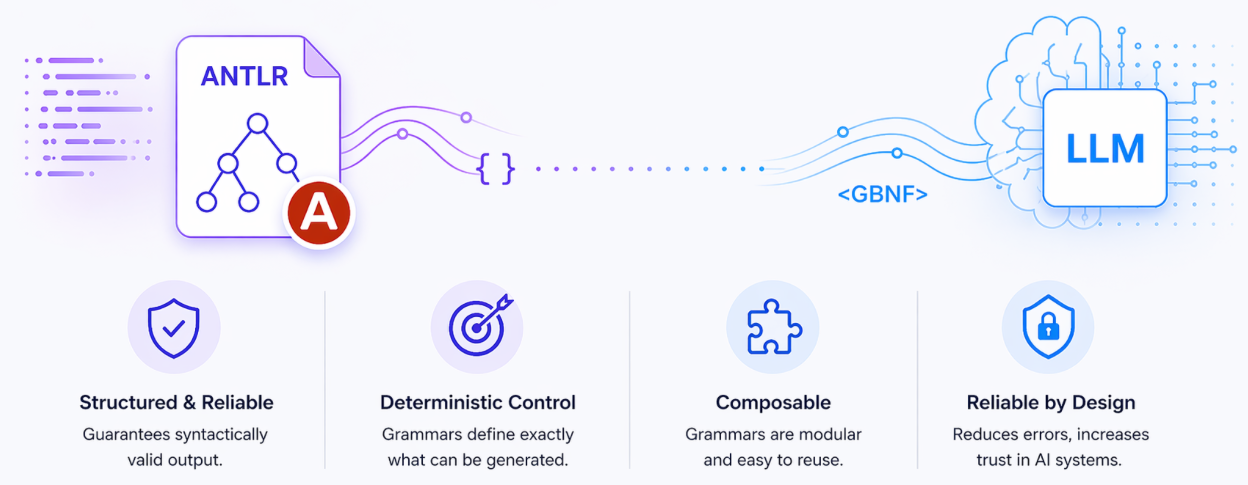
Large Language Models can generate convincing text, write code, and answer complex questions. However, in real-world systems, free-form text is often not enough. Applications expect structured output: APIs require valid JSON, databases expect syntactically correct SQL, and automation systems rely on well-defined commands.
This requirement has brought formal grammars back into focus.
Two technologies that increasingly appear together in modern AI architectures are ANTLR and GBNF. While they originate from very different worlds — compiler construction and AI inference — they now form a powerful combination for building reliable AI systems.
ANTLR helps developers parse and interpret structured languages, while GBNF can constrain the output of language models so that generated text follows a predefined grammar.
This article explores both technologies, explains their differences, and shows how they work together in modern LLM-powered architectures.
Why Grammars Matter Again
For decades, grammars were mainly used in compilers and interpreters. Programming languages, configuration languages, and query languages all rely on formal grammars to define their syntax. But the rise of Large Language Models introduced a new challenge:
LLMs generate text probabilistically, not deterministically. This means they may produce:
- invalid JSON
- malformed SQL queries
- incorrect commands
- or inconsistent structured output
For simple chat interactions this may not matter, but in automated systems the consequences can be severe. If an AI assistant is supposed to generate database queries or workflow commands, syntax errors can break the entire process. Instead of checking structure after generation, modern AI systems increasingly enforce structure during generation.
This is where grammars come back into play and that is exactly where GBNF enters the picture.
ANTLR: A Classic Parser Generator
ANTLR — short for Another Tool for Language Recognition — is a widely used parser generator originally created by Terence Parr. It allows developers to describe the syntax of a language in a grammar file and automatically generates a lexer and parser. A lexer (lexical analyzer) takes raw text and splits it into meaningful pieces called tokens, such as keywords, numbers, and symbols. A parser then takes those tokens and determines how they fit together according to the language’s grammar. In simple terms, the lexer identifies the building blocks, and the parser defines their structure. These concepts are formally explained in compiler theory.
ANTLR is commonly used for programming languages, domain-specific languages (DSLs), query languages, code analysis tools, as well as interpreters and compilers.
ANTLR grammars typically contain two types of rules:
- lexer rules that define tokens
- parser rules that define syntax structures
A key advantage of ANTLR is that it generates parse trees representing the structure of the input text. These parse trees can then be processed using visitors or listeners.
A Simple ANTLR Example
Consider a small grammar that recognizes basic mathematical expressions. File: Expr.g4
grammar Expr;

prog: expr EOF;

expr
    : expr '*' expr
    | expr '+' expr
    | INT
    ;

INT: [0-9]+;
WS: [ \t\r\n]+ -> skip;
This grammar defines a minimal expression language consisting of integers, addition, and multiplication. ANTLR can generate parsers in several programming languages, including Java, Python, and JavaScript.
To generate a Python parser, you can run:
antlr4 -Dlanguage=Python3 Expr.g4
Once generated, the parser can be used to process expressions. The following Python script demonstrates how to use the generated lexer and parser:
from antlr4 import *
from ExprLexer import ExprLexer
from ExprParser import ExprParser

input_stream = InputStream("2 + 3 * 4")
lexer = ExprLexer(input_stream)
tokens = CommonTokenStream(lexer)
parser = ExprParser(tokens)
tree = parser.prog()

print(tree.toStringTree(recog=parser))
ANTLR analyzes the input and builds a structured parse tree representing the expression. For example:
(prog (expr (expr 2) + (expr (expr 3) * (expr 4))) <EOF>)This structure can then be evaluated, transformed, or interpreted. ANTLR therefore excels at analyzing and processing structured languages.
The Shift Introduced by Large Language Models
Traditional parsers operate on text that already exists, analyzing it according to a defined grammar. Large Language Models extend this paradigm by generating text token by token. Instead of only validating completed input, developers increasingly aim to guide the generation process itself. This creates a new challenge: How can we ensure that the tokens produced by an LLM always follow a valid structure?
This is where grammar-constrained generation becomes important.
GBNF: Grammar Constraints for LLM Output
GBNF stands for Grammar Backus–Naur Form, a grammar specification used to constrain language model output. It is particularly associated with tools such as llama.cpp, where grammars can be applied directly to the decoding process of a model.
Instead of parsing existing text, GBNF limits the tokens that a model is allowed to produce. If a token would violate the grammar, it is simply not allowed during generation. The result is output that always follows the specified syntax.
Example: JSON Grammar in GBNF
A simplified JSON grammar might look like this:
root ::= object
object ::= "{" ws "}"
        | "{" members "}"
members ::= pair
          | pair "," members
pair ::= string ":" value
value ::= string
        | number
        | object
        | array
        | "true"
        | "false"
        | "null"
array ::= "[" ws "]"
        | "[" elements "]"
elements ::= value
           | value "," elements
string ::= "\"" char* "\""
number ::= [0-9]+
ws ::= [ \t\n]*
When used during inference, the LLM can only generate tokens that satisfy this grammar. That guarantees the output is always valid JSON.
Grammar-Constrained LLM Generation
Consider a prompt such as:
Generate a user profile.Without grammar constraints, the output might look like this:
Name: Alice
Age: 34
Although readable, this output is not structured enough for an API. With a grammar constraint enforcing JSON, the model produces something like:
{
  "name": "Alice",
  "age": 34
}
The grammar effectively guides the model toward syntactically valid output. This dramatically reduces errors in downstream processing.
The Key Difference Between ANTLR and GBNF
Although both technologies rely on grammars, their roles are fundamentally different.

Einstein says: ANTLR analyzes existing input — GBNF controls future output.
- ANTLR operates after text is produced, while GBNF works during generation.
- ANTLR produces structured parse trees that can be interpreted or transformed.
- GBNF instead limits the token choices available to a language model.
Because of this distinction, they complement each other rather than compete.
SQL Example: Parsing vs. Generation
ANTLR is well suited for parsing SQL. A simplified grammar might look like this:
select
 : SELECT columns FROM table
 ;

columns
 : '*'
 | column (',' column)*
 ;

column
 : IDENTIFIER
 ;

table
 : IDENTIFIER
 ;

SELECT: 'SELECT';
  FROM: 'FROM';
IDENTIFIER: [a-zA-Z_][a-zA-Z0-9_]*;
WS: [ \t\n]+ -> skip;
Given the query:
SELECT name, age FROM usersANTLR produces a structured parse tree that allows further processing.
Now consider the opposite direction: generating SQL with an LLM. Using GBNF, a grammar might be defined as:
root ::= select
select ::= "SELECT " columns " FROM " table
columns ::= "*"
          | column
          | column ", " columns
column ::= identifier
table ::= identifier
identifier ::= [a-zA-Z_][a-zA-Z0-9_]*
With this grammar applied during inference, an LLM can generate SQL queries that are guaranteed to follow the defined syntax.
At this point, a natural question arises: how is this grammar actually enforced during inference?
At each generation step, the grammar restricts which tokens are allowed next. The model can only choose from tokens that keep the output valid according to the grammar, while all others are masked out. This effectively turns generation into a guided process, ensuring the final output always conforms to the defined structure.
Modern AI Architectures Combine Both
The most interesting use case emerges when both technologies are combined. A typical architecture might look like this:

In this setup: The LLM generates commands using a grammar constraint. ANTLR parses those commands and converts them into structured operations. The system then executes them deterministically.
Example: AI Agent Command Language
Imagine an AI assistant capable of creating support tickets.
The system defines a small command language:
create_ticket(title="Server down", priority="high")A GBNF grammar ensures that the LLM only produces valid commands. ANTLR then parses the generated command and converts it into structured data. For example:
Command
 ├── name: create_ticket
 └── arguments
      ├── title="Server down"
      └── priority="high"
The application can now safely execute the command.
the Why This Matters for Modern Applications
Structured AI generation is becoming critical for many domains.
- AI agents must call tools and APIs.
- Developer copilots generate configuration files.
- Automation systems execute generated commands.
- Database assistants produce SQL queries.
Without grammar constraints, these systems would frequently fail due to syntax errors. Combining grammar-constrained generation with robust parsing enables deterministic AI workflows. This dramatically increases reliability.
The Emerging Pattern in AI Systems
Many modern architectures follow a similar pattern:
- Language model for reasoning
- Grammar constraint for structure
- Parser for interpretation
- Execution layer for action
This combination allows developers to balance creativity and control. The language model provides flexible reasoning, while grammars ensure structural correctness.
Conclusion
ANTLR and GBNF originate from very different technological traditions. ANTLR belongs to the world of compilers and language processing. GBNF emerged in the context of LLM inference and structured generation.
Yet together they form a powerful foundation for modern AI systems.
GBNF ensures that language models produce syntactically valid output, while ANTLR interprets and processes that output reliably.
As AI applications increasingly move from conversational interfaces toward action-oriented systems, the importance of structured generation will only grow.
In this new landscape, grammars are no longer just a compiler concept — they are becoming a key component of reliable AI architectures and who knows maybe its one of our foundations for APEX Future and the friendship with our SQLcl compiler. Stay tuned 🤞🏻

This is a follow up article on ANTLR vs. YAML — A Deep Dive into a Language Tool vs. a Data Format for more stories have a look at my account.

메타데이터
- post_id
- 28f9ce5e698d
- slug
- from-parsers-to-ai-why-antlr-and-gbnf-are-becoming-the-backbone-of-structured-llm-applications-28f9ce5e698d
- url
- https://medium.com/@sonja.meyer/from-parsers-to-ai-why-antlr-and-gbnf-are-becoming-the-backbone-of-structured-llm-applications-28f9ce5e698d
- canonical_url
- https://medium.com/@sonja.meyer/from-parsers-to-ai-why-antlr-and-gbnf-are-becoming-the-backbone-of-structured-llm-applications-28f9ce5e698d
- author_url
- https://medium.com/@sonja.meyer
- status
- ok
- fetched_at
- 2026-06-22 12:55:45



