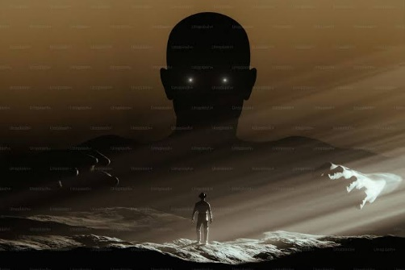
Who Is My Enemy? You Meet Him Every Morning in the Mirror
One day, a wise teacher asked his students a simple question:
Who Is My Enemy? You Meet Him Every Morning in the Mirror

One day, a wise teacher asked his students a simple question:
“Who is your enemy?”
The answers came quickly.
“Those who oppose us.”
“Those who hurt us.”
“Those who insult us.”
“Those who stand in our way.”
The teacher smiled and said, “Look carefully. Most of the people you call enemies do not even know that they are your enemies.”
The students were puzzled.
The teacher continued, “The enemy is often not the person outside you. The enemy is the thought inside you.”
His words contain a profound truth that humanity has struggled to understand for centuries.
The Origin of the Enemy
The idea of an enemy is as old as human civilization. In ancient times, kingdoms were separated by borders. Kings fought wars to expand territories, protect resources and establish power. The neighbouring kingdom was often viewed as the enemy.
Generations grew up hearing stories of battles, victories and defeats. Loyalty to one’s kingdom required suspicion of the neighbouring kingdom. The concept of “us” and “them” became deeply rooted in human thinking.
Even after monarchies disappeared and democracies emerged, the mindset survived. The kings may have gone, but the habit of creating enemies remained.
Today, we no longer live in walled kingdoms, yet we continue to divide people into categories:
“My group and their group.”
“My religion and their religion.”
“My political party and their party.”
“My family and their family.”
“My friend and my enemy.”
The labels have changed, but the tendency remains the same.
Enemies Are Created, Not Born
No child enters the world with enemies.
Children play together without asking about religion, caste, nationality, wealth or social status. They see another human being, not an opponent.
Enemies are created through perceptions, misunderstandings, prejudices, fears and repeated stories.
A person says something we dislike.
Someone disagrees with us.
A colleague receives a promotion we expected.
A neighbour behaves rudely.
Gradually, we begin building a mental image of that person. We replay incidents, interpret motives and strengthen our negative perceptions until the individual becomes an “enemy” in our mind.
The transformation happens not in reality but within our thinking.
The Friend Who Was Once an Enemy
History and daily life are filled with examples of enemies becoming friends.
Political rivals become allies.
Business competitors become partners.
Nations that fought devastating wars now enjoy peaceful relations.
Former classmates who once disliked each other later become close friends.
If a person can move from enemy to friend simply because circumstances changed, was that person truly an enemy in the first place?
Often, the answer is no.
What changed was not the person but our perception.
The enemy existed more in our mind than in reality.
The Enemy Next Door
Two men lived in neighbouring houses and had not spoken to each other for twenty years.
A small disagreement over a property boundary had grown into deep hostility. Whenever one saw the other, he would turn away. Family members inherited the bitterness. Children grew up hearing stories about “the enemy next door.”
One year, severe floods struck the area.
Water entered both houses. One elderly man became trapped inside his home. Without hesitation, the other neighbour rushed through the floodwaters, broke open a window and helped rescue him.
Later, when asked why he risked his life for someone he hated, he replied:
“When I saw him struggling, I did not see an enemy. I saw a human being.”
Twenty years of hatred disappeared in a single moment of humanity.
What changed?
The person did not change.
The circumstances revealed a deeper truth: there was never a real enemy. There were only layers of misunderstanding covering their shared humanity.
The Wisdom of “Love All”
Many games begin with a remarkable expression:
“Love All.”
In tennis, it signifies that both players start at zero points. Yet the phrase carries a beautiful symbolic meaning.
Every contest, every interaction, every relationship can begin from a place of goodwill.
The Oxford Dictionary explains “love” in this context as a score of zero. Yet there is another lesson hidden in the phrase.
When love fills the mind, hatred finds no space.
When respect exists, enemies disappear.
When understanding grows, divisions shrink.
When compassion prevails, hostility loses its power.
Perhaps every day should begin with our own version of “Love All.”
Before judging others.
Before labelling them.
Before deciding who is for us and who is against us.
The Real Enemy
If there is an enemy, where is he?
Not in the office.
Not in the neighbourhood.
Not in another religion.
Not in another political party.
Not in another country.
The real enemy often hides within us.
It appears as:
- Anger that clouds judgment.
- Ego that refuses to forgive.
- Jealousy that resents another’s success.
- Fear that distrusts others.
- Prejudice that sees differences instead of humanity.
- Hatred that poisons the heart.
These inner enemies create the outer enemies we believe we see.
A person ruled by anger finds enemies everywhere.
A person filled with compassion finds fellow human beings everywhere.
The world often reflects what we carry inside.
Seeing Humanity First
This does not mean that everyone will agree with us or behave kindly.
People may criticize us.
Some may oppose our ideas.
Others may compete with us.
There may even be individuals whose actions we must firmly resist.
Yet disagreement does not require hatred.
Opposition does not require enmity.
We can disagree with a person’s actions without treating the person as an enemy.
The moment we learn to separate the human being from the behaviour, a new understanding emerges.
We stop asking, “Who is my enemy?”
Instead, we begin asking, “What has caused this misunderstanding and how can it be resolved?”
There Is No Enemy Outside
The greatest discoveries in life are often simple.
One such discovery is this:
Most enemies exist first in the mind before they exist in the world.
The person we fear today may become our friend tomorrow.
The person we dislike may one day help us in our time of need.
The stranger we distrust may share the same hopes, fears, dreams and struggles that we do.
When love replaces hatred, when understanding replaces prejudice and when humanity replaces labels, the word “enemy” begins to lose its meaning.
Perhaps the greatest wisdom is not learning how to defeat our enemies, but realizing that there were very few enemies to begin with.
And if we search deeply enough, we may discover that the only enemy worth conquering is the one within ourselves.
메타데이터
- post_id
- 28ffe7e5499f
- slug
- who-is-my-enemy-you-meet-him-every-morning-in-the-mirror-28ffe7e5499f
- url
- https://medium.com/purely-being-human/who-is-my-enemy-you-meet-him-every-morning-in-the-mirror-28ffe7e5499f
- canonical_url
- https://medium.com/purely-being-human/who-is-my-enemy-you-meet-him-every-morning-in-the-mirror-28ffe7e5499f
- author_url
- https://medium.com/@thoma6213
- status
- ok
- fetched_at
- 2026-07-09 18:09:57