What did a medieval knight smell like? You’ll be surprised
A non-romantic account of a knight’ hygienic practices in Europe.
What did a medieval knight smell like? You’ll be surprised
A non-romantic account of a knight’ hygienic practices in Europe.
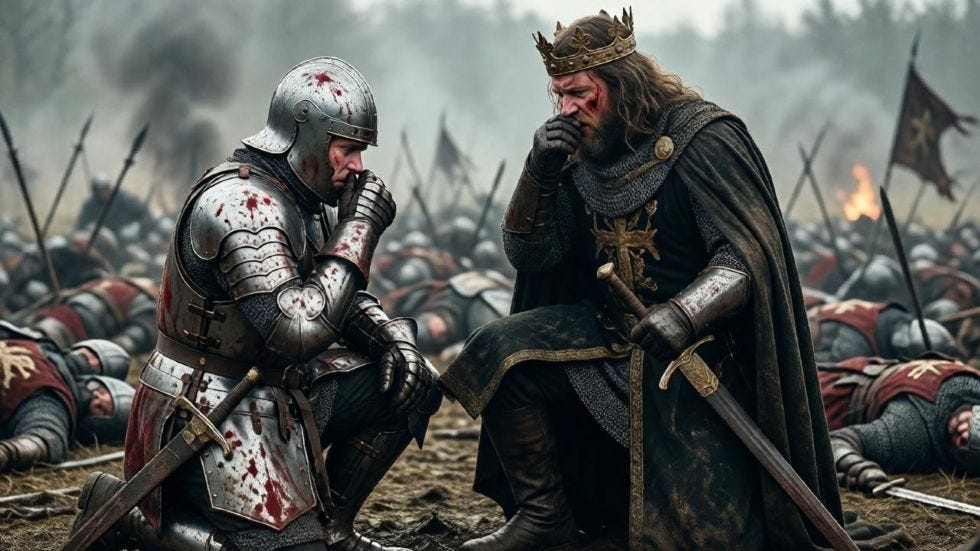
Generated with AI to illustrate the story.
When we imagine a medieval knight in full steel armor, carrying a shining sword and displaying a colorful coat of arms, we usually picture a handsome gentleman — clean, noble, and perhaps smelling of expensive cologne.
This image has been cultivated for centuries by literature and cinema, from the romantic novels of Walter Scott to countless Hollywood and European productions. I myself have read all of their novels, growing up on the idealized portrayal of Middle Ages warriors.
The historical knight, however, would have been almost unrecognizable to modern eyes — and noses in particular.
If a modern woman suddenly found herself standing next to a knight returning from campaign, she would probably pass out within minutes instead of admiring his polished armor for very long.
She would first notice the smell. It would be a powerful mixture of sweat, horse, blood, smoke, leather, and, quite possibly, urine and feces.
The knight in shining armor was, in reality, a professional killer who lived in conditions that most people today would consider unbearable.

Soldier first, gentleman… later
The medieval knight was not primarily a courtly gentleman reciting poetry to noble ladies. He was a professional soldier whose occupation involved killing people at extremely close range.
Unlike modern soldiers, who may never physically touch the enemy, medieval knights fought face to face. Combat often became a desperate wrestling match in which men stabbed each other through the gaps in armor with daggers known as misericordes.
They saw blood sprayed across helmets, smelled the metallic scent of fresh wounds, and heard the cries of dying men from only a few feet away.
After a battle, a knight’s armor, gloves, and clothing could be soaked in blood — not only his enemies’ blood, but often that of his horse, his comrades, or his own.
This was not an occasional experience. It was the very nature of his profession.

https://medium.com/@sensmedia.srl/who-lived-in-britain-before-the-anglo-saxons-112e813e6094
Armor as a steel oven
Popular culture portrays armor as an elegant suit of steel. In practice, it was a genuine mobile furnace.
Under his armor, a knight wore layers of linen and thick padded garments designed to absorb blows. During a summer campaign, these layers became drenched with sweat within hours. The armor trapped body heat and prevented proper ventilation, creating a warm, humid environment where bacteria flourished.
A knight could wear the same underclothes for days or even weeks while campaigning. There was little opportunity to wash himself or change clothing.
The result was a pungent smell that would have been overwhelming to modern senses.
Even the inside of the helmet became unpleasant. A knight’s breath condensed against the steel, with moisture dripping down onto his neck and chest. Saliva, sweat, and moisture accumulated inside the helmet, turning it into a humid metal chamber.
The famous shining armor may have looked impressive from a distance, but the man inside was effectively cooking in his own sweat.

The smell of horses
A knight’s most valuable possession was not his sword or armor, as one may think, but his horse.
Horses sweat heavily and produce enormous quantities of manure and urine. Medieval stables lacked modern sanitation and were often filthy places. Knights spent much of their lives in close proximity to their animals — feeding them, sleeping near them, and riding them for days on end.
The smell of horse sweat and manure seeped into clothing, leather belts, gloves, saddles, and blankets.
To a modern nose, a medieval knight probably smelled less like royalty and more like a stable cleaner.
The torture of urination
One of the least romantic aspects of medieval warfare concerns something every human being eventually has to do.
Battles could last from sunrise until sunset. Sieges could continue for days. A fully armored knight could not simply step aside and remove dozens of pieces of equipment to visit a latrine.
When nature called during a long battle, many simply relieved themselves where they stood. Sometimes they shitted on themselves. They couldn’t simply ask the enemy, “Hey, let’s take a break, I need to piss.”
By the end of the battle, a knight could be covered in sweat above the waist and soaked with urine or worse below it.
This was not considered particularly shocking at the time. It was simply another hardship of war.
The arming squire — a knight’s assistant — faced the unpleasant task of cleaning his master’s armor after battle. This meant scraping off “the biggest lumps of filth by hand, and removing the rest with grass, gravel and sand” — a “smelly, tiring and time-consuming job.”
The glamorous image of a squire polishing shining armor hides a far less romantic reality: he was often cleaning blood, mud, vomit, and human waste.
Medieval hygiene was limited
The lack of hygiene in Middle Ages is a myth. Contrary to popular belief, medieval Europeans did bathe.
Public bathhouses existed in many towns, and nobles appreciated cleanliness whenever circumstances allowed. Crusaders arriving in the Near East even discovered a bathing culture that surpassed what they knew at home. Some military orders built baths of their own.
Most often, however, warriors rushed to rivers and lakes in their way.

The problem was not ignorance of hygiene; it was practicality.
A knight on campaign might spend weeks without a proper bath. Clean clothes were scarce. Water could be difficult to obtain. Long military expeditions offered little opportunity for washing.
Even castles were not particularly pleasant places. Floors were often covered with rushes that trapped food scraps, animal bones, and dirt. Privies usually emptied into cesspits or dung heaps. Smoke from fireplaces filled rooms, and unpleasant odors lingered constantly.
The medieval world was, by modern standards, a very smelly place.
The reality behind chivalry
The ideals of chivalry — honor, courage, loyalty, and courtesy — were real, but they emerged partly because medieval lords needed to control violent professional warriors.
A knight was expected to behave nobly toward people of his own class, but this did not necessarily extend to peasants or enemies. The reality of knighthood was therefore a strange combination of refinement and brutality.
A man might spend the evening listening to poetry and the next morning kill another man at arm’s length and return home covered in mud and blood.

Imagine meeting a knight who had just returned from a week’s campaign.
He has spent days sleeping outdoors. His clothes are soaked with sweat. He smells of horse and smoke from campfires. There are dried bloodstains on his gloves and leather straps. The inside of his armor is damp with condensation and body odor. He has not bathed in days and may have relieved himself inside his armor during combat.
The overwhelming smell would likely be unlike anything most modern people have ever experienced.
So, the legendary knight in shining armor certainly existed — but he certainly did not smell of perfume. He smelled of iron, leather, sweat, blood, horse manure, and occasionally urine.
That is the unromantic truth of the medieval knight.
With all due respect to Mr. Scott and Mr. Mann, they should have inserted at least one scene of a noble lady fainting after getting too close to her freshly returned knight — not from admiration, but from the warrior’s heavy odor.
For the sake of historical accuracy.
Romance may have polished the steel, but it never quite managed to wash the man inside it.
If you’ve ever found comfort in my words, and if you have a little to spare, I’d be so grateful for your support — through BuyMeCoffee. Every small gesture helps more than you know. No pressure, just deep appreciation.
References:
Richard Kaeuper, Chivalry and Violence in Medieval Europe, 2001, https://academic.oup.com/book/5012
Joseph Gies and Frances Gies, Life in a medieval castle, 1974, https://openlibrary.org/works/OL6552649W/Life_in_a_medieval_castle
Charlotte Yue, David Yue, Armor — Hardcover, 1994, https://www.abebooks.com/9780395681015/Armor-Yue-Charlotte-David-0395681014/plp
The Jordan Times, From Rome to East: How Crusaders transformed bathing traditions at Marqab Castle, 2024, https://jordantimes.com/news/local/rome-east-how-crusaders-transformed-bathing-traditions-marqab-castle
메타데이터
- post_id
- 29094e680777
- slug
- what-did-a-medieval-knight-smell-like-let-me-surprise-you-29094e680777
- url
- https://medium.com/reflections-and-realities/what-did-a-medieval-knight-smell-like-let-me-surprise-you-29094e680777
- canonical_url
- https://medium.com/reflections-and-realities/what-did-a-medieval-knight-smell-like-let-me-surprise-you-29094e680777
- author_url
- https://medium.com/@sensmedia.srl
- status
- ok
- fetched_at
- 2026-07-10 22:07:19