Oracle OTBI vs. BI Publisher: Which Reporting Tool Do You Need?
In today’s data-driven business environment, organizations cannot afford to make decisions based on guesswork. Every financial transaction…
Oracle OTBI vs. BI Publisher: Which Reporting Tool Do You Need?
In today’s data-driven business environment, organizations cannot afford to make decisions based on guesswork. Every financial transaction, procurement activity, and operational process generates valuable data that needs to be transformed into actionable insights. This is where Oracle Fusion Applications offer powerful reporting tools to help businesses analyze information effectively.
However, many Oracle Fusion professionals and learners often face a common question: Should I use Oracle Transactional Business Intelligence (OTBI) or BI Publisher?
At first glance, both tools appear to serve similar reporting purposes. However, they are designed for different business needs and reporting scenarios. Understanding the strengths and limitations of each tool can help users maximize reporting efficiency and improve decision-making.
If you’re pursuing **Oracle Fusion Financial online training in Hyderabad,** gaining a clear understanding of OTBI and BI Publisher is essential because both tools play a significant role in Oracle Fusion Financials implementations.
Understanding Oracle OTBI
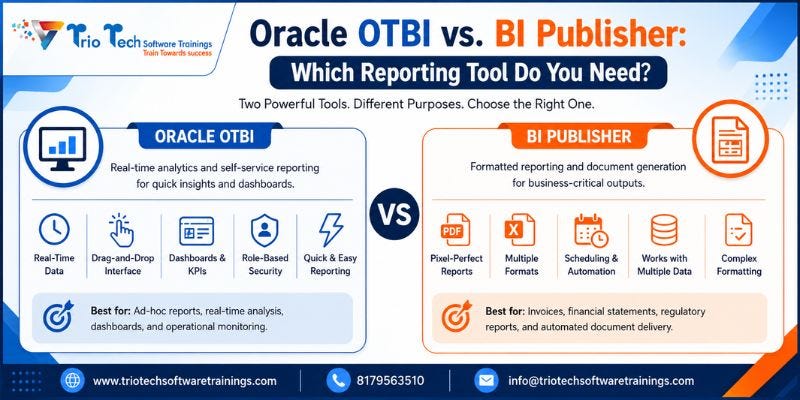
Oracle Transactional Business Intelligence (OTBI) is Oracle’s real-time reporting and analytics tool embedded directly within Oracle Fusion Applications. It allows users to create ad-hoc reports without requiring extensive technical expertise.
OTBI is designed primarily for business users who need immediate access to operational data. Since it retrieves data directly from transactional tables through predefined subject areas, users can generate reports quickly without writing SQL queries.
Key Features of OTBI
- Real-time reporting capabilities
- User-friendly drag-and-drop interface
- Interactive dashboards
- Self-service analytics
- Role-based security
- Quick report creation
For example, a finance manager can instantly generate reports related to accounts payable, accounts receivable, general ledger balances, or expense transactions without depending on technical teams.
Therefore, OTBI becomes an excellent choice when organizations require fast access to live business data.
Understanding BI Publisher
BI Publisher is Oracle’s enterprise reporting solution designed for highly formatted and pixel-perfect reports. Unlike OTBI, BI Publisher focuses on producing professional documents that can be distributed internally or externally.
It allows developers and report designers to extract data from various sources and present it in customized layouts such as:
- PDF reports
- Excel files
- Word documents
- Invoices
- Checks
- Financial statements
- Regulatory reports
BI Publisher offers greater flexibility in report formatting and supports complex business requirements.
However, report development often requires technical expertise, including SQL knowledge and data model creation.
As a result, BI Publisher is widely used for operational reporting, statutory reporting, and document generation.
OTBI vs. BI Publisher: Key Differences
1. Purpose
OTBI is primarily designed for data analysis and self-service reporting.
BI Publisher is designed for generating formatted reports and business documents.
Therefore, if your goal is data exploration and analysis, OTBI is generally the preferred option. If your goal is document generation, BI Publisher becomes more suitable.
2. Data Access
OTBI uses predefined subject areas that simplify report creation.
BI Publisher accesses data through custom data models and SQL queries.
However, OTBI’s ease of use comes with limitations because users can only access data exposed through available subject areas.
BI Publisher offers greater flexibility since developers can retrieve data from multiple sources.
3. User Skill Requirements
OTBI is business-user friendly and requires minimal technical knowledge.
BI Publisher often requires:
- SQL skills
- Data modeling knowledge
- Template design expertise
Therefore, business analysts typically prefer OTBI, while technical consultants often work extensively with BI Publisher.
4. Report Formatting
Formatting capabilities represent one of the biggest differences between these tools.
OTBI supports:
- Charts
- Graphs
- Tables
- Dashboards
BI Publisher supports:
- Pixel-perfect layouts
- Corporate branding
- Customized templates
- Professional document outputs
For example, generating an invoice with company logos and structured layouts would be difficult in OTBI but straightforward in BI Publisher.
5. Real-Time Reporting
OTBI provides near real-time access to transactional data.
This makes it highly effective for monitoring daily operations and business performance.
BI Publisher can also access current data; however, it is generally used for scheduled and formal reporting rather than interactive analytics.
6. Scheduling and Distribution
BI Publisher provides advanced scheduling capabilities.
Users can:
- Schedule reports automatically
- Email reports to stakeholders
- Deliver reports in multiple formats
- Archive outputs
OTBI offers limited scheduling capabilities compared to BI Publisher.
Therefore, organizations requiring automated report distribution often rely heavily on BI Publisher.
Core Differences at a Glance
Core Differences at a Glance
Core Differences at a Glance
Feature
Oracle OTBI
BI Publisher (BIP)
Primary Focus
Ad-hoc queries, interactive analysis, and operational monitoring.
Highly formatted, heavy batch document generation.
Formatting Control
Limited to basic table views, charts, and standard dashboards.
Pixel-perfect control over every element, page, and logo.
Data Latency
Real-time: Pulls live transactional data directly.
Batch / Scheduled: Optimized for heavy datasets and scheduled extracts.
Technical Skill Required
Low to moderate (drag-and-drop wizard; no SQL needed).
Moderate to high (Requires SQL knowledge and template building).
Security Layer
Inherits Oracle Cloud front-end user data roles and permissions.
Bypasses standard front-end role security via direct database queries.
Output Formats
Interactive UI, basic Excel, and PDF exports.
PDF, Excel, Word, RTF, XML, and CSV.
When Should You Use OTBI?
OTBI is the right choice when:
- Business users need self-service reporting.
- Real-time data analysis is required.
- Dashboards and KPIs are needed.
- Quick report creation is important.
- Minimal technical expertise is available
For example, a finance team tracking payment statuses, invoice approvals, or budget performance can quickly generate insights through OTBI.
Many learners enrolled in Oracle Fusion Financial online training in Hyderabad discover that OTBI is often the first reporting tool they encounter because of its simplicity and accessibility.
When Should You Use BI Publisher?
BI Publisher is ideal when:
- Professional document generation is required.
- Reports need complex formatting.
- Large data volumes must be processed.
- Automated report scheduling is necessary.
- Regulatory or statutory reports need to be generated.
For example, financial statements, tax reports, supplier invoices, and audit documents are commonly developed using BI Publisher.
However, organizations frequently use both OTBI and BI Publisher together because each tool addresses different reporting requirements.
Which Tool Is Better for Oracle Fusion Financials?
The answer depends entirely on your business objective.
If you need quick insights, dashboards, and real-time reporting, OTBI is usually the better choice.
If you need professionally formatted documents, scheduled reporting, and advanced customization, BI Publisher is the superior option.
Therefore, rather than viewing them as competing tools, organizations should see them as complementary solutions within the Oracle Fusion ecosystem.
Professionals pursuing **Oracle Fusion financial online training in Hyderabad** should focus on learning both tools because employers often expect candidates to understand the complete reporting landscape.
The Dual-Tool Strategy
In most functional Oracle Cloud ecosystems, these tools are not mutually exclusive; they are deployed concurrently. Organizations use OTBI to monitor day-to-day operations and manage standard workflow exceptions. They simultaneously rely on BI Publisher to deliver formal business outputs, financial distributions, and system integrations. [1, 2, 3]
To help me guide your next steps, could you clarify what specific report you are looking to build? Sharing who will view the report and whether you require automated delivery would also help narrow down the ideal tool. [1, 2]
Building Reporting Expertise for Career Growth
As Oracle Fusion Financials adoption continues to grow across industries, reporting skills have become highly valuable for consultants, analysts, and finance professionals.
Many learners enhance their practical knowledge through specialized training programs that include hands-on exposure to OTBI, BI Publisher, General Ledger, Accounts Payable, Accounts Receivable, and other Oracle Fusion Financials modules. Training institutes that emphasize real-time project scenarios, implementation practices, and reporting exercises often help bridge the gap between theoretical understanding and workplace requirements. In Hyderabad, institutions such as Triotech Software Training **in Hyderabad** have gained attention among Oracle learners for offering industry-focused learning paths that help professionals strengthen their Oracle Fusion reporting capabilities.
Final Verdict
Both Oracle OTBI and BI Publisher are powerful reporting tools, but they serve different purposes.
OTBI excels in real-time analytics, self-service reporting, and dashboard creation. BI Publisher shines in formatted reporting, document generation, and automated report distribution.
Therefore, the best approach is not choosing one over the other but understanding when to use each tool effectively. Organizations that leverage both tools can achieve greater reporting flexibility, improved operational visibility, and better business decision-making.
For aspiring Oracle professionals, mastering both OTBI and BI Publisher through quality learning resources and **Oracle Fusion financial online training in Hyderabad can significantly enhance career opportunities in the rapidly expanding Oracle Fusion ecosystem. Furthermore, practical exposure gained through Oracle Fusion Financial Online Institute can help learners confidently handle real-world reporting challenges. As demand for Oracle Fusion experts continues to rise, investing in an Oracle Fusion online financial course **remains a strategic step toward long-term professional growth.
메타데이터
- post_id
- 2916ba62529b
- slug
- oracle-otbi-vs-bi-publisher-which-reporting-tool-do-you-need-2916ba62529b
- url
- https://medium.com/@triotech82/oracle-otbi-vs-bi-publisher-which-reporting-tool-do-you-need-2916ba62529b
- canonical_url
- https://medium.com/@triotech82/oracle-otbi-vs-bi-publisher-which-reporting-tool-do-you-need-2916ba62529b
- author_url
- https://medium.com/@triotech82
- status
- ok
- fetched_at
- 2026-06-22 18:00:48