The One Database Issue That Slowed Down Our Magento Migration
A real world Magento migration experience explaining how hidden indexing conflicts and database operations quietly affected store…
The One Database Issue That Slowed Down Our Magento Migration
A real world Magento migration experience explaining how hidden indexing conflicts and database operations quietly affected store performance and backend stability.
Magento migrations often look straightforward during the planning phase.
Most teams focus on timelines, infrastructure upgrades, extension compatibility, and deployment strategy. On paper, the process usually feels manageable.
But in real world projects, hidden technical issues inside the existing Magento environment can create unexpected performance problems after migration.
Recently, during one of our Magento migration projects, we encountered a database related issue that quietly slowed down the entire store.
What made the situation difficult was that the storefront initially looked completely stable.
Pages loaded correctly.
Products appeared normally.
Checkout worked during testing.
However, after deeper usage and catalog operations, performance inconsistencies slowly started appearing across the admin panel and backend workflows.
At first, the issue looked like a temporary infrastructure bottleneck.
But after detailed investigation, the real problem turned out to be much deeper.
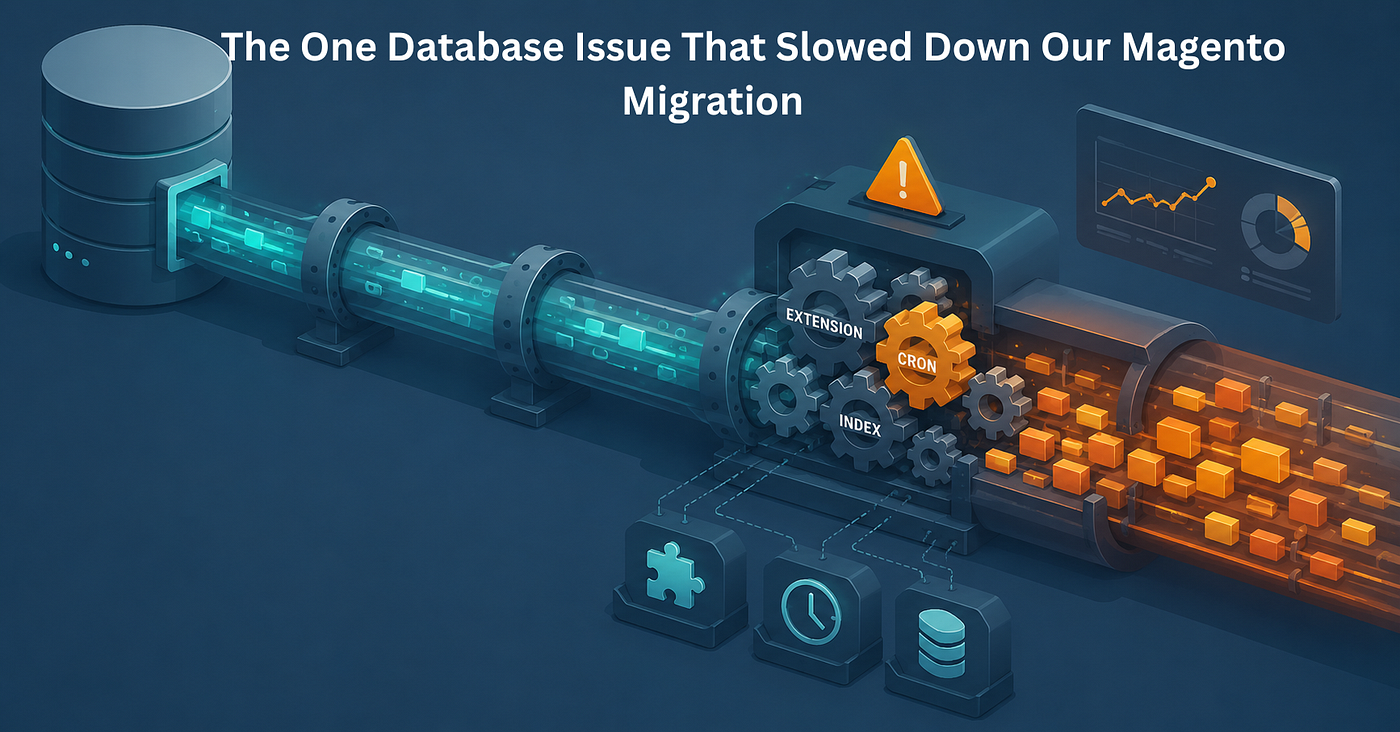
Databse failure affecting magento store speed
The Migration Itself Was Successful
The migration involved:
- Magento version upgrade
- Customer and order data migration
- Extension migration
- Server optimization
- Cache configuration improvements
- Infrastructure restructuring
The store passed quality assurance testing without major issues.
But once catalog operations became active again, several performance problems started appearing:
- Product updates became slower
- Category changes delayed storefront updates
- Admin actions took longer to process
- Indexing jobs consumed excessive resources
- CPU spikes increased during inventory synchronization
Initially, the symptoms appeared random.
But over time, the pattern became more obvious.
The Real Problem Was Hidden Inside Database Indexing
After reviewing logs, database activity, and indexing behavior, we discovered the main issue.
Several third party Magento extensions were repeatedly triggering unnecessary database operations during indexing processes.
The database itself was not corrupted.
The migration process was not broken.
Instead, overlapping extension behaviors created indexing conflicts that slowed down backend operations significantly.
Every time catalog changes occurred, Magento was processing multiple resource heavy operations simultaneously:
- Product indexing
- Search indexing
- Inventory synchronization
- Cache invalidation
- Extension specific database queries
All of these operations were competing for database resources at the same time.
Thats what created the performance bottleneck.
Why Magento Stores Commonly Face This Problem
Magento is extremely flexible and scalable.
But over time, many stores accumulate technical complexity through:
- Multiple third party extensions
- Legacy custom modules
- Unoptimized database queries
- Heavy cron operations
- Duplicate indexing tasks
These issues often remain hidden until a migration or scaling project exposes them.
This becomes especially common in Magento stores with:
- Large product catalogs
- Multi store environments
- ERP integrations
- Real time inventory systems
- Customized checkout experiences
Even strong hosting infrastructure cannot fully compensate for inefficient database operations.
What We Changed to Fix the Issue
Instead of simply increasing server resources, we focused on optimizing Magentos indexing and database workflow.
The improvements included:
- Moving indexing to scheduled mode
- Cleaning unused database tables
- Optimizing cron execution timing
- Reviewing extension conflicts
- Reducing duplicate indexing triggers
- Improving Redis and cache configuration
- Separating heavy background operations
We also audited several third party extensions that were performing unnecessary database actions after every catalog update.
Removing those inefficient operations improved backend responsiveness significantly.
The Performance Improvements After Optimization
After optimizing the database workflow:
- Admin panel response times improved
- Product updates became faster
- CPU spikes reduced considerably
- Indexing stabilized
- Storefront updates reflected properly
- Backend workflows became more predictable
Interestingly, the migration itself was never the primary issue.
The hidden indexing behavior inside the database was the real bottleneck.
What This Migration Taught Us
Many Magento performance problems are not caused by Magento alone.
In most cases, the root cause comes from:
- Extension conflicts
- Legacy development patterns
- Inefficient indexing workflows
- Poor cron management
- Database heavy customizations
Thats why Magento migration projects require much deeper technical analysis than simply moving files and databases.
Understanding how Magento behaves under real operational load is critical for long term scalability and performance.
Businesses planning migration, scaling, or optimization projects often benefit from working with an experienced **Magento Website Development Service** provider that understands both infrastructure optimization and Magento architecture deeply.
Final Thoughts
This migration reminded us that some of the biggest Magento performance issues are often hidden quietly inside backend processes.
Not in the frontend.
Not in the hosting provider.
But deep inside indexing workflows and database operations that gradually affect the entire platform.
Identifying those hidden bottlenecks early can make a major difference in store stability, scalability, and customer experience.
Frequently Asked Questions
Why do Magento migrations become slow?
Magento migrations can become slow due to indexing conflicts, extension compatibility issues, unoptimized database queries, heavy cron jobs, or inefficient server configurations.
What causes Magento indexing issues?
Magento indexing issues are commonly caused by third party extensions, duplicate indexing triggers, large product catalogs, or excessive database operations running simultaneously.
How can Magento database performance be improved?
Magento database performance can be improved by optimizing indexing workflows, reducing unnecessary queries, cleaning unused tables, improving cache configuration, and reviewing extension behavior.
Why do third party Magento extensions affect performance?
Some Magento extensions execute additional database operations, cron jobs, or indexing tasks that consume excessive server resources and create performance bottlenecks.
Is server upgrading enough to fix Magento performance problems?
Not always. Many Magento performance issues originate from application level inefficiencies such as indexing conflicts, poor database optimization, or extension related bottlenecks rather than server limitations alone.
What should businesses check before Magento migration?
Before Magento migration, businesses should review:
- Extension compatibility
- Database health
- Indexing behavior
- Cron configurations
- Infrastructure readiness
- Cache setup
- Custom module performance
Why is Magento optimization important for scaling stores?
Magento optimization helps improve store speed, backend stability, customer experience, indexing efficiency, and long term scalability for growing eCommerce businesses.
메타데이터
- post_id
- 29824fccbd4e
- slug
- the-one-database-issue-that-slowed-down-our-magento-migration-29824fccbd4e
- url
- https://medium.com/@madhublogger/the-one-database-issue-that-slowed-down-our-magento-migration-29824fccbd4e
- canonical_url
- https://medium.com/@madhublogger/the-one-database-issue-that-slowed-down-our-magento-migration-29824fccbd4e
- author_url
- https://medium.com/@madhublogger
- status
- ok
- fetched_at
- 2026-06-22 12:55:45