Beyond Sustainability: How the Circular Economy Is Redefining ESG Leadership
In recent years, ESG (Environmental, Social, and Governance) has moved from the margins of corporate strategy to its very core. Investors…
Beyond Sustainability: How the Circular Economy Is Redefining ESG Leadership
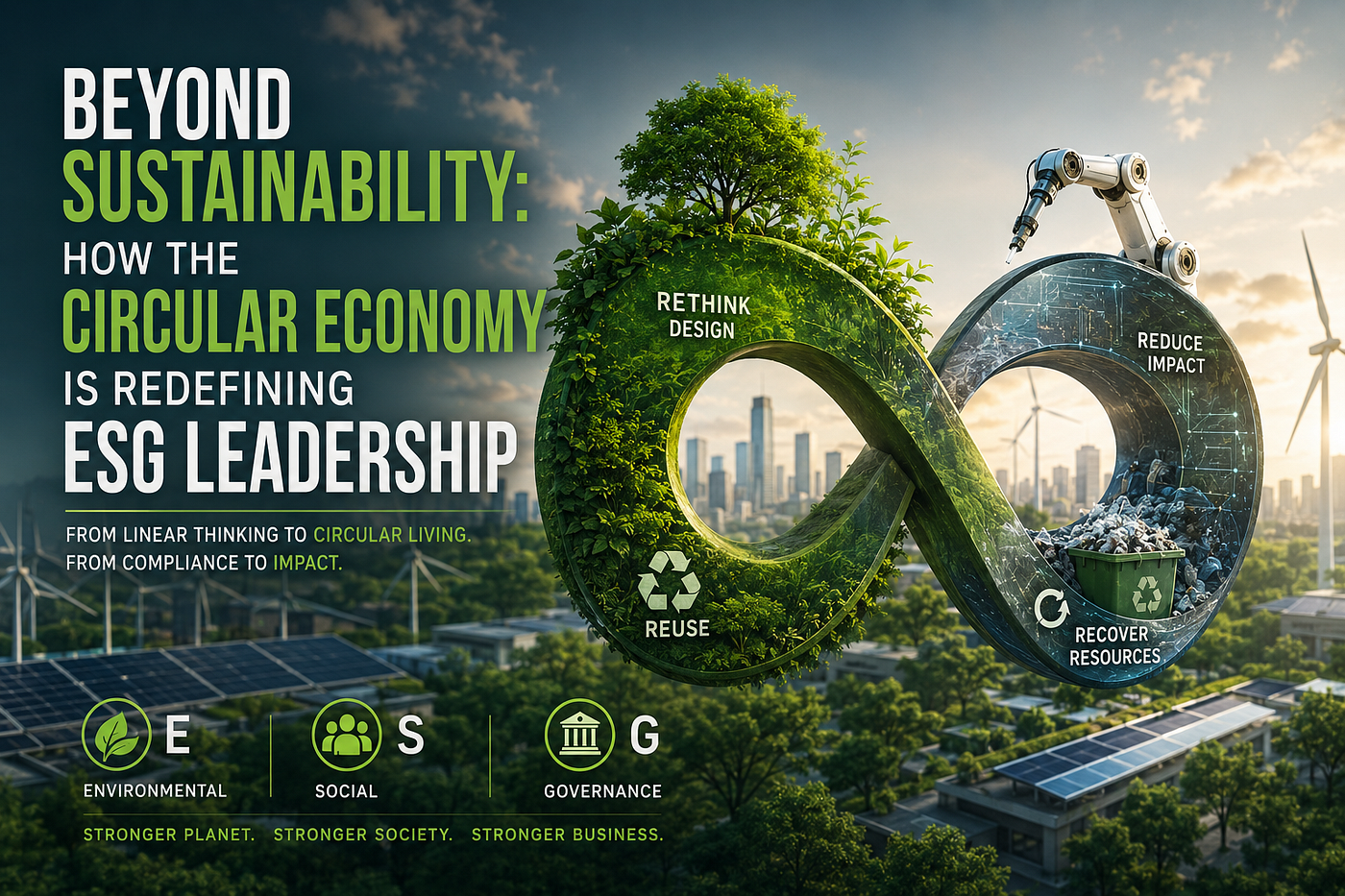
In recent years, ESG (Environmental, Social, and Governance) has moved from the margins of corporate strategy to its very core. Investors demand it, regulators enforce it, and consumers increasingly expect it. Yet, despite this surge in attention, a fundamental gap remains: many ESG initiatives are still reactive rather than transformative. The real challenge is not about doing sustainability better within the existing system, but about redesigning the system itself.
This is where the circular economy emerges as a powerful force. It is not simply another sustainability framework layered on top of ESG. Instead, it represents a fundamental rethinking of how value is created, preserved, and regenerated across the entire economic system.
The current ESG landscape, while mature in reporting and disclosure, is beginning to show signs of plateauing. Organizations have made measurable progress in tracking emissions, improving governance, and advancing diversity metrics. However, these efforts often operate within a linear economic model that continues to extract resources, produce goods, and discard them at the end of their lifecycle. This inherent contradiction limits the true impact of ESG initiatives. Efficiency improvements can only go so far when the underlying system is still designed for disposal.
The circular economy addresses this limitation by introducing a system-level transformation. It shifts the focus from optimizing resource use to eliminating waste altogether. Products are designed with longevity in mind, materials are kept in continuous use, and natural systems are restored rather than depleted. This approach aligns seamlessly with ESG objectives because it tackles the root causes of environmental degradation and social inequity rather than merely addressing their symptoms.
From an environmental perspective, the circular economy represents a shift from reduction to regeneration. Traditional ESG strategies often emphasize minimizing harm, such as reducing emissions or cutting down waste. While these efforts are essential, they are no longer sufficient in a world facing climate urgency. Circular models go further by enabling systems that actively restore ecological balance. When products are reused instead of discarded, the demand for raw material extraction decreases significantly. When materials are continuously cycled, landfill waste is minimized. When regenerative practices are adopted, ecosystems begin to recover. This transition reflects a deeper evolution in ESG thinking, where success is no longer defined by doing less harm but by creating positive environmental outcomes.
Economically, the circular economy challenges the long-standing notion that sustainability comes at a cost. In reality, it opens up entirely new avenues for value creation. Businesses that adopt circular principles often discover opportunities that were previously overlooked. Instead of relying solely on one-time product sales, they can build recurring revenue streams through service-based models. Instead of discarding used products, they can tap into secondary markets through refurbishment and resale. Instead of depending heavily on raw materials, they can achieve greater efficiency and cost stability by reusing resources. These shifts not only enhance profitability but also strengthen resilience in an increasingly volatile global economy.
The social dimension of ESG also benefits significantly from circular systems. By emphasizing repair, reuse, and localized production, the circular economy creates new employment opportunities and fosters skill development in emerging sectors. It also improves access to goods by making them more affordable through reuse markets. In developing economies, these impacts are particularly profound. Informal sectors that already contribute to recycling and material recovery can be integrated into formal systems, improving both livelihoods and efficiency. At the same time, circular models reduce dependence on fragile global supply chains, enhancing resilience for communities and economies alike.
Governance plays a critical role in enabling this transition. For the circular economy to move beyond isolated initiatives, it must be embedded into core business strategy. This requires a shift in mindset from short-term performance to long-term value creation. Leadership teams must align sustainability goals with business objectives, ensuring that circular principles influence decisions across design, operations, and supply chains. Transparency also becomes essential, as organizations need to track and report not only financial outcomes but also circular performance indicators. Without strong governance, circular efforts risk remaining experimental rather than becoming transformative.
Technology acts as a powerful enabler in this journey. Digital tools allow organizations to track materials across their lifecycle, optimize resource use, and improve supply chain transparency. Advanced analytics can identify inefficiencies and uncover new opportunities for circular innovation. Artificial intelligence, in particular, is playing a growing role in enabling predictive maintenance, extending product lifespans, and enhancing decision-making. As a result, ESG and digital transformation are becoming increasingly interconnected, with technology serving as the bridge between ambition and execution.
India stands at a unique intersection in this global transition. The country has long embraced principles of reuse and frugality, which align naturally with circular economy concepts. At the same time, rapid urbanization and industrial growth present significant sustainability challenges. This dual reality creates a powerful opportunity. By integrating circular principles into ESG frameworks, India can address pressing environmental issues while driving inclusive economic growth. The combination of cultural alignment, policy momentum, and technological innovation positions India as a potential leader in the circular economy movement.
Despite its promise, the transition to a circular economy is not without challenges. Existing economic systems often favor linear models due to established infrastructure and cost structures. Many products are not designed for reuse or recycling, making circular implementation complex. Consumer behavior also remains a barrier, as convenience and price continue to dominate purchasing decisions. Additionally, policy frameworks are still evolving, and regulatory support for circular systems is not yet fully developed. Overcoming these challenges requires coordinated action across governments, businesses, and society.
Ultimately, the shift to a circular economy is a leadership imperative. Organizations that embrace this transformation early will gain a significant competitive advantage. They will be better equipped to navigate resource constraints, regulatory changes, and shifting consumer expectations. More importantly, they will play a critical role in shaping a sustainable and regenerative future.
The future of ESG lies in its ability to move beyond reporting and compliance toward systemic change. Circular economy principles provide the blueprint for this evolution. By designing products for longevity, creating systems for material recovery, and adopting business models that decouple growth from resource consumption, organizations can redefine what success looks like.
The transition is already underway. The question is not whether it will happen, but how quickly organizations will adapt. Those who lead this change will not only drive business success but also contribute to a more sustainable and equitable world.
Call to Action
If you want to explore more insights on ESG, circular economy, AI, and the future of innovation, subscribe to the GeneCapsule channel:
https://www.youtube.com/channel/UCYs3cs0Vne4KsnyAGON88Hg
Stay informed. Stay ahead. And be part of building a truly regenerative future.
메타데이터
- post_id
- 29896bd0c3a4
- slug
- beyond-sustainability-how-the-circular-economy-is-redefining-esg-leadership-29896bd0c3a4
- url
- https://medium.com/@anandv_62921/beyond-sustainability-how-the-circular-economy-is-redefining-esg-leadership-29896bd0c3a4
- canonical_url
- https://medium.com/@anandv_62921/beyond-sustainability-how-the-circular-economy-is-redefining-esg-leadership-29896bd0c3a4
- author_url
- https://medium.com/@anandv_62921
- status
- ok
- fetched_at
- 2026-07-21 19:05:56