Information Technology as the Operating System of Modern Nigeria: Transforming Management, Oil &…
VIDA ICT by Emereonye Success Ndubuisi
Information Technology as the Operating System of Modern Nigeria: Transforming Management, Oil & Gas, Education, Real Estate, Engineering and Construction.
VIDA ICT by Emereonye Success Ndubuisi
Introduction Information Technology (IT) is no longer simply a collection of computers, software applications and internet connections. In modern organizations, IT has become the infrastructure through which decisions are made, people collaborate, assets are monitored, projects are delivered, customers are served and institutional knowledge is preserved.
For Nigeria, this transformation is particularly important. Businesses and public institutions operate in environments characterized by infrastructure constraints, rapidly changing markets, skills shortages, cybersecurity risks, increasing regulatory requirements and the need to achieve more with limited resources.
The real question, therefore, is no longer whether organizations should adopt technology. The more important question is how technology should be designed, implemented, managed and continuously improved so that it produces measurable organizational value.
This is where a modern IT approach becomes different from simply purchasing software or installing computers. A successful digital transformation requires a complete lifecycle: understanding the organization’s needs, designing the appropriate solution, building the infrastructure, deploying the system, training users, monitoring performance, maintaining the environment, protecting data and continuously improving the technology as the organization evolves.
This philosophy aligns closely with VIDA ICT’s approach to enterprise technology. VIDA describes its work as building technology, training people, driving digital inclusion and supporting innovation, rather than merely deploying technology and leaving an organization to manage it alone. Its IT project methodology begins with requirements analysis and project planning and extends into infrastructure deployment, maintenance, support and long-term technology planning.
Across Nigeria, this approach can transform five areas with enormous economic and social importance: advanced management systems, oil and gas, education, real estate, and engineering and construction.
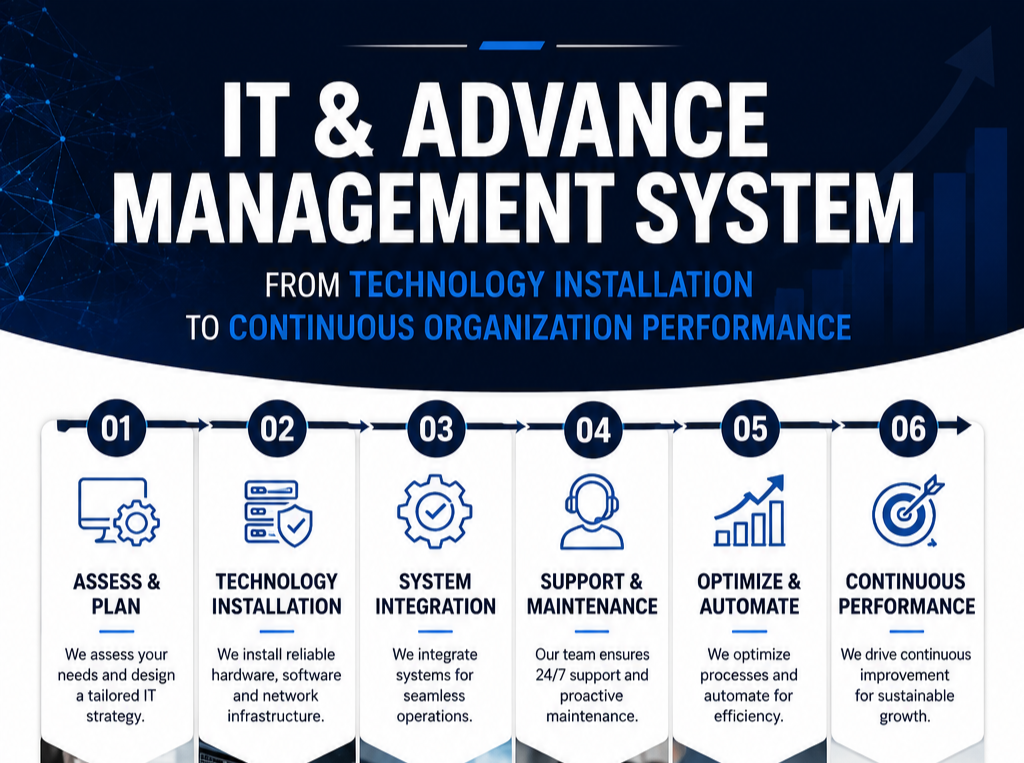
IT and Advanced Management Systems: From Technology Installation to Continuous Organizational Performance.
An advanced management system is not simply an application installed on a company’s computers. It is an integrated combination of people, processes, data, infrastructure, applications, policies and technology support designed to help an organization achieve its objectives.
For Nigerian organizations, the development of such a system should begin with understanding the business rather than beginning with software. Understanding the Process Before Building the System The first stage of an effective IT management project is requirements analysis.
An organization must understand: What processes currently exist? Where are delays occurring? Which activities are still manual? Where are errors frequently introduced? Which information does management need to make decisions? Which departments need to exchange information? What infrastructure already exists? What security risks exist? What should the organization achieve after digital transformation? This process prevents an organization from buying technology simply because it is fashionable.
VIDA ICT’s IT project methodology similarly emphasizes network assessment, requirements analysis and comprehensive project planning before deployment. The objective is to understand the existing technology environment and develop a technology roadmap that can support the organization’s long-term objectives.
IT Projects Require More Than Software An advanced management system may involve:
Enterprise Resource Planning (ERP)
Customer Relationship Management (CRM)
Human Resource Management Systems
Financial management systems
Document management
Inventory management
Business intelligence dashboards
Cloud infrastructure
Network infrastructure
Cybersecurity systems
Backup and disaster recovery
Workflow automation
Mobile applications
Data analytics
Artificial Intelligence
The important principle is integration. A finance department should not operate with information completely isolated from procurement. Human resources should not operate separately from payroll.
Management should not wait weeks for reports that could be generated automatically. A properly designed management system creates a connected information environment in which authorized users can access reliable information at the right time.
Infrastructure Is the Foundation No management system can perform better than the infrastructure supporting it. Organizations therefore need to consider: Connectivity → Servers/Cloud → End-user devices → Applications → Data → Security → Backup → Monitoring. Infrastructure planning should include network capacity, internet reliability, server or cloud architecture, power protection, cybersecurity, endpoint management, storage, backup and disaster recovery.
VIDA ICT’s managed IT approach emphasizes proactive monitoring, network maintenance, security, backup, disaster recovery, configuration optimization, reporting and IT staff augmentation. This is important because IT management should not operate only on a “break-fix” model where an organization waits until something stops working before responding.
Post-Implementation Management and Support One of the most common failures in technology projects is treating deployment as the end of the project. In reality: Deployment is the beginning of operational management. After implementation, organizations require: System monitoring, Security monitoring, Software updates, Hardware maintenance, Backup verification, Performance optimization, User support, Incident management, Asset management, Regular reporting Disaster recovery, testing, Periodic technology reviews VIDA ICT’s IT management framework specifically includes monitoring servers and workstations, managing security updates, maintaining backups, documenting fixes, optimizing configurations and producing IT management reports.
Training Is Part of the System Technology fails when people cannot use it effectively. Training should therefore occur before, during and after implementation.
Organizations should develop: Initial user training, Department-specific training Management training Cybersecurity awareness New staff onboarding Refresher training Advanced technical training User documentation Internal technology champions VIDA ICT’s training philosophy recognizes that poor technology knowledge can reduce productivity and that professional development should be tailored to the needs of different organizations and staff levels.
The result is an important principle: Technology + Process + People + Continuous Support = Sustainable Digital Transformation
메타데이터
- post_id
- 29bf403dc0e0
- slug
- information-technology-as-the-operating-system-of-modern-nigeria-transforming-management-oil-29bf403dc0e0
- url
- https://medium.com/@vidaict/information-technology-as-the-operating-system-of-modern-nigeria-transforming-management-oil-29bf403dc0e0
- canonical_url
- https://medium.com/@vidaict/information-technology-as-the-operating-system-of-modern-nigeria-transforming-management-oil-29bf403dc0e0
- author_url
- https://medium.com/@vidaict
- status
- ok
- fetched_at
- 2026-08-18 09:44:04



