Difference between Camunda 7 and Camunda 8
Core Engine:
Difference between Camunda 7 and Camunda 8
Core Engine:
Camunda 7 is backed by Activiti engine(Camunda was originally a fork of the Activiti project) where as Camunda 8 is on Zeebe engine(scalable both horizontally and linearly) developed by Camunda which makes it suitable for Cloud operations and automation processes.
Process solutions using Spring Boot:
Camunda 7:
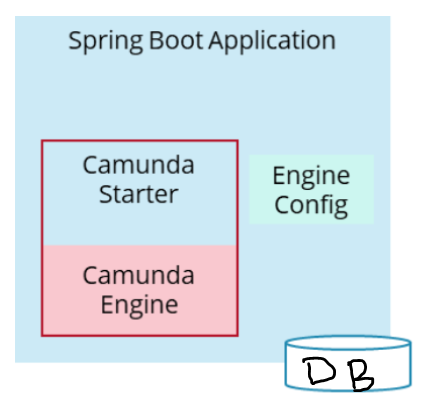
To build a process solution using Camunda 7 and Spring Boot we need :
- Java
- Spring Boot
- Camunda Spring Boot Starter with embedded engine
- Java Delegates
Camunda 8:
To build a process solution using Camunda 8 and Spring Boot we need :
- Java
- Spring Boot
- Spring Zeebe Starter (Zeebe Client)
- Job Workers

Typical Deployment Difference:


Data Storage:
In Camunda 7 data was stored in a relational database which was a bottle neck for scaling to cater huge loads.

Camunda 8 uses elasticsearch which is specialized on search efficinecy , not storage. The data can be exported into a datasource of your choice. Exporter simply takes the data from zeebe engine and puts it into elasticsearch.

Communication:
In Camunda 7 communication with engine was either through RestAPI or Java SDK in case of embedded engine.
In Camunda 8 communication with engine is via Zeebe Gateway which uses gRPC Api which will be used to start , fetch or complete a task.
Web Modeler:
Integrating Modeler with the engine in Camunda 7 was technically challenging and user-unfriendly. Camunda 8’s cloud-based Web Modeler is a lot more user-friendly.The new modeler greatly supports collaboration, since it doesn’t require Cawemo, but instead, offers separate tabs for the different roles It also offers play and design modes, as well as an AI generator for user task forms.
Connectors:
Camunda 8 introduces pre-built connectors to simplify communication with external systems in workflows. These reusable connectors will save developers time and effort. While Camunda provides some connectors, users can also build their own for internal systems. Importantly, this doesn’t restrict developer flexibility — Camunda 8 isn’t aiming to be a low-code platform. There’s an extensive connector marketplace that also includes partner-built connectors. Where as Camunda 7 does not have such in built connectors .
Operations :
The functionalities provided by Operate in Camunda 8, the equivalent of Cockpit in Camunda 7, is more limited. It’s currently impossible to suspend the execution of specific process steps, although the version is continuously being developed to include new features like retriggering task executions and manipulating stuck instances.Process instance migration is also significantly limited in Camunda 8.
Embedded Engine:
In Camunda 7, the workflow engine operates in a tightly coupled manner with your application. It achieves this by being embedded as a library within the same Java Virtual Machine (JVM). This co-location allows for shared resources, including thread pools and even the data source and transaction manager.
Camunda 8 workflow engine, Zeebe, functions as a separate, remote resource for your application. The key implication is the inability to directly share ACID transactions between your application code and the workflow engine, which means you’ll have to handle data consistency differently when planning the migration.
Scripting:
Camunda 7 allows the implementation of scripting tasks in Groovy, JavaScript and several other programming languages, which allows developers to write custom logic and perform complex operations directly within the workflow.
With Camunda 8, only FEEL script is allowed in script task activities. It aims to provide a more standardized, simplified, and optimized approach to workflow automation. However, this limitation may require developers to adapt their existing scripts and may not be suitable for all use cases. In situations where more complex or custom logic is required, developers may need to explore alternative approaches, such as implementing external services or using other extension points provided by Camunda.
Above are some of the differences between Camunda 7 and Camunda 8 .
메타데이터
- post_id
- 2a182d4f67da
- slug
- difference-between-camunda-7-and-camunda-8-2a182d4f67da
- url
- https://medium.com/@praveenbuya/difference-between-camunda-7-and-camunda-8-2a182d4f67da
- canonical_url
- https://medium.com/@praveenbuya/difference-between-camunda-7-and-camunda-8-2a182d4f67da
- author_url
- https://medium.com/@praveenbuya
- status
- ok
- fetched_at
- 2026-07-22 09:41:37