Inside the Mind of a Character Assassin
“I was always intrigued by concepts of malicious influence, psyops and propaganda targeting regular people.” — Jessikka Aro, Putin’s…
Inside the Mind of a Character Assassin
“I was always intrigued by concepts of malicious influence, psyops and propaganda targeting regular people.” — Jessikka Aro, *Putin’s Trolls*
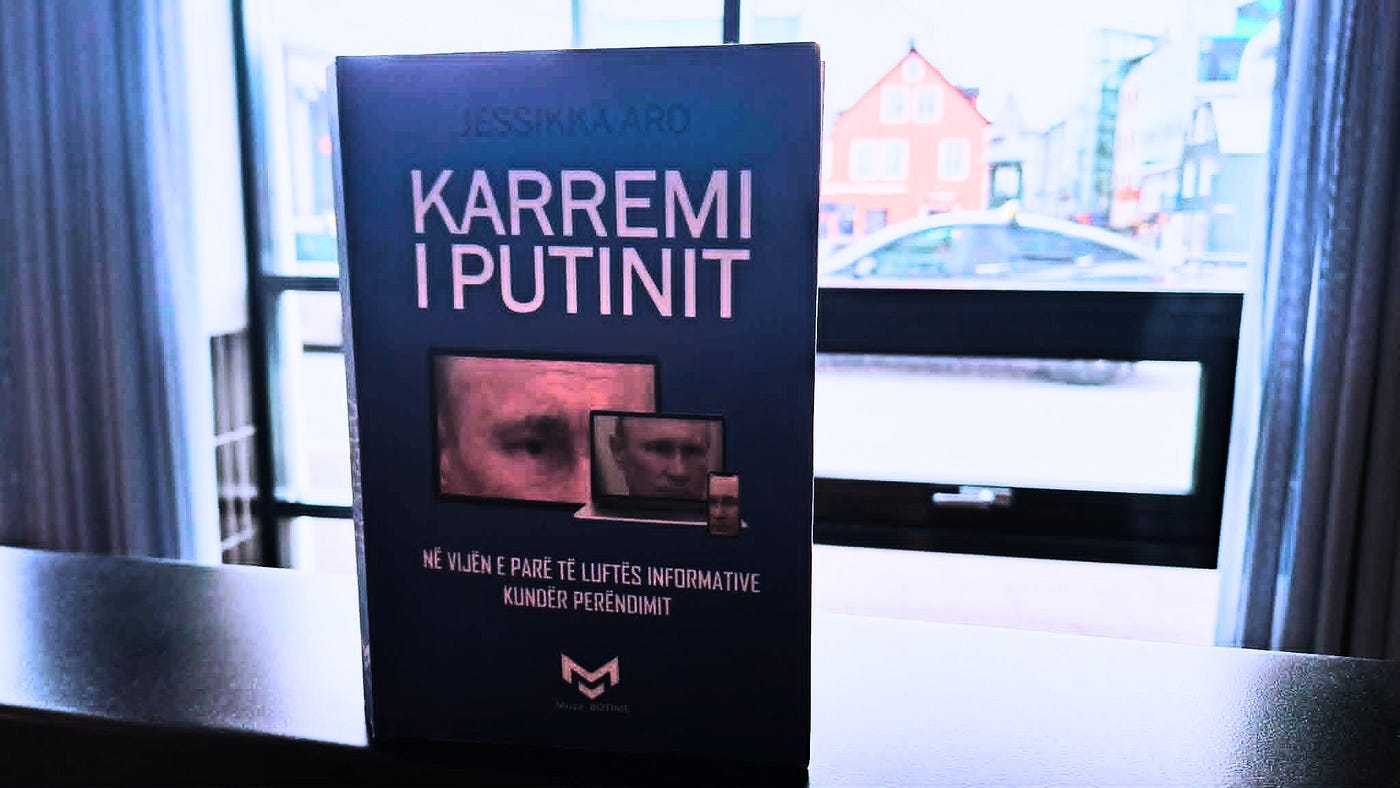
Finished reading the Albanian translation while in Reykjavik, Iceland
At first glance, a book about information warfare does not seem to belong in a series about workplace communication. However, the mechanisms of brainwashing and destroying the “enemy” Jessikka Aro describes are not unique to geopolitics. They reflect patterns that have been studied across propaganda systems and different periods in the history of humans.
The scale differs, but the underlying logic is recognizable and the effects resemble: an assassination takes place, not literal undoing of a body but intentional undoing of a career and destruction of a life.
At the core of these systems is not simply persuasion, but construction. Reality is assembled. A version of events is introduced (read: a person’s portrait is painted in a certain light), repeated, and reinforced until it becomes familiar. Over time, familiarity begins to substitute for verification. What is repeated often enough feels like context.
The aim of propaganda is not always to make people believe a lie, but to erode their capacity to distinguish truth from falsehood. Aro documents a similar dynamic in contemporary information warfare cultivating an environment in which certain persistent interpretations become dominant through repetition and volume.
In workplaces, these mechanisms can appear in subtler and more informal ways but they follow a comparable structure. A remark is made about an individual: it may be speculative, partial, or entirely unfounded. What matters is not its accuracy, but its intention and power of circulation. As it moves through conversations, it is adjusted, repeated, taking on new elements and over time, it detaches from its origin to function as accepted knowledge.
This is where character assassination begins to take shape, not as an event, but as a process.
Historically, propaganda systems have relied on reduction. Complex individuals are reframed as types. In propagandistic rhetoric, the “enemy” was defined through fixed traits or individuals were stripped of nuance and recast as categories. The purpose was not only to discredit, but to make exclusion appear rational.
A similar reduction can occur in professional environments. Specific actions are reinterpreted as stable traits, removed of context. A person is no longer described in terms of what they do, but what they are: where they were born, how they speak, how they dress, what food intolerances they have. Once this shift takes place, the conversation is no longer about behavior and turns to identity.
Dehumanization follows from this step, often without being named as such. It does not require overt hostility. It operates through simplification and distance. The individual becomes easier to discuss than to engage with. Decisions about them feel less like ethical judgments and more like administrative necessity.
What makes this process particularly difficult to identify is that it rarely looked coordinated from the outside. Just like state propaganda, there often is central directive but it stays well-hidden and participating colleagues may experience themselves as merely exchanging impressions or aligning perspectives. Yet the cumulative effect can mirror more structured systems. Repetition creates credibility.
Over time, a distributed form of consensus emerges. It does not depend on evidence, but on alignment. Once established, it becomes self-reinforcing. New information is interpreted through the existing narrative. Attempts to challenge it dismissed.
For the individual at the center, the consequences are not abstract. Their words carry less weight. Their actions are pre-interpreted. Efforts to clarify are filtered through assumptions that are already in place. In this environment, the truth is outnumbered.
Seen in this light, workplace mobbing can be understood not only as interpersonal conflict, but as a form of narrative consolidation. The comparison to historical propaganda is not about equivalence of scale or intent, but about shared mechanisms. Repetition, reduction, and the gradual normalization of a constructed view of reality makes it easier to assassinate the “other” in the workplace.
Each week, I take a book off the page into real life, translating stories and themes into how we work, lead, grow, and connect. These are not book reviews, but reflections: part literature, part lived experience, part observations. Through my passion for literature, I explore the many dimensions of workplace communication. Perhaps you will discover a book that speaks to where you are right now.
Exploring workplace communication through the lens of great books!
메타데이터
- post_id
- 2a1e40edb3bc
- slug
- inside-the-mind-of-a-character-assassin-2a1e40edb3bc
- url
- https://medium.com/@jamlinda/inside-the-mind-of-a-character-assassin-2a1e40edb3bc
- canonical_url
- https://medium.com/@jamlinda/inside-the-mind-of-a-character-assassin-2a1e40edb3bc
- author_url
- https://medium.com/@jamlinda
- status
- ok
- fetched_at
- 2026-06-09 15:37:30