Stepping Back
I came into this course as a Public Policy and International Development student. That means I was trained to trust representative samples…
Stepping Back
I came into this course as a Public Policy and International Development student. That means I was trained to trust representative samples, large datasets, and aggregated voices. My instinct, when faced with a problem, is to look for the pattern across thousands of observations, not to sit across from one person and ask them what their favourite spot in Lisbon is.
So when the first classes asked me to go out into the street, approach strangers, and conduct interviews without a structured questionnaire, I will be honest: it felt counterintuitive. Not because I thought the approach was wrong, but because nothing in my training had prepared me to treat a single conversation as a legitimate source of insight. I kept waiting for the sample size.

What this course gave me, week by week, was a different kind of rigour. The idea that empathy is not a soft skill you add at the end, but the starting point of any solution worth building, sounds obvious until you actually try to practice it. For me, the moment it stopped being abstract was when I interviewed Neeti, a beautician from Punjab working in Intendente. She said two things I have not been able to forget: that migrants keep the city running but are never seen doing it, and that working people don’t want to go to a meeting to integrate because they are simply too tired. Those two observations reshaped how I understood our entire challenge. The shift our team made, away from cultural institutions and toward low-friction, everyday moments of encounter, grew directly from listening to insights like that.
I should also admit that I came into this project thinking I already knew something about migration and integration. I had read the literature, followed the policy debates, held what felt like informed opinions. Some of my assumptions turned out to be close to the truth. But close is not the same as accurate, and the gap between the two is where the most important learning happened. What the research taught me is that other people’s experiences must be approached with humility, as a listener first, not an analyst. You have to go out there to understand the world, and you certainly have to go out there before you can demand to change it.

That willingness to let research actually change our direction was, I think, our team’s greatest strength this semester. We started with assumptions, museums, exhibitions, formal storytelling, and the fieldwork dismantled them one by one. The final solution, a participatory map where anyone can place a pin and write one word about what Lisbon means to them, is simpler than anything we imagined at the start. And it is better precisely because of that simplicity. One of our readings described the design process as less a straight line than a system of spaces you move through and return to, where the returning is not a setback but the work itself. Prototyping taught us that each iteration that removed something also clarified something.
My weakness, if I am honest, was patience with ambiguity. There were moments, particularly during synthesis, when we had walls covered in post-its and no clear direction, where I wanted to skip ahead to the answer. I am good at analysis when the framework is given; I am less comfortable when the framework itself is what you are trying to find. That discomfort, I now think, is exactly where design thinking lives. The Lego class, where we were asked to build something representing our relationship to failure, made this uncomfortably clear. Failure sucks, as one of our readings put it, but it instructs. I realised I had very little practice letting it do either.

What surprised me most was how much the process asked of the whole person, not just the professional. In an era where AI increasingly does our thinking for us, I have often found myself feeling strangely empty, as though the creative instincts I grew up with, a childhood full of books and imagination, had quietly faded away without me noticing. This course gave some of that back. Having access only to post-its, coloured pens, Lego bricks, and each other, my mind found its way to ideas I did not know it still held. I think we are all full of possibilities that simply need the right conditions to surface.
All of this connected, more personally, to where I found myself this semester. Doing this course in my last months in Lisbon, while preparing to leave a city I have come to love unexpectedly and deeply, made everything land differently. Writing Reflection 2 at the ERITAGE exhibition, I understood that the project we were building, about belonging, co-authorship, the ordinary middle of a life lived somewhere, was also, quietly, about me. The City We Live In asks people to complete the sentence “Lisbon to me means…” in one word. Doing it myself, I felt the full weight of what the semester had taught me: that belonging is not granted by legal status or language, but accumulated through small, repeated acts of attachment to a place. I know this now not only as a design insight, but as something I have lived.

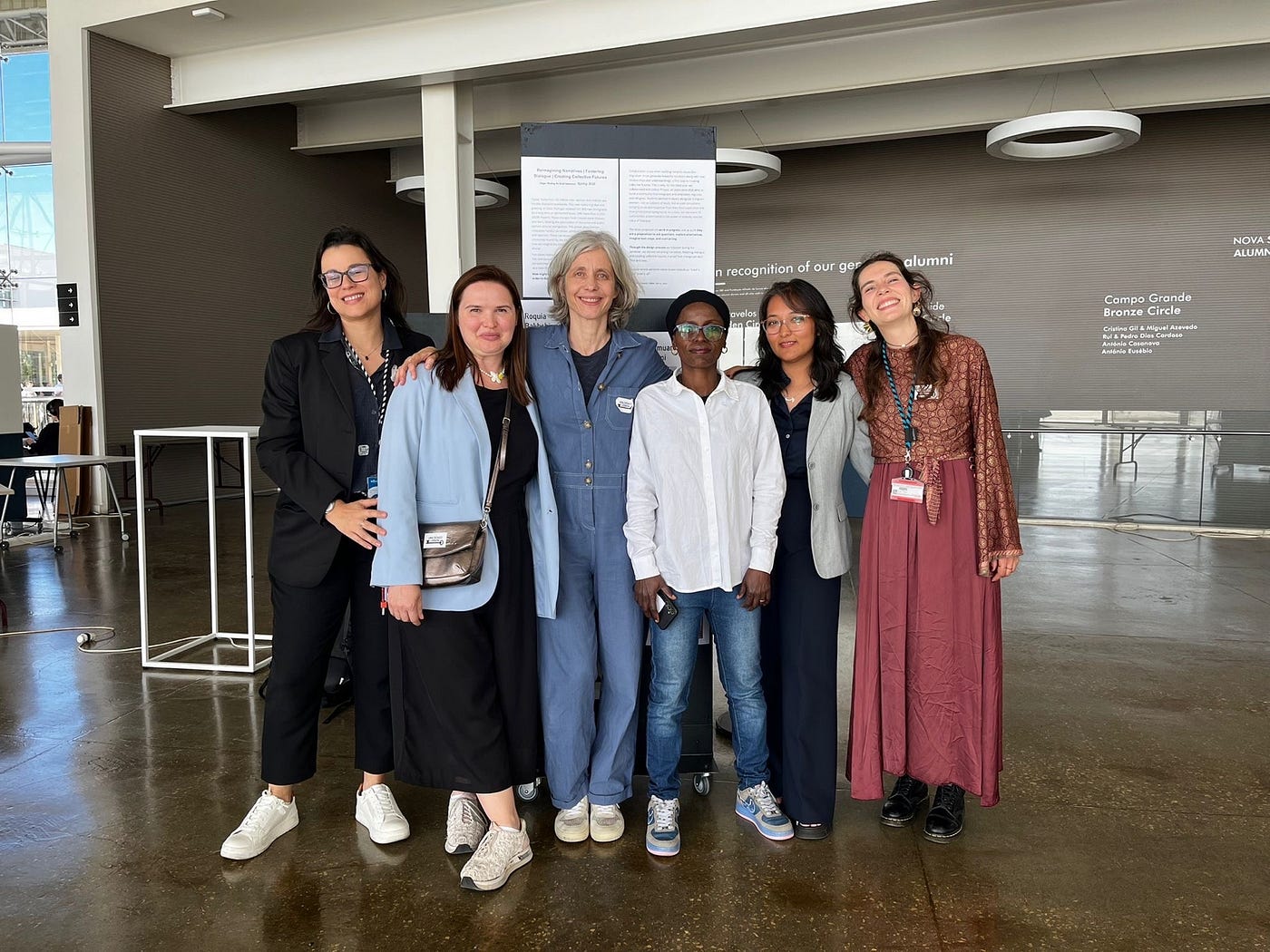
Then came the final exhibition, and despite the doubts, the moments of feeling like we had nothing solid between our hands, I found myself standing at our installation with my teammates, genuinely on fire. The map was filling up. Strangers were stopping, reading the instructions, choosing their pin, writing their word. It was working, in the quiet, unspectacular way we had always hoped it might. That feeling, of a process finally becoming whole, of trust in the work paying off even when the destination was as fuzzy as ever, is something I want to hold onto. It is a reminder that intention and effort do find their shape, even if not the shape you originally imagined.
What I want to carry forward is the ability to hold two things at once: the rigour of evidence and the irreducible specificity of a single person’s experience. I came in believing those were often in tension. I leave thinking they are incomplete without each other. More concretely, I want to explore what it looks like to bring participatory, bottom-up methods into policy work, not as a replacement for systemic thinking, but as its necessary complement. The hardest thing to design is never the system. It is the invisible friction underneath it: the exhaustion, the cultural assumptions, the small daily indignity that no dataset names but that Neeti described in just a few sentences.
Policy can change lives from the top down. But things like belonging, as this semester taught me, are built from the bottom up, one ordinary encounter, one pin on a map, at a time. Learning to work at both levels, and doing so with humility, with curiosity, and with the willingness to be surprised, feels like the most honest ambition I can leave this course with.

메타데이터
- post_id
- 2a250c5b409b
- slug
- stepping-back-2a250c5b409b
- url
- https://medium.com/design-thinking-for-social-innovation/stepping-back-2a250c5b409b
- canonical_url
- https://medium.com/design-thinking-for-social-innovation/stepping-back-2a250c5b409b
- author_url
- https://medium.com/@67070
- status
- ok
- fetched_at
- 2026-06-16 19:09:56