Mastering Cross-Chain Interoperability Protocols: A Technical Deep-Dive and Developer Guide
Introduction: The Imperative for Omnichain Architecture
Mastering Cross-Chain Interoperability Protocols: A Technical Deep-Dive and Developer Guide
Cross-Chain Interoperability Protocols
Introduction: The Imperative for Omnichain Architecture
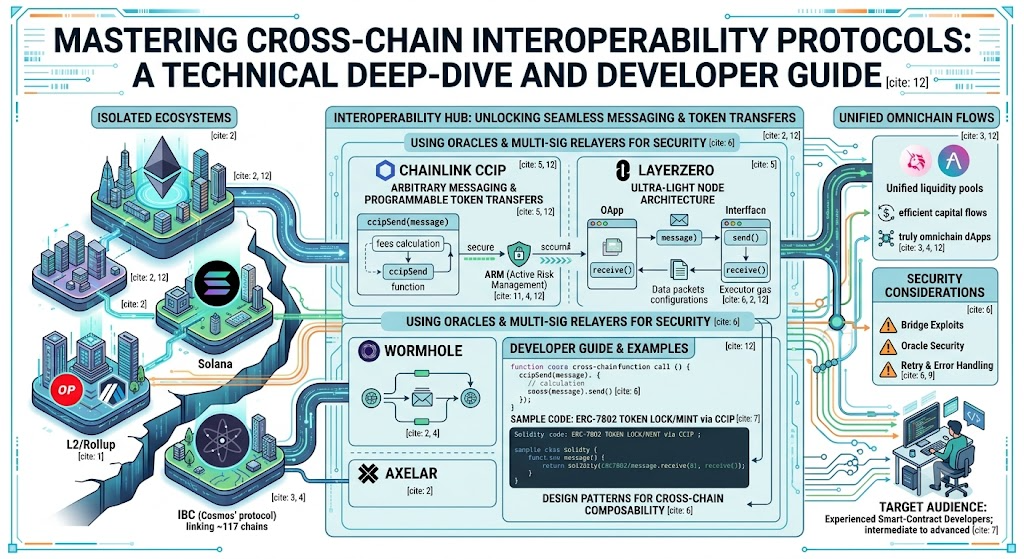
As the blockchain ecosystem matures, the proliferation of specialized Layer-1 networks, Layer-2 rollups, and application-specific chains has fractured the decentralized landscape. While this multi-chain expansion has resolved the immediate scalability bottlenecks of legacy networks, it has inadvertently generated isolated islands of execution. This isolation severely degrades the user experience and fractures capital efficiency, forcing liquidity to pool in isolated smart contracts rather than flowing dynamically to where it is most effectively utilized. To resolve this fragmentation, modern interoperability protocols such as LayerZero, Chainlink’s Cross-Chain Interoperability Protocol (CCIP), Wormhole, and Axelar have deployed generalized message-passing infrastructure. This evolution empowers developers to orchestrate seamless messaging and token transfers across entirely distinct consensus zones.
The success of these protocols is evidenced by massive ecosystem adoption. The Cosmos Inter-Blockchain Communication (IBC) protocol natively links approximately 117 independent application chains, while decentralized finance behemoths like Uniswap and Aave aggressively integrate omnichain routing flows via LayerZero and CCIP. For experienced smart contract developers, this architectural shift from a multi-chain environment where independent, unconnected instances of an application are deployed on different networks to a true omnichain environment represents a massive surface area for innovation. Developing omnichain decentralized applications (dApps) demands a rigorous understanding of the distinction between token bridging and arbitrary messaging, the nuances of varying ultra-light node architectures, the intricacies of cross-chain fallback patterns, and the ability to implement standardized, multi-environment function calls safely.
Deconstructing Messaging versus Token Bridging
Historically, cross-chain development was synonymous with basic token bridging. In the classic lock-and-mint bridging architecture, an asset on the source network is locked inside a vault contract, triggering an off-chain relayer to mint a synthetic, wrapped representation on the destination network. While functional, this methodology inherently creates non-fungible liquidity silos. A token bridged via Wormhole is cryptographically distinct from the same token bridged via Axelar, forcing users to interact with complex decentralized exchanges just to normalize their bridged assets into canonical forms. This fragmented approach is fundamentally hostile to composability.
Modern interoperability protocols transcend basic token bridging by providing arbitrary data messaging architectures. Arbitrary messaging decouples the protocol from asset transport, allowing a smart contract on Ethereum to encode an arbitrary byte array containing function signatures, state parameters, or executable logic and reliably transmit it to a smart contract on Solana, Arbitrum, or Avalanche. When developers combine token bridging architectures with arbitrary messaging capabilities, the result is programmable token transfers. Programmable transfers allow users to bridge native liquidity and simultaneously pass encoded instructions that dictate precisely what the destination smart contract should do with the newly arrived funds, such as depositing the assets into a yield-bearing collateral protocol or executing a cross-chain swap in a single user transaction.
This architectural evolution fundamentally alters smart contract design patterns. Developers are no longer restricted to managing state locally; they can utilize asynchronous composability to trigger state transitions globally. Consequently, mastering the implementation of these protocols requires deeply understanding the data encoding structures, the relayer fee mechanisms, and the underlying security validations that make asynchronous state transitions possible.
Deep Dive: Chainlink CCIP Architecture and Implementation
Chainlink CCIP Architecture and Implementation
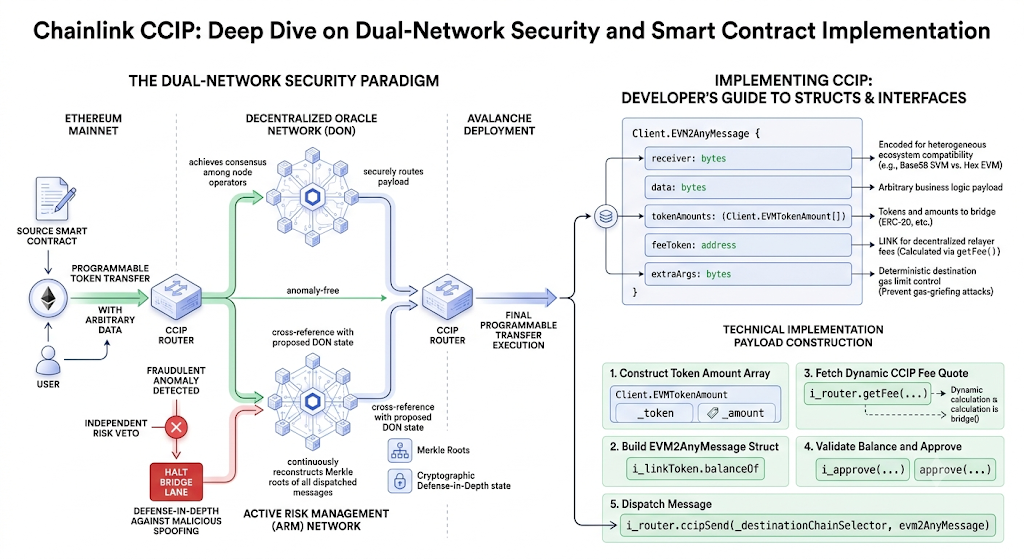
Chainlink’s Cross-Chain Interoperability Protocol (CCIP) is engineered as a highly defensive, open-source standard for generalized cross-chain communication. Unlike protocols that optimize purely for execution latency, CCIP prioritizes cryptographic defense-in-depth through a dual-network topology.
The Dual-Network Security Paradigm
The operational core of CCIP relies on the Decentralized Oracle Network (DON). When a source smart contract initiates a cross-chain transaction, the DON observes the finalized event on the source blockchain, achieves consensus among its node operators, and securely routes the payload to the destination network. However, trusting a single oracle network with billions of dollars in cross-chain value introduces a centralized point of failure.
To mitigate this systemic risk, Chainlink introduced the Active Risk Management (ARM) network. The ARM network operates entirely independently of the primary DON, utilizing a separate implementation codebase and distinctly managed infrastructure. Its singular purpose is to act as a secondary validation layer. The ARM nodes continuously reconstruct the Merkle roots of all dispatched cross-chain messages from the source chain and cross-reference them against the state proposed by the primary DON. If the ARM network detects any anomaly whether malicious spoofing by compromised DON operators or unforeseen statistical divergences it exercises an independent risk veto. This veto immediately halts the specific bridge lane, protecting user funds before the fraudulent state transition can be finalized on the destination chain.
Implementing CCIP: Pseudocode and Payload Construction
For smart contract developers, implementing CCIP requires understanding the EVM2AnyMessage structure and the IRouterClient interface. The CCIP Router acts as the universal entry point for outgoing messages. To execute a programmable token transfer, the source contract must format the message, calculate the decentralized relayer fees, grant token approvals, and finally invoke the ccipSend function.
Below is an extensive technical implementation detailing the construction of a CCIP sender contract. The contract accepts a destination chain selector, a receiver address, a specific ERC-20 token, and an arbitrary payload, bundling them into a secure cross-chain transmission.
// SPDX-License-Identifier: MIT
pragma solidity 0.8.24;

import {IRouterClient} from "@chainlink/contracts-ccip/src/v0.8/ccip/interfaces/IRouterClient.sol";
import {Client} from "@chainlink/contracts-ccip/src/v0.8/ccip/libraries/Client.sol";
import {IERC20} from "@chainlink/contracts-ccip/src/v0.8/vendor/openzeppelin-solidity/v4.8.0/token/ERC20/IERC20.sol";

contract CCIPOmnichainSender {
    IRouterClient public immutable i_router;
    IERC20 public immutable i_linkToken;

    error InsufficientFeeBalance(uint256 current, uint256 required);

    constructor(address _router, address _link) {
        i_router = IRouterClient(_router);
        i_linkToken = IERC20(_link);
    }

    /**
     * @notice Sends a programmable token transfer with arbitrary data.
     * @param _destinationChainSelector The unique CCIP identifier for the target chain.
     * @param _receiver The destination contract address.
     * @param _token The ERC-20 token to bridge.
     * @param _amount The volume of tokens to bridge.
     * @param _messageData The arbitrary string data to pass to the destination logic.
     */
    function executeProgrammableTransfer(
        uint64 _destinationChainSelector,
        address _receiver,
        address _token,
        uint256 _amount,
        string memory _messageData
    ) external returns (bytes32 messageId) {

        // Step 1: Construct the Token Amount Array
        Client.EVMTokenAmount memory tokenAmounts = new Client.EVMTokenAmount(1);
        tokenAmounts = Client.EVMTokenAmount({
            token: _token,
            amount: _amount
        });

        // Step 2: Build the EVM2AnyMessage Struct
        Client.EVM2AnyMessage memory evm2AnyMessage = Client.EVM2AnyMessage({
            receiver: abi.encode(_receiver), // Encoded to support non-EVM SVM addresses
            data: abi.encode(_messageData),   // Encoded arbitrary business logic
            tokenAmounts: tokenAmounts,
            feeToken: address(i_linkToken),   // Utilizing LINK for relayer fee payments
            extraArgs: Client._argsToBytes(
                // Configuring strict gas limits for destination execution
                Client.EVMExtraArgsV1({gasLimit: 300_000})
            )
        });

        // Step 3: Fetch the dynamic CCIP fee quote
        uint256 ccipFee = i_router.getFee(_destinationChainSelector, evm2AnyMessage);

        // Step 4: Validate balance and approve the router
        if (i_linkToken.balanceOf(address(this)) < ccipFee) {
            revert InsufficientFeeBalance(i_linkToken.balanceOf(address(this)), ccipFee);
        }

        i_linkToken.approve(address(i_router), ccipFee);
        IERC20(_token).approve(address(i_router), _amount);

        // Step 5: Dispatch the message through the CCIP Router
        messageId = i_router.ccipSend(_destinationChainSelector, evm2AnyMessage);

        return messageId;
    }
}
This implementation highlights several vital architectural patterns. Firstly, the receiver and data parameters are cast into raw byte arrays utilizing abi.encode. This abstraction is paramount because CCIP is designed for heterogeneous ecosystems; encoding the receiver into bytes ensures that the protocol can natively process routing instructions destined for non-EVM environments like Solana, which utilizes Base58 formatted public keys instead of hexadecimal Ethereum addresses.
Secondly, the getFee query dynamically calculates the execution cost of the off-chain oracle network and the destination gas execution based on the destination chain's real-time base fee. Developers must ensure that their smart contract maintains a sufficient treasury of the feeTokenin this case, LINK to sponsor the transactions, or alternatively, configure the feeToken to address(0) to sponsor the transaction utilizing the source network's native gas asset. Finally, the extraArgs parameter provides strict deterministic control over the destination environment, allowing the developer to cap the maximum gas allowance the relayer is permitted to expend when invoking the receiver contract, preventing malicious gas-griefing attacks during the asynchronous execution phase.
Deep Dive: LayerZero V2 and the Ultra-Light Node Architecture
LayerZero V2 and the Ultra-Light Node Architecture
Whereas Chainlink CCIP provides a highly curated, defensively structured protocol with its own oracle network, LayerZero V2 takes a fundamentally distinct approach by positioning itself as an unopinionated transport layer. LayerZero’s core thesis is that decentralized applications should not be locked into a monolithic security model; rather, applications should define and own their security perimeters based on their unique risk profiles.
Decoupling Verification from Execution
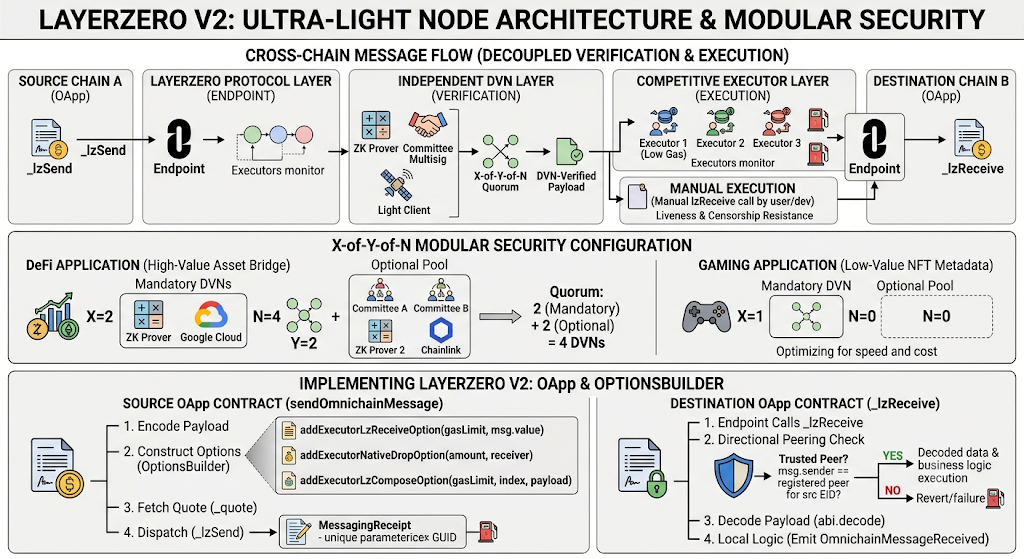
LayerZero V2 completely separates the mechanics of message verification from message execution. When a cross-chain message is generated, it interacts with the local Endpoint smart contract. From there, the message is monitored by Decentralized Verifier Networks (DVNs). A DVN is an independent, off-chain service such as a zero-knowledge prover, a light client, or a decentralized multi-signature committee that reads the source blockchain and verifies the mathematical integrity of the payload.
Completely distinct from the DVNs are the Executors. An Executor is a permissionless off-chain entity whose singular role is to purchase gas on the destination network and submit the DVN-verified payload to the target smart contract. By decoupling these roles, LayerZero creates a highly competitive marketplace. Multiple Executors can compete to deliver the payload at the lowest gas markup, driving down operational costs for developers. Furthermore, because execution is permissionless, if an Executor network suffers an outage, the end user or the protocol developer can step in and manually execute the lzReceive function, ensuring absolute censorship resistance and liveness.
The X-of-Y-of-N Security Configuration
The true power of LayerZero V2 lies in its Ultra-Light Node architecture, which enables the X-of-Y-of-N security model. Instead of accepting a standard protocol-wide oracle consensus, a smart contract developer explicitly configures the exact quorum of DVNs required to validate their application’s messages.
An application configures X specific DVNs that are absolutely mandatory for verification. It then defines a total pool of N optional DVNs, establishing a threshold where Y of those optional verifiers must also agree. For instance, a decentralized finance protocol bridging hundreds of millions of dollars might demand that a Zero-Knowledge Proof DVN and the Google Cloud DVN are explicitly required (X=2), while also requiring validation from at least two out of four other independent committee DVNs (Y=2, N=4). Conversely, a decentralized gaming application passing low-value non-fungible token metadata could optimize for cost and speed by requiring only a single, highly performant DVN. This modularity completely shifts the security burden from the protocol developers directly to the application architects.
Implementing LayerZero V2: The OApp Interface
To interface with LayerZero V2, developers inherit from the Omnichain Application (OApp) standard. The OApp contract serves as a developer-friendly facade that wraps the raw LayerZero Endpoint interface, exposing intuitive _lzSend and _lzReceive internal functions.
Below is an advanced implementation demonstrating how to inherit the OApp standard, format execution options using the OptionsBuilder, and securely process incoming payloads.
// SPDX-License-Identifier: MIT
pragma solidity 0.8.22;

import {OApp, MessagingFee, Origin} from "@layerzerolabs/oapp-evm/contracts/oapp/OApp.sol";
import {OptionsBuilder} from "@layerzerolabs/oapp-evm/contracts/oapp/libs/OptionsBuilder.sol";

contract LayerZeroOmnichainApp is OApp {
    using OptionsBuilder for bytes;

    event OmnichainMessageSent(bytes32 indexed guid, uint32 destinationEid);
    event OmnichainMessageReceived(uint32 sourceEid, string data);

    constructor(address _endpoint, address _delegate) OApp(_endpoint, _delegate) {}

    /**
     * @notice Transmits arbitrary data across chains using LayerZero V2.
     * @param _dstEid The Endpoint ID of the target blockchain.
     * @param _messageData The string payload to be transmitted.
     */
    function sendOmnichainMessage(uint32 _dstEid, string memory _messageData) external payable {
        bytes memory encodedPayload = abi.encode(_messageData);

        // Constructing Executor Options for the destination chain
        // Allocating 250,000 gas for the lzReceive execution on the destination
        bytes memory executionOptions = OptionsBuilder.newOptions()
           .addExecutorLzReceiveOption(250_000, 0);

        // Fetching the dynamic quote for the cross-chain execution
        MessagingFee memory fee = _quote(_dstEid, encodedPayload, executionOptions, false);

        require(msg.value >= fee.nativeFee, "Insufficient native gas for LzSend");

        // Dispatch the payload via the internal _lzSend wrapper
        // The Endpoint calculates the unique GUID and nonces the channel
        MessagingReceipt memory receipt = _lzSend(
            _dstEid,
            encodedPayload,
            executionOptions,
            MessagingFee(msg.value, 0),
            payable(msg.sender) // Refund address for excess gas
        );

        emit OmnichainMessageSent(receipt.guid, _dstEid);
    }

    /**
     * @notice Internal callback invoked by the local LayerZero Endpoint upon verification.
     * @param _origin Struct containing the source Eid, sender address, and nonce.
     * @param _guid The globally unique identifier of the message.
     * @param _message The encoded byte payload.
     */
    function _lzReceive(
        Origin calldata _origin,
        bytes32 _guid,
        bytes calldata _message,
        address /*_executor*/,
        bytes calldata /*_extraData*/
    ) internal override {
        // The OApp standard automatically enforces strict directional peering checks.
        // Execution reaches here ONLY if the source sender is a trusted peer.

        string memory decodedData = abi.decode(_message, (string));

        // Execute arbitrary local business logic
        emit OmnichainMessageReceived(_origin.srcEid, decodedData);
    }
}
The critical element in the LayerZero V2 transmission sequence is the utilization of the OptionsBuilder library. Unlike V1, where execution parameters were highly abstracted, V2 provides granular control over the remote Executor. By chaining addExecutorLzReceiveOption(250_000, 0), the developer explicitly mandates that the executor must provision exactly 250,000 units of gas when calling the destination contract.
Furthermore, the OptionsBuilder supports advanced composability patterns. A developer can append addExecutorLzComposeOption to allocate secondary gas limits for nested contract interactions on the destination chain. Even more powerfully, by utilizing addExecutorNativeDropOption, the source contract can instruct the Executor to airdrop a specific volume of the destination chain's native gas token directly into the target user's wallet. This effectively eliminates the "gasless wallet" problem, allowing a user with zero native tokens on a new network to bridge assets and immediately possess the underlying gas required to interact with that ecosystem.
Crucially, the _lzReceive function operates under severe security constraints. The foundational OApp standard strictly enforces directional peering. When the LayerZero Endpoint invokes _lzReceive, it automatically verifies that the _origin.sender precisely matches the trusted peer address formally registered by the contract administrator for that specific source Endpoint ID. This structural guarantee prevents unauthorized external contracts from spoofing cross-chain payloads and polluting the destination state.
The ERC-7802 Standard: Unifying Cross-Chain Native Tokens
Unifying Cross-Chain Native Tokens
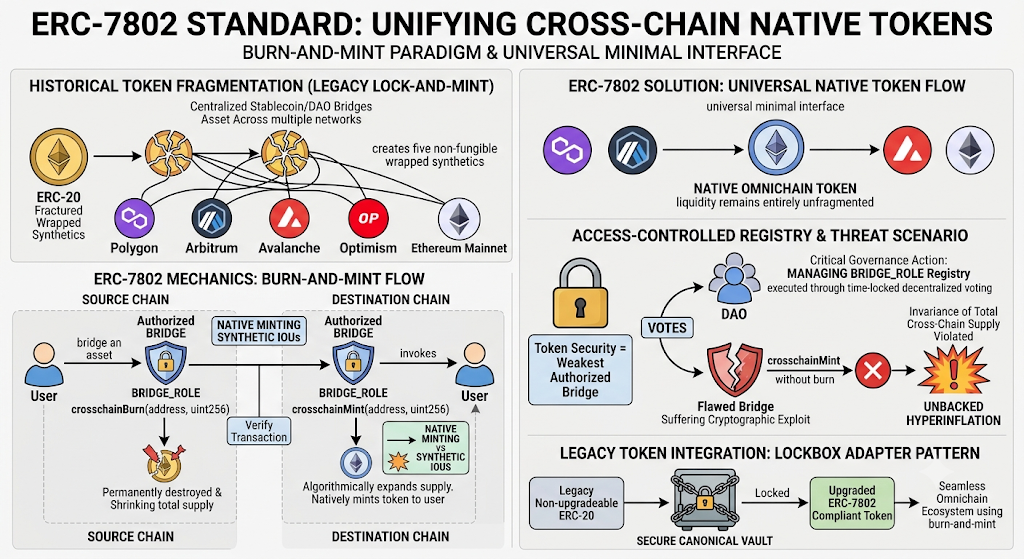
While arbitrary messaging protocols solve the problem of data transport, the proliferation of distinct bridging infrastructure has historically resulted in highly fractured token supplies. When a centralized stablecoin or a decentralized autonomous organization bridges an ERC-20 token across five different networks utilizing five different bridges, they inadvertently create five non-fungible wrapped synthetics. To address this systemic inefficiency, the Ethereum developer community introduced the ERC-7802 standard.
Authored heavily by contributors from the Optimism ecosystem and formalized from the foundational SuperchainERC20 pattern, ERC-7802 defines a universal, minimal interface for cross-chain token operations. The standard completely deprecates the legacy lock-and-mint architecture in favor of a universal burn-and-mint paradigm.
The Standardized Interface
The ERC-7802 interface strips away bridge-specific dependencies from the core token contract. It demands the implementation of two highly specific functions: crosschainMint and crosschainBurn. When a user wishes to bridge an asset, the authorized bridge contract invokes crosschainBurn, permanently destroying the local asset representation and shrinking the total supply on the source network. Upon verifying the transaction, the corresponding bridge on the destination network invokes crosschainMint, algorithmically expanding the supply on the target network. Because the tokens are natively minted rather than locked as synthetic IOUs, liquidity remains entirely unfragmented regardless of which network the token occupies.
Below is an architectural representation of an ERC-7802 compliant token utilizing an access-controlled bridge registry:
// SPDX-License-Identifier: MIT
pragma solidity 0.8.24;

import {ERC20} from "@openzeppelin/contracts/token/ERC20/ERC20.sol";
import {AccessControl} from "@openzeppelin/contracts/access/AccessControl.sol";

//@notice Minimal implementation of the ERC-7802 Cross-Chain Token Interface.
contract OmnichainNativeToken is ERC20, AccessControl {
    bytes32 public constant BRIDGE_ROLE = keccak256("BRIDGE_ROLE");

    event CrosschainMint(address indexed to, uint256 amount, address indexed sender);
    event CrosschainBurn(address indexed from, uint256 amount, address indexed sender);

    constructor(string memory name, string memory symbol) ERC20(name, symbol) {
        _grantRole(DEFAULT_ADMIN_ROLE, msg.sender);
    }

    //@notice Burns tokens from a user to initiate a cross-chain transfer.
    //@dev Restricted strictly to authorized bridge protocols.
    function crosschainBurn(address _from, uint256 _amount) external onlyRole(BRIDGE_ROLE) {
        // Implementation may require checking allowances depending on specific bridge architectures
        _burn(_from, _amount);
        emit CrosschainBurn(_from, _amount, msg.sender);
    }

    //@notice Mints tokens to a user upon successful cross-chain verification.
    //@dev Restricted strictly to authorized bridge protocols.
    function crosschainMint(address _to, uint256 _amount) external onlyRole(BRIDGE_ROLE) {
        _mint(_to, _amount);
        emit CrosschainMint(_to, _amount, msg.sender);
    }
}
The profound implication of the ERC-7802 standard is the centralization of security within the role-based access control registry. The security model of the token is identical to the security model of the weakest authorized bridge. If a DAO authorizes a flawed bridge to possess the BRIDGE_ROLE, and that bridge suffers a cryptographic exploit allowing it to invoke crosschainMint without a corresponding burn on the source chain, the strict invariance of the total cross-chain supply is violated, resulting in unbacked hyperinflation. Consequently, adding or removing a bridge from the BRIDGE_ROLE registry must be treated as a critical governance action, executed through robust, time-locked decentralized voting mechanisms.
For legacy tokens that are entirely non-upgradeable and cannot natively implement the ERC-7802 interface, developers utilize a lockbox adapter pattern. The legacy ERC-20 token is deposited and permanently locked inside a secure canonical vault. In exchange, the vault mints an equivalent volume of an upgraded ERC-7802 compliant token, which can then flow seamlessly across the omnichain ecosystem utilizing the burn-and-mint mechanics.
Bridging the Execution Divide: EVM to Solana (SVM) Integration
Developing cross-chain applications between Ethereum Virtual Machine (EVM) networks and the Solana Virtual Machine (SVM) presents the most formidable challenge in modern interoperability. The architectural disparity between the two environments is immense. The EVM operates on a sequential processing model utilizing a global state tree and smart contracts that inherently hold their own storage. Conversely, Solana operates on the highly parallelized Sealevel runtime, where smart contracts (referred to as Programs) are completely stateless, and data is managed in distinct, cryptographically derived Account structures. Furthermore, Solana employs localized fee markets per account, preventing a massive decentralized exchange liquidation event from spiking transaction costs for unrelated gaming applications.
Despite these deep foundational differences, protocols like Chainlink CCIP and Wormhole have architected robust infrastructure to seamlessly transport state across this divide. When a developer utilizes CCIP to transmit a message from Ethereum to Solana, the primary hurdle is address resolution. Because EVM addresses are 20-byte hexadecimal strings and Solana addresses are 32-byte Base58 encoded public keys (often Program Derived Addresses or PDAs), the abi.encode function within the EVM2AnyMessage struct acts as the universal translator.
When executing a programmable token transfer to Solana utilizing CCIP, developers must establish sophisticated Token Pools on the SVM. A project can utilize a Self-Serve BurnMint pool, where the Solana Program is granted minting authority to dynamically expand and contract the SPL token supply based on incoming CCIP messages. Alternatively, developers can employ a LockRelease pool on the EVM side and map it to a specific mint on Solana. Because the developer ecosystems are vastly different, engineering this topology requires dual-stack proficiency: authoring the source sender contract in Solidity via Hardhat or Foundry, while engineering the destination receiver Program in Rust utilizing the Anchor framework. This bridging capability allows liquidity locked on highly secure EVM base layers to actively participate in the high-throughput, sub-second execution environment of Solana without enduring the severe slippage associated with traditional centralized exchange routing.
Security Considerations and Comparative Verification Models
The history of blockchain interoperability is severely marred by catastrophic smart contract exploits, where inadequate cryptographic validations or logic flaws resulted in billions of dollars in extracted value. Transitioning to an omnichain deployment requires an intense focus on the specific trust assumptions underlying the chosen messaging protocol. Developers must objectively evaluate the architectural tradeoffs between external validator committees, native light clients, and modular verification networks.
Analyzing Cross-Chain Trust Models
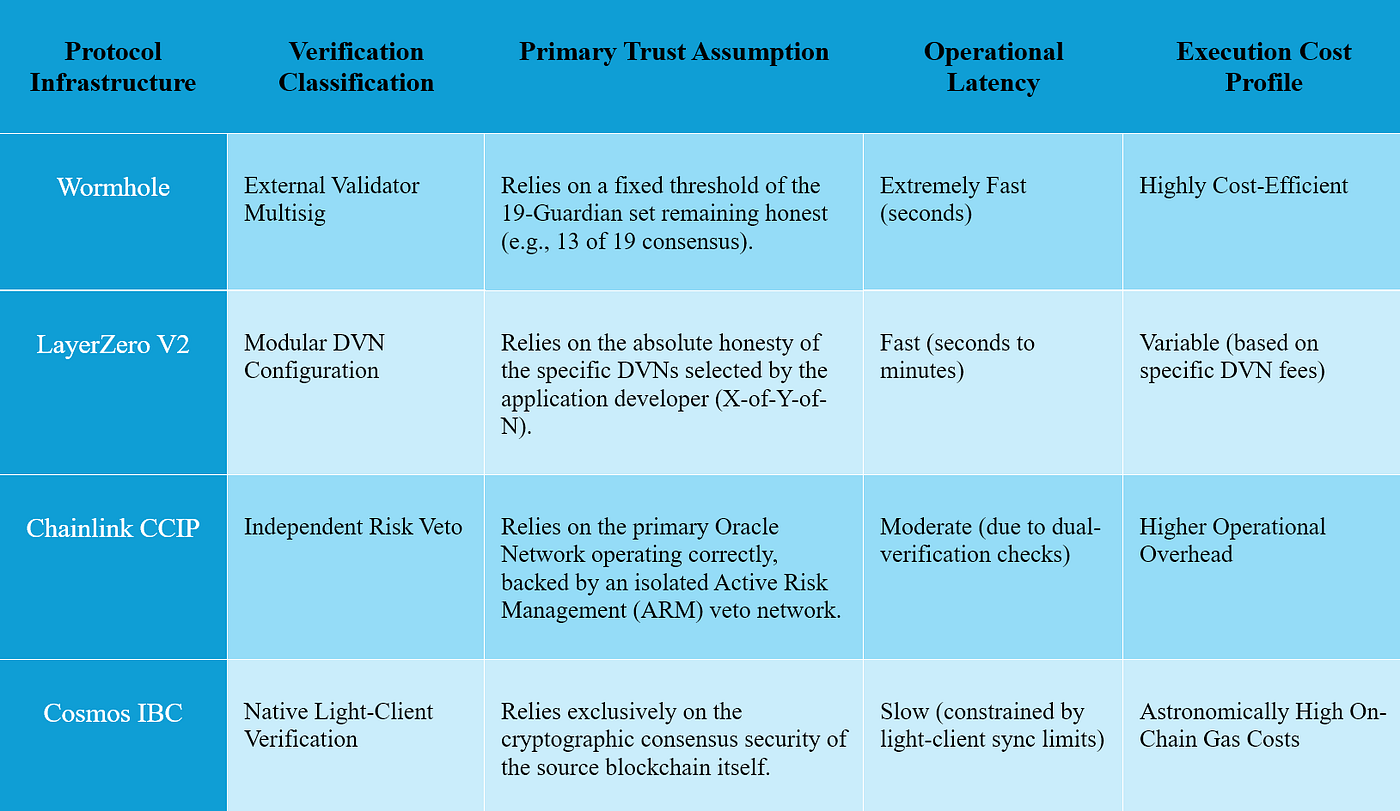
The security guarantees of an interoperability protocol dictate the maximum value it can safely transport. The following table provides a comprehensive technical comparison of the predominant verification models deployed across the industry:
Analyzing Cross-Chain Trust Models
The Cosmos IBC model represents the absolute pinnacle of trust-minimized architecture because it enforces on-chain verification of the source network’s cryptographic proofs without relying on any intermediary committee. If the source network achieves finality, the destination network guarantees execution. However, verifying complex consensus signatures (such as Ethereum’s Casper FFG) natively on a remote chain incurs crippling gas expenditures, severely restricting the model’s deployment strictly to environments explicitly optimized for it, such as the Tendermint ecosystem.
Conversely, Wormhole’s multisig approach provides massive scalability and near-instant finality but centralizes the trust assumption directly onto the Guardian network. The exact cryptographic threshold required to compromise the network is a known variable, creating a highly visible attack vector for sophisticated adversaries. Chainlink CCIP mitigates this specific vulnerability by introducing the independent ARM network, creating a defense-in-depth architecture where a secondary, highly isolated computational system can independently halt execution if it detects manipulation within the primary delivery network.
Defensive Smart Contract Patterns: Managing Asynchronous Reverts
Beyond protocol-level security, the most critical vulnerability vector in omnichain development occurs at the application layer during asynchronous execution. In a standard synchronous EVM transaction, if a nested function call reverts due to a state error, the entire transaction atomically rolls back, ensuring no state is permanently altered. However, cross-chain messaging fundamentally severs this synchronicity.
If a source contract successfully dispatches a payload, the tokens and message are committed to the bridge. If the subsequent execution on the destination chain reverts due to an unexpected out-of-gas error, an invalid localized state condition, or a failed external swap the cross-chain transaction cannot magically “roll back” the state on the source chain. Without highly specific defensive architectures, the tokens become permanently locked in the destination router, and the message execution hangs in a perpetual void.
To resolve this, robust protocols implement strict Fallback and Retry patterns. In Chainlink CCIP deployments, the destination contract deliberately isolates the entry point (ccipReceive) from the actual business logic. The execution logic is wrapped in a discrete internal function protected by a try/catch block.
If the core business logic fails, the catch block intercepts the revert. Instead of failing the entire transaction, the contract cleanly absorbs the error. It caches the original EVM2AnyMessage payload and its unique message ID into an internal s_messageContents mapping, and flags the transaction ID within a s_failedMessages registry. This exact mechanism ensures the bridging transaction officially completes, successfully moving the tokens out of the protocol router and into the application's secure custody, while logging the failure for future remediation.
An explicit administrative recovery function is then utilized. A privileged administrator can invoke retryFailedMessage, which first verifies the failed status, updates the registry state to RESOLVED (to explicitly prevent reentrancy and double-execution), and securely routes the locked assets to an emergency recovery address. This defensive engineering ensures that asynchronous failure vectors do not result in catastrophic capital loss.
Design Patterns for Cross-Chain Composability
Design Patterns for Cross-Chain Composability
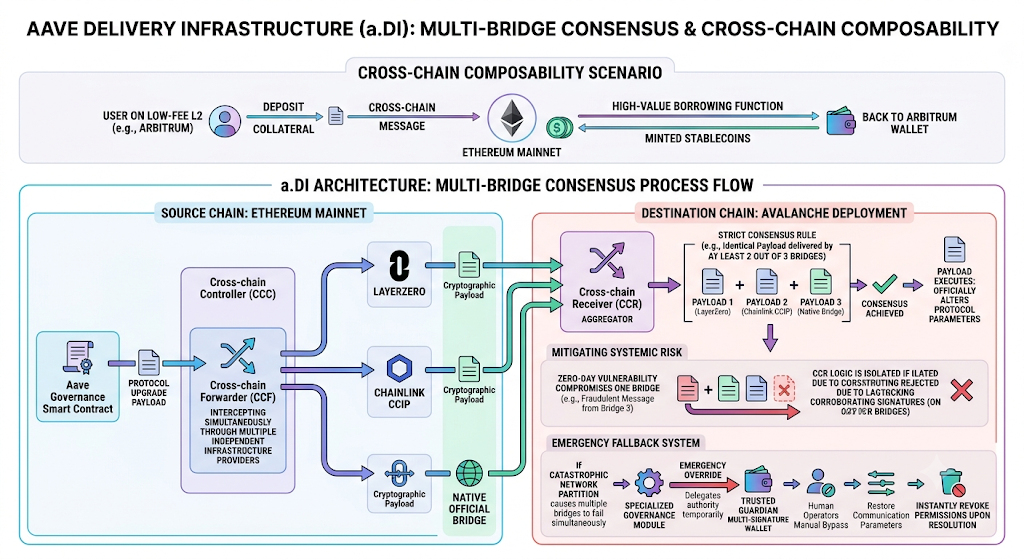
The maturation of arbitrary messaging protocols enables developers to move beyond simple asset transfers and embrace asynchronous composability. Asynchronous composability allows unbundled applications to orchestrate complex financial workflows across disparate networks. For example, a user on a low-fee Layer-2 rollup like Arbitrum can deposit collateral, triggering a cross-chain message that executes a high-value borrowing function on the Ethereum mainnet, and seamlessly routes the newly minted stablecoins back to the user’s Arbitrum wallet. Designing these asynchronous state machines requires highly advanced orchestration logic to maintain state consistency across fragmented environments.
The Aave Delivery Infrastructure (a.DI): Multi-Bridge Consensus
The most sophisticated execution of cross-chain composability currently deployed in decentralized finance is the Aave Delivery Infrastructure (a.DI). The Aave DAO manages billions of dollars across multiple decentralized network deployments, requiring a governance infrastructure that cannot be compromised by the failure of a single bridging provider. To achieve absolute sovereignty over its cross-chain operations, Aave engineered a.DI as a meta-abstraction layer sitting entirely above individual interoperability protocols.
The a.DI architecture operates via rigorous multi-bridge consensus. When the Aave Governance smart contract on Ethereum initiates a protocol upgrade targeting the Avalanche deployment, the payload is submitted to the localized Cross-chain Controller (CCC). The internal Cross-chain Forwarder (CCF) intercepts this payload, wraps it in a proprietary transaction format, and dispatches it simultaneously through multiple independent infrastructure providers such as routing the exact same payload redundantly through LayerZero, Chainlink CCIP, and the native official network bridges.
On the destination network, the Cross-chain Receiver (CCR) acts as an aggregator. Instead of executing the payload upon the first successful delivery, the CCR holds the transaction and evaluates the incoming data against a strict consensus rule. Aave Governance dictates specific thresholds for instance, requiring identical cryptographic payloads to be successfully delivered by at least two out of three independent bridge providers. Only when this mathematically enforced consensus is achieved does the payload execute, officially altering the protocol’s parameters.
By abstracting security through consensus, a.DI completely mitigates the systemic risk of underlying infrastructure. If a highly sophisticated zero-day vulnerability compromises a specific oracle network or relayer committee, the attacker’s fraudulent message will simply be isolated and rejected by the destination receiver because it lacks the corroborating signatures from the completely independent alternative bridges. Furthermore, the architecture includes a robust emergency fallback system. If a catastrophic network partition causes multiple bridges to simultaneously fail, disrupting the consensus threshold, a specialized governance module can trigger an emergency override. This localized flag temporarily delegates authority to a trusted Guardian multi-signature wallet, allowing human operators to manually bypass the halted infrastructure, restore communication parameters, and instantly revoke their own permissions upon resolution. The a.DI pattern represents the pinnacle of omnichain design, illustrating that true cross-chain security is not derived from trusting a single protocol, but from engineering resilient consensus matrices that anticipate and absorb catastrophic infrastructure failure.
Conclusion
The blockchain ecosystem has definitively crossed the threshold from a highly fragmented multi-chain environment into a cohesive omnichain paradigm. Modern cross-chain interoperability protocols have evolved from brittle, asset-wrapping bridges into highly generalized transport layers capable of transmitting complex execution logic across globally distributed state machines. By mastering the integration of Chainlink’s defensively constructed CCIP architecture and the highly granular, modular execution options of LayerZero V2, developers possess the infrastructure required to build profoundly composable decentralized applications.
Furthermore, the widespread adoption of standardized interfaces like ERC-7802 fundamentally resolves the liquidity fragmentation epidemic, unifying token supplies through seamless burn-and-mint architectures. As the industry aggressively expands to integrate wildly disparate execution environments bridging the strict sequential processing of the EVM with the highly parallelized, account-based architecture of the Solana Virtual Machine the complexity of smart contract development increases exponentially. Success in this omnichain era demands an absolute mastery of asynchronous fallback patterns, a deep understanding of relayer fee mechanics, and the implementation of robust, multi-bridge consensus topologies. Developers who successfully navigate these architectural challenges will define the next generation of decentralized finance, creating fluid, chain-agnostic applications that pool global liquidity and abstract the underlying cryptographic complexity entirely away from the end user.
© Article by Cusaldmsr
메타데이터
- post_id
- 2a31cfdbe0ce
- slug
- mastering-cross-chain-interoperability-protocols-a-technical-deep-dive-and-developer-guide-2a31cfdbe0ce
- url
- https://medium.com/@cusaldmsr/mastering-cross-chain-interoperability-protocols-a-technical-deep-dive-and-developer-guide-2a31cfdbe0ce
- canonical_url
- https://medium.com/@cusaldmsr/mastering-cross-chain-interoperability-protocols-a-technical-deep-dive-and-developer-guide-2a31cfdbe0ce
- author_url
- https://medium.com/@cusaldmsr
- status
- ok
- fetched_at
- 2026-06-23 19:38:28




