Intent Is the New Interface of Commerce
Designing Agentic Commerce Around Customer Experience
Intent Is the New Interface of Commerce
Designing Agentic Commerce Around Customer Experience
Views expressed are my own and do not reflect those of my employer
I recently gave Gemini a screenshot from my Instagram. In the image, Peggy Gou — yes, that Peggy Gou, the DJ everyone like me who is into electronic music knows — was wearing something that immediately caught my attention.
Calf massager boots 👀
If you travel a lot, you immediately understand the appeal: after long flights, those things look less like a gadget and more like a personal promise of happiness.
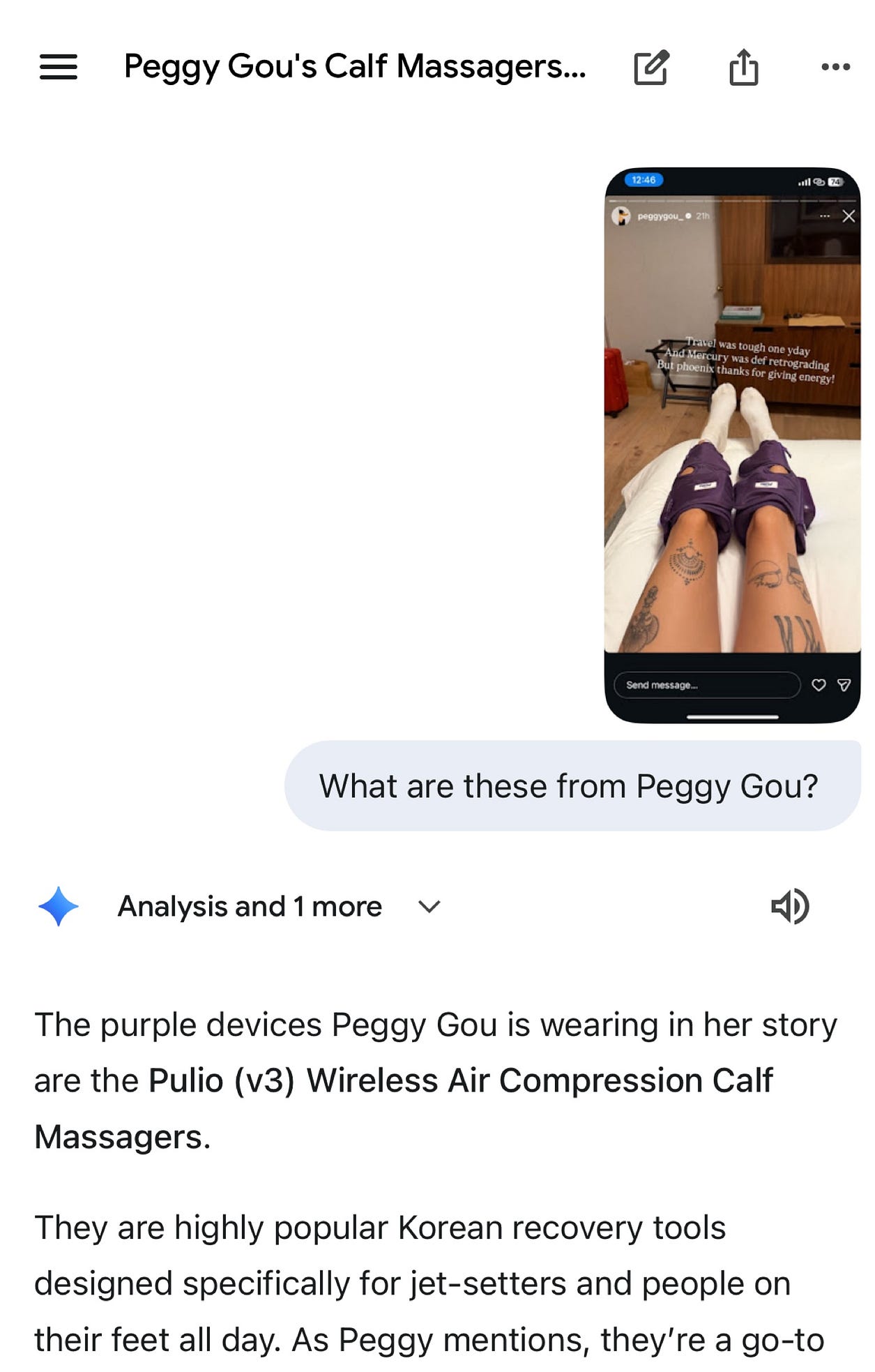
Given that I spend a suspicious amount of time thinking about agentic AI and agentic commerce (guess why 🙃), I immediately thought this would have been the perfect checkout moment. Gemini, you clearly see that I’m interested in this product. Please seduce me: override all my good intentions about saving money and staying on budget this month, ask me if I want to buy it, and carry on with the checkout.
Instead, Gemini brought a number of links to similar products and comparisons to my attention — and I ended up buying nothing.
For someone like me who is obsessed with customer experience, this became a moment of reflection. It crystallized many of the thoughts I’ve been developing recently about agentic commerce — not as an assistant experiment dedicated to a single task (buying), but as a fundamentally new kind of experience.
Today, the experience mostly revolves around an agent that goes through reviews, compares websites, opens tabs, and navigates the usual maze of the old e-commerce world before generating a token and completing the purchase. It simply does it faster and in one place, instead of me manually opening twenty tabs and reading through everything myself. In other words, what we currently call agentic shopping is, in many cases, still just web scraping in a trench coat.

We expect revolutionary intelligence, but we’re mostly designing these systems to give us a list of “curated links” we could have found ourselves. Yes, it saves time. But intelligence is not merely optimization — it is understanding. And if designed properly, this technology has the potential to fundamentally reshape how we search, discover, and experience commerce.
Intelligence is not merely optimization — it is understanding.
So, given the real innovative capabilities that agentic systems can offer, what does the future hold for commerce?
There are three shifts, in my view, that we should start paying attention to if we want the agentic commerce experience to move beyond what is essentially “search with better manners.”
All of them start from the same premise: agentic commerce should not begin with technology or data, but with the customer experience. And here is why.
1. Commerce needs to understand intent, not just products
Most commerce today still begins with a product query, typically powered by query embedding and vector similarity search (semantic search). The user knows what she needs — or at least she thinks she does. She types a product name into a prompt, the agent retrieves a list of top results, compares a few options, and eventually helps her buy.
But we (humans!!) rarely think in products. We think in intent and experiences.
Take my example. I never explicitly asked to buy calf massagers. I simply showed interest in something Peggy Gou was wearing. That signal alone contains a surprising amount of information — if the system is properly designed to interpret it.
Why was I interested? Am I a frequent flyer dealing with swollen legs after long flights? Am I just curious because Peggy Gou made them look cool? Am I exploring travel recovery tools?
Even something as simple as looking at my calendar could provide additional context: I have an upcoming trip to New York. That might explain why circulation and recovery products suddenly catch my attention, with Peggy simply acting as the trigger that brought me there.
Yes, there may be instances where we simply type a product name and that’s it. But the opportunities for agentic commerce go far beyond that.
Intent recognition enables systems to understand my plans, who I am, and what I’m interested in. Based on these signals, the system can refine its understanding of my taste and expand the range of relevant commerce opportunities for me.
Understanding intent means transforming commerce from request fulfillment or demand capture into contextual conversation. Instead of merely responding to what I ask, the system should help me understand what I might actually need — and why.
2. Intent unlocks richer discovery and larger, meaningful baskets
If an agent truly understands intent, the interaction does not stop at a product recommendation. It becomes an exploration of related opportunities that serve the same underlying customer need.
Rather than returning a sterile list of calf massagers, an intelligent system might respond with something like: “Mara, compression boots could help with circulation during long flights. But given your travel schedule, you might also want to consider a few complementary things.” Perhaps a Pilates package from a studio that has just opened near my home. Perhaps drainage teas or recovery routines recommended for frequent travelers. Perhaps even reminders to stretch during long-haul flights.
This is exactly how a good sales assistant behaves in the physical world. They don’t just answer your question; they help you think more broadly about the problem you’re trying to solve.
Interestingly, this also addresses a common fear among merchants about agentic commerce — that intelligent agents will reduce basket size by making shopping too efficient and laser-focused, disregarding related products we might otherwise discover while browsing through tabs and links.
In reality, the opposite may happen if agents designed for commerce are built around customer intent. When systems understand intent deeply, they can expand discovery in ways that are relevant rather than random, increasing basket value while improving customer satisfaction.
Remember: people don’t dislike buying; they dislike inefficient buying.
The myth in commerce is that consumers want to buy less. In reality, people are perfectly happy to buy when a purchase clearly serves their needs. What frustrates them is the effort and misalignment between what they want and what commerce delivers.
Technically, this is where approaches like ontology based commerce become critical. Instead of simply matching keywords to products, LLM-based agents can map user signals to structured ontologies that connect products, needs, contexts, and use cases across domains.
Take my example: starting from an interest in Peggy Gou’s calf massagers and connecting it with my own data, an agent designed around intent — rather than merely products — could begin connecting the dots about me and what I might like or need: electronic music, work travel, fashion, diet, legs…
In other words, the agent is not just searching a catalog; it is navigating a network of my needs and habits, reflecting those relationships into the external world to match them with products, services, and experiences that truly fit my wants, needs, and tastes.
3. If built around customer intent, agentic commerce can shift the model from demand capture to demand creation
This is why intent recognition and ontology-based design are becoming so important in agentic commerce. If a system understands intent beyond the literal meaning of a prompt, the interaction becomes richer and more useful, moving beyond simply returning products. For example, agentic commerce could connect me to broader wellness practices or travel preparation strategies I hadn’t even considered.
If agentic commerce moves beyond being a query or vector-search game with LLMs and becomes something closer to problem solving and a researcher that expands my interests, horizons, and knowledge, the opportunity becomes significant for both consumers and merchants.
Traditional e-commerce is built to capture existing demand: someone searches for a product, and the system tries to show the most relevant item as quickly as possible.
Agentic commerce introduces the possibility of something different — demand creation driven by real customer understanding.
When an agent understands both the user’s intent and the merchant’s product ecosystem, it can surface opportunities that extend beyond a single moment in time — including options the user may not have explicitly considered but that genuinely serve their needs. In that moment, the agent becomes less like a search engine and more like a trusted advisor.
And trust changes the dynamics of commerce. When recommendations consistently align with our goals and circumstances, we are far more willing to explore, purchase, and rely on the agent.
For merchants, however, this requires a different way of thinking about data. Today, product catalogs are organized around keywords and categories, but truly intelligent agents work far better when information is structured through ontologies and knowledge graphs, where products, needs, and contexts are linked through meaningful relationships that reflect the complex portrait of a customer’s interests and habits.
Because intelligence works through connections, not through isolated lists.
Agentic commerce built around customer experience and intent is still at an early stage. But if we design the underlying architecture correctly — focusing first on the customer experience and then translating it into the right technical solutions, combining intent recognition, contextual signals, and ontology-driven knowledge structures — we may finally move from a world where we search for products to one where commerce actually understands what we are trying to accomplish.
And next time Peggy Gou posts something interesting on Instagram, maybe an agent will simply say:
“Mara, I think you’re going to want these.”
Budget permitting, of course 😉
메타데이터
- post_id
- 2a3500040cef
- slug
- intent-is-the-new-interface-of-commerce-2a3500040cef
- url
- https://medium.com/@pometti-91/intent-is-the-new-interface-of-commerce-2a3500040cef
- canonical_url
- https://medium.com/@pometti-91/intent-is-the-new-interface-of-commerce-2a3500040cef
- author_url
- https://medium.com/@pometti-91
- status
- ok
- fetched_at
- 2026-07-24 16:06:45



