Snap Just Announced $2,195 AR Glasses. The Stock Immediately Disagreed.
High Price Tag, Low Market Confidence: Wall Street’s Mixed Reception to Snap’s AR Ambition
Snap Just Announced $2,195 AR Glasses. The Stock Immediately Disagreed.
High Price Tag, Low Market Confidence: Wall Street’s Mixed Reception to Snap’s AR Ambition
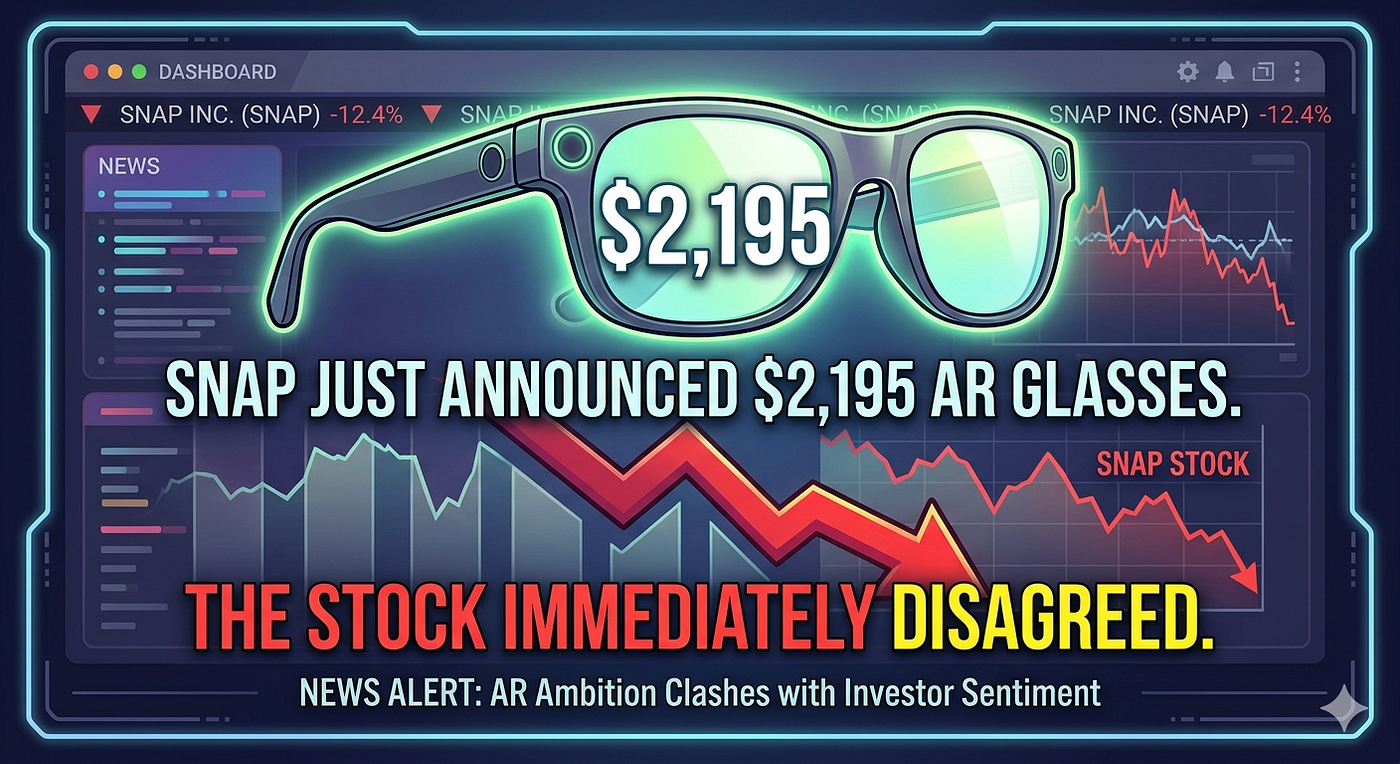
AR AMBITION CLASHES WITH INVESTOR SENTIMENT
Evan Spiegel walked onto the stage at Augmented World Expo in Long Beach, California on June 16th wearing the future — or at least his version of it. He called it “the beginning of a new era in computing.” The market called it something else. SNAP dropped nearly 10% the same day.
That’s the story. But let’s stay with it a little longer.
What Specs Actually Are
Snap’s new AR glasses — simply called Specs — are the company’s first hardware product aimed at the general public rather than developers. Standalone device. No phone tether. No external compute puck. Two Qualcomm Snapdragon chips onboard: one handling computer vision tasks like hand tracking and environment meshing, one running the AR “Lenses.” Electrochromic lenses that go from clear to tinted in 10 seconds. A claimed 7ms motion-to-photon latency — the lowest publicly stated figure for any 6DoF XR product. And about 4 hours of active battery life, with 20 hours total via the bundled case.
Objectively impressive engineering. Genuinely differentiated from the HUD-style smart glasses Meta and Google have been pushing. This is real AR — digital overlays, spatial anchoring, contextual AI assistance via OpenAI and Google partnerships — not a camera and a speaker strapped to a Wayfarer frame.
Snap didn’t build a gimmick. They built something real.
The problem is what they built it for.
The Price Is the Product
$2,195. That number isn’t incidental. It’s the whole argument.
Spiegel’s defense on CNBC was that Specs should be compared to computers, not glasses. That’s fair, technically. It doesn’t matter. The people who use Snapchat are not shopping for a $2,200 wearable computer. They’re teenagers. They’re on Discover. They’re sending streaks. The gap between Snap’s core user base and the buyer profile for a $2,195 piece of hardware is not a gap — it’s a different planet.
For context: Meta’s Ray-Ban Display glasses cost $799. Meta commands roughly 76% of the global smart glasses market. Snap is asking consumers to pay nearly three times more for a product from a company that has lost money every single year it has been publicly traded.
That’s the bet Spiegel is making. It requires a lot of faith he hasn’t earned yet.
The Market Read the Room
SNAP was already in rough shape before Tuesday. The stock had shed approximately 33% year-to-date and nearly 38% over the trailing year. Analysts at JPMorgan had it on Underweight. Citi was Neutral. RBC had slashed its target from $10 to $8.
Then the Specs announcement landed, and the stock fell from $5.86 to a low of $4.83 the following morning — a drop that persisted. Not a single-day overreaction. A verdict.
The social media reception didn’t help. The celebrity marketing campaign featuring Kaia Gerber, Jimmy Butler, and Jack Harlow was supposed to signal aspiration. Instead, the comment sections filled up with people comparing the glasses to IMAX theater 3D goggles. The frame is large. The design is conspicuous. Wearing Specs in public looks exactly like what it is: a first-generation prototype.
The Structural Problem Nobody Wants to Say Out Loud
Snap is not Meta. Snap is not Apple. Snap is not Google.
Those companies can absorb years of hardware losses because they have dominant, cash-generating businesses subsidizing the experiments. Meta’s ad machine funds Reality Labs. Apple’s iPhone margins fund Vision Pro R&D. Google’s search business is effectively a blank check for hardware exploration.
Snap’s core business — digital advertising on a social platform where monetization has always lagged engagement — has never delivered that kind of cushion. Spiegel told Reuters that memory-chip prices have already driven up Specs’ costs. If preorders stay soft, the options narrow fast: find external funding, scale back the product, or kill it.
Snap has been down this road before. The original Spectacles video sunglasses launched in 2016 to enormous hype and generated a $40 million inventory write-down. This is the third attempt at making hardware work. The stakes are higher this time because the ambition is higher, and because the company’s financial runway is thinner.
What Would Have to Be True for This to Work
Specs could succeed. Here’s the scenario where that happens.
Early adopters and developers build a compelling enough Lens ecosystem in the first six months that the product stops looking like a premium toy and starts looking like a platform. Snap uses the Claude Code, Codex, and Cursor developer integrations to actually build that ecosystem fast. Word of mouth among the tech-forward early buyer base drives enough cultural presence that the hardware becomes aspirational in the way Vision Pro was for a brief window. And Snap uses that traction to announce a lower-cost version with a credible timeline — taking the $2,195 positioning from “this is what it costs” to “this is where it started.”
That’s a narrow path. It requires execution Snap has historically struggled to deliver on hardware. And it requires patience from investors who have been waiting for a turnaround for years.
The Bottom Line
Snap built something technically remarkable and priced it for a customer that doesn’t exist in meaningful numbers yet. The $2,195 tag isn’t just a barrier to entry — it’s a statement about who Snap thinks it is versus who it actually is. A company still fighting to turn a profit doesn’t get to reframe itself as a luxury computing platform on the strength of one announcement.
The market understood this in real time. The 10% drop wasn’t an overreaction. It was investors pricing in the gap between Spiegel’s vision and Snap’s balance sheet.
Specs is a genuinely impressive product. It’s also, for now, a product for a future that hasn’t arrived — sold at a price that assumes it already has.
That’s the bet. Time will tell if Snap has the runway to wait it out.
Stackedthoughts covers AI and tech with no filter. If this hit, subscribe and bring a friend.
메타데이터
- post_id
- 2a3550ffd2de
- slug
- snap-just-announced-2-195-ar-glasses-the-stock-immediately-disagreed-2a3550ffd2de
- url
- https://medium.com/@StackedThoughts/snap-just-announced-2-195-ar-glasses-the-stock-immediately-disagreed-2a3550ffd2de
- canonical_url
- https://medium.com/@StackedThoughts/snap-just-announced-2-195-ar-glasses-the-stock-immediately-disagreed-2a3550ffd2de
- author_url
- https://medium.com/@StackedThoughts
- status
- ok
- fetched_at
- 2026-06-22 05:41:33