How a Tree Protection Plan Keeps Development Sites Moving
Trees can add real value to a site. They can strengthen a setting, improve visual appeal and help a scheme feel more established from day…
How a Tree Protection Plan Keeps Development Sites Moving
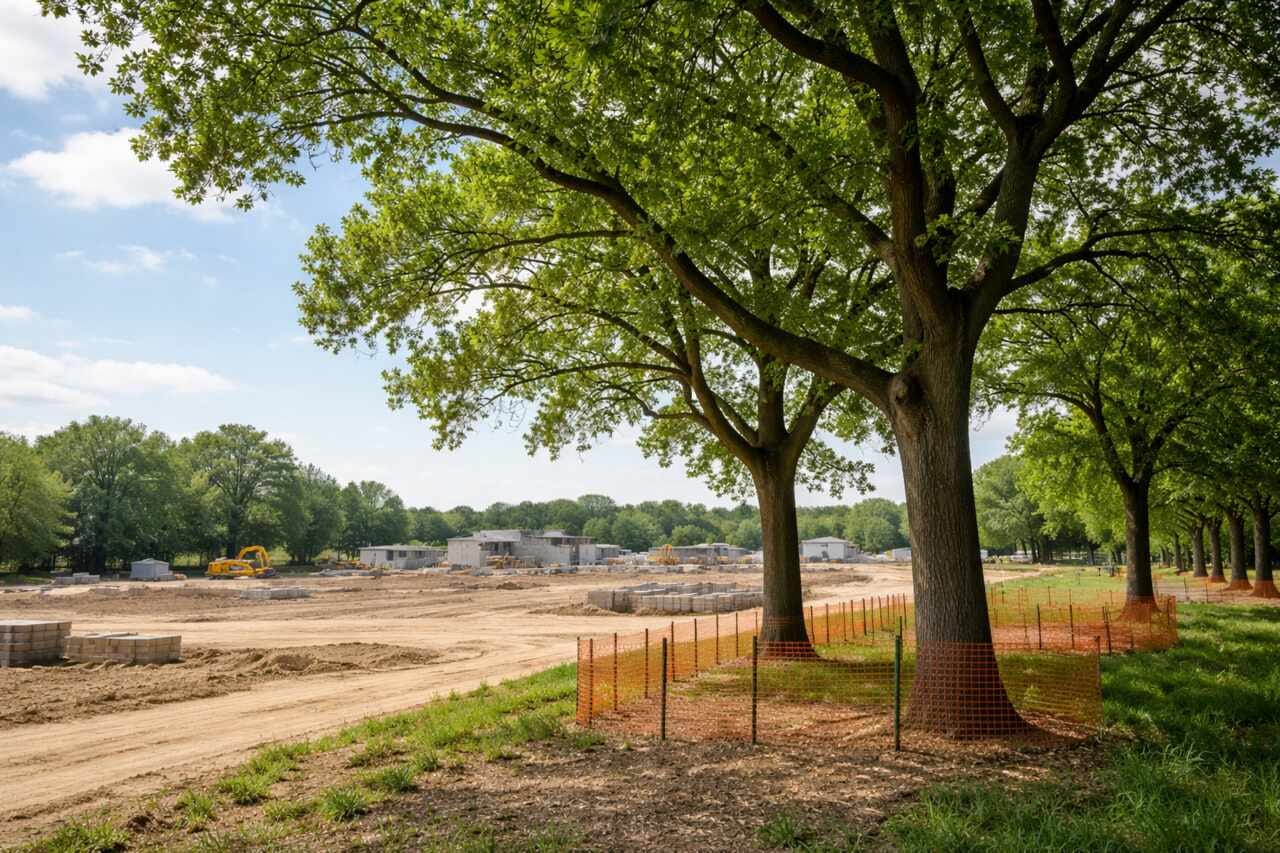
Trees can add real value to a site. They can strengthen a setting, improve visual appeal and help a scheme feel more established from day one. They can also create pressure on design, access and sequencing if they are only considered once layouts are fixed and work is about to start.
That is why a tree protection plan matters so much in practice. It is not simply a drawing for a file. It is one of the clearest ways to turn tree constraints into a workable plan that protects retained trees, supports planning, and gives site teams a practical route forward.
Where tree issues really start
By the time protective fencing is discussed, many of the key decisions have already been made. Access routes may be set. Service corridors may be fixed. Plot positions, compounds and storage areas may already be under pressure. At that stage, tree protection can start to feel like a late obstacle rather than part of a sensible delivery plan.
In reality, most tree-related problems begin much earlier. They start when root protection areas overlap with roads, parking, drainage runs or temporary working space. They start when a retained tree is shown on a plan, but the impact of construction around it has not been fully thought through. They also start when different parts of the project team are working from slightly different assumptions.
A well-prepared **tree protection plan** helps bring those assumptions together. It gives design teams, planners and contractors a shared point of reference before avoidable issues become delays.
What a tree protection plan helps you control
The biggest benefit of a tree protection plan is clarity.
It shows where retained trees need space. It shows where site activity needs to stay out. It also makes it easier to identify where a standard construction approach may not be suitable.
That can help control issues such as:
- accidental root damage during excavation
- pressure from plant movement or storage in sensitive areas
- confusion over where protective fencing should sit
- late changes to access or logistics
- avoidable clashes between the approved design and site reality
This matters because tree damage is not always dramatic or immediate. Compaction, level changes, repeated traffic and poorly controlled storage can all undermine retained trees over time. For a project team, that can create risk long after early site works appear to be complete.
Why early survey information saves time later
The strongest tree protection plans are built on strong site information.
That usually starts with **BS5837 tree surveys**, which help identify tree quality, likely constraints and root protection areas so design teams can make better decisions from the outset.
When survey data is brought in early, it becomes much easier to shape layouts around retained trees in a realistic way. You can review building positions before they harden into a problem. You can assess whether access routes are genuinely workable. You can also spot where demolition, surfacing or service installation may need a more careful method.
That early visibility often saves time later because it reduces uncertainty. Planning officers are less likely to come back with avoidable queries when the supporting tree information is clear. Contractors are less likely to discover on site that the approved arrangement is far harder to deliver than expected.
Stronger planning submissions
A planning submission is usually easier to defend when the tree story makes sense from start to finish.
That means the survey findings, impact assessment, protection details and any method-led recommendations should support each other. If one document says retained trees can be protected, but another leaves obvious questions around access, excavation or construction sequencing, uncertainty creeps in quickly.
This is where proportionate **reporting for planning applications** becomes important. Depending on the site, that may involve a straightforward arboricultural report or a wider package of survey, impact and protection information.
A good submission does not just identify constraints. It shows that the project team understands them and has a practical response. That gives decision-makers more confidence and usually makes life easier for everyone once conditions need to be discharged and works are ready to begin.
When root uncertainty threatens the programme
Some sites are fairly straightforward. Others are much tighter.
You may have retained trees close to proposed services. You may be dealing with access pressure around existing infrastructure. You may need more confidence about where roots are likely to be before finalising routes, levels or construction details.
That is where **tree radar surveys** can be useful. On constrained sites, that extra evidence can help refine service routes, test assumptions and reduce unnecessary redesign.
This kind of investigation is especially valuable when broad caution alone is not enough to keep a project moving. Better information leads to better decisions. In some cases, it can also show that a workable solution is available without taking unnecessary risk with retained trees.
What practical tree protection looks like on a live site
A tree protection plan only delivers value if it works on the ground as well as on the drawing.
That usually means translating the plan into simple, visible controls that site teams can follow from the start. On a live project, the essentials often include:
- Protective fencing installed in the right place before works begin Barriers need to be clear, robust and set out early, not moved around once traffic patterns start to develop.
- Protected areas kept free from storage and mixing Root protection areas can be damaged by routine site habits just as easily as by excavation.
- Access routes agreed before mobilisation It is far easier to prevent conflict than to manage it after compounds, welfare and deliveries are already in motion.
- Method-led working near retained trees Where construction has to happen close to sensitive areas, a plan on its own may not be enough.
- Briefing and oversight Even a good drawing can fail if the people on site do not know what it means in practice.
This is one reason BS5837 remains so important. It provides a framework for considering trees and development together through design, demolition and construction, rather than as separate issues.
Common questions that delay decisions
Do all sites with trees need a tree protection plan?
No. The level of arboricultural input should match the site and the likely impact of the works. But where retained trees sit close to the proposed development, protection details are far more likely to be needed.
Is a tree protection plan the same as a tree survey?
No. A survey records and assesses the trees. The protection plan shows how retained trees will be safeguarded during demolition and construction. They are connected, but they do different jobs.
What if a project needs to work close to retained trees?
That is often where an arboricultural method statement becomes important. The plan shows where protection sits. The method statement explains how specific works will be carried out without causing avoidable damage.
Can protection requirements change once work starts?
They can, but late changes are rarely ideal. If access, storage or construction sequencing have not been properly resolved before mobilisation, the project can lose time very quickly.
What if trees are protected by a TPO or sit in a conservation area?
That needs checking early. Work to protected trees may require consent or formal notice, and those requirements are best understood before the programme is tight and site logistics are already under strain. Planning decisions should also avoid unnecessary harm to ancient and veteran trees, including root and soil disturbance during construction.
Practical arboriculture support makes compliance easier
Tree protection works best when it is tied into the wider delivery of a project, not treated as a standalone drawing.
That is why early **arboriculture** input can make such a difference. For projects involving retained trees, that can include early survey advice, planning reports, method statements, root investigation and practical site-stage guidance.
The real value is not simply in identifying constraints. It is in helping teams move from constraint to solution with fewer surprises along the way.
At Great Oaks, we understand that tree issues are rarely just about trees. They affect design, compliance, sequencing, site access and programme confidence. Our role is to help make those moving parts easier to manage with practical advice that works in the real world.
A clearer route from planning to construction
A tree protection plan is most useful when it is seen for what it really is. Not a late drawing. Not a formality. A tool for keeping a project coordinated, compliant and buildable while protecting trees that are meant to stay.
When that process starts early, the benefits tend to follow all the way through the job. Fewer redesign loops. Clearer communication. Better protection on site. More confidence that retained trees and project delivery can work together.
If your site needs practical tree advice, Great Oaks can help with surveys, planning support, root investigations and arboricultural input that works in the real world. **Speak to Great Oaks** before tree constraints start slowing the job down.
메타데이터
- post_id
- 2a577a66f04d
- slug
- how-a-tree-protection-plan-keeps-development-sites-moving-2a577a66f04d
- url
- https://medium.com/@greatoaks/how-a-tree-protection-plan-keeps-development-sites-moving-2a577a66f04d
- canonical_url
- https://medium.com/@greatoaks/how-a-tree-protection-plan-keeps-development-sites-moving-2a577a66f04d
- author_url
- https://medium.com/@greatoaks
- status
- ok
- fetched_at
- 2026-07-17 23:16:01