Estrangement Is Trending — Oprah Avoided Parental Alienation
Recently, Oprah Winfrey hosted a podcast about the “epidemic” of family estrangement. First, Oprah isn’t neutral, she is an estranged…
Estrangement Is Trending — Oprah Avoided Parental Alienation
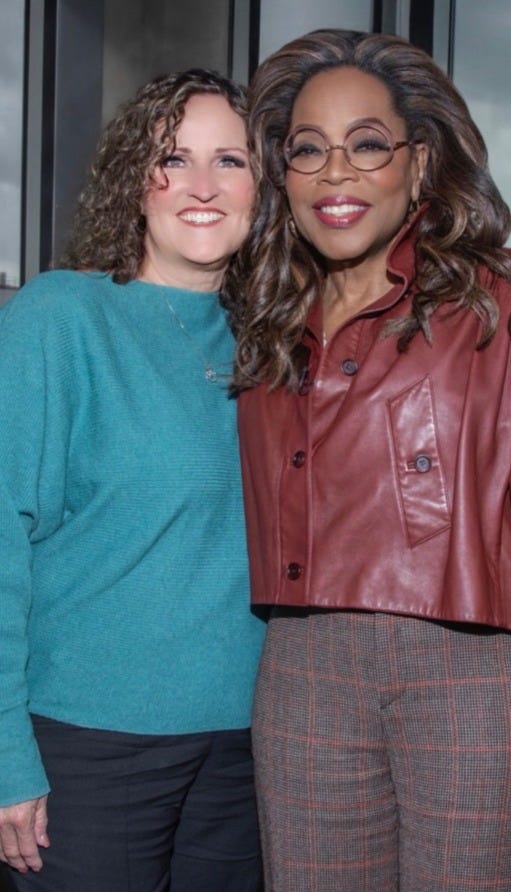
Christy aka CurlyGirlDreams from TikTok took a chance on being on a podcast. She’s not making money off her status as an estranged mom. She’s not selling coaching. She doesn’t have a course. She isn’t a therapist. She’s just a mom who misses her daughter. The amount of hate, total character assassination, and out right assumptions on her character in the social media aftermath have been nothing short of WILD. She’s the only actual estranged parent to appear on the podcast, as Aaron is reunited with his daughter, and Kendall chose to estrange from her son due to safety concerns. Christy talked about loving her daughter, her daughter’s humor, her personality, a ton of favorable aspects about her daughter. And yet, the “nurse,” and I use the term loosely, rolled her eyes at Christy, as she was talking. Oprah’s producers chose to leave that in the podcast — if it bleeds, it leads. In fact, when Kendall spoke, she asked why it was okay for Christy to be treated so disrespectfully and no one said a thing about it. But let’s remember, Oprah isn’t actually trying to fix anything, she’s simply creating rage bait for the trend — that supposedly isn’t “trending.”
Recently, Oprah Winfrey hosted a podcast about the “epidemic” of family estrangement. First, Oprah isn’t neutral, she is an estranged daughter herself, which no one is mentioning. Or at least very few. She didn’t mention it at all during the podcast, but Oprah did use her “friends” story to showcase why she thinks this podcast makes sense to showcase now. I call it stirring a very large pot of rage while pretending to give a crap.
Estranged Talking Points
One of the first talking points you will get from estranged adults is that estrangement is not a trend, it’s always existed. That’s correct. But it actually started “trending” when social media got involved — you have to know the difference between a short-term trend and the term trending for this to make sense.
But where did it start?
In the 1970s-80s therapists started encouraging patients to cut off family members. This is a small sampling and has to be viewed through the cultural norms of the different eras. I doubt the these therapists thought that their ideas would not only survive this long but that their ideas would embolden future generations to completely destroy families.
- Saul B. Newton — controversial psychotherapist, leader of “The Fourth Wall” therapy group (active especially in the 1970s–1980s). Former patients say Newton encouraged many to sever ties with their biological families. Wikipedia
- Arthur Janov — creator of “Primal Therapy,” popular in the 1970s–80s. While Janov didn’t explicitly promote “no contact,” his work emphasized uncovering deep, repressed childhood trauma. That kind of therapy — when unleashed without nuance — often encourages extreme emotional distancing, potentially giving people a rationale to cut family ties. Wikipedia+1
- Ivan Boszormenyi-Nagy and James L. Framo — foundational family therapists whose work from the 1960s onward shaped “family‑of‑origin” therapy. Their frameworks emphasized intergenerational dysfunction and the lifelong impact of family-of-origin trauma. While they didn’t call for “no contact,” their theories seeded the idea that one’s biological family might be a source of harm — making cutting ties more psychologically defensible.
The books they produced, similar to the modern book Children of Emotionally Immature Parents, were left for people to interpret alone — which meant that nuanced ideas about emotional boundaries were often flattened into black-and-white judgments, with estrangement treated as a cure-all rather than a last resort. {I will tackle the author of the book above, who was also on Oprah, in a different post}
Examples include:
The Primal Scream (1970) by Arthur Janov. A foundational text of “primal therapy.” Janov argues that neuroses stem from repressed childhood pain and that reliving early trauma — often viscerally — is needed for healing. Wikipedia Some therapists inspired by its popularity reportedly used its logic to justify radical cuts or emotional distance from one’s family — especially if the childhood environment was perceived as “traumatizing.”
Families and How to Survive Them (1983) by Robin Skynner and John Cleese. Written as a conversational guide to family dynamics and dysfunction. It walks through adult development, childhood wounds, and how family-of-origin pain often plays out in adult relationships — giving readers (lay or not) a lens to view parents as less-than-ideal, sometimes dangerously so. Wikipedia
The Family Crucible (1978) by Augustus Napier and Carl Whitaker. A classic work in family systems therapy. It explores how conflict, scapegoating, family roles, and intergenerational dysfunction operate in “normal” families — often making the case that simply staying embedded in those systems can perpetuate trauma. guidetoselfhelpbooks.com+1
Treating Family of Origin Problems: A Cognitive Approach (1994 — but rooted in earlier family-of-origin work) by Richard C. Bedrosian and George D. Bozicas. While slightly newer, this book adapts older family‑of-origin therapy ideas into structured, cognitive‑therapy approaches. It shows how “dysfunctional family background” can be treated — and how some therapy frameworks began pathologizing family roots in a way that could justify cutting ties depending on the client’s interpretation. Google Books+1
Why Bring Up Ancient History?
Because that’s exactly where the seeds of this so-called “trend” were first planted.
Long before TikTok therapists and #NoContact influencers turned cutting off your family into a self-care aesthetic, early psychologists and theorists were already questioning the sacredness of family bonds. Books in the ’70s and ’80s inserted the idea, “Maybe your parents screwed you up,” and people ate it up — hell yeah, it’s not MY fault I don’t have the life I want, it’s my parent’s fault.
Fast forward a few decades, and every therapist looking for a TEDx invite or book deal added their own spin to the “cut your parents off” party.
By the early 2000s, the shelves were full — emotionally immature parents, narcissistic mothers, boundary-violating fathers. Take your pick.
Then came COVID.
Add global isolation, a massive surge in therapy language online, and a wave of emotionally avoidant adults looking for an easy villain . . . and you’ve got the last 5–10 years of “to hell with them” content clogging every feed and group chat. Entire relationships dissolved between WiFi connections and therapy buzzwords — no reconciliation, no questions, just ghosting with a hot, steaming side dish of moral superiority.
On TikTok, “no-contact” videos rack up millions of views. On Reddit, r/estrangedAdultChild has over 40,000 members. On Instagram, therapists and coaches post stylish infographics about boundaries, narcissistic parents, and why cutting ties is “self-care.”
When the entire conversation focuses only on the leaving… and never on the why… we miss the point. And I never see any therapists talking about reconciliation. In fact, I asked (specifically) multiple young, female therapists on TikTok what their plans were for their clients who want reconciliation and three different therapists said that was not their goal. Their goal was for their clients to remain in a no contact status, which is wildly bizarre and unethical, to me.
Many people are finally finding the strength to walk away from genuinely toxic, abusive, or harmful family dynamics.
But the deeper issue is that people who go no contact for ridiculous reasons actually take away from people who go no contact for actual safety reasons. Others are walking away from relationships that never needed to be severed — because of distorted narratives, therapist overreach, social media influence, or parental alienation.
And guess which one never gets talked about?
Parental Alienation (P.A.) — the subject even Oprah avoided

Not every “toxic parent” label comes from direct experience. Some of it is inherited — not genetically, but emotionally transferred. Parental alienation happens when one parent (grandparent, sibling, spouse) manipulates, influences, or pressures a child/adult to reject a family member — often without cause.
It can sound like:
- “Your mom always cared more about herself.”
- “You were abused, your childhood wasn’t normal.”
- “Do you want your kids to be like your mom/dad?”
- “Your dad only pretends to love you when people are watching.”
- “She’s jealous of your success.”
- “You’re a better mom than she ever was.”
- “He/she left us, remember?” (even when it’s not true)
And over time, it works. It rewires the the brain’s loyalty. It re-codes memories. It plants doubt, fear, and false protection.
It turns a child/adult into a mirror of the alienator — and a hate starts to fester. Once that hate starts fermenting there is almost no turning back.
But alienation is hard to define. It’s subtle. It’s not visible to the naked eye, so it’s not like a beat-down with bruises. And because it deals in “emotions” and “memories,” it’s easy for people — even therapists and judges — to dismiss it as unprovable.
So it keeps getting ignored.
Even by Oprah.
P.A. starts small. Even a single comment can derail the strongest of kids — especially during formative years and/or a divorce. A subtle suggestion that a beloved parent is a liar, a cheater, or even worse a pedophile. The targeted parent often never sees it coming because the parent doing the alienating started it very early on in the relationship and tells the child one thing and the other parent another.
I’ll give you an example. We’ll call the mom Salty Daws — mom has a male spouse we’ll call Mr. Daws. Early on in the marriage Mrs. Daws realizes that Mr. Daws is actually quite homophobic. She doesn’t think much of it, their kids are young, no worries.
Until their kids aren’t young and one of the Mini Daws comes out as gay. Now Mrs. Daws has a dilemma on her hands because Mr. Daws doesn’t like gay people and now one of their children is that gay person.
Mr. Daws, however, says one thing to the child and another to the spouse — consistently, implying to Mini Daws that mom doesn’t like gay people and implying to Mrs. Daws that he doesn’t like gay people. Now he has transferred his homophobia to Mrs. Daws with a snap of his fingers.
So, the Mini Daws thinks, “Oh man, mom doesn’t like gay people,” when it’s really dad that doesn’t like gay people. OR — wait for it, was Mr. Daws just creating a dynamic to foster division and competition and he really couldn’t care less one way or another?
Now Mini Daws is not talking to Mrs. Daws because Mini Daws believes the alienating parents’ lies. Mini Daws has put aside decades of knowing, loving, and understanding Mrs. Daws until divorce hits and Mr. Daws now parentifies Mini Daws and Mini Daws is none-the-wiser.
I know — that sounds far fetched and convoluted doesn’t it? I understand. I’ve lived it.
I believed my mom who said my real dad [I’m a 57-year-old woman who still refers to her dad as her “real dad” — that’s how deep the conditioning is] — I believed my dad was just lazy and didn’t want to work.
My dad said he had a back operation and was disabled. I believed my mom, your dad is just lazy.
Fast forward about four decades or so, and dad died. I had to go through his things. I found an X-ray from the 1970’s of my dad’s back with six HUGE — and I mean HUGE — screws in his spine, holding it together. Mind blown.
That’s the power of loving and believing in a parent who chooses to use you as a weapon instead of loving you enough to let you foster your own opinions of the other parent.
Back to P.A. — the alienating comments don’t even have to be huge — subtle eye rolls, demeaning comments, questions without answers [I wonder why your mom/dad isn’t answering her/his phone] inserts the doubt needed for a child to start to question a parent he or she loves.
To dive into all the signs and symptoms of P.A. would take a book, much more than this article is ready to handle. But here is the ultimate goal and it doesn’t take as much as you think it ought to.
“This person isn’t safe. This person never loved you the right way. This person doesn’t deserve access to you.”
And once that belief sets in, memory bends to serve it. In the 1980s and early ’90s, the U.S. lived through the “Satanic Panic,” a moral wildfire fueled by therapists who believed they were helping children “recover” buried memories of abuse. Instead, many of those memories were created — shaped by leading questions, suggestive therapy sessions, and cultural hysteria. Entire daycare's were accused of pedophilia and ritual abuse based on stories that were later proven impossible, fabricated, or implanted.
It was one of the clearest historical examples of how easily a mind — especially a child’s — can be guided into believing something that never happened.
And if whole communities could be convinced their daycare workers were part of secret cults, it’s not hard to understand how a single parent can engineer an alienated child’s “memories,” too.
That is the dark magic of alienation.
Hella poor reporting on Oprah’s part to leave out an entire segment of the estrangement community — right?
When Alienation Meets Therapy Culture
There’s a troubling overlap happening right now:
- A child who was fed lies about a parent
- Sees trauma-informed content online
- Starts connecting dots that were planted by someone else
- Then gets validated by a therapist who only hears one side
Boom: Estrangement sealed.
It’s not just the manipulative parent.
It’s the culture — the algorithms, the echo chambers, the therapists who don’t dig deeper or are just grown estranged kids themselves, and the tone-deaf content creators who say “cut off anyone who doesn’t make you feel good.”
No one ever asks, “Whose feelings are you basing this on?”
11 Questions to Ask Before You Call It Estrangement
If you’ve been estranged — or are considering it — ask yourself:
- Who first told me that this person was unsafe or harmful?
- When did I stop loving the target parent? Why?
- Do I have an actual example of dangerous behavior to base my choices on?
- Have I seen the actions myself or are they “memories?”
- Do I remember actual moments of harm — or just a feeling that I was “supposed” to be angry?
- Did the narrative change after a divorce, custody battle, or family fallout?
- Is it just habit or a competition at this point?
- Where did my empathy go for the other parent?
- Why do I have more empathy for complete strangers than I do for a person who raised me and loved me and in some cases grew me in their own damn body?
- Have I ever spoken directly to the parent I cut off — as an adult — without someone else interpreting their actions for me?
- Do I feel more like myself since the estrangement… or more like someone else’s version of me?
About the Author
MaryAnna Clemons is a writer, intuitive, and an outspoken voice on estrangement, alienation, and emotional recovery.
ParentalAlienation #Estrangement #FamilyEstrangement #NoContactCulture #TherapyCulture #MediumParenting #AlienationAwareness #DramaDetox
메타데이터
- post_id
- 2a57daad77ee
- slug
- estrangement-is-trending-oprah-avoided-parental-alienation-2a57daad77ee
- url
- https://medium.com/@maryannaclemons/estrangement-is-trending-oprah-avoided-parental-alienation-2a57daad77ee
- canonical_url
- https://medium.com/@maryannaclemons/estrangement-is-trending-oprah-avoided-parental-alienation-2a57daad77ee
- author_url
- https://medium.com/@maryannaclemons
- status
- ok
- fetched_at
- 2026-06-27 07:40:21




