Why Queue Saturation Quietly Breaks Blockchain Production Systems
Most blockchain production failures do not begin with dramatic outages.
Why Queue Saturation Quietly Breaks Blockchain Production Systems
Most blockchain production failures do not begin with dramatic outages.
They begin with systems slowly losing the ability to keep up.
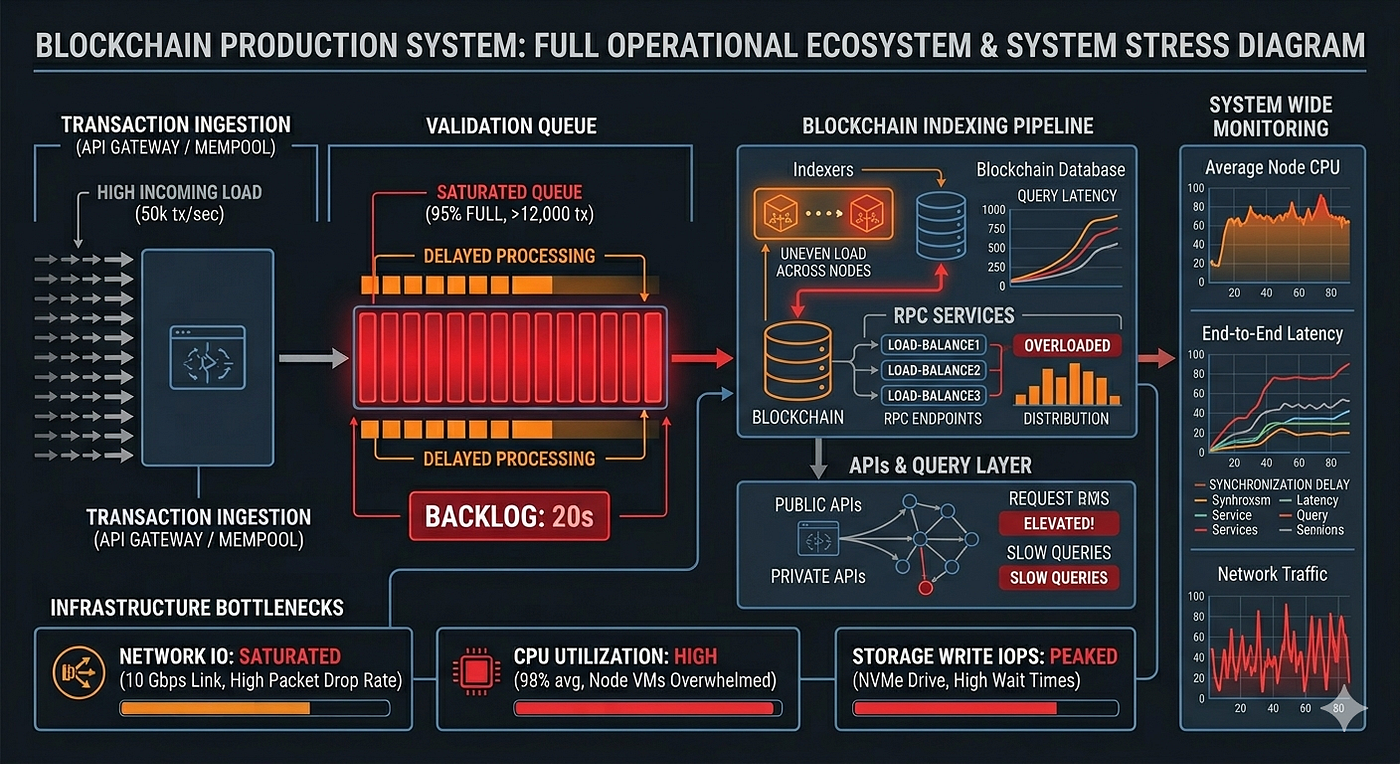
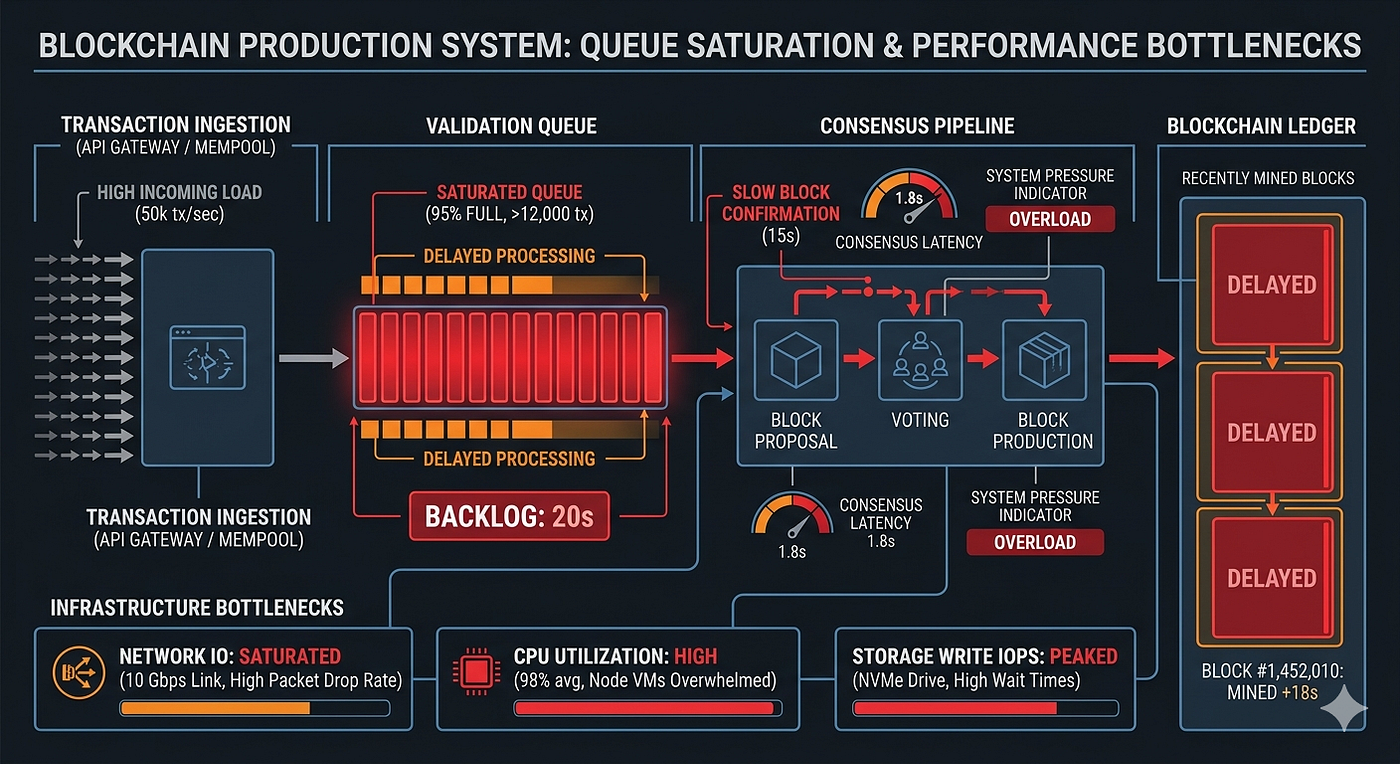
One of the most overlooked causes of this degradation is queue saturation — a condition where internal workloads accumulate faster than the system can process them.
At first, everything still appears operational. Requests succeed. Services stay online. Dashboards remain green.
But internally, the system is already moving toward instability.
Queues Exist Everywhere in Production Systems
Modern blockchain infrastructure depends on queues far more than most teams realize.
They exist between:
- RPC ingestion layers
- indexing pipelines
- sequencing systems
- event processors
- retry handlers
- state synchronization services
Under normal traffic, queues absorb temporary spikes and smooth workload distribution.
The problem begins when incoming demand consistently exceeds processing capacity.
Saturation Happens Gradually
Queue failures are dangerous because they rarely fail immediately.
Instead:
- queue depth slowly increases
- processing delay compounds over time
- retries amplify load further
- dependent services drift behind state
The system may continue functioning for hours before users notice visible symptoms.
This delay creates a false sense of operational stability.
Why Horizontal Scaling Often Fails
A common reaction to queue pressure is adding more workers.
Sometimes this helps temporarily. In many production environments, it introduces new problems:
- database contention
- lock amplification
- increased retry traffic
- coordination overhead
- uneven workload distribution
Without understanding the true bottleneck, scaling workers simply shifts pressure elsewhere.
Backpressure Without Visibility Is Dangerous
Production systems need explicit mechanisms for slowing traffic before instability spreads.
Without proper backpressure:
- queues become unbounded
- retries accumulate aggressively
- dependent systems collapse together
Teams often discover saturation only after downstream failures begin surfacing across the stack.
At that stage, recovery becomes much harder.
Operational Stability Depends on Predictable Failure Modes
Healthy systems are not systems that never experience pressure.
They are systems that:
- degrade predictably
- surface overload clearly
- preserve recovery paths
- prevent uncontrolled queue growth
This requires treating queue behavior as a first-class production concern rather than a background implementation detail.
Why Queue Saturation Matters in Blockchain Infrastructure
Blockchain systems are especially vulnerable because many workloads depend on ordered processing:
- block ingestion
- state transitions
- event indexing
- transaction sequencing
Once queues drift significantly behind, restoring consistency becomes operationally expensive.
In severe cases, systems recover slower than traffic accumulates.
The Bigger Production Lesson
Queue saturation is rarely an isolated issue.
It usually exposes deeper architectural problems:
- hidden coupling between services
- weak observability
- unbounded retry logic
- unrealistic throughput assumptions
Understanding these patterns is critical for building production systems that remain stable under real-world growth.
Peesh Chopra: Technical Realities of Blockchain Production https://medium.com/@cryptodevpeeshchopra/peesh-chopra-technical-realities-blockchain-production-f63480383548
메타데이터
- post_id
- 2a612668697c
- slug
- peesh-chopra-queue-saturation-blockchain-production-2a612668697c
- url
- https://medium.com/@cryptodevpeeshchopra/peesh-chopra-queue-saturation-blockchain-production-2a612668697c
- canonical_url
- https://medium.com/@cryptodevpeeshchopra/peesh-chopra-queue-saturation-blockchain-production-2a612668697c
- author_url
- https://medium.com/@cryptodevpeeshchopra
- status
- ok
- fetched_at
- 2026-06-09 14:34:10