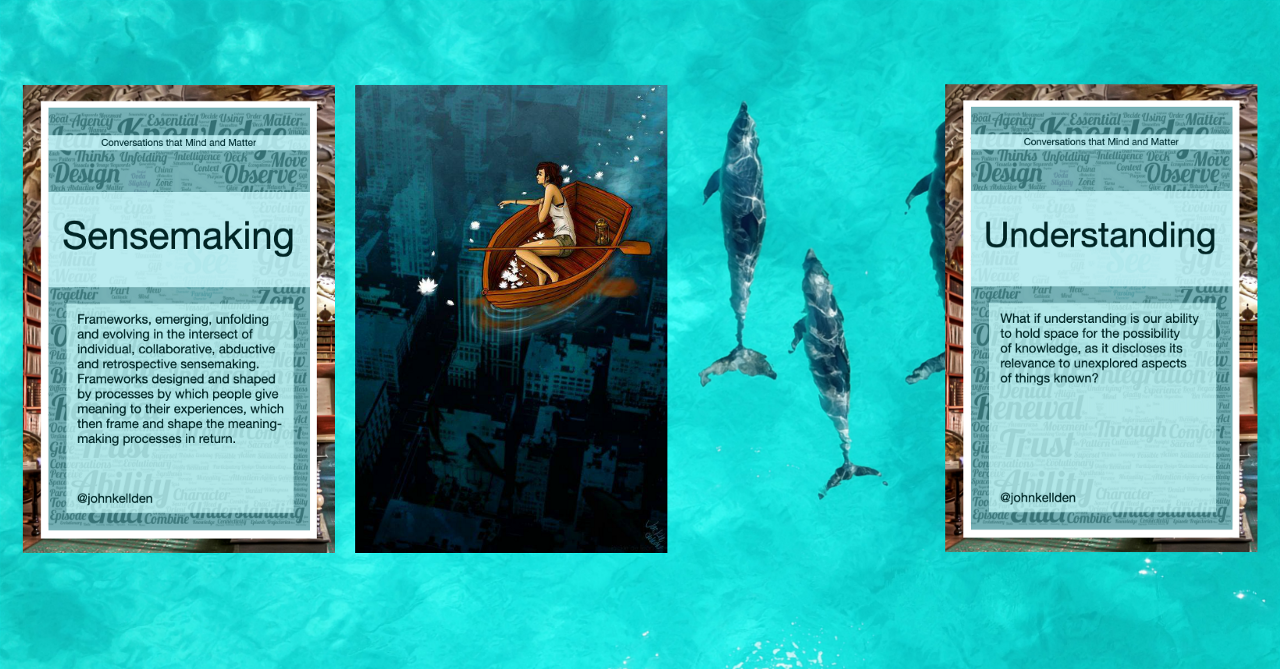
Playⁿ: Story
Two Cards as a Spark of Meaningful Fun
Playⁿ: Story
Two Cards as a Spark of Meaningful Fun
In the brain, a thought is a spark. In Playⁿ, a move is a spark between two cards. In Winⁿ, success is rediscovering meaningful fun between narratives.
This is my story:
— We made it? — What happened? — We happened.
Let’s see if we can enter Gameⁿ and play your story …
Gameⁿ: A Ten Minute Session Questions; cards addressing them; one minute for each turn; jot down thoughts; card-play conversation turned question and cards into story.
Playⁿ can be explained as a framework, a practice, a coherence engine, a grammar, a card system, a cultural technology, a gameboard, a memory architecture, or a living grammar for thinking together under complexity.
All of that is true. But if we stop there, don’t play, don’t pick any cards, don’t co-create our seed stories, we may miss something essential.
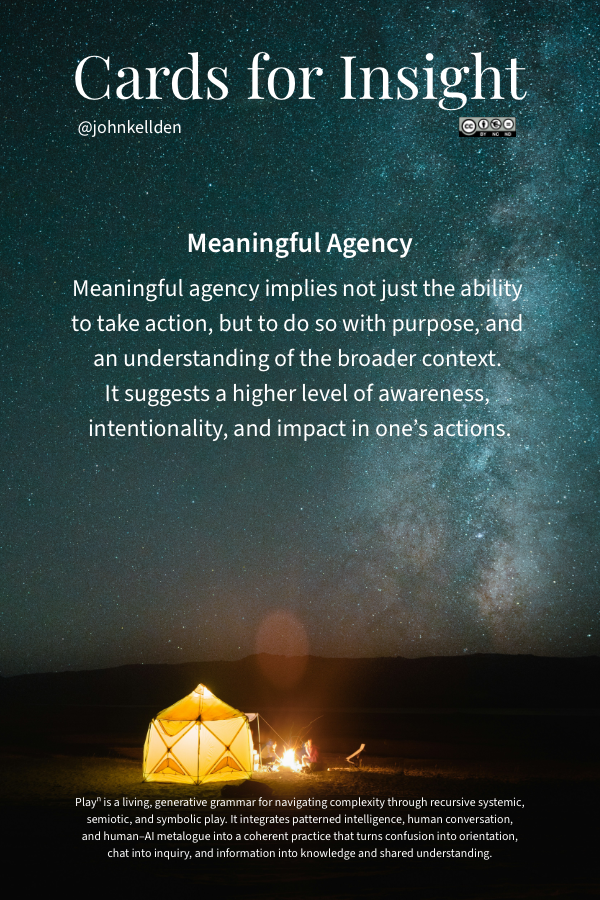
Meaningful Agency, one the 504 cards in the Playⁿ Source Deck.
Card: Meaningful Agency Meaningful agency implies not just the ability to take action, but to do so with purpose, and an understanding of the broader context. It suggests a higher level of awareness, intentionality, and impact in one’s actions.
Playⁿ is fun. Deep, meaningful, relational meaning-making fun.
Not shallow fun. Not distraction-fun. Not platform dopamine. Not the little twitch of a like button, the little glow of being seen by the algorithm, the little imitation of participation that disappears almost as quickly as it arrives.
A deeper fun. The fun of meaning beginning to move again. The fun of seeing a card and feeling, strangely, that it has named something you were living but could not yet say.
Gameⁿ: A Ten Minute Session Questions; cards addressing them; one minute for each turn; jot down thoughts; card-play conversation turned question and cards into story.
The fun of placing two cards beside one another and watching a spark appear between them.
The fun of discovering that a conversation does not have to collapse into opinion, performance, argument, or exhaustion.
The fun of realizing that complexity may not be simple, but it can become playable.
This is the hidden spark, movement and music of Playⁿ.
“Go, take your sister then by the hand Lead her away from this foreign land Far away, where we might laugh again We are leaving, you don’t need us” — CSN
It is not the music of escape. It is the music of participation.
A question gathers. A card opens. A second card tensions the first. A story begins. A small move becomes possible.
And somewhere, quietly, someone who had been scrolling through noise pauses long enough to ask:
What story do I want to weave?
That is where Playⁿ begins.
1. Aria Finds the First Spark
Imagine Aria.
Not as a demographic. Not as a user persona. Not as a customer segment.
As a person.
She is tired. Not ruined. Not hopeless. But tired in the way many people are tired now: saturated by content, surrounded by platforms, half-informed, over-exposed, under-nourished, carrying a private sense that the world is both too much and not enough.
On a whim, she browses the Playⁿ website. She notices a card:
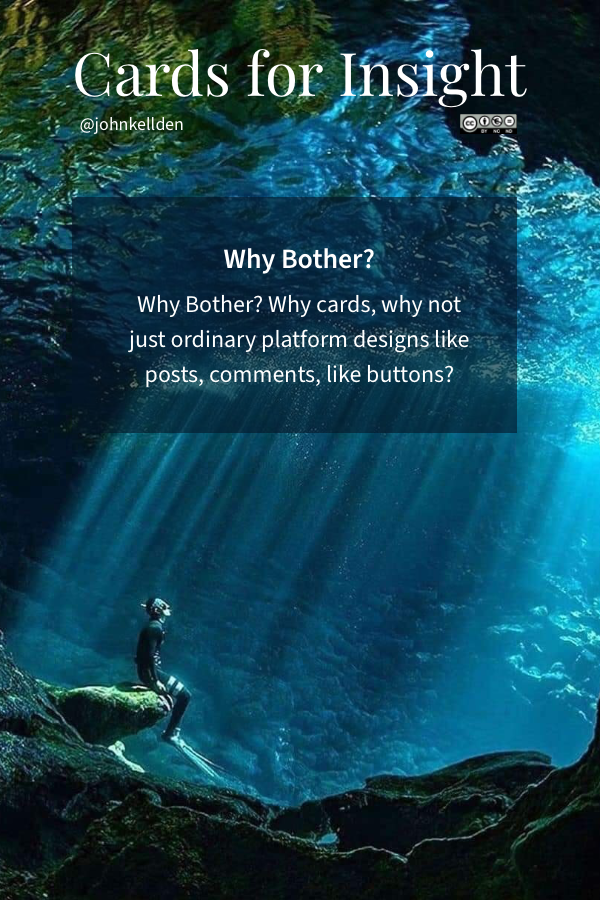
Why Bother, one the 504 cards in the Playⁿ Source Deck.
Why Bother
At first, she laughs. Why bother, indeed? It sounds like a joke. Or a dare. Or the title of the thought that visits her when she is too tired to pretend that everything is fine.
Card: Why Bother? Why Bother? Why cards, why not just ordinary platform designs like posts, comments, like buttons?
But curiosity gets the better of her. She clicks the Why and How related to the card:
Why Bother Why: Traditional platforms prioritize reactions and surface-level interaction. Playⁿ, on the other hand, prioritizes deep engagement, layered discovery, and collective meaning-making. The card format helps slow down and organize thought in ways posts and comments don’t, encouraging more reflective and purposeful interactions.
How: With cards, you engage in guided conversation, fostering richer discussions and uncovering deeper insights than typical social media interactions.
She keeps reading and reflecting. The card does not scold her. It does not pitch her. It does not demand engagement. It does not ask her to optimize herself, subscribe to a worldview, or become productive in a more enlightened way.
It simply opens a small space. And beneath it, she sees another card:
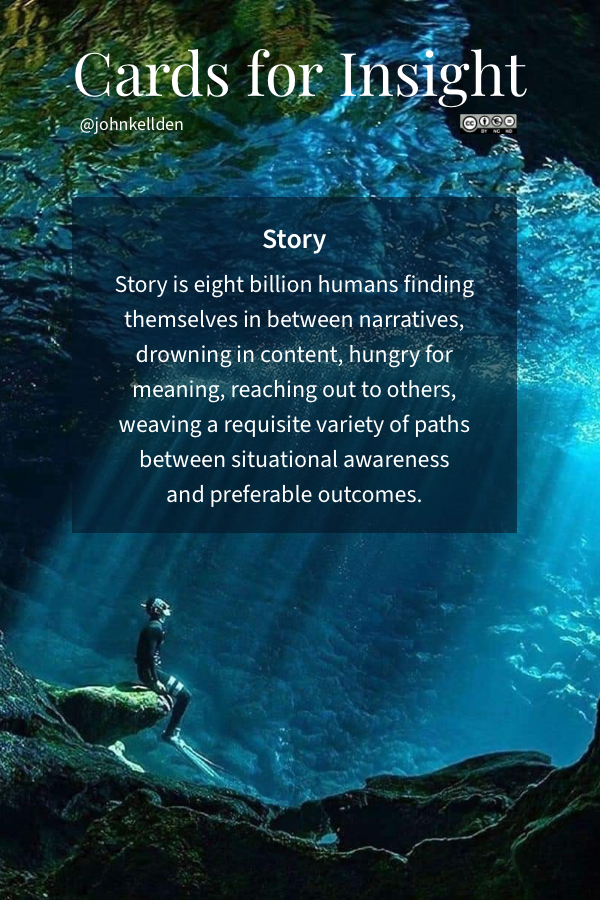
Story, one the 504 cards in the Playⁿ Source Deck.
Story
The card reads:
Story is eight billion humans finding themselves in between narratives, drowning in content, hungry for meaning, reaching out to others, weaving a requisite variety of paths between situational awareness and preferable outcomes.
She reads it once. Then again. Then she stops. Something in the card has named her situation without accusing her.
Between narratives.
There it is. That is where she is.
Between the story she used to believe — that the world made sense, that decency would carry her, that institutions were flawed but basically oriented toward something human — and the story she is now expected to believe: that everything is chaos, cynicism, algorithms, collapse, branding, extraction, noise.
The card does not deny the immersion, the flood, the drowning. But it also does not end there.
It says: hungry for meaning. It says: reaching out. It says: weaving.
Such a small word:
Weaving does not force. It does not conquer. It does not solve everything at once. It suggests patience, craft, relation, texture, time.
And for the first time in a while, not knowing does not feel like failure. It feels like the beginning of a question.
Aria whispers to herself:
What story do I want to weave?
Then something even smaller, even more important, happens.
She thinks:
I should reach out to Jules and Kai.
That is the first move.
Not a manifesto. Not a life overhaul. Not a brand new identity.
A small move toward others. Gathering around a question. The game has begun.
2. Two Cards as a Spark
A single card can open a perspective. But two cards can create a spark.
The first card, Why Bother, meets Aria where she is: skeptical, tired, amused, defensive, half-curious.
The second card, Story, opens the field. It gives her a way to see her condition as something larger than private malaise.
Together, they create a hinge:
Why bother? Because story is still being woven.
Or:
Why bother? Because eight billion humans are between narratives, drowning in content, hungry for meaning, and reaching out.
Or:
Why bother? Because the next story will not weave itself.
This is the deep fun of two cards.
They do not simply add meanings together. They create relation.
relational meaning-making
One card asks from within fatigue. The other answers from within possibility.
One card touches the personal ken comfort zone. The other opens the adjacent possible.
One card gives permission to doubt. The other gives permission to begin.
That spark is not accidental. It is one of the most important kinds of Playⁿ fun.
Not fun as amusement only.
Fun as the sudden liveliness of relation.
A card becomes more interesting when another card changes what it can mean.
3. Does It Have to Be Cards?
The Smallest Possible Vessel of Meaningful Fun
At some point, someone will ask:
Does it have to be cards?
It is a fair question.
If Playⁿ is about inquiry, conversation, coherence, meaning-making, and small moves, could the cards be replaced by something else? Could we use prompts, essays, sticky notes, digital tiles, gestures, images, AI-generated themes, musical tones, diagrams, or open conversation?
The short answer is:
Not necessarily physical cards. But something must perform the card function.
And the card function is not superficial.
Cards are not decorative props. They are not gamified packaging. They are not content objects pretending to be profound.
In Playⁿ, cards are the minimal playable units of generativity.
The Four Card-Functions They do four things at once.
First, a card is a bounded infinity device. It is finite, nameable, indexable, and holdable. Yet it becomes generative through combination, placement, conversation, and return. One card opens a perspective. Two cards create a spark. Three cards form a field. Eight cards can gather around a GCQ on the 3x3 gameboard. The card is small, but its possible relations are vast.
Second, a card is a semiotic capsule. It holds a word, phrase, image, or fragment of meaning without exhausting it. It anchors attention without freezing interpretation. A good card does not tell the group what to think. It creates a shared sign around which thinking can begin.
Third, a card is an attention scaffold. It externalizes thought. It lets people think with their eyes, hands, voices, and one another. It gives the group something outside any one person’s head to gather around. This matters because much of conversation fails not from lack of intelligence, but from lack of shared attention.
Fourth, a card is a field activator. Placed between people, it becomes a neutral attractor. No one owns it. Everyone can respond to it. It can invite agreement, disagreement, story, metaphor, memory, humor, resistance, and curiosity. It stabilizes difference long enough for meaning to move.
This is why cards matter.
They make complexity tangible without reducing it. They make inquiry playful without trivializing it. They make conversation structured without controlling it. They make meaning portable without making it fixed.
So, yes, in one sense:
It has to be cards.
Not because of subjective preference. Not because of card-development sunk cost. Not because paper objects are inherently superior. Not because Playⁿ cannot one day include digital tiles, app objects, diagrams, gestures, or AI-supported symbolic forms.
It has to be cards because of function.
Any alternative would still need to be card-like:
- modular,
- symbolic,
- bounded,
- playable,
- combinable,
- iterable,
- shareable,
- and capable of activating a field.
Without that, Playⁿ loses its smallest unit of meaningful play.
It becomes talk.
Perhaps very good talk. Perhaps insightful talk. Perhaps even beautiful talk.
But not the same thing.
The card is not the content. It is the condition for generativity.
It is not the answer. It is the architecture of inquiry.
Playⁿ uses cards not to simplify complexity, but to ritualize complexity — to make it tangible, engaging, iterable, combinable, and playable.
This is where the deep fun begins.
A card is small enough to enter lightly. Large enough to carry pattern. Neutral enough to host difference. Precise enough to gather attention. Open enough to invite surprise.
That is why a card can feel like a toy, a key, a mirror, a seed, a threshold, and a move — all at once.
4. The Card as Conversational Gene
Card-play conversation can be seen, experienced and understood as the lyrics to the Playⁿ music.
A deeper way to say this is:
Cards are conversation DNA.
Each card is a living memeplex seed: capable of replication, mutation, recombination, and expression.
Just as genes help build organisms through recursive expression, cards help build meaning-ecosystems through recursive play. A card can be drawn in one session, return in another, combine with a different card, create a new shard, enter the CKR, and later reappear under better light.
A card is not merely a prompt.
It is a conversational gene.
It carries a pattern without determining the whole organism. It can express differently in different fields. It can mutate through interpretation. It can recombine with other cards. It can help a group generate meanings none of the participants brought in fully formed.
This is one reason Playⁿ can be fun in a way that deepens over time.
The first fun is drawing a card and seeing what happens. The deeper fun is watching cards combine. The recursive fun is seeing a card return later, changed by the field. The systemic fun is noticing that the cards are not only producing thoughts, but helping the group grow a living ecology of meaning.
Without cards, Playⁿ loses its genetic code.
The organism can still speak. But it cannot self-replicate as Playⁿ. It cannot evolve with the same modular richness. It cannot sustain generative diversity in the same simple, portable, playful way.
This is why the card is not an accessory to the fun. The card is one of the reasons the fun becomes meaningful.
5. The Hidden Music
The hidden music of Playⁿ begins when meanings start to sound together.
A card is like a note.
One note can be beautiful. Two notes can make an interval. Three notes can make a chord. A sequence can become a melody. A return can become a refrain. A group can begin to hear the field.
In Playⁿ, the hidden music is not a metaphor only. It is a way of describing how coherence becomes felt.
A card lands. A second card tensions it. A third card forms a field. Someone speaks from experience. Someone else adds a story. A shard appears. The group senses that something more than chat is happening.
The field begins to hum.
This hum is not proof. It is not magic. It is not agreement.
It is a field signal.
It says: attention is gathering. It says: difference is not destroying the conversation. It says: something meaningful is becoming playable. It says: stay with this a little longer.
The hidden music is the joy of finding pattern without closing the world.
That is why Playⁿ can be both serious and playful.
It does not trivialize meaning. It makes meaning more available.
6. The Deep Fun of Playⁿ
The fun of Playⁿ is the fun of discovering that complexity can be entered without being conquered.
A person does not have to arrive with a finished opinion. They do not have to dominate the conversation. They do not have to know the theory. They do not have to perform certainty.
They can pick a card.
They can say:
“This reminds me of…”
or:
“I don’t know why this card bothers me…”
or:
“This card names something I’ve been feeling…”
or:
“What if we placed this next to the other one?”
Playⁿ is fun because it gives permission to participate before mastery.
It lets meaning appear through movement.
It creates a field where curiosity is not naïve, doubt is not failure, and uncertainty is not a defect to be eliminated as quickly as possible.
The deep fun of Playⁿ is this:
you get to play with meaning without making meaning meaningless.
Many systems make meaning too heavy. Many platforms make meaning too shallow.
Playⁿ offers the option to hold the middle.
Deep enough to matter. Light enough to enter.
7. The Deep Fun of Gameⁿ
If Playⁿ is the invitation, Gameⁿ is the field.
Gameⁿ says: play becomes more generative when it has a form.
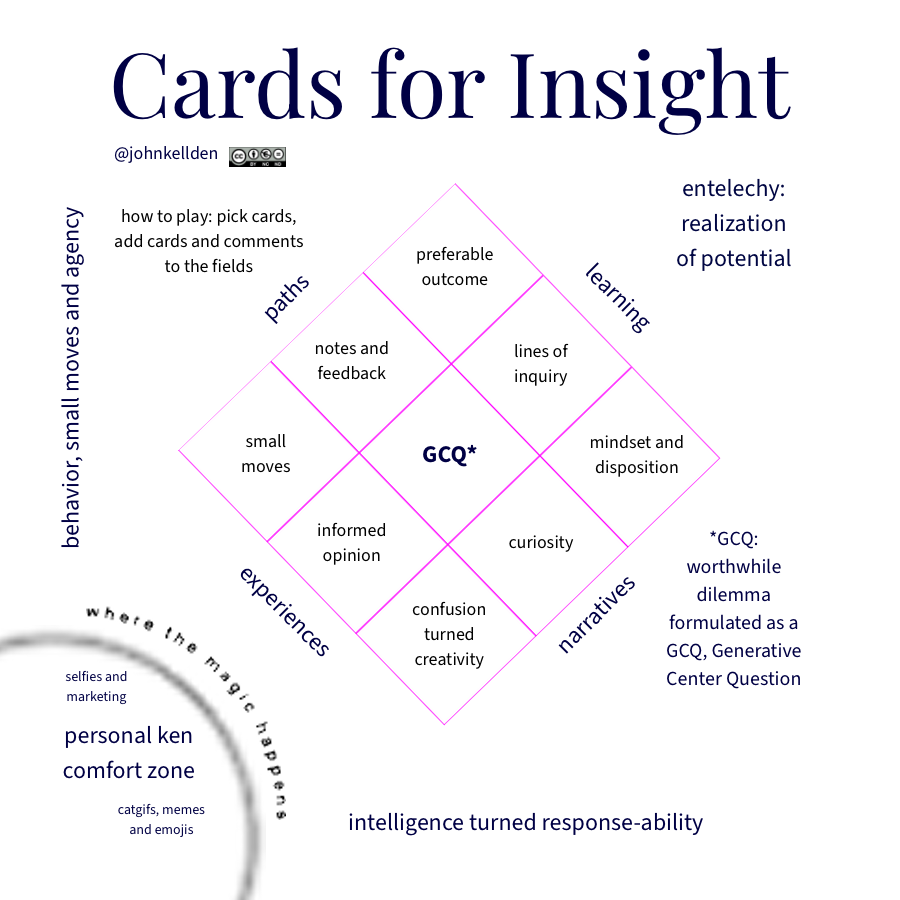
GCQ: One of the Playⁿ diagrams
A board. A question. A few rules. A center. A boundary. A way to move. A way to capture what matters.
This is the paradox of good games:
constraint creates possibility.
A blank page can intimidate. A 3x3 board invites.
A vague problem can overwhelm. A Generative Center Question gathers.
A chaotic conversation can scatter. Cards give attention somewhere to land.
Gameⁿ is fun because structure becomes generous.
Not rigid structure. Not bureaucratic structure. Not rules as obedience.
Rules as playable constraints.
A good Playⁿ game does not tell the participants what to think. It helps them think together more fruitfully.
The fun is discovering that a little structure can make a field more alive.
8. The Deep Fun of Winⁿ
Winⁿ changes the meaning of winning.
In many games, winning means defeating someone.
In Playⁿ, winning means the field becomes more coherent, more capable, more alive, more able to move.
A group winsⁿ when:
- a dilemma becomes clearer,
- a stuck conversation starts to breathe,
- a phrase becomes a shard,
- a participant feels included in the field,
- one next coherent move becomes possible.
Winⁿ is not conquest.
It is shared coherence becoming actionable.
This is fun because success becomes relational.
The question is no longer:
Did I beat you?
It becomes:
Did we create enough understanding to move more wisely?
That is a different pleasure. The pleasure of not needing to dominate the field in order to contribute to it. The pleasure of seeing that one’s own insight becomes more meaningful when it joins the field rather than owns it.
9. The Deep Fun of Hypoicon-Play
Hypoicon-Play is the fun of images, diagrams, metaphors, and symbols helping thought become visible.
A card gives language.
A hypoicon gives shape.
A diagram can show what a paragraph cannot. An image can slow a reaction. A metaphor can open a threshold. A board can reveal how attention is arranged.
The fun of Hypoicon-Play is the recognition:
“I didn’t understand it until I saw it.”
Or sometimes:
“I didn’t know I understood it until the image showed me.”
Hypoicon-Play reclaims time.
It interrupts the reflex to answer too quickly. It gives the group a shared object to look at, inhabit, question, and revise.
This is not decoration. It is symbolic cognition made playable.
A card titled Story may open a thought. An image of threads, paths, rivers, or constellations may help that thought become felt.
A diagram of the 3x3 board may help a group see that confusion, curiosity, informed opinion, small moves, and notes are not random fragments. They are fields in relation.
Hypoicon-Play is fun because perception itself becomes part of the game.
10. The Deep Fun of Recursive Play
Recursive Play is the fun of return.
Something happens in a session.
A shard appears:
“Trust may begin when partial understanding can safely enter the field.”
At the time, it feels useful.
Later, the group returns to it.
Now it means more.
A new session changes the shard. The shard changes the session. The field remembers. The game deepens.
Recursive Play is fun because the past is not dead content. It becomes playable again.
A question returns under better light. A card reappears in a new context. A phrase that seemed minor becomes central. A previous insight becomes a bridge.
This is one reason CKR matters.
Without memory, every session begins again.
With recursive memory, play develops.
The fun becomes cumulative.
Not accumulation as hoarding. Accumulation as deepening.
The game remembers what mattered.
11. The Deep Fun of Recursive Systemic Play
Recursive Systemic Play adds the larger field.
Now the question is not only:
What does this card mean?
It becomes:
What does this card do in the system? What pattern does it reveal? What loop is being repeated? What shift might a small move create?
This is fun because the participant begins to see that meaning is not isolated.
A card sits inside a conversation. A conversation sits inside a group. A group sits inside a platform. A platform sits inside a culture. A culture sits inside an ecology of signs, incentives, histories, fears, hopes, technologies, and stories.
Recursive Systemic Play lets a person sense complexity without drowning in it.
The fun is not control.
It is participation with increasing awareness.
A person starts to feel:
“I do not control the whole system, but I can make a meaningful move inside it.”
That is profoundly different from helplessness.
12. The Deep Fun of RSSSP
RSSSP — Recursive Systemic Semiotic Symbolic Play — is the deep form.
It brings together recursion, systems, signs, symbols, and play.
RSSSP is fun because it lets participants play at the level where worlds are made.
Humans do not live in facts alone. We live in meanings.
We live in stories, metaphors, rituals, images, signals, interfaces, narratives, signs, roles, identities, platforms, memories, and imagined futures.
RSSSP lets us ask:
- What signs are shaping this field?
- What symbols are we obeying without noticing?
- What story has captured us?
- What metaphor could free us?
- What card changes the meaning of the situation?
- What shard should return?
- What small move might re-pattern the field?
This is where play becomes cultural.
Not because it becomes grandiose.
Because it touches the level where daily reality is continuously made, reinforced, revised, and reimagined.
RSSSP is fun because the participant realizes:
meaning is not fixed, and yet meaning matters.
That is the core of symbolic freedom.
13. Playⁿ: Rules and Guidelines
The Fun of Rules, Meta-Rules, and Evolving Meta-Rules
Is it fun? Is it fun the more you participate? Is it deep, meaningful fun?
These are not trivial questions. They may be among the most important design questions for Playⁿ.
A practice that is meaningful but not playable may become heavy. A game that is playable but not meaningful may become empty. A system that is deep but not fun may attract only the already converted. A system that is fun but not deep may become another passing distraction.
Playⁿ needs a deeper answer.
The rules are what make the first moves possible.
They give beginners enough structure to enter:
- draw a card,
- place it in a field,
- speak from experience,
- listen,
- capture a shard,
- make one small move,
- return later.
Rules reduce the anxiety of the blank field.
They say:
“Here is how to begin.”
But the meta-rules are what keep people coming back.
Meta-rules are not only instructions for play. They are the deeper principles that make the play worth continuing:
- build the field before rushing to opinion,
- treat signs as invitations, not commands,
- hold cards and beliefs as instruments, not identities,
- turn position into inquiry,
- step gently beyond the personal ken comfort zone,
- capture what is worth returning to,
- revise every rule under better light.
The rules help people play.
The meta-rules help people trust the play.
They create the felt sense that this is not manipulation, not performance, not another engagement trap, not a disguised productivity system, not a doctrine.
The meta-rules say:
“You can enter this field without losing yourself.”
Then come the evolving meta-rules.
These are what help people become co-creators of the practice.
At first, a participant follows the rules.
Later, they understand why the rules matter.
Eventually, they help adapt the rules to the field.
The evolving meta-rules help people:
- notice when a rule has become too rigid,
- sense when a session needs a different rhythm,
- change the format without losing the grammar,
- create new card combinations,
- develop new gameboards,
- generate better GCQs,
- build CKR entries,
- refine app flows,
- teach others,
- and participate in Playⁿ as a living cultural technology.
This is where the fun becomes deep.
A beginner has fun because the cards are surprising.
A participant has fun because the conversation becomes meaningful.
A facilitator has fun because the field begins to cohere.
A wise wielder has fun because the grammar becomes generative.
A community of practice has fun because Playⁿ itself becomes something they can help evolve.
This is the crucial difference.
The rules invite entry. The meta-rules invite return. The evolving meta-rules invite stewardship.
And stewardship, when it remains playful, may be one of the deepest forms of fun available to human beings:
the joy of helping something meaningful become more alive.
14. Cultural Technology Meets Recursive Play
Adding the harmonics between the cards offers a powerful way to understand Playⁿ’s deeper fun.
One dimension points toward Playⁿ as cultural technology.
Technology here is not only machinery. It is technolution: the evolution of human possibility through tools, interfaces, practices, and forms. In this sense, Playⁿ is a cultural technology because it gives people a way to navigate the new, scale relational meaning-making, and respond to the age of cultural machines without surrendering the human field.
We live among cultural machines now.
AI systems. Platforms. Feeds. Recommendation engines. Dashboards. Metrics. Content loops. Workflow systems. Productivity tools. Engagement architectures.
These machines shape attention.
They imitate language. They compress experience. They accelerate response. They reward visibility. They often optimize for behavior without caring whether meaning deepens.
Fear in the face of cultural machines is not irrational.
But Playⁿ offers a different response.
Not rejection alone. Not surrender. Not nostalgia. Not acceleration for its own sake.
Playⁿ says:
Let us build cultural technologies that restore attention, deepen participation, preserve meaning, and help humans think together under complexity.
That is one dimension, one side. The other side of the underlying harmonics of the Playⁿ system design points toward recursion: RSSSP, Recursive Systemic Semiotic Symbolic Play.
This is the capacity to return to a field, revise the frame, notice the signs, re-enter the question, capture what shifted, and move again.
When these two dimensions meet, Playⁿ becomes a cultural technology of recursive symbolic renewal.
That is where the deep fun becomes counterintuitive.
The fun is not that we escape AI.
The fun is that we learn to play a better game of meaning alongside, around, through, and beyond our cultural machines.
Not faster than the machines.
Better than the machines at what machines cannot own:
- lived experience,
- care,
- judgment,
- trust,
- shared meaning,
- symbolic responsibility,
- timing,
- grace,
- humor,
- courage,
- situated wisdom.
Playⁿ is fun because it lets humans rediscover the craft of meaning-making in an age when machines can generate language but cannot participate as we do.
The cultural machine can produce text.
But the field must still decide:
What matters? What returns? What becomes a shard? What move is worthy? What story do we weave?
15. The Seven Levels of Deep Fun
The extended Shu Ha Ri sequence can be read as seven levels of increasingly deep fun.
1. Platform Minions At the shallowest level, fun is non-committal clicking.
A like. A scroll. A small pulse of recognition.
This is not evil. But it is thin.
The person participates without much consequence.
2. Pre-Shu Here, social cognition is extended online, but not yet skillfully.
People muddle through.
They share, react, argue, repost, identify, perform, collapse, recover, scroll again.
Meaning appears in fragments and disappears.
This is where many of us begin.
3. Shu At Shu, the participant learns the form.
Draw a card. Ask a question. Place the card. Speak. Listen. Capture a shard.
There may be doubt, frustration, anxiety. Learning almost always includes awkwardness.
But there is also relief.
The participant begins to feel:
“There is a way to enter.”
4. Ha At Ha, the participant begins to understand design.
The rules are no longer merely followed. They are seen.
The participant notices tensions:
- governance,
- cybernetics,
- recursion,
- field dynamics,
- facilitation,
- timing,
- boundaries.
The fun becomes meta-fun.
“We are not only playing. We are learning how play works.”
5. Ri At Ri, the participant begins to move fluently.
RSSSP becomes less like a concept and more like a practice.
Cards, signs, symbols, systems, conversations, shards, and stories begin to interweave.
The fun becomes embodied fluency.
6. Kai At Kai, timing enters.
The participant senses the occasion.
The right card appears at the right moment. A shard returns when needed. A small move meets the field.
The fun becomes kairotic.
“This is the move now.”
7. Simplicity Beyond Complexity At the deepest level, play becomes simple again.
Not because complexity disappeared.
Because the participant no longer has to fight the whole field.
They can participate well.
Draw a card. Ask a real question. Listen. Capture what matters. Move.
This is mature fun.
Seeds of entelechy flourishing in fields of plenitude.
The joy of becoming more fully oneself in a field where others are also becoming more fully themselves.
16. One to Eight Cards
The Scaling Grammar of Meaningful Fun One of the important things about Playⁿ is that the fun can scale.
One Card: Threshold A single card opens a perspective.
The Playⁿ twist:
One card is a threshold.
It asks:
What becomes visible if we enter through this word?
Two Cards: Spark Two cards create tension, bridge, polarity, analogy, or hinge.
The Playⁿ twist:
Two cards create a seed of a worthwhile dilemma.
They ask:
What meaningful tension lives between these two?
Three Cards: Field Three cards form a dilemma, triad, developmental sequence, seed story, or playable hypothesis.
The Playⁿ twist:
Three cards create a small ecology of meaning.
They ask:
What pattern appears when these three begin to speak together?
Four Cards: Context Four cards can form the boundaries around a gameboard:
- experiences,
- paths,
- learning,
- narratives.
The Playⁿ twist:
Four cards create world-framing context.
They ask:
What kind of field are we inside?
Five Cards: Compass Five cards orient participants through creativity as an emergent compass.
The Playⁿ twist:
Five cards create orientation under uncertainty.
They ask:
What direction is emerging that no single card could reveal?
Six Cards: Recursive Contrast Six cards combine tension and field:
tension × field
The Playⁿ twist:
Six cards create recursive contrast.
They ask:
Which tensions belong together, and what field can hold them?
Seven Cards: Multi-Unity Seven cards form a larger multi-unity, with one card as center, like seven circles held inside a larger circle.
The Playⁿ twist:
Seven cards create polycentric coherence.
They ask:
What center allows the many to remain many, yet cohere?
Eight Cards: Complete Session Field Eight cards fill the eight surrounding fields of the 3x3 Gameboard, with the GCQ at the center.
The Playⁿ twist:
Eight cards create a playable coherence mandala.
They ask:
What pattern emerges around the question, and what move becomes possible?
Playⁿ: Scaling Grammar The scaling grammar becomes:
1 = threshold 2 = spark 3 = field 4 = context 5 = compass (confusion turned creativity) 6 = recursive contrast 7 = multi-unity 8 = complete session field
Meaningful fun made scalable.
A beginner can start with one card.
A pair of participants can play two.
A small group can play three or five.
A full session can play eight around the center.
The game grows with the field.
17. The Core of Meaningful Fun
So what is the core?
I believe the core of Playⁿ’s fun is this:
meaning can be played with without being trivialized.
That is the difference.
Playⁿ does not ask us to make everything serious in a heavy way.
It does not ask us to make everything light in a shallow way.
It invites a third thing:
serious play.
Or better:
meaningful play.
A field where:
- complexity can be entered,
- cards can spark,
- opinions can soften,
- stories can be rewoven,
- images can slow time,
- questions can gather,
- shards can return,
- systems can be sensed,
- AI can assist without ruling,
- and small moves can carry meaning forward.
The hidden music is not in the cards alone.
It is in the relations.
Card to card. Person to person. Question to field. Shard to memory. Story to future. Human to machine. Meaning to action. Potential to plenitude.
That is why Playⁿ is fun the more you participate.
The first fun is surprise.
The deeper fun is recognition.
The mature fun is contribution.
The enduring fun is return.
18. Closing: What Story Do We Want to Weave?
Aria begins with a small question:
Why bother?
Then she finds Story. The two cards create a spark. Not a solution. A spark.
Enough to loosen the knot. Enough to ask another question. Enough to reach out. Reach out to her friends: Jules and Kai.
That is how Playⁿ begins.
A single card opens a perspective. Two cards spark a story. Three cards form a field. Eight cards gather around a question.
And sometimes, in the middle of all this, the field begins to sing.
Not loudly. Not perfectly. Not forever.
But enough.
Enough for meaning to move. Enough for a shard to appear. Enough for a small group to become more than separate opinions. Enough for a person between narratives to feel included again.
This is the hidden music of Playⁿ.
The deck is finite. The combinations are vast. The field is alive.
And the fun is deep because it is not only fun. It is a way of remembering that we can still weave.
— We made it? — What happened? — We happened.
Together.
Postscript I: John Kellden
Participate well. Sing out for yourself. Hold still for three seconds — long enough for the noospheric transception to land (and remain perfectly yourself if it does not), and let the rest unfold.
I am less interested in being right than in remaining responsive to what feels meaningful and true, building further on what is already there, while occasionally adding something new.
My work, centered on cards, large finite sets, and bounded infinity, explores conscious evolution, cultural sensemaking, and human-AI metalogue as practices of becoming rather than systems of certainty.
I do not assume understanding will be immediate or universal. I assume only that careful attention, small moves, and shared inquiry can make a difference over time.
If there is a through-line, it is this:
to participate, as best I can, in the ongoing experiment of human becoming.
What remains will remain.
The work is simply to participate well — guided by living into our own questions, and leaving concerns about lasting meaning and purpose to those who follow. In the end, we add our own unique touch to the larger canvas, meeting ourselves, others, the world, and the universe halfway.
We made it? What happened? We happened.
John Kellden is a Swedish facilitator, storyteller, and creator of Playⁿ, a card-based practice for navigating complexity through playful and structured inquiry. For more than two decades he has developed and field-tested a 504-card source deck designed to spark perspective shifts, generative dialogue, and new patterns of understanding in individuals and small groups.
At the core of his work is a simple practice:
- pick a card,
- make a move,
- notice what shifts,
- sing out for yourselves,
- and follow where the inquiry leads.
John lives in Sweden with his family and continues to explore how play, storytelling, and human-AI collaboration can support conscious evolution and meaningful cultural change.
Postscript II: Does it have to be cards?
Cards, MPOE, and the Ontology of Meaningful Play The question “Does it have to be cards?” can sound practical.
Sometimes it is.
A person may simply be asking whether Playⁿ can be done digitally, verbally, visually, or with some other medium. The answer is yes, if that medium performs the card function.
But sometimes the question reaches deeper.
It asks:
What is the underlying form of reality, knowledge, and participation assumed by Playⁿ?
That is where cards become philosophically important.
Playⁿ is not built on the assumption that knowledge is a static object to be transferred from one mind to another. Nor is it built on the assumption that reality is simply “out there,” waiting to be represented correctly, while human beings stand outside the process.
Playⁿ assumes something closer to a Modular Process Onto-Epistemology.
That phrase sounds abstract, but the intuition is simple:
Knowing and being unfold together through participation.
We do not merely observe situations. We enter them. We ask questions. We use signs. We interpret. We respond. We change the field. The field changes us.
The absorbent mind meeting the world, halfway.
Ontology concerns what is. Epistemology concerns how we know. MPOE says these are not separate in practice.
In living situations, what is and how we know it co-arise through participation.
This is exactly what a Playⁿ card session enacts.
A card is a module: bounded, portable, repeatable, combinable.
But it is also processual: its meaning changes depending on where it is placed, who reads it, what question holds the field, what other cards surround it, what experiences enter the conversation, and what shard is captured.
So each card is both:
- an ontological node: a small piece of world-in-becoming,
- and an epistemological affordance: a way of knowing that world through participation.
The uploaded “Does it have to be cards?” (a human-AI thread turned pdf) text maps the four core card functions directly to this deeper layer: cards operate as modular open boundaries, semiotic participation, situated cognition, and onto-epistemic co-arising.
In simpler language:
1. Cards are bounded infinity modules A card is finite, but its meanings are not exhausted.
This mirrors a process view of reality: each occasion is particular, yet open into relation. A card is a bounded occasion of meaning that can enter many future combinations.
2. Cards are semiotic participation devices A card mediates knowing through signs.
It does not merely describe meaning. It activates semiosis. It asks participants to interpret, relate, test, and respond.
3. Cards are attention scaffolds Knowing is not only internal.
It is embodied, distributed, social, and situated. A card lets people think together by giving attention a shared object.
4. Cards are field activators A card placed between people becomes a locus of co-arising.
Meaning does not belong to the card alone, nor to any individual alone. It emerges in the relation: card, question, field, participant, story, response. One of the preferable outcomes: the seed story.
That is why the card is not merely a tool.
It is a small enactment of Playⁿ’s ontology.
It demonstrates the deeper claim:
to know something is to participate in its becoming.
This also changes how we answer the objection.
When someone says:
Does it have to be cards?
one possible answer is:
No — but what alternative underlying epistemology and ontology do you have in mind?
That is not a rebuke. It is an invitation.
If someone has another medium that can perform the same four functions — bounded generativity, semiotic anchoring, attention scaffolding, and field activation — then the conversation can continue fruitfully. Perhaps it could be tiles, diagrams, gestures, rituals, spatial forms, musical motifs, app objects, or some other symbolic module.
But if the alternative is simply “let’s talk without the cards,” then something important is lost.
The modularity is lost. The bounded infinity is lost. The shared attention object is lost. The field activator is lost. The grammar of recombination is lost. The smallest vessel of coherence is lost.
What remains may still be conversation.
But Playⁿ is not only conversation.
It is conversation made playable through modular symbolic forms.
This is why the card matters to Playⁿ: Fun.
The fun is not only that cards are enjoyable. The fun is that cards give meaning a body small enough to move.
A card can be picked up. Placed. Turned. Paired. Reframed. Returned. Remembered. Archived. Played again.
That physical and symbolic modesty is part of its power.
The card is the smallest possible vessel of coherence.
The minimal viable unit of civilization rehearsing itself through play.
Without cards, or something truly card-like, there is no grammar of becoming — only speech.
And speech, however beautiful, often evaporates.
A card lets meaning stay long enough to be played.
tl; dr
The card is not the content; it is the condition for generativity. It is not the answer, but the architecture of inquiry.
Playⁿ uses cards not to simplify complexity, but to ritualize complexity — to make it tangible, iterable, and playable.
So, yes, it has to be cards. Not because of preference, attachment, or sunk cost, but because of function.
Cards are the smallest possible vessels of coherence: the minimal viable units of civilization rehearsing itself through play.
Without them, there is no grammar of becoming — only speech.
And we all know how un-fun speeches are.
메타데이터
- post_id
- 2a76137a8bf9
- slug
- playⁿ-story-2a76137a8bf9
- url
- https://medium.com/@johnkellden/play%E2%81%BF-story-2a76137a8bf9
- canonical_url
- https://medium.com/@johnkellden/play%E2%81%BF-story-2a76137a8bf9
- author_url
- https://medium.com/@johnkellden
- status
- ok
- fetched_at
- 2026-06-14 11:28:49