The World’s Largest Banks Are Chinese. But Money Still Flows Through America.
The future of financial power may not belong to the biggest banks.
The World’s Largest Banks Are Chinese. But Money Still Flows Through America.
The future of financial power may not belong to the biggest banks.

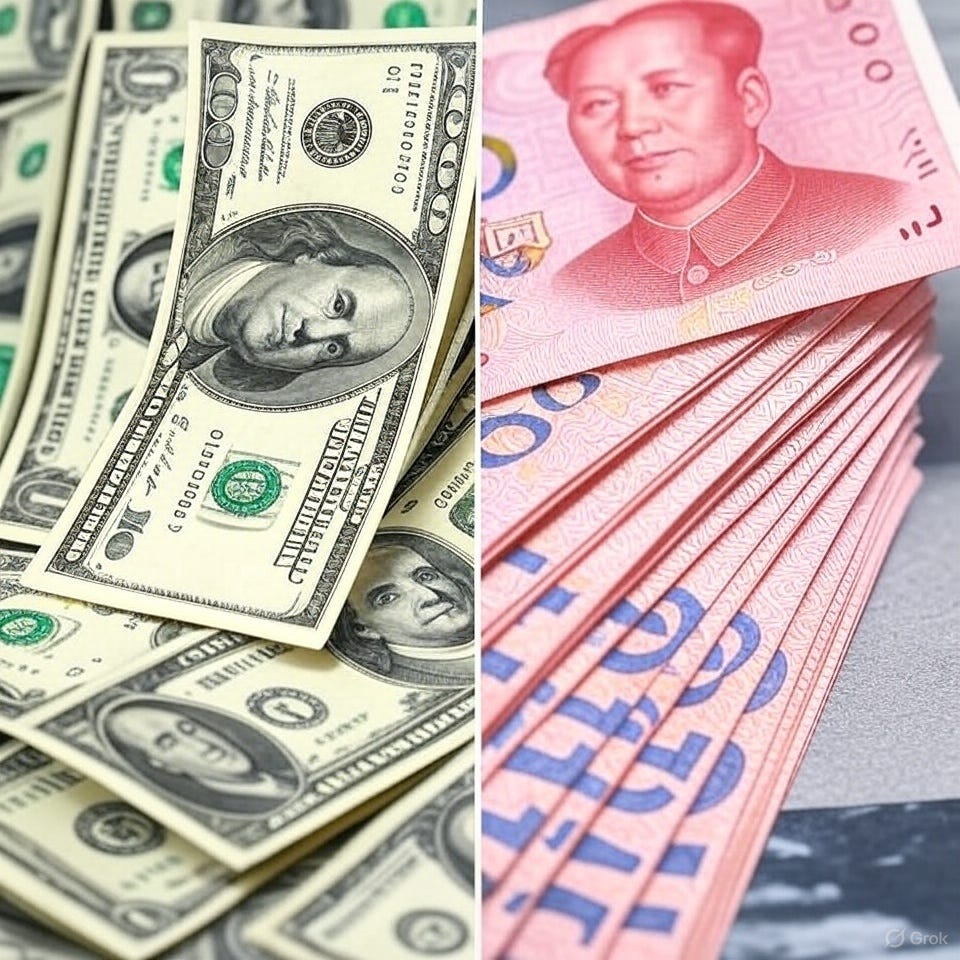
AI-generated illustration of global financial power.
Four of the world’s five largest banks are Chinese.
Yet money still moves through America.
At first glance, those facts should not coexist.
One suggests financial dominance. The other suggests something very different.
The contradiction points to a deeper shift unfolding beneath global finance, and it reveals why banking size may no longer be the best measure of financial power.
Understanding that gap requires looking beyond banks themselves.

Source: Wikipedia compilation based on annual reports and S&P Global rankings.
Size Is Not the Same as Influence
China’s banking giants are enormous by any measure.
Viewed from that perspective, China’s banking dominance appears straightforward.
A larger economy produced larger banks.
But financial power is rarely that simple.
The institutions that hold money and the systems that move money are not necessarily the same thing.
Financial scale and financial influence often grow at different speeds.
Industrial and Commercial Bank of China, Agricultural Bank of China, China Construction Bank, and Bank of China collectively hold trillions of dollars in assets. Their scale reflects decades of economic expansion, industrial growth, and state-directed investment.
This distinction becomes visible when we look at global payments.
Despite China’s dominance in banking assets, international financial activity remains heavily concentrated in dollar-based networks.
According to recent SWIFT payment data, the U.S. dollar accounts for more than 50% of global payment activity. The yuan represents less than 3%.

Source: SWIFT RMB Tracker, April 2026.
Four of the world’s largest banks are Chinese, yet the dollar still handles most of the world’s financial traffic.
That gap reveals something important.
Large banks can support economic growth.
But payment systems shape financial influence.
A country may operate enormous financial institutions while still depending on infrastructure designed elsewhere.
The Infrastructure Beneath Global Finance
This is not just a banking story.
It reflects a broader pattern in geopolitics.
The visible institutions often attract the most attention.
The deeper competition frequently occurs within the infrastructure that supports them.
Manufacturing depends on supply chains.
Artificial intelligence depends on computing infrastructure.
Global finance depends on payment networks.
The real competition is increasingly occurring beneath the visible layer.
The contest is shifting from institutions to infrastructure.
That helps explain why China has spent years expanding the reach of the digital yuan and investing in alternative cross-border settlement systems.
These initiatives are often presented as financial technology projects.
In reality, they are also geopolitical projects.
Countries have spent decades integrating into a global financial architecture centered around the dollar.
That architecture offers efficiency, liquidity, and trust.
But it also creates dependence.
The ability to restrict financial access, impose sanctions, or influence capital flows has demonstrated that payment systems are not merely economic tools.
They are instruments of power.
Payment networks are becoming strategic infrastructure.
Why More Countries Want Options
As geopolitical competition intensifies, more governments are beginning to think differently about financial infrastructure.
China is not alone.
Discussions around local-currency settlements, regional payment systems, and digital currencies have emerged across multiple regions.
This is not necessarily an attempt to replace the dollar.
In many cases, it is an attempt to reduce vulnerability.
Countries increasingly want options.
And the desire for options is becoming a recurring feature of the international system.
This is not just an event.
It reflects a deeper pattern.
When systems become critical to economic activity, governments eventually seek greater control over them.
Why should this matter beyond central banks and finance ministries?
Because financial infrastructure ultimately affects the real economy.
Changes in payment systems influence trade costs, investment decisions, supply chains, and the movement of capital across borders.
Over time, those shifts affect business strategy, economic growth, employment, and even the prices consumers pay for goods and services.
The architecture of global finance may seem distant.
Its consequences are not.
The Contradiction Defining the Current Moment
Yet the existing system remains remarkably resilient.
For all the discussion surrounding de-dollarization, investors continue to move toward dollar-denominated assets during periods of uncertainty.
Global capital still seeks the liquidity, depth, and trust associated with U.S. financial markets.
Foreign demand for U.S. Treasury securities remains substantial.
This creates the defining contradiction of the current moment.
Alternative networks are growing.
Existing networks remain dominant.
The competition is expanding faster than the balance of power is changing.
The system is evolving.
The system has not been replaced.
Similar patterns are emerging across geopolitics.
***Periods of systemic pressure often encourage adaptation rather than collapse.***
Instead, they encourage the gradual construction of alternatives alongside them.
That dynamic is already visible in trade, technology, energy, and increasingly in finance.
The question is no longer whether alternative financial infrastructure is emerging.
It already is.
The more important question is how much influence those alternatives will eventually acquire.
Because the next phase of financial competition may not be determined by balance sheets.
It may be determined by payment rails, settlement networks, digital currencies, and the infrastructure that most people never see.
The countries shaping those systems today could influence how money moves tomorrow.
And in the modern world, the ability to shape how money moves is increasingly becoming a form of geopolitical power.
This is part of a broader pattern — what I think of as geopolitical strategic systems, where pressure quietly moves across trade, energy, technology, and conflict.
메타데이터
- post_id
- 2a7b3d40cb48
- slug
- the-worlds-largest-banks-are-chinese-but-money-still-flows-through-america-2a7b3d40cb48
- url
- https://medium.com/the-geopolitical-economist/the-worlds-largest-banks-are-chinese-but-money-still-flows-through-america-2a7b3d40cb48
- canonical_url
- https://medium.com/the-geopolitical-economist/the-worlds-largest-banks-are-chinese-but-money-still-flows-through-america-2a7b3d40cb48
- author_url
- https://medium.com/@athawre4
- status
- ok
- fetched_at
- 2026-06-17 08:20:12