The Euclidean Algorithm:
Find the Greatest Common Divisor (GCD) of two integers.
The Euclidean Algorithm
Find the Greatest Common Divisor (GCD) of two integers.
- What is a GCD? The largest number that divides both of them without leaving a remainder.
- Example: GCD(12, 18) = 6
- The Magic Rule:
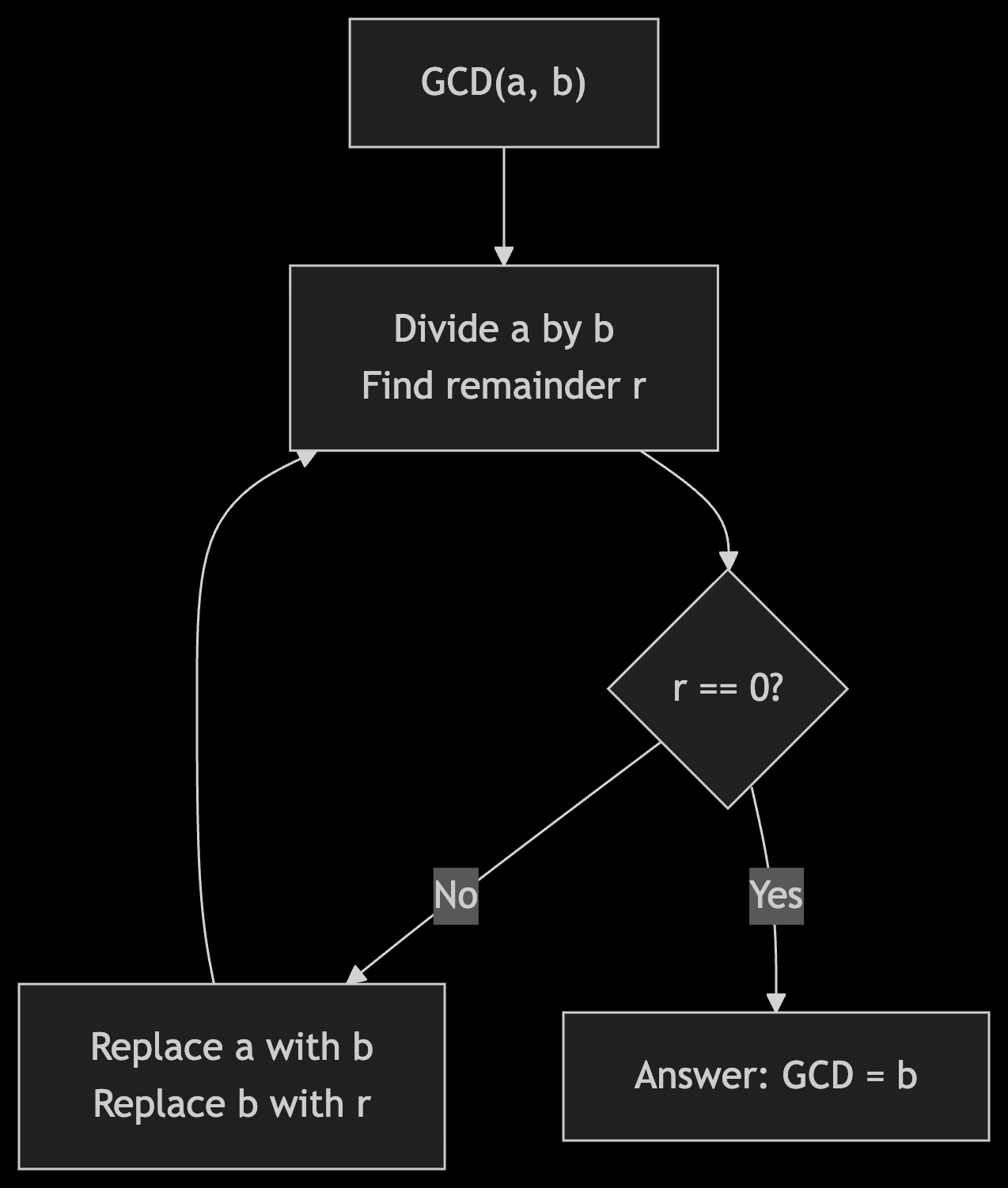
GCD(a, b) = GCD(b, a mod b) a mod bis the remainder whenais divided byb.
2. Why This Rule Works (The Visual Insight)
Imagine a rectangle of size a × b. The GCD is the side length of the largest square that can tile it perfectly.
Example: Find GCD(48, 18)
- Tile the 48×18 rectangle. The biggest square that fits is 18×18. It fits 2 times, leaving a 12×18 strip.
- Now, tile the leftover 18×12 strip. The biggest square is 12×12. It fits 1 time, leaving a 6×12 strip.
- Finally, tile the 12×6 strip. The biggest square is 6×6. It fits 2 times perfectly, leaving no remainder.
Conclusion: The side of the smallest square (6) is the GCD. The algorithm works by repeatedly breaking the problem into smaller, identical problems.
3. The Step-by-Step Algorithm
Follow this simple, efficient process. Stop when the remainder is 0.
Division EquationConclusion & Next Step48 = 2 × 18 + 12GCD(48, 18) = GCD(18, 12) → Continue18 = 1 × 12 + 6GCD(18, 12) = GCD(12, 6) → Continue12 = 2 × 6 + 0⬇️ Remainder is 0! STOP. ⬇️GCD = 6 (The last divisor)
Process Summary:
- Divide the larger number by the smaller number.
- Find the remainder.
- Replace the larger number with the smaller number.
- Replace the smaller number with the remainder.
- Repeat until the remainder is
0. The GCD is the last non-zero divisor.
4. Worked Example: GCD(270, 192)
Let’s apply the steps to a more complex pair.
StepDivision EquationConclusion1270 = 1 × 192 + 78GCD(270, 192) = GCD(192, 78)2192 = 2 × 78 + 36GCD(192, 78) = GCD(78, 36)378 = 2 × 36 + 6GCD(78, 36) = GCD(36, 6)436 = 6 × 6 + 0Stop. GCD = 6
∴ GCD(270, 192) = 6
5. Key Takeaways & Why It’s Efficient
- Simple and Powerful: It transforms a difficult problem into a series of simple division steps.
- Extremely Fast: Even for huge numbers (with hundreds of digits), the number of steps required is surprisingly small. This makes it crucial for:
- Computer Science
- Cryptography (e.g., RSA Encryption)
- Simplifying Fractions
- The Final Visual: The entire process is a journey from a large problem to a small, solved one.
“If you enjoyed this, I’d appreciate it if you shared it with someone else who might, too. Thanks for reading!” Happy Algorithms…..
메타데이터
- post_id
- 2a7bbc192de2
- slug
- the-euclidean-algorithm-2a7bbc192de2
- url
- https://medium.com/@aibhi.dev/the-euclidean-algorithm-2a7bbc192de2
- canonical_url
- https://medium.com/@aibhi.dev/the-euclidean-algorithm-2a7bbc192de2
- author_url
- https://medium.com/@aibhi.dev
- status
- ok
- fetched_at
- 2026-07-09 09:18:05