Everything Everywhere All At Once (Week 3)
Tracing the ripple effects of fathers taking parental leave
Everything Everywhere All At Once (Week 3)
Tracing the ripple effects of fathers taking parental leave
One of the most useful lenses I took away from the User-Centred Project module in Term 1 of my MA Service Design course was the Micro, Meso, and Macro framework. It helped me think more clearly about how a design intervention can create value at different levels, from individual experiences to organisational cultures and wider structural change. I have found myself returning to that framework in this project because it gives me a clearer way to understand not just what the issue is, but where the impact of a project might sit within a wider ecosystem.
(Week 3 — This post is part of a series documenting my journey through the Final Major Project in the MA Service Design programme at LCC, UAL)
In simple terms, the framework helps map where impact sits across a system. The micro level focuses on individuals and immediate relationships, the meso level looks at organisations and cultures, and the macro level considers wider policy and structural conditions. What I find most useful about this lens is that it separates the scale of a problem from the scale of a potential intervention.
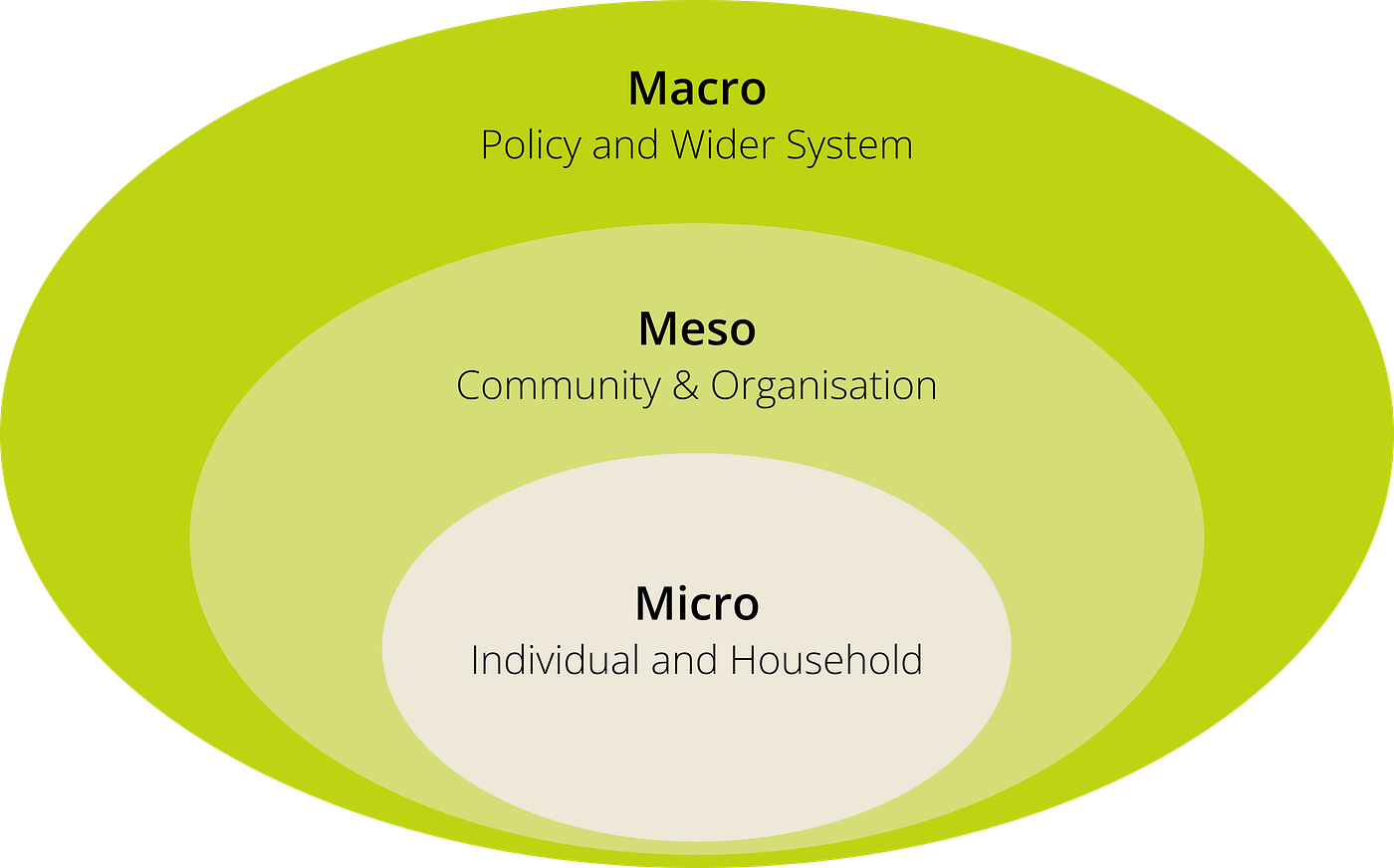
Applied to my project direction, the micro level is where the effects of fathers taking leave are felt most directly. This includes fathers, mothers, children, and the everyday experience of care within the household. Research reviewed by Bartel et al. (2023) suggests that paid family and medical leave is associated with positive outcomes for infant, child, and parental health. It also highlights that fathers taking leave can improve mothers’ postpartum physical and mental health.
The UK context reinforces this. Enabling fathers and partners to spend time with their children during the first 12 months of life can improve mothers’ physical and mental wellbeing. When a woman’s partner takes parental leave, she is 34 percent more likely to feel physically ready to return to work (Fogden et al., 2023).
The meso level sits in workplaces, teams, and organisational culture. This is where leave stops being only a legal entitlement and becomes a cultural question: does the environment around a father make taking leave feel acceptable, supported, and normal?
The OECD review identifies workplace culture as one of the major factors shaping whether fathers take leave. It also notes that when male co-workers take parental leave, positive peer effects can encourage others to do the same (OECD, 2025). This is what makes the meso level especially important. If workplaces normalise fathers taking leave, they do more than support individual employees. They begin to reshape what care, commitment, and professionalism are expected to look like.
Then there is the macro level, where the issue connects to policy, labour markets, and wider gender equality. At this level, fathers taking more leave matters because it can support a more equal division of unpaid care, reduce the concentration of motherhood penalty on women, and contribute to fairer workplace outcomes over time (OECD, 2025).
This wider impact can already be seen in the data. Countries with more than six weeks of paid paternity leave have a 4 percentage point smaller gender wage gap and a 3.7 percentage point smaller labour force participation gap than countries with less generous provision (Fogden et al., 2023). The same report estimates that closing gender employment gaps across UK local authorities could increase economic output by £23 billion, or around 1 percent of GDP.

The potential impact and value of my project direction, captured across the ecosystem
In other words, the issue has implications far beyond individual households: it connects directly to labour market inequality and national economic performance.
However, I do not see my project operating primarily at the policy level. Instead, I see it sitting more strongly at the micro and meso levels, where I can more meaningfully engage with user groups and organisations. This means understanding the lived experiences of fathers, partners, and families navigating parental leave and also exploring how workplace norms, organisational systems, and service interactions shape whether fathers feel able to take leave without stigma or perceived career risk.
The project sits within a wider ecosystem of policy and gender inequality, but its most meaningful contribution may lie in understanding and influencing the experiences, behaviours, and organisational cultures that exist at the micro and meso levels. This feels more aligned with what service design can realistically do within the constraints of time, access, and scope. One of the most important lessons from the course has been that starting smaller does not mean thinking smaller. It means being more precise about where design can intervene
References
Bartel, A., Rossin-Slater, M., Ruhm, C., Slopen, M. and Waldfogel, J. (2023). The Impacts of Paid Family and Medical Leave on Worker Health, Family Well-Being, and Employer Outcomes. Annual Review of Public Health, [online] 44(1). doi:https://doi.org/10.1146/annurev-publhealth-071521-025257.
Fogden, R., Singh, T., Merkulova, T., Brearley, J., Fabianski, L. and Franklin, B. (2023). Leave in the lurch: Paternity leave, gender equality and the UK economy . [online] UK: Centre for Progressive Policy, Pregnant the Screwed, Women in Data. Available at: https://www.progressive-policy.net/downloads/files/CPP_Parental-Leave-report_June-2023.pdf.
OECD (2025). Paid leave for fathers: Recent OECD policy trends. [online] OECD. Paris: OECD Publishing. Available at: https://www.oecd.org/en/publications/paid-leave-for-fathers_07442bed-en/full-report.html#title-4aeb482f2d.
메타데이터
- post_id
- 2a7cc0ffc5f5
- slug
- everything-everywhere-all-at-once-2a7cc0ffc5f5
- url
- https://medium.com/@mehalchandra24/everything-everywhere-all-at-once-2a7cc0ffc5f5
- canonical_url
- https://medium.com/@mehalchandra24/everything-everywhere-all-at-once-2a7cc0ffc5f5
- author_url
- https://medium.com/@mehalchandra24
- status
- ok
- fetched_at
- 2026-07-09 00:50:33





