20 API Design Best Practices Every Backend Engineer Should Know
Good API design is about creating APIs that are easy to understand, consistent, secure, scalable, and maintainable. Here are the most…
20 API Design Best Practices Every Backend Engineer Should Know
Good API design is about creating APIs that are easy to understand, consistent, secure, scalable, and maintainable. Here are the most important best practices used in modern REST APIs.
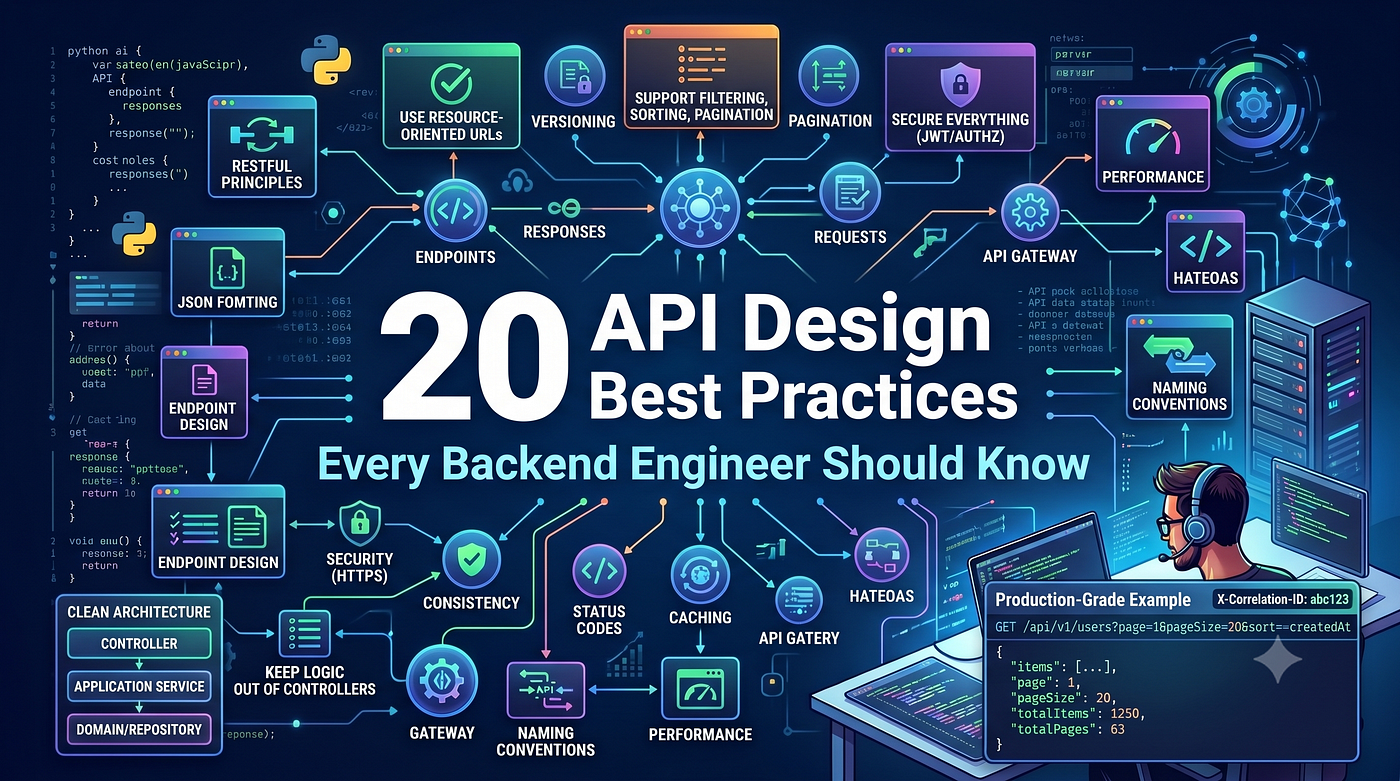
20 API Design Best Practices
1. Use Resource-Oriented URLs
Use nouns, not verbs.
✅ Good
GET    /users
GET    /users/123
POST   /users
PUT    /users/123
DELETE /users/123
❌ Avoid
GET /getUsers
POST /createUser
DELETE /deleteUser/123
2. Use HTTP Methods Correctly
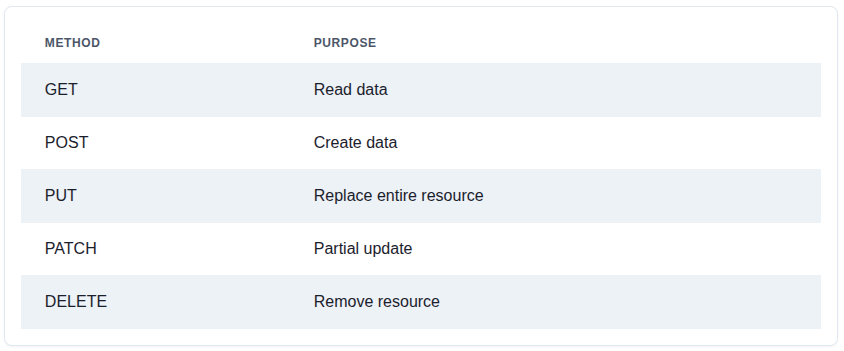
Use HTTP Methods Correctly
Example:
PATCH /users/123

{
  "firstName": "John"
}
3. Use Consistent Naming
Choose one convention and stick to it.
Common practice:
/users
/user-roles
/course-enrollments
Avoid mixing:
/userRoles
/user_roles
/UserRoles
4. Version Your APIs
Never break existing clients.
/api/v1/users
/api/v2/users
or
Accept: application/vnd.company.v2+jsonURL versioning is usually simpler.
5. Return Proper HTTP Status Codes
Success
200 OK
201 Created
204 No Content
Client Errors
400 Bad Request
401 Unauthorized
403 Forbidden
404 Not Found
409 Conflict
422 Unprocessable Entity
Server Errors
500 Internal Server Error
503 Service Unavailable
Example:
POST /users201 Created
Location: /users/1236. Design Meaningful Response Bodies
Response:
{
  "id": 123,
  "name": "John Doe",
  "email": "john@example.com"
}
Avoid:
{
  "status": 1
}
Clients shouldn’t need to guess.
7. Standardize Error Responses
A consistent error format saves developers hours.
{
  "code": "USER_NOT_FOUND",
  "message": "User does not exist",
  "details": {
    "userId": 123
  }
}
For validation:
{
  "code": "VALIDATION_ERROR",
  "errors": [
    {
      "field": "email",
      "message": "Invalid email address"
    }
  ]
}
8. Support Filtering, Sorting, and Pagination
Filtering
GET /users?status=activeSorting
GET /users?sort=name
GET /users?sort=-createdAt
Pagination
GET /users?page=1&pageSize=20Response:
{
  "items": [...],
  "page": 1,
  "pageSize": 20,
  "totalItems": 542,
  "totalPages": 28
}
9. Avoid Deeply Nested URLs
✅ Good
/users/123/orders❌ Too deep
/companies/1/departments/2/teams/3/users/123/ordersUse query parameters when relationships become complex.
10. Make APIs Idempotent When Appropriate
Calling the same request multiple times should not produce unexpected results.
PUT /users/123should always leave the resource in the same state.
This becomes critical when handling retries.
11. Use Request Validation
Validate:
- Required fields
- Data types
- String lengths
- Business rules
Example:
{
  "email": "invalid-email"
}
Return:
422 Unprocessable Entitywith detailed validation errors.
12. Secure Everything
Authentication
- OAuth2
- JWT
- API Keys
Authorization
Don’t only authenticate. Check permissions:
Can user edit this course?
Can user view this school?
Additional Security
- Rate limiting
- Input sanitization
- HTTPS only
- Audit logging
13. Use OpenAPI (Swagger)
Document APIs in a machine-readable format.
Benefits:
- Interactive testing
- SDK generation
- Better collaboration
- Easier onboarding
Popular tools:
14. Make Responses Backward Compatible
Avoid removing fields.
Bad:
{
  "fullName": "John Doe"
}
Later changing to:
{
  "name": "John Doe"
}
This breaks clients.
Prefer adding new fields and deprecating old ones gradually.
15. Support Correlation IDs
Support Correlation IDs means adding a unique identifier to every API request so it can be traced across all services in a system.
This ID is passed from the client through all backend services and included in logs, making it much easier to debug issues, track request flow, and diagnose failures in distributed systems or microservices.
Request:
X-Correlation-ID: abc123Response:
X-Correlation-ID: abc123Logs:
[abc123] User created successfully16. Be Careful With Bulk Operations
Instead of:
POST /users1000 times
Provide:
POST /users/bulkResponse:
{
  "successful": 980,
  "failed": 20
}
Useful for integrations and imports.
17. Keep Business Logic Out of Controllers
A common architecture:
Controller
    ↓
Application Service
    ↓
Domain
    ↓
Repository
For example, in NestJS/Clean Architecture:
Presentation Layer
    ↓
Application Layer
    ↓
Domain Layer
    ↓
Infrastructure Layer
Controllers should orchestrate requests, not contain business rules.
18. Design for Observability
Log:
- Request ID
- User ID
- Execution time
- Errors
Expose metrics:
- Request count
- Error rate
- Latency
- Throughput
This becomes essential as systems scale.
19. Prefer Consistency Over Cleverness
If one endpoint returns:
{
  "items": []
}
all collection endpoints should do the same.
Don’t mix:
{
  "users": []
}
and
{
  "items": []
}
Consistency is one of the biggest factors in API usability.
20. Think About Future Evolution
Before creating an endpoint ask:
- Can this scale to millions of requests?
- Can it support new fields?
- Can clients retry safely?
- Can it work in microservices?
- Will it be easy to document?
Good API design is less about today’s requirements and more about avoiding tomorrow’s problems.
A Production-Grade Example
GET /api/v1/users?page=1&pageSize=20&status=active&sort=-createdAtResponse:
{
  "items": [
    {
      "id": "123",
      "name": "John Doe",
      "email": "john@example.com"
    }
  ],
  "page": 1,
  "pageSize": 20,
  "totalItems": 1250,
  "totalPages": 63
}
Headers:
200 OK
X-Correlation-ID: abc123
This style is commonly used by large-scale APIs from companies like Stripe and GitHub, because it remains maintainable as systems grow.
Thanks for reading…… If you enjoyed this article, consider following for more content on backend development, API design, and system architecture.
Feel free to share your thoughts or experiences in the comments — your feedback helps improve future articles.❤️
메타데이터
- post_id
- 2a834d803d16
- slug
- 20-api-design-best-practices-every-backend-engineer-should-know-2a834d803d16
- url
- https://blog.devgenius.io/20-api-design-best-practices-every-backend-engineer-should-know-2a834d803d16
- canonical_url
- https://blog.devgenius.io/20-api-design-best-practices-every-backend-engineer-should-know-2a834d803d16
- author_url
- https://medium.com/@wanuja18
- status
- ok
- fetched_at
- 2026-06-13 12:55:53