Why Traditional Product Development Is Failing Modern Manufacturers and What Industry Leaders Are…
The result is predictable:
Why Traditional Product Development Is Failing Modern Manufacturers and What Industry Leaders Are Doing DifferentlyManufacturing companies are under more pressure than ever to launch products faster, reduce engineering costs, improve quality, and respond to changing customer demands. Yet many organizations continue to follow product development processes built for a different era.
The result is predictable:
Long development cycles.
Repeated design revisions.
Higher prototype costs.
Delayed market launches.
Engineering teams spending more time fixing issues than creating innovation.
The companies gaining market share today are approaching product development differently.
The New Reality of Product Development
Traditional product development often relies on disconnected systems, manual handoffs, and late-stage validation. Problems are discovered after significant engineering effort has already been invested.
Modern manufacturers are moving toward integrated digital engineering environments that connect design, simulation, validation, manufacturing, and supply chain planning from the beginning of the development lifecycle. Research and industry studies show digital twins, virtual validation, and model-based engineering can significantly reduce development cycles while improving decision quality. (Deloitte)
The goal is simple:
Identify problems before physical prototypes are built.
Five Capabilities Driving Faster Product Development
1. Digital Engineering and Simulation First
Engineering teams can validate performance, manufacturability, and reliability virtually before physical testing begins.
Benefits include:
Reduced prototype iterations
Earlier issue detection
Faster design approvals
Lower development costs
2. Cross Functional Collaboration
Successful products are no longer designed by engineering alone.
Manufacturing, procurement, quality, and supply chain teams must be involved early to avoid downstream delays.
3. Design for Manufacturability (DFM)
A product that works in CAD but is difficult to manufacture creates cost overruns and production bottlenecks.
Early manufacturability analysis helps reduce waste, tooling issues, and production risk.
4. Data Driven Decision Making
Advanced analytics and AI are increasingly helping manufacturers predict costs, optimize designs, and accelerate quoting processes. Emerging machine learning models are now capable of identifying cost drivers directly from engineering drawings, improving speed and consistency in manufacturing decisions. (arXiv)
5. Validation Throughout the Development Cycle
Instead of waiting until the final stages, validation should occur continuously throughout development.
This reduces engineering rework and improves product quality.
What Manufacturing Leaders Are Prioritizing in 2026
Across automotive, industrial equipment, aerospace, and consumer products, several common priorities are emerging:
Shorter product development cycles
Virtual prototyping
Digital twin implementation
AI assisted engineering
Integrated validation processes
Improved cost visibility
Greater engineering efficiency
Organizations investing in these capabilities are building more resilient and scalable product development ecosystems. (Deloitte)
How Goken Helps Manufacturers Accelerate Product Development
At Goken, we help manufacturers transform product ideas into production-ready solutions through engineering expertise, digital development methodologies, validation services, and manufacturing-focused design strategies.
Our teams support organizations throughout the entire product lifecycle, helping reduce development risk, improve engineering efficiency, and accelerate time to market.
The future belongs to manufacturers that can innovate faster without sacrificing quality.
Product development is no longer just an engineering function.
It is a competitive advantage.
Manufacturing #ProductDevelopment #EngineeringServices #DigitalEngineering #ProductDesign #Innovation #Goken #IndustrialEngineering #ProductLifecycleManagement #ManufacturingTechnology
Article 2: Value Engineering in Manufacturing: How Smart Companies Reduce Cost Without Sacrificing Quality
One of the biggest misconceptions in manufacturing is that cost reduction automatically means compromising quality.
The most successful manufacturers know that is rarely true.
Instead of focusing solely on cutting expenses, they focus on increasing value.
This is where Value Engineering becomes a strategic advantage.
What Is Value Engineering?
Value Engineering is a structured methodology used to improve the relationship between a product’s function and its cost.
Simply put:
The objective is not to make products cheaper.
The objective is to deliver the same or better performance at a lower total cost. (Investopedia)
When implemented correctly, Value Engineering improves profitability, product competitiveness, and customer satisfaction simultaneously.
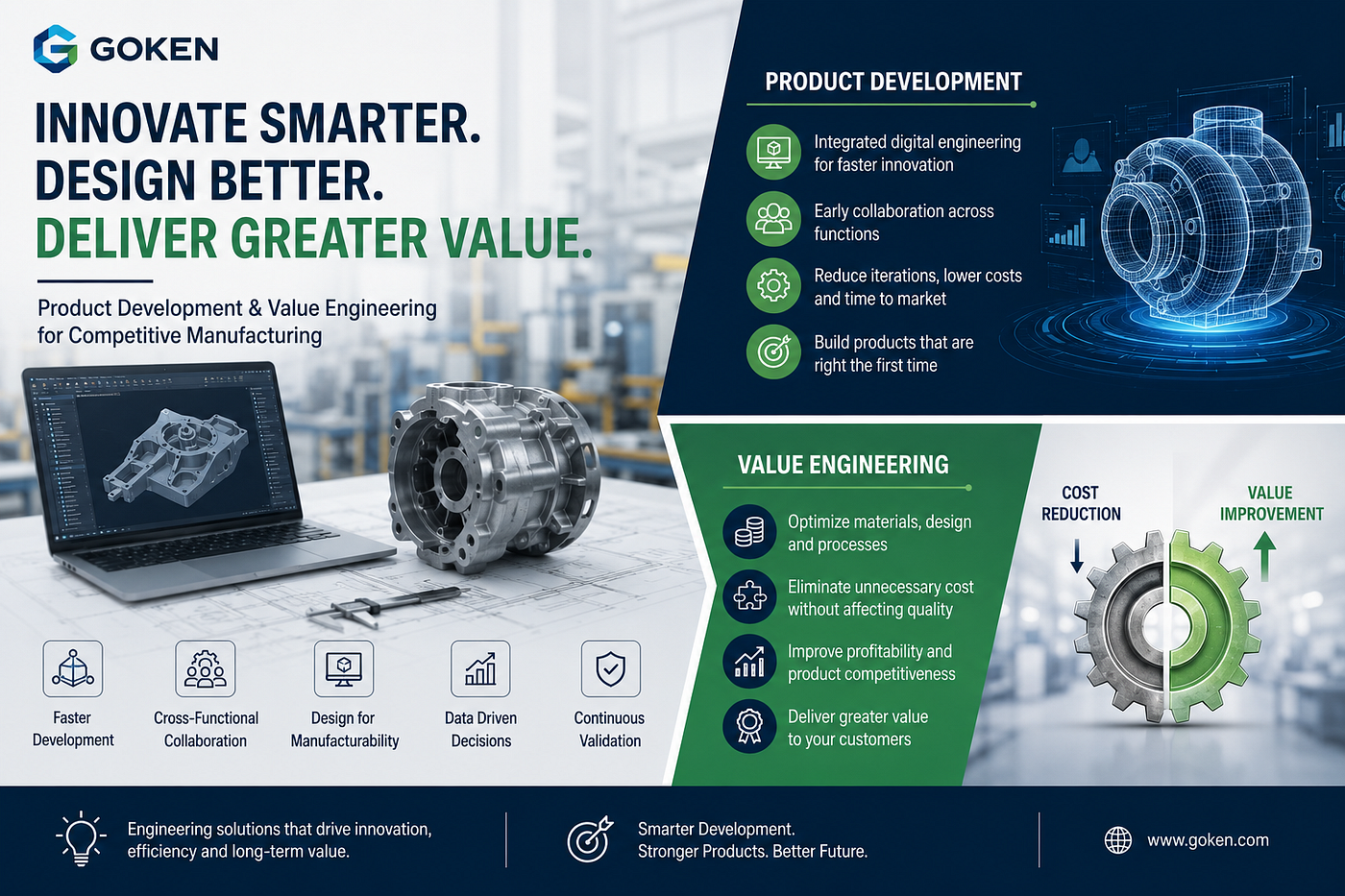
Why Manufacturers Are Prioritizing Value Engineering
Today’s manufacturers face several challenges:
Raw material cost increases
Supply chain volatility
Competitive pricing pressure
Shorter product lifecycles
Demand for greater product customization
Under these conditions, every engineering decision directly impacts profitability.
Value Engineering helps organizations identify unnecessary costs hidden within designs, materials, manufacturing processes, and product specifications.
Common Areas Where Value Engineering Delivers Results
Material Optimization
Alternative materials can often provide equivalent performance while reducing overall product cost.
Component Consolidation
Reducing part counts simplifies assembly and lowers manufacturing complexity.
Manufacturing Process Improvements
Process redesign can improve throughput while reducing waste and labor requirements.
Design Simplification
Removing unnecessary complexity often improves reliability and manufacturability.
Supplier Collaboration
Working closely with suppliers can uncover lower-cost alternatives without affecting quality.
Value Engineering Is Not Cost Cutting
Many organizations confuse Value Engineering with aggressive cost reduction initiatives.
The difference is significant.
Cost cutting asks:
“How can we spend less?”
Value Engineering asks:
“How can we deliver the required function more efficiently?” (Investopedia)
This distinction helps companies maintain performance, reliability, and customer trust while improving margins.
A Practical Example
A manufacturing company may discover that a component is overengineered for its actual application.
By optimizing material selection, simplifying geometry, and improving manufacturing processes, the company can reduce production costs while maintaining required performance standards.
Studies across manufacturing environments have demonstrated that structured Value Engineering methodologies can produce meaningful cost reductions without sacrificing product functionality. (ResearchGate)
How Goken Supports Value Engineering Initiatives
Goken helps manufacturers identify opportunities to optimize product designs, improve manufacturability, reduce complexity, and enhance overall value.
Our engineering teams work across product development, manufacturing engineering, validation, and cost optimization initiatives to help organizations achieve measurable business outcomes.
In an increasingly competitive market, the manufacturers that win will not necessarily be those spending less.
They will be those delivering greater value.
Value Engineering makes that possible.
ValueEngineering #ManufacturingEngineering #CostReduction #ProductDevelopment #EngineeringServices #DesignOptimization #Manufacturing #IndustrialEngineering #Goken #ContinuousImprovement
메타데이터
- post_id
- 2a8993972dae
- slug
- why-traditional-product-development-is-failing-modern-manufacturers-and-what-industry-leaders-are-2a8993972dae
- url
- https://medium.com/@suroliabhagyashree/why-traditional-product-development-is-failing-modern-manufacturers-and-what-industry-leaders-are-2a8993972dae
- canonical_url
- https://medium.com/@suroliabhagyashree/why-traditional-product-development-is-failing-modern-manufacturers-and-what-industry-leaders-are-2a8993972dae
- author_url
- https://medium.com/@suroliabhagyashree
- status
- ok
- fetched_at
- 2026-06-21 22:26:41

