Account Security in CS2: Why External Architectures Are Superior to Internal Software
In the Counter-Strike 2 (CS2) ecosystem, “security” comes first — especially for players with thousands of dollars in inventory and…
Account Security in CS2: Why External Architectures Are Superior to Internal Software
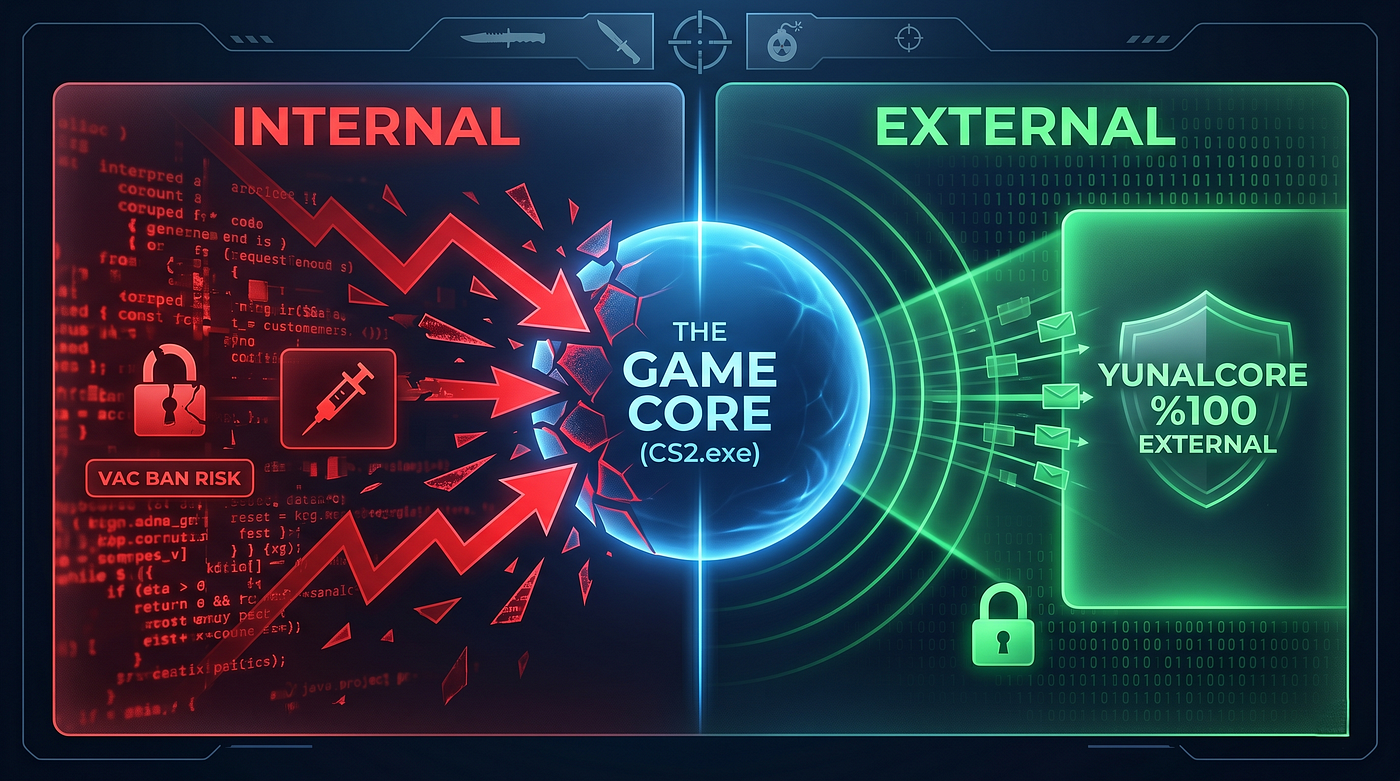
In the Counter-Strike 2 (CS2) ecosystem, “security” comes first — especially for players with thousands of dollars in inventory and high-tier Prime accounts. In this cat-and-mouse game where developers constantly update their anti-cheat systems, the architecture of the third-party software you use is the most critical factor determining your account’s fate.
There are generally two types of software architectures in the market: Internal and External. If you have a valuable account and don’t want to take unnecessary risks, let’s examine the technical details of why you should always choose an External architecture.
❌ Why Internal Architecture Carries a Massive Risk
Internal software, as the name suggests, attempts to infiltrate the “inside” of the game. These systems typically work by injecting a DLL (Dynamic-Link Library) file directly into the cs2.exe process.
The fundamental flaws of this method are:
- Writing to Memory (WriteProcessMemory): Internal software directly interferes with the game’s memory, altering game data and executable code.
- Function Hooking: They interrupt the original code execution and insert their own code (detours). VAC (Valve Anti-Cheat) is actively designed to scan for these anomalies and hooks.
- Forensic Traces: When a DLL is injected into the game, it leaves digital fingerprints in the Windows process tables. Anti-cheat systems don’t just check inside the game; they monitor these tables as well.
In short, using internal software is like trying to enter a bank vault by smashing the wall with a sledgehammer. It is practically impossible not to leave a trace.
✅ The Irresistible Advantage of External Architecture
External software operates on a completely different philosophy: Observation. An external system does not inject any code into the game. It runs as an independent, separate process (usually a standard .exe).
- Read-Only (ReadProcessMemory): External software writes nothing to the game’s memory. It only reads what is happening in real-time.
- Zero Interference: The game’s code, files, or memory regions are never modified.
- Transparent Overlay: Visual features (like ESP) are not drawn inside the game engine. Instead, they are rendered onto an invisible, transparent window (overlay) placed on top of your screen. The game isn’t even aware that there is a layer above it.
This method is like watching the inside of the bank through binoculars from a building across the street. Because you aren’t touching the vault, you don’t trigger the alarm.
🛡️ A Modern Case Study: YunalCore
To see how this architectural difference is applied in practice, we can look at **YunalCore**, a project I developed entirely as a solo developer.
Unlike standard software on the market, the core philosophy behind YunalCore was built entirely on “maximum stealth.” The system was engineered from the ground up to operate completely from the outside (100% External).
How YunalCore takes external architecture a step further:
- True Read-Only Process: Not a single byte is altered in the game’s memory space. This ensures that the game’s integrity checks always come up completely clean.
- Polymorphic Builds: Every user is provided with a uniquely compiled executable, completely nullifying signature-based detections.
- Dedicated Threads: Features like the Aimbot and Triggerbot do not hook into the game engine. Instead, they simulate mouse movements from the outside using dedicated threads with humanized delays.
Unlike bulky internal projects developed by large teams, this minimalist, external-only structure — driven by a solo developer’s vision — makes YunalCore the ideal tool for users looking to protect their valuable inventories.
Conclusion
In the CS2 ecosystem, your skins, service medals, and competitive rank represent years of effort. When utilizing third-party automation, testing, or assistant software, your most logical line of defense is staying far away from internal systems that violate the game’s memory. By only reading data without touching the game itself, external software reduces the risk of detection to an absolute minimum (and to zero, when designed flawlessly).
Security is not a coincidence; it begins with the right architectural choice. 100% External approaches offered by projects like YunalCore are the most modern standard of that security.
메타데이터
- post_id
- 2a8ddd893398
- slug
- account-security-in-cs2-why-external-architectures-are-superior-to-internal-software-2a8ddd893398
- url
- https://medium.com/@yunalcore/account-security-in-cs2-why-external-architectures-are-superior-to-internal-software-2a8ddd893398
- canonical_url
- https://medium.com/@yunalcore/account-security-in-cs2-why-external-architectures-are-superior-to-internal-software-2a8ddd893398
- author_url
- https://medium.com/@yunalcore
- status
- ok
- fetched_at
- 2026-06-09 14:42:20




