What If “In Water” Is Not the Ending of Silent Hill 2, but the Beginning?
An interpretive essay connecting the endings of Silent Hill 2 into a single cycle of death, denial, and release.
What If “In Water” Is Not the Ending of Silent Hill 2, but the Beginning?
An interpretive essay connecting the endings of Silent Hill 2 into a single cycle of death, denial, and release.
The book is available in English:
ENG: https://drive.google.com/file/d/1EJkLCbkCfnACVXBmzHYcBZAxD3yunKGy/view?usp=sharing
Major spoilers ahead: this essay discusses the central revelation and the main endings of both the original Silent Hill 2 and its remake.
This is an unofficial interpretation and artistic reconstruction. It is not presented as established canon.
We usually treat the endings of Silent Hill 2 as separate possibilities.
In Leave, James accepts the truth and walks away from Silent Hill with Laura. In In Water, guilt overwhelms him, and he drives into Toluca Lake with Mary’s body beside him. In Maria, he chooses a woman created by the town in his dead wife’s image, only to hear the first warning signs of the same illness. In Rebirth, he refuses to accept death at all and attempts to bring Mary back through an ancient ritual.
The remake adds Bliss, in which James consumes White Claudia and enters a happy videotaped memory where Mary is healthy and their tragedy appears never to have happened.
Each ending seems to offer a different fate. But what if they are not separate fates?
What if “In Water” is the beginning of James Sunderland’s journey — and “Leave” is its true conclusion?
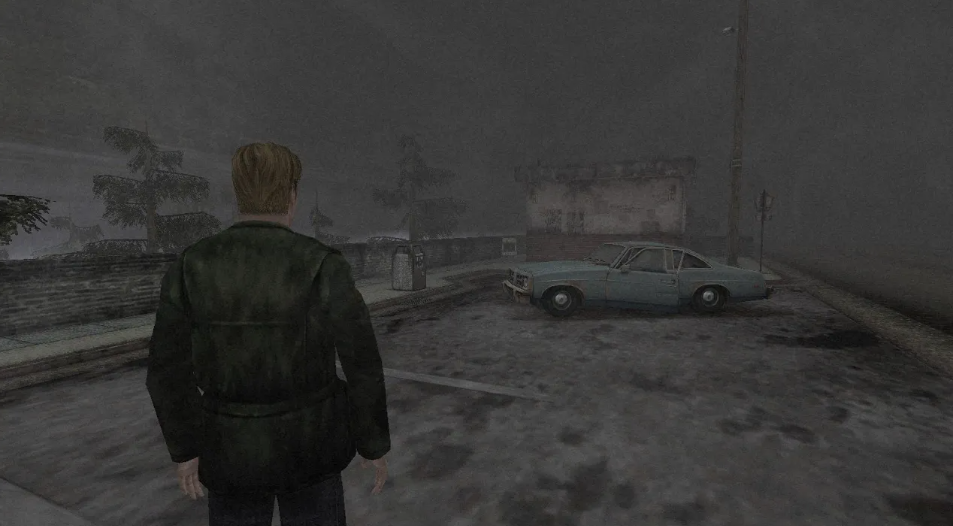
Silent Hill 2 (2001). Screenshot used for critical commentary.
Five Doors Leading into the Same Corridor
On the level of game mechanics, the endings depend on the player’s behavior. Silent Hill 2 quietly watches how we treat James: whether we protect his life, how often we examine Mary’s belongings, and how much attention we give to Maria.
Each ending reflects the emotional state in which James reaches the final threshold.
In Leave, he acknowledges what he has done, accepts Mary’s final words, and leaves the town with Laura.
In Maria, he turns away from Mary and chooses a woman shaped from his desires. Yet as they leave, Maria begins to cough. The tragedy is already preparing to repeat itself.
In Rebirth, James cannot accept the finality of death. He gathers the ritual objects and travels toward the island in Toluca Lake, hoping to bring Mary back.
In Bliss, he escapes even further. Instead of confronting the videotape, he enters a happier version of it — one in which Mary is healthy, loving, and untouched by the events that destroyed them.
Finally, in In Water, guilt becomes stronger than the desire to live. James enters the car with Mary’s body and disappears beneath Toluca Lake.
Usually, this is where the story ends.
But this is also where we can begin it again.
Through the Windshield of a Sunken Car
Let us imagine that after killing Mary, James really did bring her body to Silent Hill.
He could not return to his former life. He could not continue living with the knowledge of what he had done. At the edge of Toluca Lake, he made his final decision.
James drove the car into the water.
The vehicle sank. His physical life ended.
But Silent Hill did not allow him to rest.
Under this interpretation, the overlook at the beginning of the game is not the first arrival of a living man. It is a reconstructed starting point created for someone who has already died.
The real car may already be lying at the bottom of Toluca Lake, with Mary’s body inside it. What James sees beside the restroom is only a spectral copy: a familiar object recreated by the town, emptied of everything that might reveal the truth too early.
There is no water inside it.
There is no body.
There is no memory of the impact.
James sees his own car, but he does not recognize it as his grave.
He looks at himself in the mirror, gathers his thoughts, and begins searching for Mary — without understanding that he may already have arrived with her.
The journey begins beside a copy of the vehicle in which it may already have ended.

James at the overlook. The familiar beginning may also be a reconstructed memory.
In this reading, Silent Hill does not simply summon a guilty man. It builds a safe beginning for him.
The town removes the unbearable parts of the memory and replaces them with a mystery James is still capable of following: a letter from his dead wife, an empty car, and a road disappearing into the fog.
The truth is not erased. It is delayed.
James must reach it gradually, passing through streets, apartments, hospitals, prisons, and other people’s private hells. Only then can the town return him to the moment he has buried inside himself.
Each cycle may therefore begin in almost the same way.
A letter.
A mirror.
An empty car.
A path into the fog.
A Town That Benefits from Keeping James
Why would Silent Hill repeat this journey?
In my interpretation, the town is not a neutral judge that carefully delivers a fair punishment. It behaves more like a predatory environment that has learned how to feed on human suffering.
A person enters Silent Hill carrying trauma, fear, guilt, or violence. The town gives those feelings physical form. It turns them into corridors, monsters, rituals, and impossible spaces, then forces the person to move through their own inner catastrophe.
James is almost perfect nourishment for such a place.
He loves Mary and hates himself for killing her. He wants punishment, yet continues to hide from the truth. He wishes to let her go, but creates replacements for her. He searches for forgiveness while doubting that he deserves it.
There is enough contradiction inside him to sustain the town indefinitely.
As long as James continues to deny one part of the truth, Silent Hill can begin the process again.
The Bodies James Leaves Behind
Throughout Silent Hill 2, James encounters corpses that resemble him.
Some wear clothing similar to his. Others appear in places that seem disturbingly personal: in front of a television, inside an apartment, abandoned along the path through the town.
There are practical and symbolic explanations for this resemblance. The repeated model can be read as a production choice, a reflection of James’s self-destructive state, or a warning of the fate awaiting him.
But within the theory of a repeating pilgrimage, these bodies can be read differently.
They may be the remains of earlier attempts.
One James failed before reaching the truth. Another died in front of a television. Another collapsed somewhere on the streets. Each body marks a point at which a previous version of the journey ended.
The town does not clean away these failures.
It preserves them.
Silent Hill builds each new cycle over the remains of the last one, allowing James to walk past his own forgotten deaths without recognizing them.
The corpses are not necessarily proof that the cycle is real. But they become powerful visual evidence inside this interpretation: the town is filled with abandoned versions of the man who is still trying to escape it.
James does not recognize the dead because he no longer remembers being them.

A body resembling James. In a cyclical reading, it may become the remains of an earlier failed journey.
“Maria”: Rebuilding the Tragedy
The Maria ending may look hopeful for only a few seconds.
James defeats the final manifestation of Mary, turns away from his dead wife, and leaves Silent Hill with another woman. Maria resembles Mary, but she is healthier, more openly affectionate, and shaped around the desires James could never admit.
He appears to have chosen life.
Then Maria coughs.
James immediately tells her that she should do something about it.
The exchange is brief, but it destroys the illusion of escape. James has not accepted Mary’s death. He has replaced her with a more convenient version and carried the old relationship into a new body.
The conditions of the tragedy have already been restored.
Once again, James has a woman who resembles Mary.
Once again, illness has entered their relationship.
Once again, his first response contains anxiety, distance, and irritation.
The setting has changed, but the mechanism has begun moving in the same direction.
“Maria” does not break the cycle. It rebuilds its starting conditions.
Maria is therefore not a reward offered to James after his ordeal. She is one of Silent Hill’s most carefully designed traps.
The town gives him exactly what he believes he wants: Mary without the hospital room, without the resentment, and without the unbearable final years of illness.
But by accepting Maria, James also accepts the possibility of repeating everything that brought him to Toluca Lake.
He leaves the town without leaving the pattern behind.
Silent Hill only needs to wait.
“Rebirth”: Refusing the Finality of Death
In Rebirth, James chooses a different form of escape.
He does not replace Mary with another woman. He does not surrender to death. Instead, he attempts to reverse the loss itself.
After collecting the ritual objects hidden throughout Silent Hill, James carries Mary’s body toward the island in Toluca Lake. He intends to use the town’s ancient spiritual traditions to bring her back.
At first, this may seem like the most active ending.
James is no longer simply reacting to grief. He has made a decision, gathered the necessary objects, and committed himself to a purpose.
Yet emotionally, he remains trapped at the same point.
He cannot accept a world in which Mary is dead.
The ritual is not an act of acceptance. It is an attempt to force reality to return to the shape he wants.
James does not release Mary. He turns his grief into a ritual and calls it hope.
If the ritual fails, James remains bound to the same guilt and longing.
If it succeeds, the result may be even more dangerous.
Silent Hill rarely grants a desire without distorting it. The town does not restore what was lost in a clean or merciful form. It gives internal suffering a body.
A resurrected Mary may therefore become another manifestation shaped by James’s need, fear, and memory — less a returned person than a new prison created in her image.
The ending leaves the ritual unresolved, but within the theory of the cycle, its emotional meaning is clear.
James has still refused the one truth that might release him.
Mary is dead.
He killed her.
And no ritual can return them to the life they had before her illness.
Rebirth does not lead beyond the cycle. It carries James deeper into it.

The journey toward the island is not necessarily a path to restoration. It may be another descent into denial.
“Bliss”: Happiness Frozen on Film
The remake offers James an even more seductive escape.
In Bliss, he consumes White Claudia before watching the videotape in Room 312.
But the recording no longer reveals Mary’s death.
Instead, James appears inside a happy home video. Mary is healthy. She does not cough. The hospital, the resentment, and the murder seem to have disappeared.
They smile.
They embrace.
For a brief moment, the nightmare appears to have been corrected.
Then the camera returns to Room 312.
The chair in front of the television is empty.
James is gone.
He has not changed the past. He has disappeared into an edited version of it.
This is what makes Bliss more disturbing than its surface suggests.
James does not confront the truth and overcome it. He removes himself from the reality in which the truth exists.
The ending offers him a world without illness, guilt, or consequences — but also without movement.
There is no future inside the recording.
There is only one perfect moment, preserved and repeated.
The name Bliss is therefore deeply ambiguous. James may no longer suffer, but his peace depends entirely on ignorance. He receives happiness only by surrendering his ability to remember, change, or continue.
The most revealing detail is his clothing.
Inside the apparently happy memory, James still wears the same green jacket he wore throughout the events of the game.
This does not look like the historical James who originally stood beside a healthy Mary.
It looks like the present James — the man who has already crossed Silent Hill, killed its monsters, and approached the truth — entering the image from outside.
The jacket becomes a seam between memory and illusion.
It suggests that James has not returned to the past.
He has carried his current consciousness into a fantasy constructed from it.
“Bliss” does not free James from the cycle. It stops him inside a single frame.
In Maria, James replaces Mary.
In Rebirth, he tries to restore her.
In Bliss, he removes the reality in which he lost her.
All three endings offer relief without acceptance.
They differ in form, but each preserves the emotional wound that gives Silent Hill power over him.
The town does not need to drag James back by force.
It only needs to offer him a lie beautiful enough to choose for himself.

A happy memory — or a sealed room from which James will never need to awaken?
The Other Pilgrims of Silent Hill
James is not the only lost person moving through Silent Hill.
Eddie, Angela, and Laura are not merely supporting characters placed along his route. Each of them forces him to confront a part of himself that he would rather leave buried.
Eddie shows James what happens when suffering becomes permission to inflict suffering on others.
For much of the game, James looks at Eddie as though they belong to different moral worlds. Eddie is unstable, paranoid, and increasingly willing to kill anyone he believes is mocking him. James still imagines himself as a reasonable man caught inside an unreasonable nightmare.
That distance disappears when James kills him.
Standing over Eddie’s body, James can no longer think of murder as something committed only by monsters or madmen. He has taken a human life with his own hands.
The act does not reveal the truth about Mary immediately, but it creates a crack in his self-image.
James recognizes the weight of killing before he remembers whom he killed first.
Eddie forces James to see the murderer before he is ready to remember the victim.
Angela reflects a different part of James’s inner state.
She moves through a world shaped by abuse, guilt, fire, and the desire to disappear. Her suffering is not the same as his, and their actions cannot be morally equated. Yet James recognizes something in her hopelessness.
Both of them are searching for a person they have already lost.
Both are pulled toward a place associated with death.
And both carry, beneath their stated purpose, the possibility that they did not come to Silent Hill in order to return home.
Angela gives form to the self-destructive impulse James continues to hide beneath the language of love and reunion.
When she asks whether he would save her, his silence becomes part of the answer.
He cannot rescue Angela because he has not yet decided whether he himself deserves to survive.
Angela shows James the destination toward which his guilt has been quietly leading him.
Laura stands outside this shared world of punishment.
She moves through Silent Hill without seeing the monsters that define James’s journey. She remembers Mary not as a dying wife, a source of resentment, or an object of guilt, but as a living person who loved her.
That makes Laura dangerous to James’s illusion.
She carries memories of Mary that do not belong to him.
Through Laura, Mary is no longer only the woman James suffered beside, killed, and transformed into the center of his private tragedy. She becomes someone who formed relationships, offered affection, and imagined a future beyond her husband’s pain.
When James finally admits that he killed Mary, Laura does not grant him immediate understanding.
She accuses him.
She demands that he return the person he took from her.
Her anger prevents the confession from becoming a private ritual in which James forgives himself without facing anyone else’s loss.
Laura returns Mary to the world outside James Sunderland.
Together, these three encounters dismantle the story James has constructed around himself.
EddiЕe reveals his capacity to kill.
Angela reflects his desire for death.
Laura confronts him with a version of Mary that cannot be reduced to his guilt.
They do not absolve James.
They make absolution impossible without truth.
Only after passing through their suffering can he approach an ending that does not depend on replacement, resurrection, intoxication, or self-destruction.

Each companion reflects a different part of the truth James has tried to escape.
“Leave”: The Ending That Does Not Erase the Crime
Unlike the other endings, Leave does not offer James a way to reverse, replace, or forget what happened.
Mary remains dead.
James remains the person who killed her.
Nothing in the ending restores the life they lost or transforms his crime into an act of innocence.
Instead, James finally allows Mary’s letter to exist without turning it into another invitation, command, or excuse.
He listens.
He remembers.
And he accepts that love, exhaustion, resentment, and murder can exist inside the same history without cancelling one another.
This acceptance does not make him innocent.
It makes further denial impossible.
James leaves Silent Hill not because the crime has been erased, but because he has stopped trying to erase it.
In this interpretation, the final confrontation is not simply a battle against Mary or Maria.
James is destroying the last image he has created around his wife: Mary as the supreme judge of his afterlife.
Throughout the journey, he has transformed her into many things.
A lost woman waiting to be rescued.
A source of punishment.
A perfect memory.
A sick body.
A seductive replacement.
A dead wife whose voice continues to summon him.
By elevating Mary into the absolute center of his punishment, James denies her ordinary humanity. She becomes either a saint, a victim, a monster, or a god — but never simply a person who suffered, loved, became angry, and died.
The final creature embodies that distortion.
Mary — or Maria — is suspended inside a metal structure, trapped within the role James has assigned to her. She is no longer only the woman he remembers. She has become the architecture of his guilt.
Defeating this figure therefore does not mean defeating Mary herself.
It means breaking the shrine James built from her suffering.
Before Mary can rest, James must stop using her as the god of his punishment.
When the rusted structure collapses, Silent Hill loses its strongest hold over him.
The town does not suddenly become merciful.
It simply becomes unable to imprison a man who no longer feeds it with the same lie.
In Leave, Mary does not walk away with James and Laura.
Her absence is not a defeat.
It is her release.
She no longer needs Maria’s body, the metal frame, or the role of final judge. By destroying the private temple he has built around her, James gives Mary the right to disappear from his personal purgatory.
She is no longer required to remain his victim.
She is no longer required to forgive him.
She is no longer required to punish him.
She is finally allowed to be absent.

Mary’s absence may be the first moment in which James allows her to exist beyond his need for punishment.
James himself does not leave the cycle purified.
He carries the truth of the murder with him.
But acknowledged guilt functions differently from buried guilt.
While it remained hidden, it shaped the entire town around him. It became monsters, corridors, bodies, rituals, and repeated deaths.
Once accepted, it no longer needs to return in those forms.
The guilt does not disappear.
It changes from a rusted chain into a weight James is finally capable of carrying.
That distinction is essential.
Leave is not a declaration that James has suffered enough and therefore deserves forgiveness. Silent Hill does not possess the authority to absolve him, and the player is not required to do so either.
The ending only suggests that endless self-destruction is not the same thing as responsibility.
Punishment can repeat forever without producing understanding.
James leaves when he stops confusing suffering with atonement.
Endless punishment preserves the cycle. Responsibility makes departure possible.
James and Laura leave through a cemetery.
Within a conventional reading, it is simply the road out of Silent Hill.
Within the theory of a posthumous pilgrimage, it becomes a threshold.
The cemetery is not their destination. It is the edge of the abyss they are finally leaving behind.
James does not walk away lightly because he has been forgiven.
He walks away carrying the truth.
Laura walks beside him carrying a memory of Mary that does not belong to his guilt.
And Mary does not follow them because, for the first time, she no longer has to remain inside James Sunderland’s story.
Their departure is not a reward granted by the town.
It is the defeat of a predator.
Silent Hill can repeat the journey only while James continues to deny its central truth. Once that denial collapses, the town loses the wound from which it has been feeding.
Two figures cross the cemetery.
The letter is no longer bait.
The rust begins to lose its power.
And the cycle finally opens.

The cemetery is not the end of their path. It is the boundary they finally cross.
Not a New Canon, but Another Way of Seeing the Story
This interpretation does not prove that every ending of Silent Hill 2 officially happens in sequence.
The game was never designed to surrender itself to one final explanation. Its endings remain separate possibilities, shaped by the player’s behavior and by the emotional state in which James reaches the end of his journey.
That ambiguity is part of what has allowed the story to survive for so long.
But if we temporarily connect those endings, a different structure appears.
In Water becomes James’s physical death and the beginning of his posthumous pilgrimage.
Maria becomes an attempt to replace what he has lost.
Rebirth becomes an attempt to reverse the loss itself.
Bliss becomes an escape into a reality where the loss never happened.
And Leave becomes the only ending in which James neither destroys himself nor asks the town to rewrite the past.
He accepts that Mary is dead.
He accepts that he killed her.
And he continues forward without demanding that suffering make him innocent.
The endings no longer represent different answers. They become different stages of James’s refusal — or ability — to face the same truth.
Seen this way, Silent Hill 2 is not a story about selecting the correct conclusion.
It is a story about repeated failures to reach one.
James returns to Toluca Lake again and again.
He awakens beside a spectral copy of the car already resting beneath the water. He reads a letter from the woman whose body may still lie inside it. He enters the fog, crosses rusted corridors, witnesses the suffering of other lost souls, and approaches the memory he has buried.
Sometimes he chooses a replacement.
Sometimes he chooses resurrection.
Sometimes he chooses oblivion.
Sometimes he chooses death.
And each time he refuses the truth, the town gains another opportunity to begin again.
A new letter can appear.
The car can return to the overlook.
The mirror can show him a face he still does not recognize.
The road can disappear into the fog.

Every cycle can begin with the same empty car, the same mirror, and the same road into the fog.
Only Leave allows the pattern to change.
James does not recover the life he lost. He does not receive proof that he has been forgiven. He simply stops asking the town to protect him from reality.
That may be the most difficult form of release Silent Hill 2 can imagine.
Not purity.
Not absolution.
Not a happy ending created by forgetting.
Only the willingness to carry an unbearable truth without turning it into another monster.
James and Laura cross the cemetery.
Mary remains behind — not abandoned, but finally released from the roles James forced her to play.
The car remains at the bottom of Toluca Lake.
The rust remains beneath the surface.
But for the first time, the road does not lead James back to the water.
The fog begins to lift.
This essay is adapted from my Russian-language book-length project Rust at the Bottom of Toluca, an unofficial cultural analysis and artistic reconstruction of Silent Hill 2.
Future essays will explore Eddie, Angela, Laura, Maria, and the town itself in greater detail.
— Limonchik
메타데이터
- post_id
- 2a92c707cf74
- slug
- what-if-in-water-is-not-the-ending-of-silent-hill-2-but-the-beginning-2a92c707cf74
- url
- https://medium.com/@limonchik/what-if-in-water-is-not-the-ending-of-silent-hill-2-but-the-beginning-2a92c707cf74
- canonical_url
- https://medium.com/@limonchik/what-if-in-water-is-not-the-ending-of-silent-hill-2-but-the-beginning-2a92c707cf74
- author_url
- https://medium.com/@limonchik
- status
- ok
- fetched_at
- 2026-08-04 21:13:18