SendSwap: What Is a Non-Custodial Crypto Exchange? (And Why It Matters)
SendSwap: The difference between holding your keys and handing them to a platform — explained for instant swaps
SendSwap: What Is a Non-Custodial Crypto Exchange? (And Why It Matters)
SendSwap: The difference between holding your keys and handing them to a platform — explained for instant swaps
If you’ve searched non-custodial crypto exchange, you’re probably trying to understand one distinction: who holds the private keys while the trade happens? In custodial models, the platform does — at least temporarily. In non-custodial instant swaps, you send from your wallet and receive to your wallet, without a persistent platform balance in between.
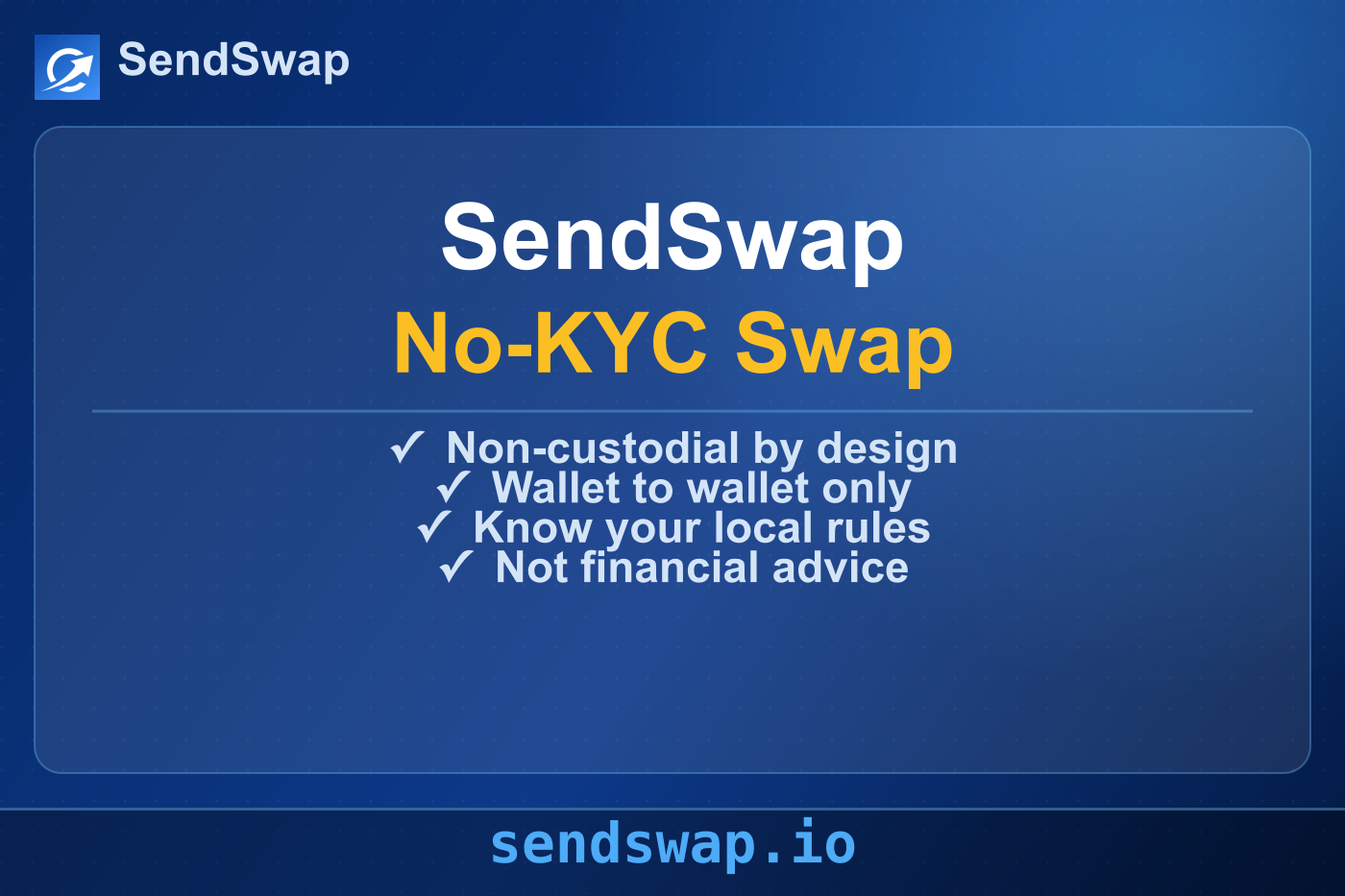
SendSwap is a non-custodial, no-KYC instant swap service: 2000+ assets, fixed or float rates, wallet-to-wallet settlement.
Custodial vs non-custodial — simple definitions
Custodial exchange or swap
- You deposit crypto to their address or account
- They credit an internal balance
- You trust them to process withdrawals, stay solvent, and protect data
- KYC is common because they hold customer funds
Non-custodial instant swap
- You send one asset from your wallet for a specific order
- Liquidity partners fulfill the trade
- Output goes to your receive address
- No ongoing “account balance” at the swap site
The non-custodial crypto exchange label fits when you never rely on a platform balance as storage.

Why non-custodial swaps grew popular
- Exchange hacks and insolvencies taught users that hot wallets and pooled balances are risk concentrations
- Self-custody movement — “not your keys, not your coins”
- Privacy preference — fewer incentives to upload ID for every hop
- Speed — instant swaps compete on UX without full CEX order books
SendSwap sits in the instant swap category: optimized for pair-to-pair moves, not margin trading or fiat ramps.
How a non-custodial swap works on SendSwap
- You select send asset and receive asset (network included in the pair).
- You provide a receive address you control.
- You send the deposit for that order only.
- SendSwap routes the swap; payout hits your wallet.
There’s no “withdraw” step because coins weren’t held in your name on a ledger — they moved through the swap pipeline.
Non-custodial doesn’t mean risk-free
You still face:
- Operational errors — wrong network, wrong address, expired orders
- Rate movement — especially on float orders during volatility
- Phishing — fake sites mimicking swap UIs
Non-custodial removes counterparty custody risk, not user diligence.
Non-custodial vs DEX vs CEX
CEX (centralized) — order books, accounts, often KYC, custodial balances.
DEX (decentralized exchange) — smart contracts, you approve tokens, on-chain swaps; gas and slippage on AMMs.
Instant non-custodial swap (SendSwap) — optimized cross-asset routing (including BTC, XMR, stablecoins across chains) without you managing AMM pools or bridge contracts directly.
Each tool fits different jobs. For BTC → USDT, ETH → XMR, or long-tail pairs, instant swaps often win on simplicity.
Who should prefer non-custodial swaps?
The non-custodial crypto exchange model fits if you:
- Already self-custody with hardware or software wallets
- Want to avoid KYC surface area for crypto-to-crypto hops
- Need cross-chain or cross-asset pairs without managing bridges manually
- Prefer one order, one deposit over maintaining exchange accounts
It fits less well if you need fiat on/off ramps, margin, or deep order-book limit orders — those remain CEX territory.
SendSwap in the non-custodial landscape
SendSwap focuses on speed and pair breadth (2000+ assets) rather than replicating a full exchange terminal. Fixed and floating rates, transparent quotes, and wallet-to-wallet settlement are the core product — not lending, staking, or custodial storage. That specialization is why many users pair SendSwap with their existing wallets instead of replacing them.
FAQ
Is SendSwap non-custodial?
Yes — designed for wallet-to-wallet settlement without holding user balances for withdrawal later.
Do non-custodial swaps require KYC?
SendSwap does not require signup or KYC for swaps. Regulations apply to you locally; this isn’t legal advice.
Can non-custodial services freeze my coins?
They don’t hold a balance to freeze; if you haven’t sent yet, you still control everything. After you send to an order deposit address, you’re in the swap pipeline — follow order status and support with order ID if needed.
Bottom line
Understanding non-custodial crypto exchange mechanics helps you choose tools that match self-custody values. SendSwap delivers instant, no-signup swaps across 2000+ assets — your keys on send and receive, no platform piggy bank in the middle.
Learn more at **sendswap.io**.
메타데이터
- post_id
- 2aa42b2f5e85
- slug
- sendswap-what-is-a-non-custodial-crypto-exchange-and-why-it-matters-2aa42b2f5e85
- url
- https://medium.com/@SendSwap/sendswap-what-is-a-non-custodial-crypto-exchange-and-why-it-matters-2aa42b2f5e85
- canonical_url
- https://medium.com/@SendSwap/sendswap-what-is-a-non-custodial-crypto-exchange-and-why-it-matters-2aa42b2f5e85
- author_url
- https://medium.com/@SendSwap
- status
- ok
- fetched_at
- 2026-08-29 10:14:15