Who Keeps Talking About the Last Wolf?
“…and all we ask is that you immortalize the experience, immortalize it entirely as you see fit… something that springs out of your…
Who Keeps Talking About the Last Wolf?
“…and all we ask is that you immortalize the experience, immortalize it entirely as you see fit… something that springs out of your thoughts about Extremadura, so you see we are perfectly clear about what we would like you to do.”
— László Krasznahorkai, The Last Wolf
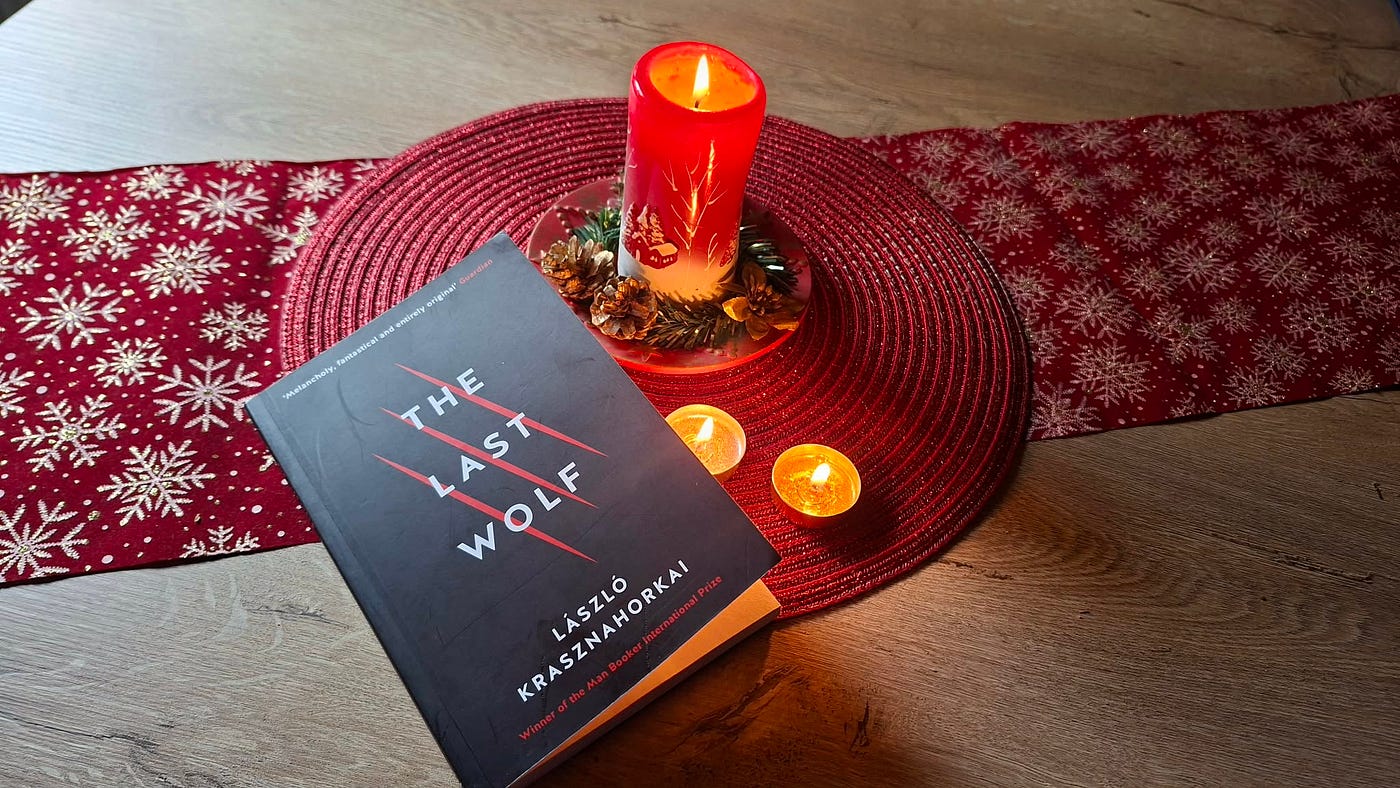
Re-reading some favorite parts at home, December 2025
There is a moment, as Krasznahorkai presents so beautifully, that a story is not simply told but is gasped out in a continuous sentence that does not seem to ever end, like the last breath of something once wild and alive. In the realm of workplace communication, I do not encounter the last wolf in Extremadura, but the phenomenon of the last voice still capable of honesty. When that voice finally evaporates or is made to disappear, something much larger and more important has died. Still, much like in Krasznahorkai’s novella, the daily life in the office continues as if nothing happened.
I have been in organizations that had its own version of “Extremadura”. I refer to a landscape where the last wolves now survive only in memory. Sometimes what disappears is not a species but a sensibility and courage to speak dissent, to highlight nuances, to showcase refusal, and to uphold conscience. When these go extinct, what remains is a kind of barren land where people wither to adapt themselves to whatever the environment demands: silence, complicity, the erasure of integrity.
In such landscapes, stories about “the last wolf” continue even after the wolf is gone. Such stories are retold, reshaped, embellished, and more often than not weaponized. I have experienced how twisted narratives about people survive longer than the people themselves. Such a workplace can go on retelling someone else’s story long after that person has left, even by those who never even met them. It is as if the disappearance becomes an invitation for mythmaking. Over time, the “wolf” becomes a legend, a symbol, especially a cautionary tale but is never depicted in the truest of its story, a human being who simply tried to speak and belong.
And once the wolves go extinct, everyone else simply goes on in a faded version of who they started out to be. They give consent for the silence to become normal. They become willing accomplices in turning the absence into a story that keeps mutating, told with great certainty by those who were never there.
Does the extinction happen only once, or does it repeat each time the story is told incorrectly, each time office people choose to preserve a lie rather than examine a truth?
Perhaps this is Krasznahorkai’s quiet warning: extinction does not end with the death of a species. It continues in the stories we tell after. And maybe the real question is not who killed the last wolf, but who keeps resurrecting it as a monster long after it is gone. In that person we find the answer why they did it.
Each week, I take a book off the page into real life, translating stories and themes into how we work, lead, grow, and connect. These are not book reviews, but reflections: part literature, part lived experience, part observations. Through my passion for literature, I explore the many dimensions of workplace communication. Perhaps you will discover a book that speaks to where you are right now.
Exploring workplace communication through the lens of great books!
메타데이터
- post_id
- 2ac1db242557
- slug
- who-keeps-talking-about-the-last-wolf-2ac1db242557
- url
- https://medium.com/@jamlinda/who-keeps-talking-about-the-last-wolf-2ac1db242557
- canonical_url
- https://medium.com/@jamlinda/who-keeps-talking-about-the-last-wolf-2ac1db242557
- author_url
- https://medium.com/@jamlinda
- status
- ok
- fetched_at
- 2026-06-09 15:37:30