Liquid Nitrogen as Emergency Cooling: A First-Principles Hypothesis Nobody Has Built Yet
The Heat Problem Is Getting Out of Hand
Liquid Nitrogen as Emergency Cooling: A First-Principles Hypothesis Nobody Has Built Yet
The Heat Problem Is Getting Out of Hand
AI infrastructure is scaling faster than most people expected — and the thermal consequences are compounding.
GPU accelerator power has roughly tripled in four years — from 400W with the A100 to over 1,200W in full-spec Blackwell B200 configurations — and rack-level thermal loads have followed. GB200 NVL72 systems already operate at 132 kW per rack; NVIDIA’s Rubin Ultra roadmap targets 600 kW by 2027, with Vertiv projecting 1 MW by 2029. The cooling infrastructure required to support these densities has scaled accordingly: liquid-based cooling captured an estimated 46% of the data center cooling market by revenue in 2024 (Mordor Intelligence). But scaling liquid cooling adoption also scales the consequences when liquid cooling fails.
That’s the backdrop for everything that follows.
Cooling Failures Are Sometimes More Dangerous Than Servers Going Down
This is the first argument I want to make — because I think it’s under-discussed.
When power goes out, servers shut down. Heat generation drops rapidly. The damage is downtime and data loss, but the thermal situation stabilizes and hardware typically survives intact.
When cooling fails while power stays on, the situation is fundamentally different. Servers continue running at full load, heat accumulates with nowhere to go, and a clock starts the moment the first temperature alarm fires. The damage is also categorically different: chips running at sustained high temperatures cause permanent physical harm — micro-cracks in solder joints from thermal cycling, electromigration in conductive pathways, PCB delamination, and in 3D-stacked chip packages now standard in AI accelerators, heat trapped between dies can cause warping and fracture. This damage is irreversible. At up to $70,000 per GB200 superchip and over $3 million per NVL72 rack — per HSBC analyst estimates — the hardware stakes of a cooling failure in 2025 are of a different order of magnitude than they were five years ago.
According to Uptime Institute survey data, cooling-related failures have consistently been the second-largest cause of data center outages, accounting for between 13% and 19% depending on the year — behind only power failures. As rack densities continue rising, the margin between designed cooling capacity and actual thermal load narrows — making cooling failures both more likely and faster-moving when they occur.
When a Cooling Failure Hits, the Response Window Is Narrow
The fastest backup options operate on very different timescales: while modern CDUs with redundant pumps can achieve automatic failover in under a second in ideal configurations, thermal stabilization across the full cooling loop — pressure re-establishment, flow redistribution to coldplates — can take considerably longer in practice. Emergency chillers need around 2 minutes. Mobile precision cooling units take 30 minutes or more to deploy. Experimental data shows a 15 kW blade server chassis can reach thermal shutdown within 60 seconds of cooling loss (per Active Power White Paper 105) — for higher-density AI GPU servers, this window is likely considerably shorter.
CDU redundancy handles most single-component failures well. But it assumes the cooling loop itself remains functional — that there is coolant to pump, pressure to maintain, heat to reject. A primary loop leak, a heat exchanger fouled by poor water chemistry, an AI workload spike that overwhelms total cooling capacity, a maintenance valve closed in the wrong sequence — these aren’t CDU failures. They’re cooling loop failures. In those scenarios, pump redundancy alone cannot compensate, because the problem isn’t the pump. It’s the medium.
Uptime Institute data shows 54% of significant outages cost over $100,000. A 2016 Ponemon Institute study sponsored by Emerson Network Power (now Vertiv) found an industry average of $9,000 per minute in downtime losses — a figure widely cited since. Around 80% of outages are assessed as avoidable in retrospect. We know the problem occurs, we know the cost, and we know that human response rarely moves fast enough once the thermal clock starts.
An Old Material, A Different Logic
Existing backup cooling faces two distinct failure boundaries. The first is speed: even the fastest CDU switchover takes tens of seconds while chip thermal shutdown happens in seconds. The second is more fundamental: when the cooling loop medium itself is unavailable, no redundant CDU can help — they all depend on the same failed infrastructure. What’s needed is a completely independent cooling source that can step in directly when the primary loop is gone.
Liquid nitrogen is cold enough, and the basic heat removal mechanism is real — overclocking communities have used it for years to push chips past their thermal limits, confirming the underlying physics, even if that context is very different from data center emergency cooling. Continuous LN2 cooling is expensive and impractical for normal operations. But emergency scenarios follow a different logic: the comparison isn’t LN2 cost versus operating budget — it’s LN2 cost versus the cost of what you’re about to lose.
Has anyone tried this direction? The literature is instructive. Researchers have experimentally validated LN2-based emergency cooling for nuclear plant data centers using finned-tube heat exchangers. Multiple USPTO patents cover passive, pressure-driven LN2 emergency systems. Passive safety injection components such as accumulators have existed in commercial PWR designs since the 1970s; fully integrated passive ECCS designs — pressure-driven, responding within seconds, without external power — entered commercial operation with the Westinghouse AP1000 in 2018.
Every existing publicly documented implementation, however, stops at the room level. LN2 cools the air; air cools the chip. No publicly available research has closed the last mile. The gap is not component availability — cryogenic coldplates, solenoid valves, and dry-nitrogen standby circuits all exist commercially. The gap is system integration, control architecture, and validation at the chip level.
The Proposal: A Stacked Backup Coldplate
The simplest implementation I can envision is a stacked configuration.
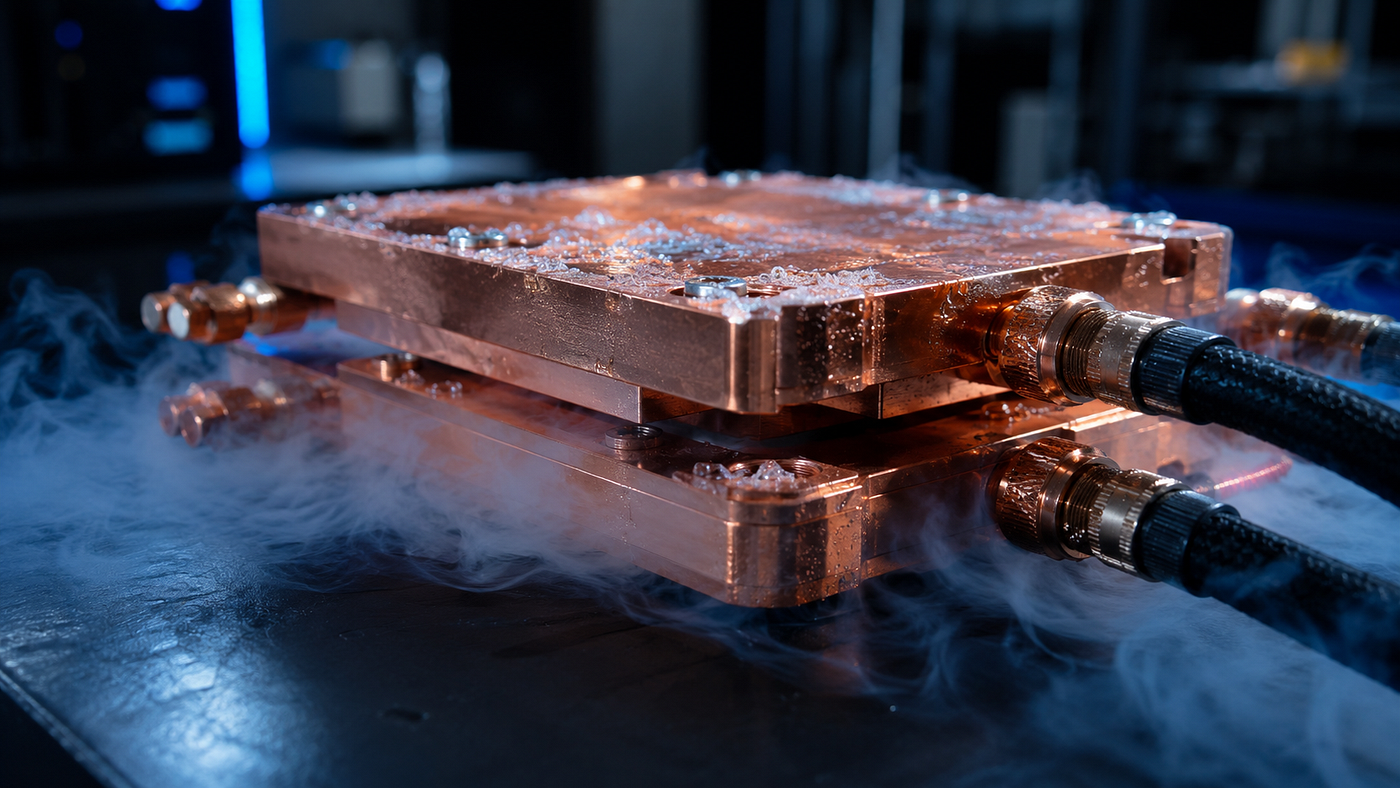
Take an existing liquid-cooled server. Add a second coldplate above the primary one — thinner, lighter, designed purely for emergency use. The backup plate sits dormant, channels filled with dry nitrogen at positive pressure to reduce moisture ingress and ice formation risk. When primary cooling fails, a temperature sensor — cross-confirmed with primary loop flow data to avoid false triggers — opens a solenoid valve. Pressurized LN2 flows into the backup coldplate. A closed-loop temperature control system limits the chip-side interface temperature to a provisional minimum of approximately –40°C — selected conservatively based on JEDEC published storage temperature floors for advanced packaging (typically –40°C to –55°C), and on the assumption that emergency operation is brief and non-cyclic. Full package qualification under cryogenic transient conditions would be required to establish real operating limits; this figure is a starting constraint for experimental design, not a validated specification. Two copper plates between the LN2 and the chip provide some thermal buffering — though the actual effect depends on plate thickness, contact resistance, and heat flux, and needs measurement, not assumption.
Some things need honest acknowledgment. The primary coolant loop could remain hydraulically separate, but the thermal-mechanical stack requires redesign — clamping load, TIM compression, package flatness, and service procedures all change when mass is added above the primary coldplate. Facility operations also change: cryogenic storage, pressure vessels, nitrogen venting, oxygen monitoring, and staff training are real operational additions. Gas-phase nitrogen should be routed outside the building per applicable safety codes — oxygen displacement is a genuine risk.
Chilldyne already ships hybrid coldplates combining liquid cooling with passive air-cooling fins as backup — the dual-path logic is commercially validated, though LN2 backup involves materially different thermal behavior and control complexity. The hardware material cost of an LN2 backup system runs roughly $8,000 to $15,000 per protected cluster in components — full lifecycle cost including certification, qualification, and operational burden would be the real economic question. Even so, at an industry-average downtime cost of $9,000 per minute (Ponemon Institute, 2016), the case is worth serious analysis for systems where tens of seconds of thermal shutdown is categorically unacceptable.
What I Don’t Know — And Why That’s the Point
This is a first-principles engineering hypothesis, not a validated system.
The thermal response time at chip level has never been measured. The closed-loop control architecture needed to hold interface temperatures within safe bounds is an open engineering problem. Long-term seal behavior under multi-year dry-nitrogen standby is unknown. Two-phase flow in microchannels under variable heat flux needs characterization. The full failure mode table — false activation, stuck-open valve, sensor drift, tank depletion, overcooling — has not been written. These are not reasons to dismiss the concept. They are the scope of work needed to move it from hypothesis to engineering proposal.
What the literature confirms: LN2 emergency cooling works at room level. Dual-path coldplate logic is in commercial production. Cryogenic systems can be designed for passive, power-independent activation. A first bench test — controlling for condensation, cryogenic handling, and failure containment — would be the right starting point.
The Gap Is Real. The Answer Is Open.
Redundant CDUs cover most cooling failures. But there are three scenarios they cannot address: response too slow for the thermal window; cooling medium itself unavailable; and liquid cooling running but unable to keep up with localized heat accumulation. Nvidia’s GB200 NVL72 — a fully liquid-cooled 72-GPU rack — experienced widely reported overheating in deployments in late 2024, requiring multiple supplier-level rack design revisions; analysts at Semianalysis characterized the reworks as routine engineering iteration, though the episode illustrates that liquid cooling running does not automatically mean liquid cooling sufficient.
For all three scenarios, no chip-level emergency intervention currently exists. As rack densities climb toward 600 kW on published roadmaps, the thermal consequences of cooling failure scale proportionally — and the response window does not.
Chip-level LN2 emergency cooling is a first-principles hypothesis, not a validated system. The bench work needed to test it is defined: thermal response characterization at the chip interface, closed-loop control architecture for temperature-bounded LN2 flow, long-term seal validation under dry-nitrogen standby, and a complete failure mode analysis. None of this requires new materials or undiscovered physics. It requires someone to run the experiment.
If you work in data center thermal engineering, liquid cooling system design, or high-reliability compute infrastructure — and you see a flaw in this reasoning — I’d like to know specifically where it breaks down. And if the gap this describes matches something you’ve encountered in the field, that’s worth a conversation too.
Statistics are cited with sources in the references below. Engineering reasoning and design assumptions represent the author’s own first-principles analysis — a hypothesis for industry discussion, not a validated system.
References
Key statistics and claims are linked inline in the text. Core academic and patent sources below.
- Uptime Institute. Annual Outage Analysis 2024. https://uptimeinstitute.com/resources/research-and-reports/annual-outage-analysis-2024
- Ponemon Institute / Emerson Network Power. “2016 Cost of Data Center Outages.” https://www.vertiv.com/en-emea/about/news-and-insights/news-releases/2016/emerson-network-power-study-says-unplanned-data-center-outages-cost-companies-nearly-$9000-per-minute/
- Active Power. “Data Center Thermal Runaway.” White Paper 105. https://powertechniquesinc.com/wp-content/uploads/2015/08/Active-Power-WP-105-Data-Center-Thermal-Runaway.pdf
- Wang et al. “Impact of a novel emergency cooling system on data center environment under long-term power failure.” Applied Thermal Engineering, 2024. https://doi.org/10.1016/j.applthermaleng.2024.122940
- Wang et al. “Experimental research on the influence of a novel passive cooling system on the data center temperature distribution.” Energy and Buildings, 2023. https://doi.org/10.1016/j.enbuild.2023.113651
- USPTO Patent US9484119 — Liquid nitrogen emergency cooling system for nuclear power plants
- USPTO Patent US10522256 — Emergency and back-up cooling using liquid nitrogen with thermally activated release
- Data Center Dynamics. “Nvidia redesigns 72-GPU AI server racks after Blackwell GPUs overheat.” 2024. https://www.datacenterdynamics.com/en/news/nvidia-redesigns-72-gpu-ai-server-racks-after-blackwell-gpus-overheat-report/
메타데이터
- post_id
- 2acda5ed2a5a
- slug
- liquid-nitrogen-as-emergency-cooling-a-first-principles-hypothesis-nobody-has-built-yet-2acda5ed2a5a
- url
- https://medium.com/@carson.r.zhang/liquid-nitrogen-as-emergency-cooling-a-first-principles-hypothesis-nobody-has-built-yet-2acda5ed2a5a
- canonical_url
- https://medium.com/@carson.r.zhang/liquid-nitrogen-as-emergency-cooling-a-first-principles-hypothesis-nobody-has-built-yet-2acda5ed2a5a
- author_url
- https://medium.com/@carson.r.zhang
- status
- ok
- fetched_at
- 2026-06-24 11:06:28