Ebola at a Crossroads
Briefing article on the Bundibugyo outbreak, outbreak control, and what clinicians should watch for.
Ebola at a Crossroads
Briefing article on the Bundibugyo outbreak, outbreak control, and what clinicians should watch for.
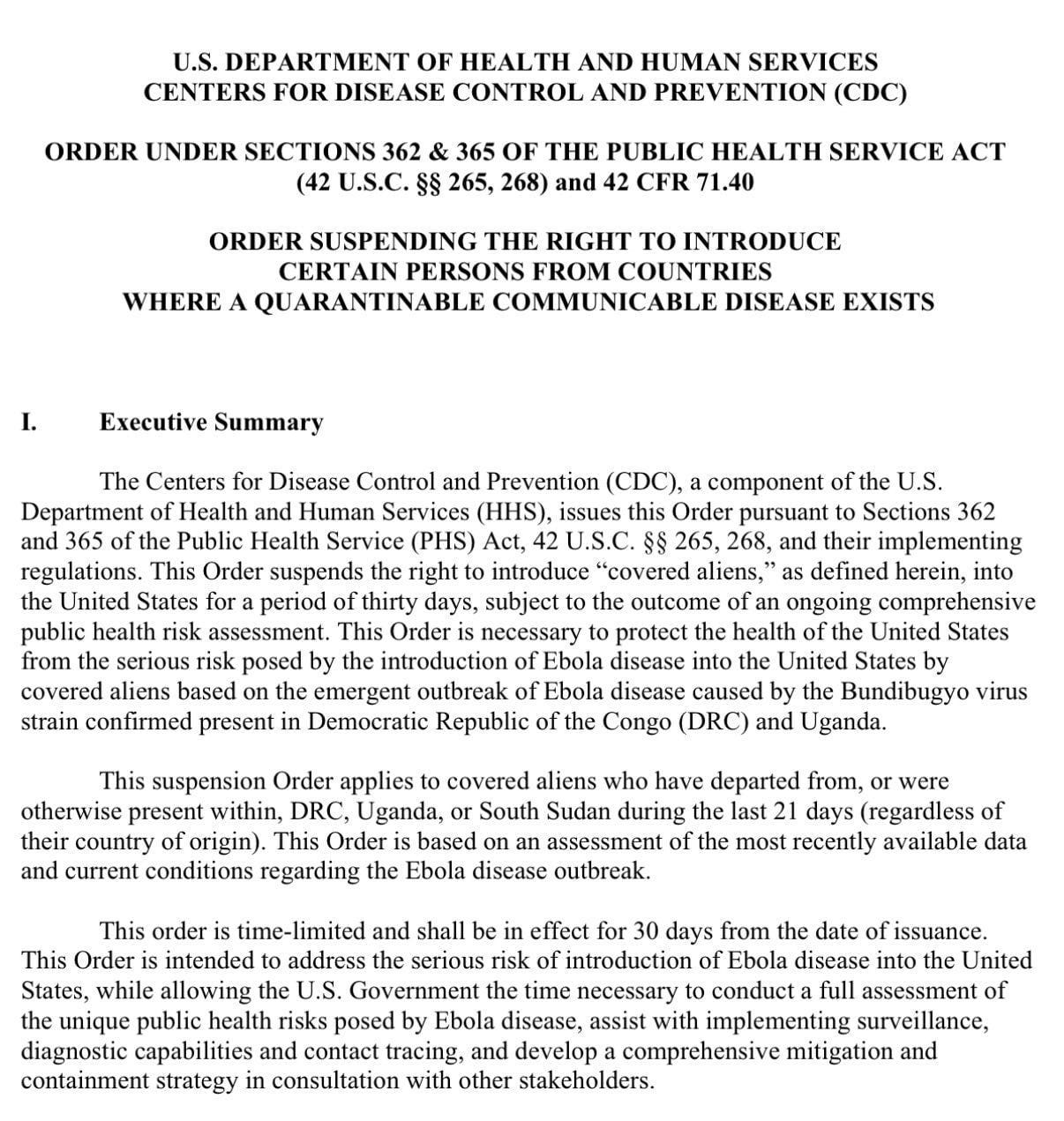
Executive summary As of 20 May 2026, reporting from Reuters and AP indicates that the current Ebola event in the Democratic Republic of the Congo and Uganda is being treated by WHO as a serious national and regional emergency, with roughly 51 confirmed cases in Congo, two confirmed cases in Uganda, nearly 600 suspected cases, and 139 suspected deaths under investigation; WHO’s assessment is that the global spread risk is low while the national and regional risk remains high. [1][2]
The likely operational lesson for clinicians is simple: do not wait for classic haemorrhage before isolating a suspect patient. Early Ebola frequently begins as a nonspecific febrile illness and can mimic malaria, typhoid, dengue, and other endemic infections. [3][4] For Bundibugyo Ebola specifically, the key limitation is countermeasure scarcity.
Reuters reported that there is no currently available vaccine for this strain, which raises the importance of diagnosis, triage, infection prevention, safe burial practice, and rapid contact tracing. [2] For India, and especially Kerala, the practical issue is preparedness rather than panic.
The right response is travel-history screening, immediate isolation pathways, trained PPE use, sample routing to designated reference laboratories, and disciplined communication that avoids sensationalism. Key facts at a glance Domain Clinical significance Agent Bundibugyo ebolavirus is one of the Ebola virus species associated with severe viral haemorrhagic fever.
Transmission Direct contact with infected blood or other body fluids, contaminated materials, and high-risk caregiving or burial practices. Incubation Commonly 2–21 days; early symptoms can be nonspecific. Clinical priority Immediate isolation, supportive care, and infection prevention and control. Countermeasures Approved tools are limited for Bundibugyo; current response depends heavily on supportive care and public-health containment.
Public-health posture High vigilance in affected regions; low global spread risk if containment remains intact.
- The outbreak in context
- The present outbreak should be read in two registers at once. First, it is a local and regional outbreak in central/eastern Africa with immediate case-finding and containment implications. Second, it is a test of whether modern outbreak systems can still move fast enough when the pathogen is rare, the geography is difficult, and public confidence is fragile. [1][2] What makes Ebola operationally different from many other viral threats is not only the severity of disease, but the route of spread.
- Ebola is transmitted by direct contact, not by casual airborne spread. That distinction matters because it makes careful barrier nursing, strict isolation, and decontamination decisive interventions rather than optional extras. [3][4]
- This is also why the current episode has triggered concern even among experienced clinicians: a virus that is difficult to recognise early, difficult to control once healthcare workers are exposed, and difficult to manage in crowded urban or conflict-affected settings can outpace weaker response systems.
Why Bundibugyo deserves special attention Bundibugyo Ebola is not simply a minor edition of the Zaire strain. It is a distinct Ebola virus species with different epidemiology and a different countermeasure landscape. Historically, Bundibugyo has tended to show lower case fatality than the most severe Zaire outbreaks, but “lower” does not mean low. It remains a serious haemorrhagic fever capable of severe dehydration, shock, multiorgan failure, and death. [4][5]
- The immediate practical challenge is that standard frontline systems often optimised for more common febrile syndromes can miss the diagnosis early. If a patient is first treated as malaria, typhoid, or dengue without a travel history and exposure history, precious time is lost.
- In Ebola control, time is biology. [3][4] A second challenge is caregiver risk. Historical outbreaks repeatedly showed that healthcare workers become infected when triage, PPE, needle safety, or ward segregation fail. This is the reason Ebola planning has to be built into emergency departments, fever clinics, ambulance services, mortuary services, and laboratory chains at the same time.
- Diagnostic discipline: what experts should look for The most common diagnostic error in an emerging Ebola situation is to over-rely on the presence of bleeding. By the time frank haemorrhage appears, the patient may already be clinically advanced. The better trigger is a compatible febrile illness plus exposure risk: travel to an affected area, contact with a suspected or confirmed case, participation in caregiving, funeral exposure, or contaminated material contact. [3][4]
- Clinicians and triage nurses should therefore operate on a low threshold for isolation.
The sequence is straightforward: screen, separate, protect, sample, and communicate. Any patient with a concerning exposure history should be placed in an appropriate isolation area before routine processing continues.
- Laboratory testing must be handled through designated pathways. Open-bench handling of suspect samples is not acceptable in a low-resource or general hospital environment. The correct model is controlled transport, reference-laboratory testing, and immediate public-health notification if suspicion is high.
- Clinical management: what actually saves lives For Bundibugyo Ebola, the treatment philosophy is still predominantly supportive: aggressive fluid and electrolyte replacement, haemodynamic monitoring, management of vomiting and diarrhoea, treatment of pain and fever, nutritional support, and prompt treatment of co-infections where appropriate.
- Supportive care is not a consolation prize in Ebola; it is a life-saving intervention. [3][4] The most important bedside priorities are maintaining circulation, correcting dehydration, preserving renal perfusion, and avoiding secondary infections.
- Patients should be managed by staff trained in high consequence infection control, with attention to line safety, waste management, sharps control, and environmental cleaning.
- Mortality is also shaped by speed of access. In practical terms, a patient who reaches care early, receives fluids early, and is isolated early has a materially better chance than a patient who is recognised late or moved through multiple unprotected facilities.
Why India must stay vigilant — and why Kerala is unusually well placed India does not need panic to justify preparedness.
It needs disciplined anticipation. Large population density, extensive international travel, and busy hospital corridors mean that even a single imported case would require rapid, exacting control measures. The first line of defence is not technology. It is triage behavior: ask about travel, ask about exposure, and isolate before the patient circulates through crowded spaces. For any patient with acute fever and a relevant travel history, the default should be containment until proven otherwise.
Kerala has a practical advantage because its public-health system has repeatedly demonstrated the ability to investigate clusters quickly, trace contacts aggressively, and use decentralised community structures. In outbreak terms, the state is used to moving information from community to clinic faster than transmission can move from one household to another. That does not make Kerala invulnerable.
It means Kerala is better positioned than many places to convert vigilance into action. The correct message is not “we are safe no matter what.” The correct message is “we have better muscles for the response if the first case appears.”
What healthcare workers should do immediately Operational step Why it matters Ask about travel and exposure at triage Early Ebola mimics common tropical febrile illnesses. Isolate before routine workup Prevents contact spread in waiting areas and wards. Use full PPE correctly every time Healthcare workers are a known high-risk group. Route samples through designated labs Avoids laboratory exposure and false reassurance.
Coordinate with public health immediately Contact tracing and case-finding start with the first call.
What the 2014–2016 West African epidemic changed
The 2014–2016 West African epidemic remains the defining modern lesson in Ebola governance. It exposed the cost of delayed recognition, weak surveillance, fragmented communication, and under-resourced field response.
The outbreak forced global institutions to move from reactive warning to more structured preparedness. Three reforms matter most. First, outbreak governance became more operational, including stronger emergency response architecture inside WHO.
Second, the R&D ecosystem moved toward pre-positioned vaccine and diagnostic development, so that the next crisis would not begin from zero.
Third, external evaluation and health-system readiness became more visible, because self-reporting alone had proved too optimistic.
The deeper lesson is cultural as much as technical: communities do not comply with outbreak guidance simply because guidance exists. Trust, communication, and respectful burial practice are all part of containment.
What should be handled cautiously In any fast-moving outbreak, the information environment often becomes noisier than the pathogen.
Numbers change, names change, and speculation can travel faster than laboratory confirmation.
That is exactly why current claims should be tied to dated public-health reporting.
A number of highly specific statements that circulate online during outbreaks — exact policy attributions, exact vaccine timelines, exact case counts, or exact diagnostics used by every laboratory — should be treated as provisional until they appear in official bulletins or directly verifiable reporting.
For clinicians, the safest practice is not to repeat every dramatic claim. It is to act on the parts that matter immediately: isolate, protect staff, communicate with public health, and avoid premature reassurance.
Bottom line
The current Bundibugyo Ebola situation is serious because it combines a dangerous pathogen, delayed recognition, and an operational environment that is difficult for public health to control. It is not a reason for panic. It is a reason for disciplined triage, strong infection control, careful communication, and immediate reference-laboratory pathways. For India, and especially Kerala, the most useful posture is steady vigilance: assume an imported case would be manageable only if the first response is fast, trained, and uncompromising. That is where the real defence lies.
Source notes and references
[1] Associated Press. ‘WHO says risk of global spread of Ebola outbreak is low, but high at national, regional levels.’ 20 May 2026. [2] Reuters. ‘Ebola likely circulating in Congo for two months, outbreak to grow, WHO says.’ 20 May 2026. [3] World Health Organization. Ebola disease overview / emergency updates. [4] U.S. Centers for Disease Control and Prevention. Ebola virus disease: clinical overview, transmission, and infection control guidance. [5] Historical Ebola outbreak literature on Bundibugyo ebolavirus, case fatality patterns, and outbreak response. si=epq2DkORPkID
find Source URLs Associated Press article: https://apnews.com/article/2bbfe841ed70b824d27c5adfd659edf7 Reuters article: https://www.reuters.com/business/healthcare-pharmaceuticals/who-says-139-suspectedebola-deaths-congo-outbreak-numbers-expected-rise-2026-05-20/ World Health Organization (Ebola emergencies): https://www.who.int/emergencies/disease-outbreak-news/item/2026-DON-Ebola U.S. CDC Ebola page: https://www.cdc.gov/ebola/ ECDC main site: https://www.ecdc.europa.eu/en
메타데이터
- post_id
- 2adc5ab19fb6
- slug
- ebola-at-a-crossroads-2adc5ab19fb6
- url
- https://medium.com/@eanaskincare/ebola-at-a-crossroads-2adc5ab19fb6
- canonical_url
- https://medium.com/@eanaskincare/ebola-at-a-crossroads-2adc5ab19fb6
- author_url
- https://medium.com/@eanaskincare
- status
- ok
- fetched_at
- 2026-06-09 15:37:30