How Good Does the Music Have to Be Before We Stop Looking?
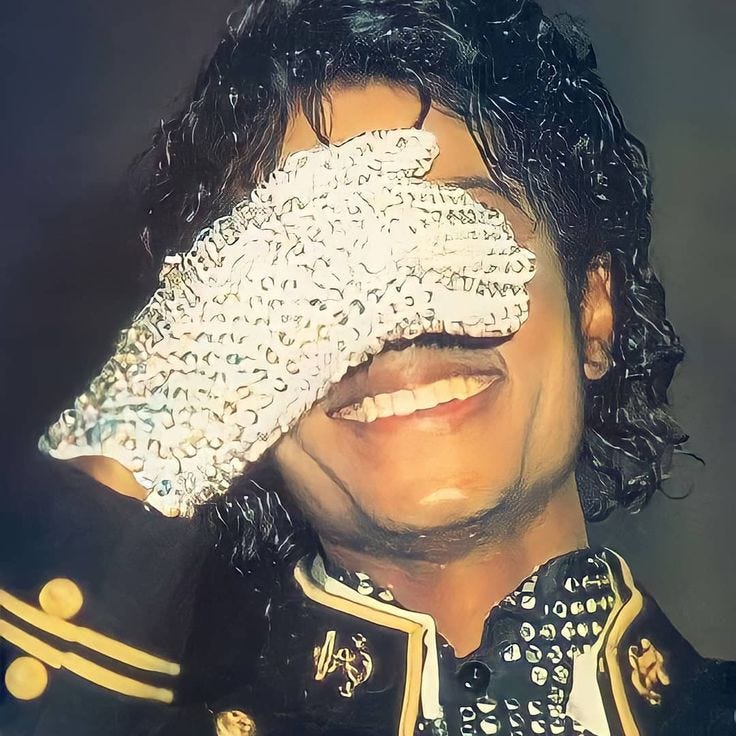
A society of shining gloves.
How Good Does the Music Have to Be Before We Stop Looking?
A society of shining gloves.
Imagine, for a moment, that he is not Michael Jackson.
Not the glove. Not the moonwalk. Not the impossible falsetto. Not the child who sang like an adult had already suffered inside him. Not the man whose music entered weddings, kitchens, funerals, car rides, talent shows, birthday parties, and the private weather of millions of people who never met him.
Imagine he is simply a man in your neighbourhood.
You hear that children have slept in his bedroom. You hear that, after earlier child sexual abuse allegations, he still described sharing sleeping space with children as something innocent and loving. You hear that, in a later criminal trial, jurors were shown books seized from his bedroom years earlier that included images of nude and swimsuit-clad boys. You hear that he denied wrongdoing. You hear that he was acquitted. You hear that other people, years later, still say something happened.
What would you do with that information if there were no music attached to it?
Not what would a court do. Not what would a fan page do. Not what would a documentary do. What would you do? How much context would you need before your alarm became active? How quickly would “that is disturbing” become “but his childhood was stolen from him”? How soon would you reach for trauma as explanation? How soon would you reach for genius as evidence of innocence?
This is not an article about proving Michael Jackson guilty. The courts did what courts do, and the record must be spoken about carefully. He was acquitted in 2005, and an acquittal matters. The state did not prove its case beyond the required standard. That fact cannot be treated like a minor footnote just because the surrounding story feels morally unresolved. But an acquittal is also not the same thing as emotional closure, historical certainty, or innocence in the imagination of everyone who watched. It is a legal outcome. It has weight, but it does not end the questions that continue to gather around fame, harm, memory, and belief.
This is also not an article pretending that art stops being beautiful because the artist becomes difficult to look at directly. That would be too easy, and worse, dishonest. I still listen to artists whose names have become morally complicated. I still know what it feels like to have a song arrive before my ethics can gather themselves. I know the unsettling experience of loving something made by someone I do not know how to morally hold.
This is an article about that gap.
The gap between the song and the allegation. The gap between what we would fear in an ordinary person and what we explain in a famous one. The gap between innocence as a legal condition and innocence as something the public donates to people it cannot bear to lose. The question is not simply whether bad people can make good art. They can. History has already answered that in too many ways to count. The more frightening question is what good art does to us when the person who made it is accused of doing harm. Does beauty make us slower to believe? Does talent make us more patient? Does fame give a person access to forms of psychological tenderness that ordinary people are rarely granted?
Because this is what seems to happen again and again. A regular person is accused, and suspicion arrives immediately. A famous person is accused, and biography arrives first. Childhood. Pressure. Addiction. Loneliness. Exploitation. Misunderstanding. Genius. The public begins building rooms inside the accused person before it has even finished listening to the accusation. That does not mean every accusation is true. False accusations exist, and due process exists for a reason. But the asymmetry is still worth staring at. Some people are met first as threats. Others are met first as tragedies.
Michael Jackson may be the clearest example because he is not just an artist. He is a childhood location. For many people, he is not only a singer but a memory system. He is family gatherings, school dances, old television clips, parents cleaning on Saturday mornings, cousins trying to moonwalk in socks, a voice so familiar that it can feel almost pre-moral. His music often reaches the body before the mind has time to object. That is part of the difficulty. We are not only defending him when we defend him. We are defending the version of ourselves that loved him without complication.
Fandom is strange because it can feel intimate without being mutual. A person can know every lyric, every interview, every rumour, every gesture, every era of an artist’s face and still not know the artist at all. The relationship is emotionally real, but structurally one-sided. Research on parasocial relationships describes these attachments as one-sided bonds people form with public figures, and studies of celebrity scandals suggest that fans often experience something like grief or rupture when a beloved figure is accused of serious wrongdoing. That rupture creates a problem. If the artist is guilty, then something we loved came through someone capable of harm. If the artist is innocent, then the public may be participating in the destruction of a person. Either possibility is morally heavy. So the mind looks for relief. It decouples. It separates the work from the life. It says: the song is the song, the person is the person. Scholars call this kind of separation “moral decoupling,” a process where people separate judgements of performance from judgements of morality, allowing continued support for someone whose conduct is troubling or immoral.
Sometimes decoupling may be necessary. Nobody consumes culture without contradiction. If moral purity became the condition for art, the museum would shrink, the playlist would collapse, and the library would start looking very thin. But sometimes decoupling becomes something else. It becomes a solvent. It dissolves the victim. It dissolves the allegation. It dissolves the ordinary moral reaction we would have had if the accused person had not given us pleasure first. That is the part that disturbs me.
When the D4vd case became public, I remember feeling shocked, but I also remember being frightened by the shape of my own reaction. As of April 2026, David Burke, known professionally as D4vd, has pleaded not guilty to first-degree murder and related charges in the death of 14-year-old Celeste Rivas Hernandez. Prosecutors allege that her remains were found in a Tesla registered to him, and his lawyers have maintained his innocence. Even writing that carefully feels heavy. It should. The allegations are horrific. But what scared me was not only the horror of the case. It was the thought that my shock had limits. It was the recognition that public life has trained many of us to treat scandal as a recurring genre. Another allegation. Another headline. Another statement from lawyers. Another fandom fracturing into camps. Another debate about separating art from artist. Another day where a real person’s death or harm becomes a discourse object.
I wondered what would happen if the artist were bigger.
What if it were not a rising artist, but someone whose songs had already become part of the architecture of people’s lives? What if the accusation attached itself not to a person the public was still learning to love, but to someone the public had loved for decades? What happens when the allegation is not only asking us to judge the accused, but asking us to disturb our own memories? This is where fandom becomes more than admiration. It becomes self-defence.
The fan says, “He could not have done that,” but often what they mean is, “I cannot survive what it would mean if he did.” The fan says, “People are lying for money,” but sometimes what they mean is, “Please do not make me revise my childhood.” The fan says, “You are trying to destroy a legend,” but sometimes what they mean is, “You are asking me to accept that beauty and harm can come from the same place.” That is not an excuse. It is the problem.
They can. They always have.
The phrase “hurt people hurt people” is often treated like a moral explanation, but it can quietly become a moral escape route. It is true that many people who harm others have been harmed themselves. It is true that childhood abuse, exploitation, humiliation, neglect, and violence can fracture a person’s development. Michael Jackson’s childhood was not normal. His father’s alleged cruelty, the machinery of childhood stardom, the racial gaze placed on his body, and the global consumption of him as a product all matter. Any serious account of him has to admit that something was done to him long before he became someone the world could accuse.
But a wound is not a passport.
A childhood can explain the wound without giving the wound permission to travel into someone else’s body. Trauma may help us understand why a person develops strange attachments, blurred boundaries, or desperate relationships to innocence. It does not make those boundaries less necessary. If anything, it makes them more necessary, because children cannot be asked to carry an adult’s unfinished childhood for him. This is where the public defence of famous people becomes revealing. Admiration seems to grant access to a level of psychological generosity most people will never receive. Michael Jackson’s defenders often reach for his stolen childhood as a way of making his relationships with children legible, even innocent. The idea is that he was childlike, not predatory; wounded, not dangerous; misunderstood, not harmful. That may be emotionally compelling to people who love him, but it also raises a hard question: why does celebrity so often transform warning signs into symbols?
An ordinary man who insists on sleeping in the same room or bed as unrelated children would not usually be granted a global theory of innocence rooted in his childhood pain. Most people would simply be alarmed. They would not need to prove a crime had occurred in order to say that the situation itself was unacceptable. Yet fame allows the public to treat boundary violations as biography. It gives strangeness an orchestra. This does not mean that public suspicion is always just. James Baldwin understood that suspicion itself can be structured by power. In The Evidence of Things Not Seen, Baldwin wrote about the Atlanta child murders, the arrest of Wayne Williams, and the racial and institutional conditions that shaped public belief. The book is not merely a true-crime intervention; it is an indictment of a society that decides who is believable, who is disposable, and whose guilt can become useful before the truth has fully arrived.
That matters here because the opposite danger is also real. We should not become a society where accusation alone destroys a person. We should not pretend the court of public opinion is morally pure. It is often reckless, racist, sexist, classist, bored, and hungry. Some people are presumed guilty because they are poor, racialized, strange, ugly, unpopular, or already marked by the world as disposable. Baldwin helps remind us that suspicion is not neutral. It falls differently depending on the body underneath it. But celebrity produces another distortion. It does not always make suspicion heavier. Sometimes it makes suspicion softer. A famous man accused of harm can become a wounded genius. A poor man accused of harm becomes a threat. A beloved athlete becomes a complicated icon. An ordinary person becomes a predator. A director becomes an auteur whose art must be protected from moral fashion. A regular person becomes someone we would not want near our children, our sisters, our friends, or our homes.
Consider how often public conversation circles around figures like Cristiano Ronaldo or Woody Allen, not because their cases are identical, but because they reveal the same public difficulty. Ronaldo was accused of rape in relation to a 2009 incident in Las Vegas; he denied the allegation, and prosecutors said in 2019 that the case could not be proven beyond a reasonable doubt, so no criminal charge was brought. Woody Allen has long denied Dylan Farrow’s allegation that he sexually abused her as a child; no criminal charges were filed, and public debate over the allegation has remained bitterly divided for decades. These examples should not be collapsed into one another. That would be intellectually lazy. The legal histories are different. The evidence is different. The public stakes are different. But the emotional mechanism surrounding them often feels familiar. Fans and defenders do not only ask, “What happened?” They ask, “What will I lose if I believe this?” They ask, “What happens to the films, the goals, the songs, the memories, the genius, the myth?”
That question is more human than people like to admit.
Because nobody wants their heroes to become evidence against their own judgement. Nobody wants to discover that the person who made them feel free may have made someone else feel trapped. Nobody wants to accept that their joy might have travelled through someone else’s pain. But adulthood, morally speaking, may require exactly that kind of double vision.
We should be able to say that a song is brilliant and that brilliance is not character evidence. We should be able to say that a person was acquitted and that acquittal is not the same thing as sainthood. We should be able to say that some allegations are unproven without turning accusers into villains for speaking. We should be able to say that trauma deserves compassion without making children responsible for healing the traumatised adult. We should be able to say that due process matters and that public worship is not due process. What worries me is how rarely we manage to hold all of that at once.
Instead, we split. One side wants immediate banishment. One side wants immediate absolution. One side says the art is contaminated forever. One side says the art has nothing to do with the body that made it. One side says believe all victims. One side says everyone is lying. One side turns ambiguity into guilt. One side turns ambiguity into innocence. Almost nobody wants to remain inside uncertainty because uncertainty is exhausting, and celebrity culture is built to sell relief.
The artist gives us relief from ourselves. The scandal gives us ourselves back.
Maybe that is why we resist it.
If Michael Jackson is only a monster, then the music becomes easier to abandon for some people and impossible to abandon for others. If he is only a misunderstood innocent, then the allegations become easier to dismiss. Both versions are clean. Both versions protect us from the harder possibility that he was a human being of extraordinary beauty, extraordinary damage, extraordinary talent, and deeply troubling proximity to children. The harder possibility is not a verdict. It is a refusal to let the music anesthetize the questions. The same is true beyond Jackson. The famous person accused of harm becomes a test of what we think art is for. Is art evidence of the soul? If someone made something tender, must they be tender? If someone made millions dance, must they be safe? If someone gave language to loneliness, must they be incapable of causing it? If someone’s work saved us, do we secretly believe they are owed salvation from us in return?
This is the bargain fandom often tries to make. You made me feel alive, so I will help keep you morally alive. You gave me beauty, so I will give you doubt. You entered my childhood, so I will protect yours. You sound innocent to me, so I will make innocence out of sound. But beauty is not innocence. Talent is not evidence. Suffering is not absolution. And being loved by millions does not make a person incapable of harming one.
That may be the sentence I keep returning to.
Being loved by millions does not make a person incapable of harming one.
The privilege of being seen is a beautiful thing. To be understood in context, to be granted complexity, to have people consider your childhood, your wounds, your contradictions, your humanity before reducing you to the worst thing attached to your name. That is a privilege more people deserve. In a better world, ordinary people would receive more patience, more care, more fairness, more resistance to easy condemnation. But in this world, it often seems that the burden of humanity is reserved for those already rich enough to purchase it, or beloved enough to have it donated by strangers.
That is the part I cannot stop thinking about. The same public that can destroy an unknown person with very little information can become suddenly philosophical when the accused person is famous. Then everyone discovers nuance. Everyone discovers trauma. Everyone discovers legal standards. Everyone discovers the danger of rushing to judgement. Everyone discovers complexity at the exact moment complexity protects someone they already love. I do not want less nuance for famous people. I want more nuance for everyone else.
I want a world where the presumption of innocence is not treated as a luxury good. I want a world where victims are not forced to become perfect before they are heard. I want a world where accused people are not socially executed before facts can breathe. I want a world where art can be loved without being turned into a shield. I want a world where we stop asking beauty to do the work of morality.
Maybe saints are the wrong comparison, or maybe they are exactly the right one. Saints have never been uncomplicated. Many religious and cultural traditions understand sainthood not as the absence of sin, but as a life marked by struggle, failure, transformation, and contradiction. The public, though, prefers cleaner saints. We want heroes who do not disturb the merchandise. We want genius without residue. We want the shining glove without the shadow of the bedroom. We want the voice without the testimony. We want the moonwalk without the police file. We want to keep dancing without asking what the dance is helping us avoid. But the shadow is there.
And perhaps the most honest thing we can do is not immediately stop dancing, nor dance harder to drown it out. Perhaps the honest thing is to notice the split inside us. The foot moving. The stomach tightening. The memory glowing. The question returning. The part of us that wants to defend. The part of us that wants to condemn. The part of us that is ashamed of still loving the song. The part of us that is afraid of what it would mean not to. Maybe the question is not whether we can separate the art from the artist. Maybe the question is why we are so desperate to separate ourselves from what our attachments reveal about us.
The song may still be good. That is the interesting part. The song may still move the body before the mind has finished objecting. The chorus may still rise. The beat may still know where childhood lives. The artist may still have changed music forever.
But none of that answers the moral question.
It only makes the question harder to ask. And maybe that is exactly why we have to ask it.
Largely inspired by: The Prince We Never Knew
메타데이터
- post_id
- 2ae0840bf3a3
- slug
- how-good-does-the-music-have-to-be-before-we-stop-looking-2ae0840bf3a3
- url
- https://medium.com/@ascarofage/how-good-does-the-music-have-to-be-before-we-stop-looking-2ae0840bf3a3
- canonical_url
- https://medium.com/@ascarofage/how-good-does-the-music-have-to-be-before-we-stop-looking-2ae0840bf3a3
- author_url
- https://medium.com/@ascarofage
- status
- ok
- fetched_at
- 2026-06-09 15:37:30

