Seedance 2.0 vs Kling: Choosing the Right AI Video
AI video creators are no longer asking one simple question:
Seedance 2.0 vs Kling: Choosing the Right AI Video
AI video creators are no longer asking one simple question:
Which model looks better?
For commercial content, social videos and creative campaigns, that question is too narrow.
The better question now is:
Which model fits the piece you are trying to make?
Seedance 2.0 and Kling are both strong AI video models, but they serve different creative moments. One may help a scene hold together with stronger continuity. The other may help test motion, energy, and visual hooks faster.
Seedance 2.0 Works Better When Continuity Matters
Seedance 2.0 is often a strong choice when the video needs to feel connected across frames or shots.
This matters most when the video needs to feel like part of a larger world. A character scene, a product sequence, a fashion visual, or a cinematic campaign all depend on the same thing: the subject should remain recognizable, tone should feel connected.
For image-to-video workflows, this is especially important. A strong source image already carries a lot of creative direction. Seedance 2.0 works well when that visual anchor is clear and the goal is to bring it into motion without losing the original identity. This makes Seedance 2.0 useful for creators working with image contents, instead of asking the model to invent the whole scene from text alone, the workflow can begin with a defined visual foundation.
If the work depends on contents consistency or a more polished cinematic AI video result, Seedance 2.0 is usually a strong place to start.
Kling Is Strong for Motion, Energy, and Fast Testing
Kling is often useful in a different part of the creative process.
When creators want bold movement, dramatic camera action, strong scene energy, or quick visual exploration, Kling can be a good model to test early. It works well for social-first content where the first few seconds matter and motion often carries the hook.
For surreal short-form content, especially the kind built for social media, the goal is often less about carrying a long narrative and more about finding the image or motion that has the strongest pull. Kling can be useful at that stage because it turns loose ideas into movement quickly. A reference, a trend, a prompt fragment, or even a rough feeling can become something visible enough for the team to build from.
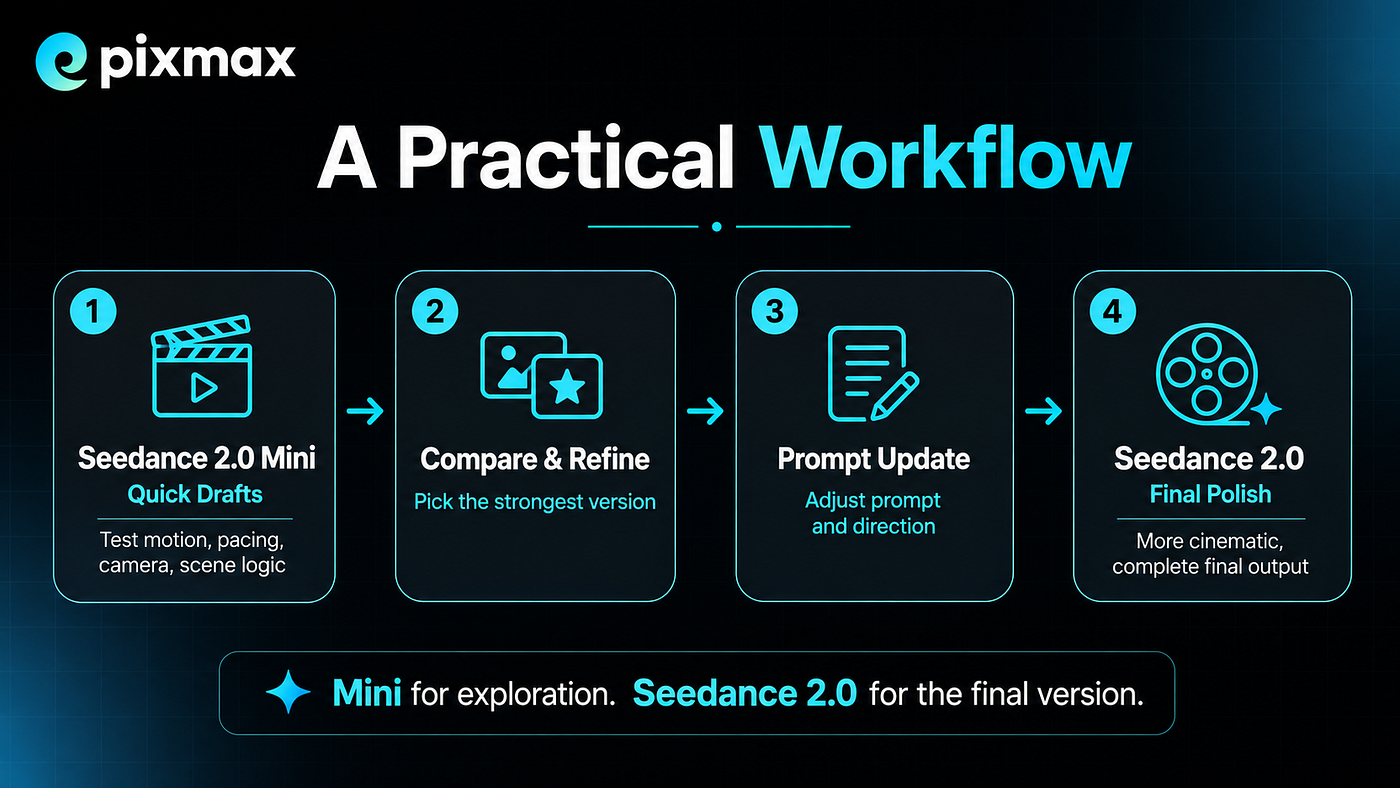
Inside Pixmax, this kind of exploration becomes easier to manage. Creators can branch ideas, compare outputs, refine prompts, and decide which direction deserves more time instead of losing track of scattered generations.
For viral AI video, prompt-to-video testing, social media video creation, and high-energy motion exploration, Kling can be a strong option.
The Real Difference Shows Up in the Workflow
A model comparison becomes more useful when we stop treating each model like a standalone answer.
Most creators do not need one perfect generation in isolation. A real project usually involves testing a hook and some meterials for publishing. That process is not one prompt. It is a workflow.
Seedance 2.0 may be the better choice when a project needs stronger continuity, reference control, and a more connected visual narrative. Kling always better when the idea needs speed, motion, and immediate visual impact.
For surreal short-form content, especially the kind made for social media, the goal is often not to carry a long narrative but to find the moment that makes people stop watching and start paying attention. Kling can be useful at this stage because it helps a loose idea become visible quickly, even before the concept is fully formed. Instead of waiting for a complete script or polished direction, a creator can test the movement, energy, and overall feel of the scene early, then decide whether the idea is worth developing further.
This is why multi-model access matters. The future of AI video production will be about knowing how to direct the right model at the right moment.
How to Choose Between Seedance 2.0 and Kling
When choosing an AI video model, we usually look at four things.
- First, what is the asset for?
- Second, does the subject need to stay consistent?
- Third, is motion the main value?
- Fourth, how many versions need to be tested?
[embed]
Pixmax is built around this kind of decision-making. Multi-model AI video generation, source image anchors, prompt refinement, branching outputs, and the AI Content Creation Platform help creators keep the process structured instead of treating every generation as a separate experiment.
So, Which One Should You Use?
Use Seedance 2.0 when your work depends on continuity, character consistency, reference-based control, image-to-video quality, or a more connected cinematic sequence.
Use Kling when your work needs bold motion, fast ideation, social-first energy, or visually striking short clips.
The best AI video model is the one that helps the idea survive the full process: testing, refining, extending, editing, and publishing. That is where model choice becomes less about preference and more about direction.
[embed]
Use Pixmax when you want to compare both inside one AI video workflow and choose the model that best fits each creative stage. Explore Seedance 2.0, Kling, and multi-model AI video workflows: https://www.pixmax.ai/
메타데이터
- post_id
- 2aeaffcdc7c2
- slug
- seedance-2-0-vs-kling-choosing-the-right-ai-video-2aeaffcdc7c2
- url
- https://medium.com/@pixmax.ai1/seedance-2-0-vs-kling-choosing-the-right-ai-video-2aeaffcdc7c2
- canonical_url
- https://medium.com/@pixmax.ai1/seedance-2-0-vs-kling-choosing-the-right-ai-video-2aeaffcdc7c2
- author_url
- https://medium.com/@pixmax.ai1
- status
- ok
- fetched_at
- 2026-07-13 06:23:13