Hallucinations: The Real Reason AI Makes Things Up
Why “just prompt better” is not a real solution
Hallucinations: The Real Reason AI Makes Things Up
Why “just prompt better” is not a real solution
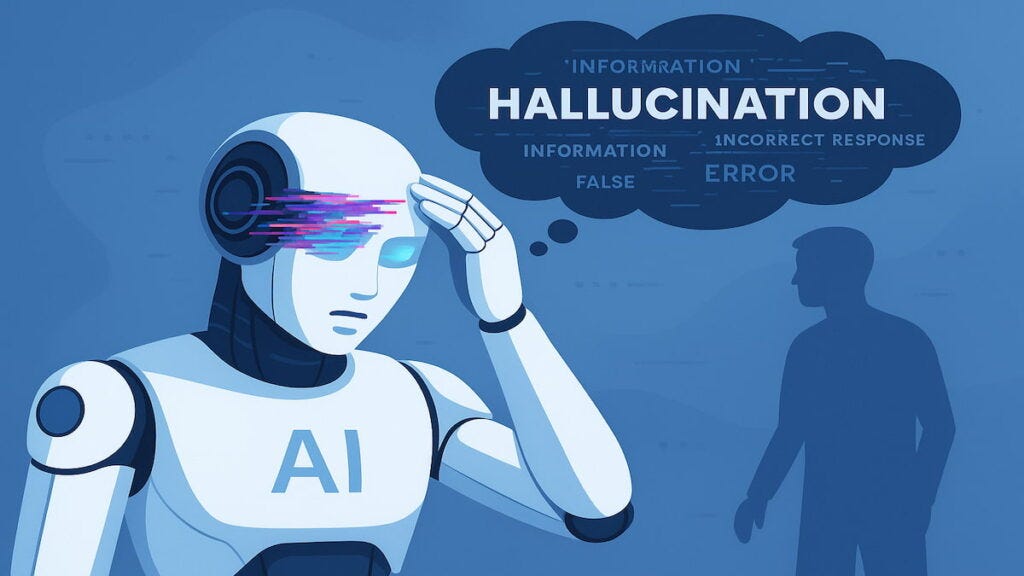
Photo from DigWatch
If you’ve used a large language model long enough, you’ve probably seen something like this:
- A confident answer that is completely wrong
- A citation to a paper that doesn’t exist
- A technical explanation that sounds perfect — but contains subtle errors
This behavior is commonly called AI hallucination.
The name can be misleading. It sounds like the model is malfunctioning.
But hallucinations are not a bug in language models.
They are a natural consequence of how these systems work.
Understanding this changes how you design AI systems.
What “Hallucination” Actually Means
In the context of generative AI, a hallucination is:
When a model generates information that sounds plausible but is not grounded in reality or the provided data.
Examples include:
- Fabricated statistics
- Fake citations
- Incorrect explanations
- Invented historical details
- Code that looks correct but does not work
The key detail is that hallucinations are usually fluent and confident.
They rarely sound uncertain.
That’s because the model isn’t trying to determine truth. It is trying to generate the most plausible sequence of tokens.
The Core Cause: Probability, Not Knowledge
Large language models do not store facts like a database.
Instead, they learn statistical patterns in language.
When answering a question, the model is essentially asking:
Given the prompt and everything I have seen during training,
what sequence of words is most likely to come next?
That means the model is optimizing for plausibility, not correctness.
If a plausible-sounding answer exists but the model lacks the real information, it will often generate the plausible one.
For example:
Prompt:
Who won the Nobel Prize in Physics in 2030?Since that event has not happened yet, there is no correct answer.
But the model might still generate something like:
The Nobel Prize in Physics in 2030 was awarded to…From the model’s perspective, that is the most likely continuation of the sentence pattern.
Probability Gaps: When the Model Doesn’t Know
A useful concept here is the probability gap.
This happens when:
- The model does not have reliable knowledge about something
- But language patterns suggest that an answer should exist
Humans usually respond to this situation by saying:
I don’t know.But LLMs are not optimized to say that.
They are optimized to continue the sequence plausibly.
So the model fills the gap with something that sounds correct.
Missing Context Is the Biggest Trigger
Another major cause of hallucinations is missing information in the prompt.
Consider this prompt:
What are the main challenges of the system described above?If there is no prior context, the model may still generate an answer by guessing what system you might be referring to.
Why?
Because the language pattern suggests that there should be an answer.
The model does not know the context is missing — it simply predicts what a typical response would look like.
This is why hallucinations often appear when:
- prompts are vague
- context is incomplete
- the task requires external knowledge
Why “Just Prompt Better” Doesn’t Work
A common suggestion for fixing hallucinations is:
Just improve the prompt.
Better prompts can reduce hallucinations in some cases.
For example, you can instruct the model:
- “If you are unsure, say you do not know.”
- “Only answer based on the provided text.”
This sometimes helps.
But it does not solve the fundamental problem.
Why?
Because the model still operates on probability, not verification.
If the model believes that generating an answer is the most likely continuation, it may still do so.
Even when the prompt says not to.
The Hard Truth: Hallucinations Cannot Be Eliminated
This is one of the most important facts about generative AI:
Hallucinations cannot be completely removed from language models.
They can only be reduced.
This is because the model’s objective during training is:
- produce fluent outputs
- match patterns in data
- minimize prediction error
Truth verification is not part of that objective.
Without external grounding, the model has no way to distinguish:
- a plausible sentence
- a factual statement
How Real AI Systems Handle Hallucinations
Instead of trying to eliminate hallucinations through prompting, real GenAI systems add external structure around the model.
Common strategies include:
Retrieval-Augmented Generation (RAG)
The system retrieves relevant documents from a database and inserts them into the prompt.
This gives the model actual information to reference instead of guessing.
Constrained Outputs
Systems often require structured formats such as:
- JSON
- predefined schemas
- fixed templates
This reduces ambiguity and makes responses easier to validate.
Validation Layers
Some systems add additional checks:
- fact verification
- rule validation
- secondary models that critique outputs
This helps detect when a response may be incorrect.
Tool Usage
Instead of generating answers, the model can call tools such as:
- calculators
- search engines
- databases
The model becomes an orchestrator, not the source of truth.
The Right Mental Model
The key mental shift is this:
Language models are excellent generators of plausible text, not reliable sources of truth.
When they hallucinate, they are not malfunctioning.
They are doing exactly what they were trained to do.
The responsibility for reliability belongs to system design, not just the model.
메타데이터
- post_id
- 2aebd3099d33
- slug
- hallucinations-the-real-reason-ai-makes-things-up-2aebd3099d33
- url
- https://medium.com/@stoic.engineer/hallucinations-the-real-reason-ai-makes-things-up-2aebd3099d33
- canonical_url
- https://medium.com/@stoic.engineer/hallucinations-the-real-reason-ai-makes-things-up-2aebd3099d33
- author_url
- https://medium.com/@stoic.engineer
- status
- ok
- fetched_at
- 2026-07-08 05:22:04