The Snitch Story: How a Fearless Brand Redefined Indian Menswear in Just 5 Years
Introduction
The Snitch Story: How a Fearless Brand Redefined Indian Menswear in Just 5 Years
Introduction
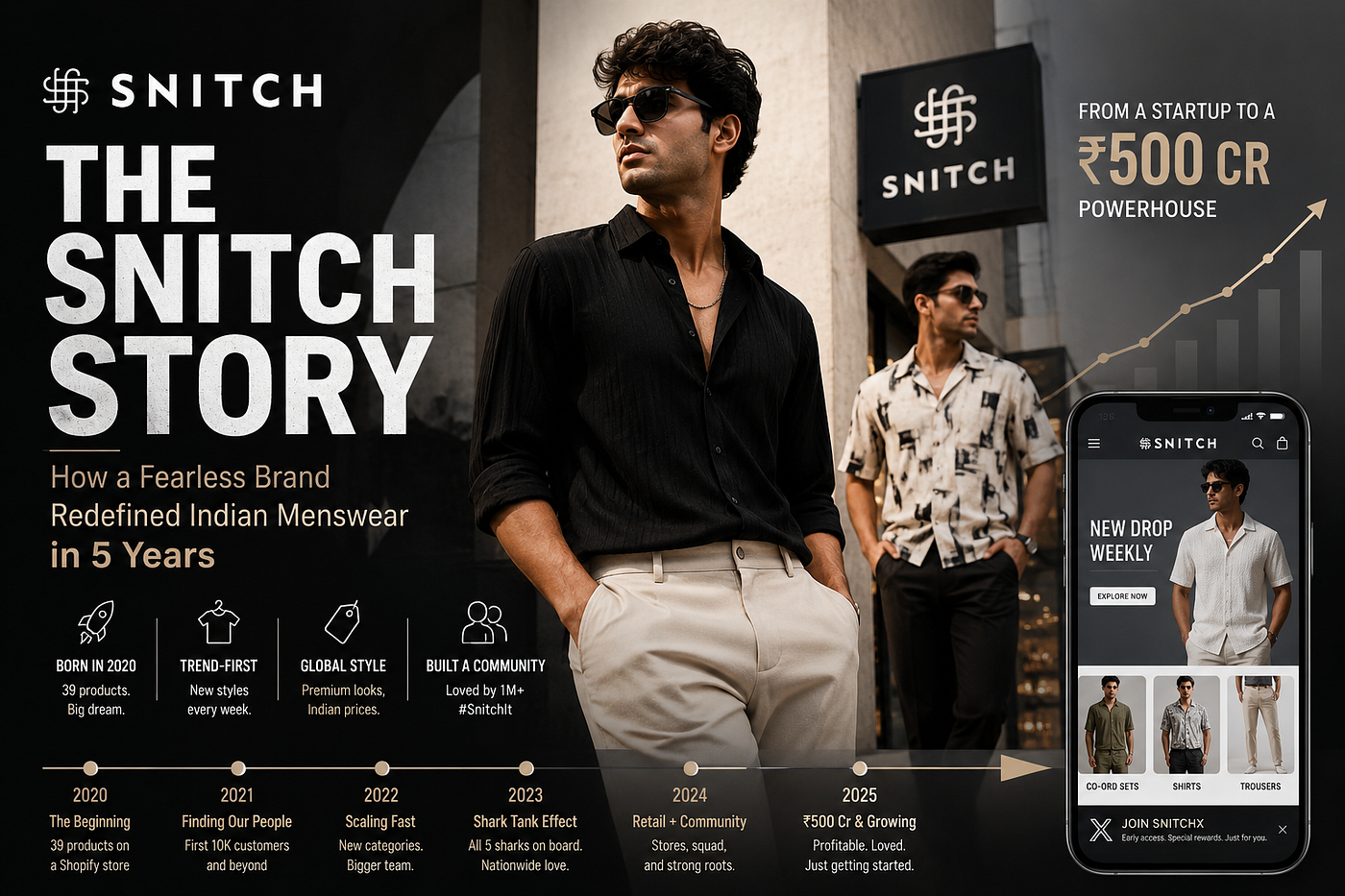
Back in 2020, while the world was hitting pause, Siddharth Dungarwal was just getting started. From a small Bengaluru office with a tiny team and 39 products on a Shopify store, Snitch was born. Fast forward five years, and it’s no longer just a startup,it’s a ₹500 crore powerhouse that’s actually making money while dressing the modern Indian man.
This isn’t a tale of overnight luck. It’s about a brand that truly “gets” its audience. By listening to what guys actually want to wear and moving at lightning speed, Snitch has built more than a customer base,they’ve built a community.
In this post, we’re peeling back the curtain on how they did it. Whether you’re an aspiring entrepreneur or just a fan of the brand, there’s a lot to learn from how Snitch took on global giants like Zara and H&M by staying true to its Indian roots.
Brand Overview and Market Context
Siddharth wasn’t new to the game; he had 17 years of industry experience. But when the pandemic hit his wholesale business, he didn’t quit,he pivoted. He saw a gap in the market for trendy, affordable menswear and decided to go straight to the people.
Product Category: Men’s fast fashion shirts, co-ords (which Snitch pioneered for men in India), trousers, jeans, accessories, perfumes, and footwear. Over 5,000+ active SKUs with new styles dropping weekly.
Market Positioning: Affordable trend-driven menswear. Average order value is around ₹1,700. Snitch sits between budget brands (₹300 — ₹600 shirts) and premium fast fashion (Zara, H&M at ₹2,000+). The tagline is essentially “Global style, Indian price.”
Revenue Trajectory: ₹11 Cr (FY21) → ₹44 Cr (FY22) → ₹100 Cr (FY23) → ₹243 Cr (FY24) → ₹506 Cr (FY25). EBITDA grew 5x YoY to approximately ₹30 Cr in FY25. The brand is targeting ₹1,000 Cr revenue in FY26.
Funding: Total funding of approximately $53 million. Series A (₹110 Cr, Dec 2023) co-led by SWC Global and IvyCap Ventures. Series B (₹340 Cr, June 2025) led by 360 ONE Asset. Valuation: ₹2,500 Cr.
Shark Tank Moment: Season 2, Episode 20 (aired January 2023). Siddharth secured an all-five-sharks deal,₹1.5 Cr for 1.5% equity,from Anupam Mittal, Aman Gupta, Namita Thapar, Vineeta Singh, and Peyush Bansal. At pitch time, the brand was doing 2,000 daily orders and ₹9.3 Cr monthly revenue.
Why they stand out: While most brands take months to bring a sketch to the shelf, Snitch does it in two weeks. They focus solely on men, offering styles that were previously hard to find in India without breaking the bank.
Target Audience and User Personas
Snitch speaks the language of Gen Z and millennials. They aren’t just selling shirts; they’re selling the “vibe” you see on your Instagram feed. Their pricing is sweet-spot territory,more premium than a basic tee, but way more accessible than high-end mall brands.
Primary Persona: Arjun, 23, Urban College Graduate
Demographics: Male, 21–26 years old, living in a Tier 1 or Tier 2 city, earning ₹15,000-₹40,000/month (entry-level job or pocket money).
Core Pain Point: Wants to dress like the outfits he sees on Instagram reels but can’t afford Zara. Local brands feel outdated or boring.
Buying Trigger: A friend’s Instagram post wearing a Snitch co-ord set, a micro-influencer’s styling reel, or a flash sale notification on WhatsApp.
Discovery Channels: Instagram Reels, YouTube shorts, Google search (“men’s co-ord sets”), and peer recommendations.
Trust Builders: User-generated content from real customers (#SnitchIt), product reviews on the app, and the Shark Tank appearance providing credibility.
Evidence: Snitch’s content is built around outfit transitions, GRWM (Get Ready With Me) clips, and fit-check reels,all formats that resonate with this age group. The average order value of ₹1,700 and weekly drops confirm the “affordable variety” positioning aimed at this demographic.
Secondary Persona: Vikram, 29, Young Professional
Demographics: Male, 27–32 years old, Tier 1 city, earning ₹60,000-₹1,20,000/month. Works in tech, consulting, or media.
Core Pain Point: Needs versatile pieces that work for office-to-evening transitions. Tired of rotating between three Allen Solly shirts.
Buying Trigger: Walking past a Snitch store in a mall, or a retargeting ad showing the exact shirt he browsed last week.
Discovery Channels: Mall stores, Google Shopping ads, marketplace browsing (Myntra, Amazon), and LinkedIn peer posts.
Trust Builders: Physical store trial, easy returns policy, and the SnitchX loyalty programme offering early access and birthday discounts.
Evidence: Snitch’s offline expansion (40–45% of FY25 revenue from stores) and the Snitch LUXE sub-brand indicate targeting of a slightly older, higher-spending customer alongside the core Gen Z base. The store sizes of 4,000–5,000 sq ft on high streets suggest a premium browsing experience designed for this persona.
Marketing Channels Overview
Before diving deep into Snitch’s top channels, here is a quick overview of every channel the brand operates on and what role each plays:
Channel
Activity Level
Objective
Key Observation
Social Media (Instagram, YouTube)
Very Active
Awareness + Acquisition
Primary discovery engine; Reels, UGC, styling content
Influencer Marketing
Very Active
Awareness + Acquisition
Snitch Squad programme; 1,000+ nano/micro-influencers
Paid Ads (Meta, Google, YouTube)
Active
Acquisition + Retargeting
Search, Shopping, display, retargeting cart abandoners
SEO / Content
Moderate
Acquisition
Branded search dominant; limited blog/content SEO
Marketplaces (Myntra, Amazon, Flipkart, Ajio)
Active
Acquisition
15% of revenue; used for discovery, not margin
Offline Retail (50+ Stores)
Very Active
Acquisition + Retention
40–45% of FY25 revenue; mall + high street formats
Email / WhatsApp / SMS
Active
Retention + Recovery
Cart recovery, flash sales, new drop alerts
PR / News
Moderate
Awareness + Credibility
Shark Tank, Inc42, ET coverage; founder-led PR
Quick Commerce (60-min delivery)
Pilot Stage
Acquisition
Launched Oct 2025 in Bengaluru; expanding to 4 cities
OOH and BTL
Moderate
Awareness
Mall branding, college fest activations
Deep Dive Into Key Channels
1. Influencer Marketing , The Core Growth Engine
The Human Touch: Young guys don’t want to be lectured by a celebrity in a suit; they want to see someone who looks like them. Snitch realized early on that real trust comes from real people.
The Snitch Squad: Instead of one big face, they have a thousand. By empowering “micro” creators who genuinely love the clothes, the brand feels like a recommendation from a friend rather than a billboard advertisement.
Why it works: The economics are simple. A single celebrity post might cost ₹5 lakh and generate low-engagement reach. The same budget across hundreds of nano-influencers generates authentic content, higher engagement, and direct trackable sales. Snitch’s CAC reportedly dropped 15–30% through this model. Additionally, each piece of influencer content doubles as a social proof asset that Snitch can repurpose on its own channels,creating a compounding content flywheel.
Customer journey stage: Primarily Awareness and Consideration. The influencer content introduces the brand to new audiences and provides the social proof needed to move a potential buyer from “I’ve seen this brand” to “I trust this brand enough to try it.”
2. Social Media (Instagram + YouTube) , The Digital Storefront
More than an app: For Snitch’s audience, Instagram is where they go to get inspired. The brand treats its feed like a mood board, helping guys figure out how to pull a look together.
What they are doing: Snitch’s content strategy prioritises style inspiration over product promotion. The brand posts Reels showing outfit transitions, festival lookbooks, GRWM clips, and behind-the-scenes factory footage. Key campaigns include #SwitchToSnitch (transition videos showing style upgrades), #SnitchIt (user-generated content where customers share their Snitch outfits), and “The Last Minute? Snitch it” (targeting men who need event-ready outfits quickly). The Ambassador Programme further extends this,customers who post wearing Snitch on Instagram Stories get a personalised 20% discount code and their Instagram username turned into a unique referral code.
Why it works: The content is inherently shareable because it solves a real problem (“what should I wear?”) rather than pushing a product. The UGC loop is self-reinforcing: customers post → get featured → feel valued → buy again → post again. With reported 400,000+ Instagram followers and high engagement, this channel drives both brand discovery and repeat purchase behaviour.
Customer journey stage: Full funnel. Reels drive Awareness, styling content supports Consideration, shoppable posts enable Conversion, and the Ambassador Programme fuels Retention and Advocacy.
3. Paid Advertising (Meta + Google) , The Precision Layer
Why this channel matters for Snitch: While influencer marketing and organic social drive top-of-funnel discovery, paid advertising provides the precision targeting and retargeting needed to convert browsers into buyers. For an e-commerce brand doing 18 million monthly website sessions, the retargeting opportunity alone is massive.
What they are doing: On Google, Snitch runs Search ads (branded and category keywords like “men’s co-ord sets”), Shopping ads with high-quality product images, and Display ads for retargeting. On Meta (Facebook and Instagram), the brand targets lookalike audiences based on existing buyer data, retargets cart abandoners (recovering 15–20% of abandoned carts through automated WhatsApp + ad sequences), and runs conversion-optimised campaigns for flash sales and new drops. YouTube ads target interest-based audiences with short-form video creative repurposed from their Reels content.
Why it works: Snitch’s paid strategy is efficient because 80% of sales come from owned channels (website, app, stores), meaning the brand has rich first-party data to build custom and lookalike audiences. The marketing cost dropped 50% in FY25 despite revenue doubling,this indicates the paid spend is increasingly supported by organic brand pull, reducing dependency on cold acquisition.
Customer journey stage: Primarily Consideration and Conversion. Search ads capture high-intent buyers; retargeting ads recover lost conversions; flash sale ads drive urgency-based purchases.
4. Offline Retail , The Profitability Multiplier
The Best of Both Worlds: While they started online, Snitch knew that sometimes you just need to feel the fabric and try it on. Their stores aren’t just shops; they’re physical extensions of the brand’s energy.
What they are doing: Snitch operates 50+ stores across India in two formats: mall outlets (1,800–2,000 sq ft) and high-street stores (4,000–5,000 sq ft). A 10,000 sq ft flagship opened in Bengaluru. The stores serve a dual purpose,they are retail points AND marketing assets. When Snitch opens a store in a new city, online sales in that city reportedly jump 3x. The model is split 60% franchise and 40% company-owned, with plans to move to a 50:50 mix. Every store is claimed to be profitable, and the capex is approximately ₹3,000 per sq ft.
Why it works: Offline stores solve the trust problem that every D2C fashion brand faces,customers want to touch the fabric before committing. But the real insight is that stores reduce marketing costs. A physical store is a permanent billboard that also generates revenue. The offline customer reportedly spends 2.5x more than the online customer, and the halo effect on digital sales means Snitch gets the best of both worlds. This is why marketing costs dropped 50% in FY25,the stores are doing the heavy lifting that paid ads used to do.
Customer journey stage: Conversion and Retention. Stores convert hesitant online browsers into buyers and create repeat purchase habits through in-person experience and the SnitchX loyalty programme.
Business Impact Analysis
Snitch’s marketing channels do not operate in isolation,they form an interconnected system where each channel amplifies the others:
Influencer content creates awareness → social media amplifies it → paid ads retarget the interested audience → the website or store converts the sale → post-purchase WhatsApp and email flows drive retention → the Ambassador Programme turns buyers into new content creators → the cycle repeats.
This is a classic growth flywheel, and the numbers prove it is working. Revenue doubled from ₹243 Cr to ₹506 Cr in one year. EBITDA grew 5x while marketing costs dropped 50%. The retention rate exceeds 100% at both order and revenue levels (meaning existing customers are buying more frequently and spending more over time). 80% of sales come from owned channels, which means Snitch controls its customer relationships rather than renting them from marketplaces.
The strategy is clearly performance-heavy in its DNA (the founder comes from a numbers-driven background), but it is increasingly shifting toward brand-building. The Shark Tank appearance, PR coverage in Inc42 and Economic Times, and the body-positivity campaign on LinkedIn signal a brand that is thinking about long-term equity, not just short-term ROAS.
If this strategy resembles a growth engine model, it is the “product-led + community-led” hybrid: fast product cycles keep the catalogue fresh (reducing the need for heavy ad spend on stale inventory), and the community of influencers and ambassadors generates free acquisition fuel.
Key Marketing Lessons
1. Speed-to-Trend Is a Marketing Strategy, Not Just an Operations Metric
Snitch’s 2-week design-to-shelf cycle means every product is marketing-ready when the trend is still hot. Most competitors take 3–6 months, by which time the trend has moved on and the product needs heavy discounting. The lesson: if your product is always relevant, your marketing becomes easier and cheaper because you are selling what people already want.
2. Micro-Influencers Beat Celebrity Endorsements in Low-Trust Categories
In men’s fast fashion, a customer does not trust a Bollywood actor wearing a ₹1,200 shirt. They trust a college student from their own city. Snitch understood that trust is built through relatability, not aspiration, and designed an entire automated system (Snitch Squad) to scale this insight. The lesson: build systems that make authentic peer advocacy scalable, not just individual influencer deals.
3. Offline Stores Can Be the Cheapest Marketing Channel
Counter-intuitive but proven by the data: Snitch’s marketing costs dropped 50% as offline stores grew from 30% to 45% of revenue. A store is a permanent, trust-building, revenue-generating advertisement. The lesson: for D2C brands hitting a digital acquisition ceiling, offline expansion may reduce overall marketing cost, not increase it.
4. Retention-First Economics Fund Acquisition
With 50% of customers being repeat buyers and retention rates exceeding 100% at the revenue level, Snitch’s existing customer base funds its growth. High retention means lower blended CAC, which means more budget available for experimentation and expansion. The lesson: invest in post-purchase experience (loyalty programmes, personalised recommendations, fast delivery) before scaling acquisition spend.
5. Own Your Channels Before Renting Distribution
80% of Snitch’s sales come from its own website, app, and stores. Marketplaces account for only 15% of revenue. This gives Snitch full control over customer data, pricing, and brand experience. The lesson: use marketplaces for discovery, but invest in building owned channels where you control the relationship and the margin.
Strategic Gaps and Recommendations
Gap 1: SEO and Content Marketing Are Underutilised
Snitch’s organic search traffic is overwhelmingly branded (“snitch”, “snitch clothing”). There is very little evidence of category-level SEO play for high-volume keywords like “men’s co-ord sets”, “men’s printed shirts”, or “affordable men’s fashion India.” The brand has no visible blog or content hub. This is a missed opportunity to capture high-intent organic traffic that currently goes to Myntra, Amazon, and fashion blogs.
Recommendation: Build a content hub with SEO-optimised style guides, trend reports, and occasion-based outfit articles. Target category keywords that have high purchase intent. This would reduce dependency on paid acquisition over time.
Gap 2: Over-Dependence on Fast Fashion Velocity Creates Sustainability Risk
Snitch’s entire model depends on speed,weekly drops, limited quantities, trend-chasing. While this minimises dead inventory, it raises questions about sustainability (environmental and brand-level). As consumers become more conscious, the brand may face backlash. The “Relove” and “Resell” initiatives exist but are not prominently marketed.
Recommendation: Elevate sustainability messaging from a footnote to a visible brand pillar. Consider launching a “conscious collection” with sustainable materials as a halo product line, even if margins are thinner. This future-proofs the brand narrative.
Gap 3: Men-Only Category Ceiling
Snitch has built its identity entirely around menswear. While this focus has been a strength, it also caps the addressable market. Women’s apparel is a $53 billion market in India versus men’s at roughly half that. As growth targets become more ambitious (₹1,000 Cr FY26), the brand may need adjacent categories to sustain momentum.
Recommendation: Rather than launching women’s wear (which dilutes brand identity), explore unisex accessories, lifestyle products, or a separate sub-brand for adjacent categories. The “Snitch LUXE” and “Snitch PLUS” sub-brands suggest this thinking has already begun.
Conclusion
Snitch is proving that you don’t need to be a century-old heritage brand to win. You just need to listen, move fast, and treat your customers like a community rather than just numbers on a spreadsheet.
First, speed is a marketing advantage, not just an operational one. When your product cycle is faster than your competitors’, you spend less on convincing people to buy because you are always selling what is already trending.
Second, community beats celebrity. The Snitch Squad model proves that an army of relatable micro-influencers can outperform a handful of expensive celebrity endorsements,especially in categories where trust is built through peer validation.
Third, owned channels compound while rented channels extract. Snitch’s shift to 80% owned-channel revenue and the resulting 50% drop in marketing costs is the clearest proof that investing in your own website, app, and stores pays off exponentially over time.
As they look toward an IPO, one thing is clear: Snitch isn’t just selling clothes. They’re building a new era of Indian fashion,one trend at a time.
메타데이터
- post_id
- 2aec930bccf6
- slug
- the-snitch-story-how-a-fearless-brand-redefined-indian-menswear-in-just-5-years-2aec930bccf6
- url
- https://medium.com/@khubaibmohd72/the-snitch-story-how-a-fearless-brand-redefined-indian-menswear-in-just-5-years-2aec930bccf6
- canonical_url
- https://medium.com/@khubaibmohd72/the-snitch-story-how-a-fearless-brand-redefined-indian-menswear-in-just-5-years-2aec930bccf6
- author_url
- https://medium.com/@khubaibmohd72
- status
- ok
- fetched_at
- 2026-07-20 23:28:45



