Life Lessons We Could Learn From Russell from Disney/ Pixar’s Up
Although the 2009 film, Up, was not fully an Asian film, it does represent every one of our Asian values, cultural identity and virtues…
Life Lessons We Could Learn From Russell from Disney/ Pixar’s Up
Although the 2009 film, Up, was not fully an Asian film, it does represent every one of our Asian values, cultural identity and virtues that we grew up with- all through the lens of one of its main characters, Russell
Although Russell was not the focus character of the movie, he did, however did strike a chord with me for certain reasons, many years later. Photo source from Disney/ Pixar (2009). Image source from the author.
Back then, in November 2014, I had watched Disney/Pixar’s Up for the first time(and fully) on a cable network. As a young 19-year-old animation and film art student, who is trying to obtain some insights of inspiration from every single film that I can get my hands on, I was fortunate to come across this 2009 modern Pixar classic on a particular movie cable network and only to watch it. Also, that was a day before I had been able to watch another Disney classic, Big Hero 6, on the big screens- and part of the reason on why I had wanted to watch Up, right before watching Big Hero 6 was to compare and to contrast on how both of its Asian leading (and co-leading) characters were therefore represented properly at the big screen, especially if it is a big budgeted animated Hollywood production.
However, it turns out that after watching Up, I was initially offended by Russell’s portrayal of being pretty much stereotypically Asian. From his character design, to his hyperactive tone and also his overachieving personality- I was unable to get him at that point, and not to mention slightly disappointed with how Russell was portrayed, as to being a representation towards the Asian community at that period when Asian representation was already very much scarce in the 2000s and the early 2010s. I was hoping for more positive Asian representation, after watching and growing up with cartoons in my childhood, which featured Asian leads, like Juniper Lee from Cartoon Network’s The Life and Times of Juniper Lee, or Jake Long from Disney Channel’s American Dragon: Jake Long. Or even Hiro and Tadashi Hamada from Disney’s latest film, Big Hero 6, which I was overall satisfied with how humanly they were portrayed as Asians (although they were biracial). At that time, however, Russell from Disney/Pixar’s Up did not feel that way for me.
But, ten years later, after watching Disney/Pixar’s Up again on the Disney+ streaming service, I had truly got it with Russell.
How Russell Properly Represents Us In Terms of Our Cultural Asian Values?
When I watched Up the second time, and two weeks ago, I realised that this film was indeed a clear allegory on how badly we treat our elderly citizens in our society.
We were first introduced to the world of Carl, an elderly man who was still reeling from the loss of his wife, Ellie, whom he had been faithfully married to for several years. Despite many of the challenges and the obstacles that they had endured, and the struggles that they were unable to produce offspring and have children or grandchildren who could take care of them much later, when they get older, they were still happily married, until tragedy happened, where Ellie had just passed away. Apart from losing Ellie, Carl’s dream of heading to Paradise Falls had also been suffocated and put aside.
Additionally, we had also started to see the pitfalls of being a single elderly citizen in society, where Carl had been unjustly and unfairly treated by his own community, especially the property developers who are persistent enough to wreck his home for a new developing skyscraper building as well as the law authorities who had considered him to be a very dangerous and serious threat, due to him hitting a contractor in the first place. Due to the consequences of his actions, he was been considered as a social ‘pariah’ and a aggressive perpetrator on a justified action- thus leading him to a directive no choice situation of being placed in an old folk home, which was considered as a calculative move by the society which deeply viewed him as a problematic brunt.
However, Russell’s actions towards Carl were very starkly different.
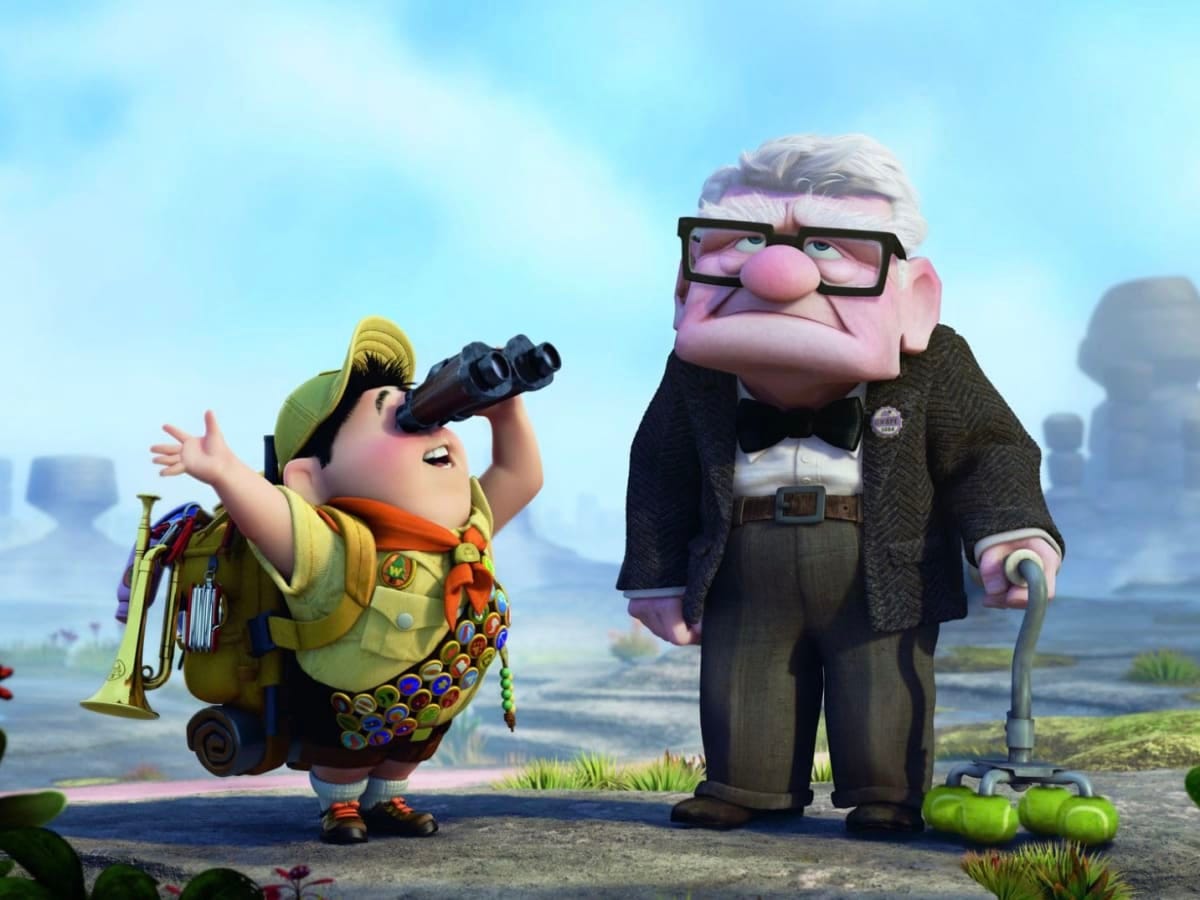
Russell might complicate things, but he still proves that he has the heart to understand Carl from his perceptive, as compared to the others in the 2009’s Disney/Pixar’s Up narrative. Photo source from Disney/ Pixar(2009). Image source from the author.
Compared to the rest of the society, who had therefore viewed him as a black log that needed to be removed immediately, Russell had instead viewed him as an elderly that needed assistance and needed a companion (although it was also done in a nuanced self-centred motivation to earn his Scout Elderly Badge). As the film develops, Russell’s initiative to support and to care for Carl, which the society had refused to do due to individualistic motives, and to accompany him on a dangerous and life-threatening adventure to Paradise Falls through hanging onto Carl’s (iconic) floating house was very much commendable, despite the young-age (probably nine-years-old according to the voice actor, Jordan Nagai’s age at the time the film was released) and also his lack of societal experience- other than the skills that he acquired from his Scout expertise. His shared experience of personal rejection, which stems from his parent’s divorce and also his father’s growing distance with him- with his stepmother being a verge in the emotional stability in the relationship, and coupled with his father’s unavailability to spend some quality time like they used too, had helped him to forge a bond with the already ostracized Carl, which was vital for them in survival in the wild jungles of South America, and additionally, to help them to battle against a much sinister and evil force in the wild- especially Charles Muntz, who happened to be Carl’s idol and hero, which had thus ended up in a broken pedestal, given the timeline of the film events.

His willingness to spend some time with the elderly reclusive Carl, was the effective heart of the narrative in Disney/Pixar’s Up, despites the danger and the challenges that they both had to endure together. Photo source from Disney/ Pixar (2009). Image source from author.
In hindsight, Disney/Pixar’s Up was a social commentary on the lack of understanding towards our elderly citizens, especially on how individualistic our society had started to become, according to a recent study in 2025 which was done towards Southeast Asian individuals- particularly in Malaysia. With the rising cases of elderly loneliness epidemic which was imp actual to the current society, according to a study in January 2020, and another study which had focused directly within the Southeast Asian community (Thailand) in March 2023, with additional information from newspaper article from The Straits Times in December 2020- highlighting the loneliness epidemic in Singapore, especially among the elderly citizens, the 2009 Disney/Pixar’s film Up had been able to properly several social concerns on how we can tackle the growing elderly loneliness epidemic in our already individualistic community where we see the elderly as a burden instead of a nugget of wisdom to gain valuable insights on what life had to offer. Russell’s empathetic, open-minded, caring and respectable attitude towards the elderly and ostracised Carl- by following him and assisting him in his time, his pursuits and adventure into heading to Paradise Falls to fulfil his deceased wife’s wish and also, in risking his life to protect Carl from further harm from Charles Muntz, was a strong representation of our Asian values, cultural identity and beliefs, although its main motivation is more nuanced and self serving at first. His determination to prioritise and risk his own life for a lonely, spiteful and resentful elderly man whom he had just met, and who had a much privileged ethnicity than he, had truly encapsulated the audience's heart that had truly helped the film to stood its test of time, especially in the 2020s when the epidemic of elderly loneliness is thus growing- and that help cement this 2009 Pixar classic into an indirect watershed and culturally relevant film for the Asian community, that deserves to be highlighted as a proper benchmark for Asian representation, instead of the 2025 Netflix/ Sony Pictures Animation cultural animated misfire, K-Pop Demon Hunters, which had utilize Asian stereotyping in its worse and offensive way. Despite having a lead Caucasian protagonist, rather than Russell, the emphasis of ‘filial piety’ was strongly emphasized and directed as the main message and core of the film, which had helped the nuancing of Asian representation in Disney/Pixar’s Up- making it an unexpected “Asian” film, partly due to the film’s subtle yet immersive respect for the Asian cultural identity, values, and societal dilemmas as portrayed through the lens of a very young Asian protagonist, like Russell- which I had eventually grew fond of after my second viewing of the film.

Although Russell’s motive of helping Carl was more nuanced and self-centred at first, his determination to demonstrate the Asian values of ‘filial piety’- despite how resistant Carl is, had helped make the film a subtle benchmark for Asian representation due to its positive and subtle portrayal of Asian cultural values. Photo source from Disney/Pixar (2009). Image source from author.
Except we just hope that by learning from the message of the film, we could be able to spend some time, and even the little time for the elderly, and not to build the intergenerational relationship for the sake of filling up honour badges or as token points for our co-curriculum or any social school or university projects, but rather as a sincere effort that thus comes from within.
At the end, to understand someone else regardless of their background or their age requires tremendous amount of empathy and understanding, and a dash of respect for their experience, and by opening ourselves to their world, we can get a wider perceptive on how we can learn and draw between their own experience and our own to make the society a better place- and to combat loneliness between one another, especially in the Asian context.
Disney/Pixar’s Up is currently streaming on Disney+ worldwide.
If you want to keep in touch, you can also contact the writer, Charlotte Cheng, at charlottejoancheng@gmail.com for tips and advice, as well as feedback and further collaboration on her works. If you would like to make a donation or tip, you can do so via PayPal.
메타데이터
- post_id
- 2af594c9cc3f
- slug
- life-lessons-we-could-learn-from-russell-from-disney-pixars-up-2af594c9cc3f
- url
- https://medium.com/bouncin-and-behavin-academy/life-lessons-we-could-learn-from-russell-from-disney-pixars-up-2af594c9cc3f
- canonical_url
- https://medium.com/bouncin-and-behavin-academy/life-lessons-we-could-learn-from-russell-from-disney-pixars-up-2af594c9cc3f
- author_url
- https://medium.com/@charlottejoancheng
- status
- ok
- fetched_at
- 2026-07-12 01:49:19