The Most Important Line in NRED’s Release Had Nothing to Do With Security
It was easy to focus on the obvious features in NRED’s EyeX announcement: cameras, drones, fuel leaks, personnel location, unauthorized…
The Most Important Line in NRED’s Release Had Nothing to Do With Security

It was easy to focus on the obvious features in NRED’s EyeX announcement: cameras, drones, fuel leaks, personnel location, unauthorized access, vandalism, and theft.
But the most interesting part may have been just four words near the end of that list: potentially rock and ore content.
That distinction matters. EyeX cannot yet be described as a system capable of determining copper grade from ordinary video. The official release refers only to a potential capability.
Still, the idea goes far beyond surveillance.
A camera that can detect a person near a storage area today could theoretically be trained to distinguish rock types, visible veining, surface textures, fragment shapes, or changes in colour. At that point, computer vision stops being only a security tool. It begins to work alongside geology.
What an Ordinary Camera Can Actually See
A camera does not see the chemical composition of a rock in the way a laboratory does. It sees light reflected from the surface.
In a standard RGB image, an algorithm can analyze colour, contrast, shape, particle size, surface texture, and the spatial arrangement of visible features.
For a geologist, those characteristics are not random. Oxidized copper minerals may create green or blue tones. Sulphide mineralization, quartz veining, iron oxides, alteration types, and contacts between rock units may also have visible characteristics.
A model can be trained to identify recurring combinations of those features. It does not “understand” geology in the same way a person does, but it can detect patterns across a much larger number of images.
That example shows that an ordinary image can contain enough information to support rapid rock sorting under specific conditions.
But it also reveals something often missing from technology presentations: the model did not appear out of nowhere. A geologist first classified the material, and a laboratory supplied the actual metal-grade data.
Without that foundation, the camera would simply be looking at rocks.
A Camera May Detect a Signal Without Explaining It
The main limitation of an RGB image is that different rocks can look similar, while the same rock can look completely different under changing conditions.
Lighting, shadows, dust, water, camera angle, oxidation, distance, and surface freshness can all change colour and texture. Wet rock looks different from dry rock. A fresh fracture may look very different from a weathered surface of the same sample.
That does not mean RGB cameras are ineffective. They are inexpensive, fast, and may already be installed at a site.
But there is a large gap between saying “the algorithm sees a difference” and saying “the system knows the exact copper grade.”
The most realistic first application for EyeX may therefore not be precise grade estimation. A more useful function would be identifying material that differs from the surrounding rock and deserves closer inspection by a geologist.
For example, the system could detect a new zone of colour change on an outcrop, an unusual texture in a material pile, or a recurring vein pattern across images from several locations.
It does not need to immediately say: “This contains 0.42% copper.”
It may be enough for the system to say: “This material does not resemble most of the previous images. Take a closer look.”
For a junior explorer, that alone could have practical value.
Hyperspectral Imaging Sees Much More
A standard camera divides visible light mainly into red, green, and blue channels. A hyperspectral sensor measures reflected light across dozens or hundreds of narrow wavelength bands.
Different minerals absorb and reflect light in different ways. As a result, they can have spectral signatures that are almost impossible to detect with the human eye or a conventional camera.
This is much closer to true geological intelligence.
https ore analysis would rely only on RGB cameras or could eventually include hyperspectral, thermal, or other sensors.
But this may be where the longer-term opportunity lies.
EyeX could begin by analyzing basic video feeds. Over time, more advanced sensors could potentially be connected to the same software layer. A system that distinguishes a vehicle from a person today could one day compare the spectral characteristics of a rock against a library of known minerals.
The underlying logic remains the same: capture an image, identify features, compare them with training data, and highlight an event or object that deserves attention.
What changes is the depth of information provided by the sensor.
Why the Laboratory Is Not Going Away
Even the best computer-vision system does not eliminate the need for sampling.
An image analyzes only the visible surface. It does not reveal what is inside the rock, how evenly mineralization is distributed, or the actual metal content of the full sample.
Two fragments may look identical but have different grades. Others may look different because of weathering even though their chemical composition is similar.
That is why an algorithm needs ground truth: a set of reliable results against which its predictions can be tested.
The ore-sorting research demonstrates this dependency directly: the model was trained using geological classification, while its performance was verified using laboratory grade results.
Computer vision does not replace those steps. It may help determine where they should be carried out first.
The Most Realistic Use Case for NRED
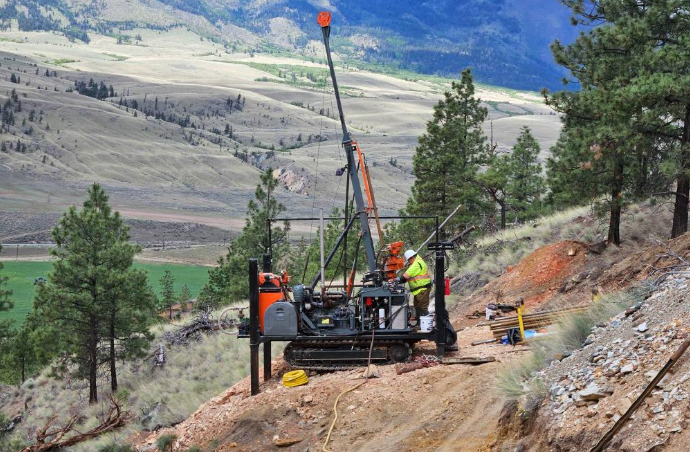
Wilmac covers 16,078 hectares. Across an area that large, it is impossible to collect and analyze every visible rock fragment in detail.
A field team must constantly make choices: which sample to collect, which outcrop to photograph, where to conduct additional sampling, and which area to leave for later.
EyeX would not need to become a digital laboratory to be useful in that environment.
Imagine that NRED geologists upload thousands of images linked to laboratory results. Over time, the model begins to recognize visual features that appear more frequently in mineralized samples.

During a later field program, a drone or camera records similar material in another part of the property. The system does not announce a discovery or estimate a resource. It simply raises the priority of that location.
A geologist inspects it in the field. The team collects a sample. The laboratory returns the actual result. That result is then fed back into the model.
A useful feedback loop begins to form:
image → prediction → sample → laboratory result → more accurate model.
MetalCore could work with historical geology, geochemistry, and spatial data within that system. EyeX could potentially add another layer: what a camera or drone sees directly in the field.
One system helps decide where to search. The other may help identify what deserves a closer look.
Four Words That Now Need Evidence
“Potentially rock and ore content” is not yet a finished product or a confirmed EyeX capability.
But it could be the most important direction in the entire release.
Security, access control, and leak detection help manage a site. Rock analysis could move EyeX closer to the fundamental reason an exploration company is in the field: finding mineralization.
The next meaningful step for NRED would not be another broad description of possible applications. A narrow test with clear numbers would be far more convincing.
What type of camera was used? How many samples were included in the training set? Were they laboratory tested? How accurately did the model distinguish mineralized material from waste rock? How did performance change under rain, dust, or different lighting conditions?
Those details will separate a strong idea from a working geological tool.
A camera is unlikely to replace an assay laboratory anytime soon.
But if it helps a geologist choose the right sample to send to that laboratory, it could still change how a small exploration team works across a large property.
메타데이터
- post_id
- 2af7958161eb
- slug
- the-most-important-line-in-nreds-release-had-nothing-to-do-with-security-2af7958161eb
- url
- https://medium.com/@william.jio121/the-most-important-line-in-nreds-release-had-nothing-to-do-with-security-2af7958161eb
- canonical_url
- https://medium.com/@william.jio121/the-most-important-line-in-nreds-release-had-nothing-to-do-with-security-2af7958161eb
- author_url
- https://medium.com/@william.jio121
- status
- ok
- fetched_at
- 2026-07-21 09:12:41