The Art of Bio Signals
The Silent Symphony: Why Your Body is the Ultimate Instrument
The Art of Bio Signals
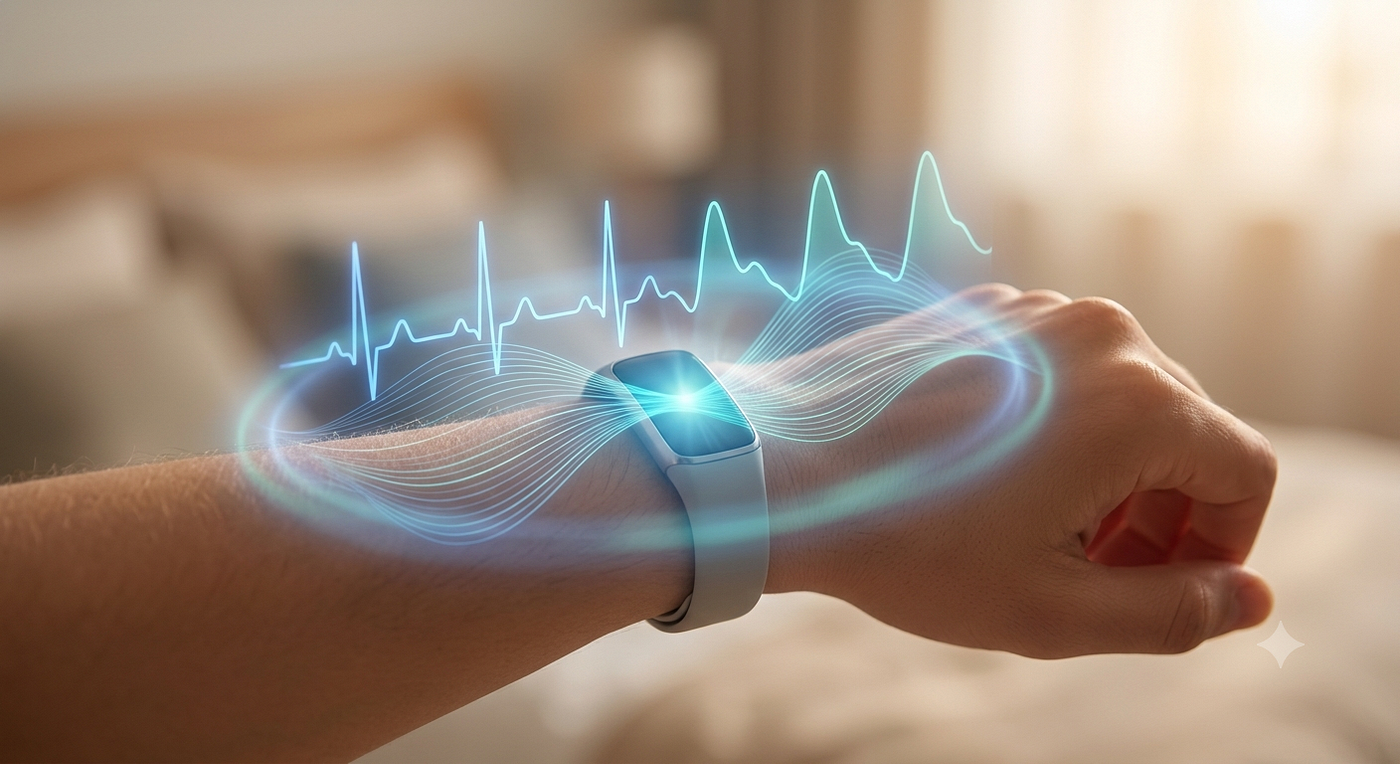
Our bodies are constantly broadcasting complex physiological data, waiting to be interpreted.
The Silent Symphony: Why Your Body is the Ultimate Instrument
Imagine this: You are fast asleep, completely unaware of the world around you. Yet inside, your body is incredibly active and working together like a perfectly timed orchestra. Your heart beats a steady rhythm, your brain cells fire quick electrical flashes, and your lungs move with a slow, deep breath.
For centuries, the only way to “hear” this symphony was to open the body to look inside with scalpels and probes. But today, we are learning to listen from the outside.
We are moving into the era of the non-invasive bio-signal, where the bridge between cold engineering and living physiology is finally being built. This isn’t just about sensors and wires; it’s about decoding the silent language your body has been speaking all along.
Decoding the Language
What exactly are these “bio-signals”? Simply put, they are the time-varying ripples of energy produced by your cells. They are the body’s way of reporting its status in real-time:
- The Electrical: The sharp, rhythmic depolarization of your heart (ECG) or the chaotic, beautiful chatter of your brain (EEG).
- The Optical: The subtle fluctuations in light reflected by your blood, turning a flickering beam into a pulse (PPG).
- The Mechanical: The rhythmic expansion and contraction of your chest as you breathe.
These signals are whispers: low-amplitude, noise-prone, and incredibly fragile. To capture them, an engineer cannot simply build a machine; they must build an interpreter. It requires a delicate dance of analog design and signal processing to pull a clear, clinical melody out of a noisy, everyday environment.
The Engineer’s Paradox: The “Art” of the Signal
If biosignal acquisition were purely science, it would be easy. You’d just place a sensor, filter the noise, and get a perfect reading. But in the real world, the “art” is in the struggle.
When you try to measure a heart rate on a person walking, running, or shivering, you aren’t just recording a heart; you are recording an entire human experience. You face the “Engineer’s Paradox”:
- How do you keep a sensor comfortable enough for a patient to wear for days?
- How do you differentiate between a life-threatening arrhythmia and the “noise” of a person simply scratching their arm?
Solving these problems requires more than just code. It requires an understanding of human movement, skin chemistry, and comfort. It is here, in the messy middle ground between the human body and the digital sensor, that the art of biosignal engineering truly lives.
From the Clinic to the Wrist
The impact of this work is nothing short of a revolution. We are watching the shift from “episodic medicine,” where we wait for a doctor’s visit to find a problem, to “continuous, personalized medicine.”
We are now seeing:
- Preventive Insights: Detecting a trend in heart health before a patient ever experiences a symptom.
- Neurological Clarity: Enabling people to study their own sleep cycles and cognitive triggers safely from home.
- Remote Reach: Bringing the precision of the hospital bedside to the middle of nowhere, using nothing more than a wearable device.
The Horizon
We are standing on the precipice of a new reality. Soon, our devices won’t just track our steps; they will monitor our physiological baselines, provide real-time feedback, and, most importantly, act as a silent guardian for our long-term health.
The future of healthcare isn’t going to be defined by more machines; it will be defined by better ones. It will be defined by systems that understand the nuance of a human heartbeat and the complexity of a neural pulse.
Biosignals are our window into the body’s inner life. By bridging the gap between raw, imperfect physical signals and actionable knowledge, we are not just engineering better tools; we are learning to better understand what it means to be human.
As we move toward a future where our devices are constantly “listening” to our bodies, what is the one physiological metric you would want your own wearable to track, and why?
메타데이터
- post_id
- 2af9503da3d3
- slug
- the-art-of-bio-signals-2af9503da3d3
- url
- https://medium.com/@sanugiw/the-art-of-bio-signals-2af9503da3d3
- canonical_url
- https://medium.com/@sanugiw/the-art-of-bio-signals-2af9503da3d3
- author_url
- https://medium.com/@sanugiw
- status
- ok
- fetched_at
- 2026-08-18 23:03:26