🗂️ The Evolution of Distributed File Systems: A Critical Comparative Review
In the digital age of massive data, distributed systems have become the backbone of everything from cloud storage to big data analytics. At…
🗂️ The Evolution of Distributed File Systems: A Critical Comparative Review
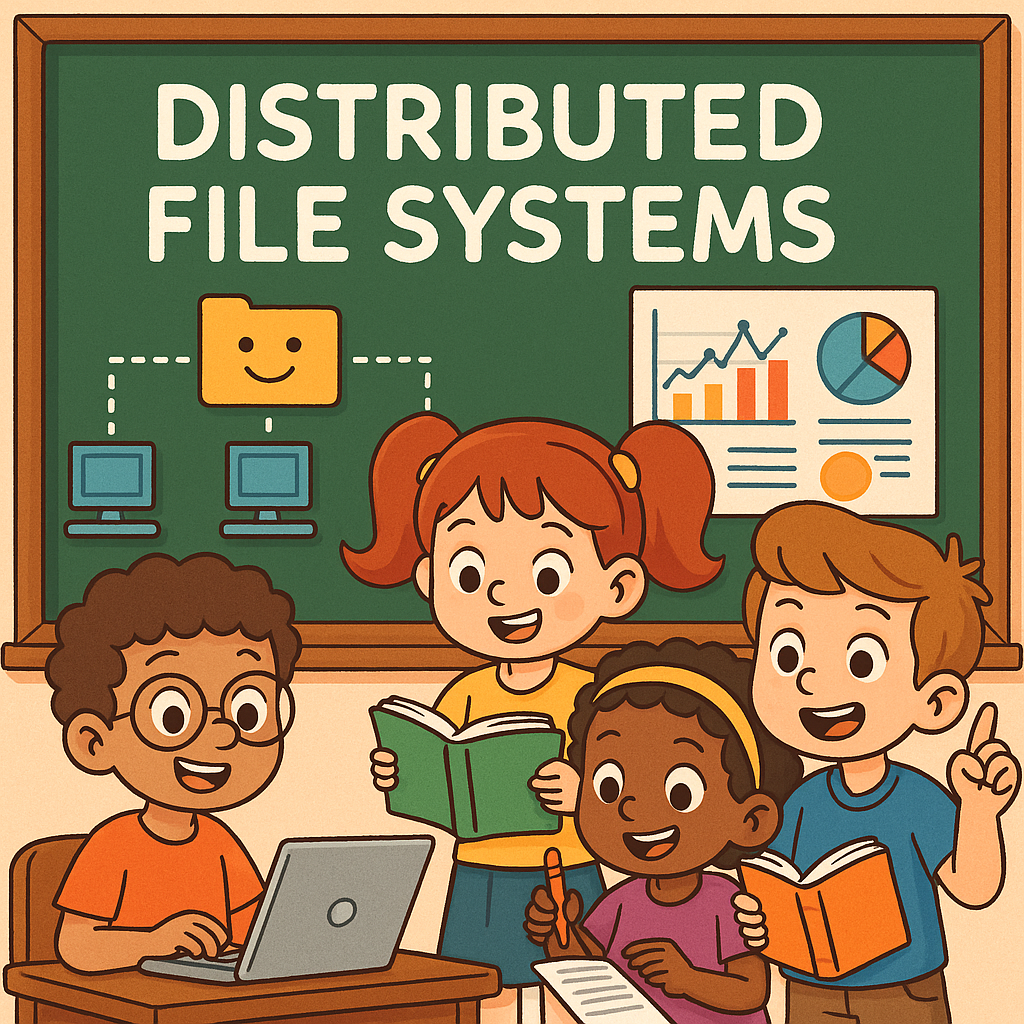
In the digital age of massive data, distributed systems have become the backbone of everything from cloud storage to big data analytics. At the heart of this infrastructure lies the Distributed File System (DFS) — a powerful abstraction that allows users to interact with files across networks as if they were local. From early academic prototypes to industrial-scale systems powering Google and Hadoop, DFS design has evolved significantly, shaped by changing demands and technological breakthroughs.
In this post, we’ll dive into a critical comparison of several influential DFS designs — AFS, Coda, GFS, HDFS, and NFS — to explore their architectural principles, strengths, weaknesses, and how well they balance key trade-offs in distributed computing.
🔍 What is a Distributed File System?
A Distributed File System enables users and applications to access and store data across multiple networked machines with transparency. It hides the underlying complexity of the distributed environment and creates a single, logical file system interface.
Key Features:
- Transparency (location, replication, access)
- User Mobility
- Performance and Scalability
- Reliability and Security
- Support for Heterogeneity
🏗️ Architectural Design & Core Characteristics
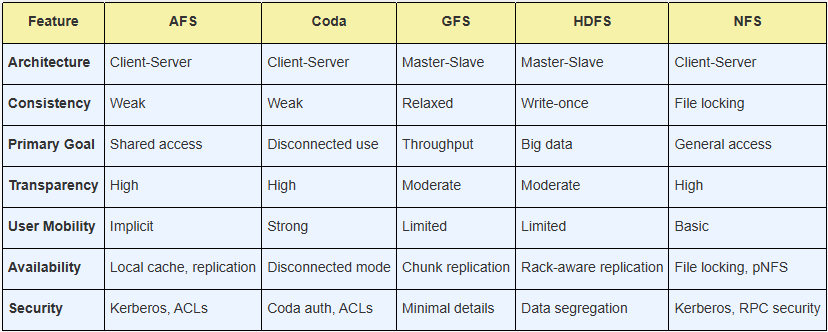
Each DFS implements unique design strategies to solve common distributed challenges. Here’s a snapshot of how the five systems approach the foundational goals of DFS:
Characteristics
🧪 System-by-System Breakdown
1. Andrew File System (AFS)
Originally from Carnegie Mellon, AFS was among the first to introduce client-side caching and a global namespace. It’s scalable (up to 25K+ clients) and offers moderate availability through replication.
Pros: ✅ Transparent, scalable, and cache-efficient Trade-off: Weak consistency — file changes are propagated only when closed.
2. Coda
Coda took AFS further with a major innovation: disconnected operation. This means users can work offline and sync back later, making it ideal for mobile environments.
Pros: ✅ Strong user mobility, high availability Trade-off: Complexity from conflict resolution when reconnecting.
3. Google File System (GFS)
Designed to support Google’s internal needs, GFS optimizes for high-throughput, append-heavy workloads. It features a single master that manages metadata and multiple chunkservers for data storage.
Pros: ✅ Massive scalability, fault-tolerant Trade-off: Relaxed consistency; latency-sensitive apps may suffer.
4. Hadoop Distributed File System (HDFS)
An open-source cousin of GFS, HDFS underpins much of the big data ecosystem. It supports batch processing, data locality, and high fault tolerance — optimized for write-once, read-many workloads.
Pros: ✅ Open, scalable, and fault-tolerant Trade-off: Poor performance for low-latency or small-file access.
5. Network File System (NFS)
The granddaddy of DFS, NFS is still widely used for general-purpose file sharing. Over the years, it evolved to support locking, security, and scalability (via pNFS in NFSv4).
Pros: ✅ Simple and widely supported Trade-off: Earlier versions are stateless, limiting advanced features.
🧠 Design Philosophies & Trade-offs
A recurring theme in DFS design is trade-offs — you can’t have it all. The CAP Theorem reminds us that systems can only guarantee two out of three: consistency, availability, and partition tolerance.
- AFS & Coda prioritize transparency and client-side performance.
- GFS & HDFS favor scalability and throughput over strict consistency.
- NFS focuses on general-purpose simplicity.
No one-size-fits-all solution exists — your DFS choice should align with your application workload, consistency needs, and user environment.
🚀 What’s Next in Distributed File Systems?
As modern applications demand more from storage systems, DFS is evolving. Here are key trends shaping the future:
1. Cloud & Edge Integration
DFS must now operate in hybrid and edge computing environments, reducing latency and bringing data closer to users.
2. AI/ML Workloads
Data-hungry models need efficient, high-throughput storage systems. HopsFS and similar innovations are tuning DFS for machine learning pipelines.
3. Blockchain for Metadata
Using blockchain for managing metadata can remove single points of failure like the NameNode in HDFS.
4. New Hardware & Protocols
Technologies like NVMe, RDMA, and erasure coding promise better performance and efficiency in next-gen DFS designs.
📌 Final Thoughts
Distributed File Systems are foundational to modern computing. Whether you’re building an AI training cluster or deploying edge devices, your choice of DFS will shape system performance, scalability, and reliability.
📣 TL;DR: There is no universal DFS — only the right one for your workload. Evaluate based on trade-offs, architecture, and how your system balances transparency, consistency, and scalability.
Sources: GeeksForGeeks, Tanenbaum, CMU, Wikipedia, and system documentation.
메타데이터
- post_id
- 2b1cec07b274
- slug
- ️-the-evolution-of-distributed-file-systems-a-critical-comparative-review-2b1cec07b274
- url
- https://medium.com/algorithm-alchemist/%EF%B8%8F-the-evolution-of-distributed-file-systems-a-critical-comparative-review-2b1cec07b274
- canonical_url
- https://medium.com/algorithm-alchemist/%EF%B8%8F-the-evolution-of-distributed-file-systems-a-critical-comparative-review-2b1cec07b274
- author_url
- https://medium.com/@nerdnodes2023
- status
- ok
- fetched_at
- 2026-07-17 01:16:21