Famous Courtesans of Antiquity- Phryne
Her pale complexion gave her this name as phryne means toad in Greek
Famous Courtesans of Antiquity- Phryne
Her pale complexion gave her this name as phryne means toad in Greek

Phryne before the Areopagus by Jean-Leon Gerome (1861)
This is the second in a series of famous courtesans from antiquity. In many cases the sources on which the information that we have about these famous or infamous women is somewhat scarce. However, one thing is clear, people have always loved to gossip and particularly about matters of a salacious nature.
There is much debate among historians as to the veracity of some of the accounts of these women that are found in ancient texts and whether the women were more than just courtesans or whores as many of them were intellectually accomplished, astute political operatives or successful businesswomen. I don’t see why they couldn’t have been all of these things. Human beings are complex and not one dimensional.
These disputes aside one thing is clear, throughout history women have always had a degree of agency and have used what talents they have to shape their own destinies as best they can given the opportunities and limitations of any given time.
Phryne was a celebrated hetaira who as best we know was born in Boeotia around 370 BCE and whose name was Mnesarete. She spent most of her life in Athens and must have been highly successful at her trade as she became one of the richest persons in that city.
A hetaira was essentially a high-class prostitute but denoted a woman with other accomplishments be they intellectual or artistic. I suppose that one could look upon them as not dissimilar to a geisha in that regard. As a class they were differentiated from common prostitutes or pornai, who worked in brothels or the streets.
According to Marguerite Johnson of the University of Newcastle, ‘“Hetairai” even attended symposia, or ancient Greek drinking parties, to provide not just sex but to also perform music and even engage in debates and discussions with the participants. 1
Anyone interested in sex in Ancient Athens should read a superb book titled Courtesans and Fishcakes by James Davidson, Fontana Press, London 1998.
Davidson makes the point that one of the methods by which hetaerae were able to command premium prices for their services was by maintaining a degree of seclusion and therefore a certain inaccessibility. In other words, scarcity drives up price.
“Of course, the hetaerae unlike the decent wife covers herself up out of chastity but to mislead and delude and to maintain her market value. They are contrasted with Philemon’s praiseworthy pornai who stand naked ‘so that you’re not deceived’. According to Aristophanes’ Om Hetaeras, ‘Nannio was nicknamed Proscenium (Stage-set) because although she possessed refined features and wore golden jewelry and dressed herself in expensive fabrics, without her clothes she was very ugly.’ “ 2
“No such suspicions attached to Phryne, the greatest of the hetaerae and the cleverest manipulator apparently of this scopic economy, carefully rationing out sightings, carefully calculating withdrawal and disclosure.” 3
Davidson goes on to say, “”A hetaera must always have freedom to exercise her whim and keep alive the possibility, however small, of doing something for nothing or of not returning the favor at all…Moerichus was attempting to get Phryne into bed. When she asked him for one hundred drachmas he said, “You ask for a lot. Did you not yesterday stay with a stranger, though you received only two gold pieces?” “Well then,” she said, “the same applies to you. Wait until I want to have sex, and I will take that amount.” (4)
Unfortunately, almost all of the original sources documenting Phyrne’s lifehave been lost. What we know of it comes from later sources from the Roman empire that had access to the original Greek sources. The primary source is that of Athenaeus of Naucratis, a Greek who lived in Egypt in the late 2nd and early 3rd centuries CE. His work the Deipnosophistae is an excellent source of information on sexual matters in antiquity. Athenaeus would have had access to the speech of her lawyer Hyperides who defended her at her trial for blasphemyThis trial is the central incident of her life which has kept her memory alive and inspired admirers and artists both in antiquity and in more recent times.
A number of writers from the 2nd and 3rd centuries CE such as Plutarch, Pausanias and Diogenes Laertius tell anecdotes about her.
She was reputed to be a great beauty, and it was said of her that she had such a great natural beauty that at a dinner party she had the other women present wipe the makeup off their faces which revealed the fact that Phryne was the only woman there who was naturally beautiful and not relying on artifice for her looks.
Hermippus of Smyrna tells us that: “in fact she was more beautiful in those parts not exposed to view. Because of that it was not easy to see her naked. She always wore a little chiton clinging to her flesh and did not use the public baths.” (5)
Plutarch says that she was so attractive that she was able to continue to charge high fees to her clients in old age.
She is reputed to be the model for the sculpture of the goddess Aphrodite by Praxiteles, the famous Athenian sculpture with whom Phryne is reputed to have a had a relationship.
Unfortunately, the original statue does not survive but here is a Roman copy from the 2nd century CE and housed in the Capitoline Museum in Rome.

Aphrodite of Knidos
Phyrne has continued to inspire artists to this day. Beginning in the 18th century she has been depicted in painting, perhaps the most famous of which is Phyrne Before the Areopagus (shown above) by the French artist Jean-Leon Gerome (1824–1904) depicting the climactic moment of her trial.
There was a famous painting in antiquity Aphrodite Anadyomene by Apelles who was a contemporary of Phryne’s having been born on Kos in about 370BCE. The painting does not survive but is described in Pliny’s Natural History. It depicts the goddess Aphrodite bathing at Eleusis. According to Athenaeus the painting was inspired by Phryne who bathed nude in the sea during the festival. The seashell upon which Aphrodite stands in the famous painting by Botticelli symbolizes the female vulva.
The painting by Apelles inspired this 19th century work by Henryk Siemiradzki (1843–1902).
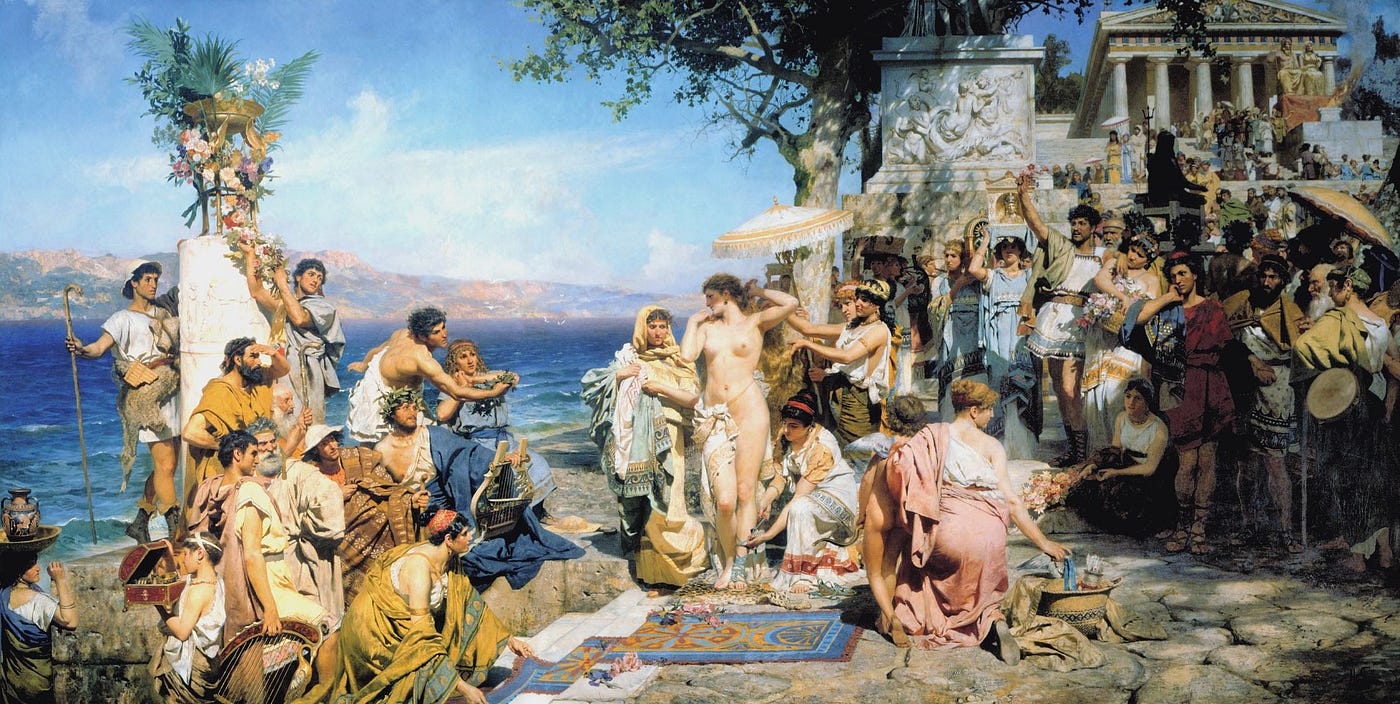
Phryne at the Poseidonia in Eleusis-1889
Athenaeus tells us that Phryne was possessed of a tremendous wit and she must have had a lot going on that she is reputed to have been rich enough according to Callistratus to offer to pay for the rebuilding of the walls of Thebes after Alexander razed them in 335 BCE. However, she is reputed to have insisted that an inscription that “Phryne the hetaira” was responsible for the walls being rebuilt. This may have fueled part of the reason for her prosecution.
She was brought to trial sometime between 350 and 340 BCE by one Euthias who is reported to be a former (and aggrieved) lover of Phryne’s.
The prosecution speech delivered by Euthias — which, according to Athenaeus, was composed by Anaximenes of Lampascus on his behalf — does not survive. Phryne was defended by Hypereides, a well-known and wealthy orator who had a reputation for associating with hetairai. Six of the speeches attributed to him relate to hetairai, and in a surviving fragment of his defense of Phryne, he admits to being her lover.(6)
Hypereides’ defence speech survives only in fragments, though it was greatly admired in antiquity. The date of the trial is uncertain. If Anaximenes did compose the speech for the prosecution, it must have been before he moved to Macedon, and therefore was perhaps between 350 and 340 BC.(7)
Phryne was charged with, a kind of blasphemy. three specific accusations against her — that she held a “shameless “ or ritual procession, that she introduced a new god, and that she organized unlawful thiasoi or debauched meetings.(8)
This latter kind of charge sounds like something salacious that the prosecution added both as a simple smear tactic and also in respect of her status as a hetaira.
There is speculation among historians that the trial was in part politically motivated. In addition, it is thought that Phryne’s demand that her name with the appellation hetaira be put on the rebuilt walls of Thebes antagonized members of the elite ruling class in that city.
Phryne was famously acquitted after she bared her breast to the Areopagus (the aristocratic council of Athens) sitting as jury as depicted in the painting above. There are different accounts concerning her disrobing. According to Quintilian (35–100CE), Sextus Empiricus (mid-late 2nd century CE) and Philodemus (110–35BCE) it was Phryne who made the decision to expose herself to the jury.
Athenaeus, however, says that Hypereides prompted her to do it after seeing that his defense speech had not moved the jury favorably. (9)
In any case, the sight of her breasts (or body according to Quintillian) were such that the jury was moved to acquit her. (10) I suppose that it would also be fair to assume that a number of them then aspired to be clients after such a public advertisement of her charms.
She must have been stunningly beautiful.
I will leave you with this question: Which version of the tale do you prefer, that she possessed agency to display herself or won through the artful trick of an accomplished lawyer?
-
Elite companions, flute girls and child slaves: sex work in ancient Athens
-
Courtesans and Fishcakes, James Davidson, London 1998
-
Op.cit.
-
op. cit.
-
Felix Jacobi, Die Fragmente der griechischen Historiker continued: Hermippos of Smyrna, Critical edition and English translation of the extant fragments by J. Bollansée, Leiden, Brill, 1999.
-
op.cit.
-
op.cit.
-
The Deipnosophists by Athenaeus, Translation by C. D. Yonge 1854
-
Institutio Oratoria, Quintillian, translated by H. E. Butler, Loeb Library 1920.
A fellow Medium writer Aurelia Bliss brought to my attention the fact that she had written about Phryne back in 2023. Here is a link to her article.

Glenn M Stewart
Pugilist, polemicist, Oxford Arabist, financial mastermind, international man of mystery, film producer, playwright, part-time-poet, full-time provocateur…
메타데이터
- post_id
- 2b44ab1303a7
- slug
- famous-courtesans-of-antiquity-phryne-2b44ab1303a7
- url
- https://medium.com/mmm-mondays/famous-courtesans-of-antiquity-phryne-2b44ab1303a7
- canonical_url
- https://medium.com/mmm-mondays/famous-courtesans-of-antiquity-phryne-2b44ab1303a7
- author_url
- https://medium.com/@glenn-stewartm
- status
- ok
- fetched_at
- 2026-06-11 06:59:45