Understang the Claude’s Hidden Thinking System
Not a Member? Read for FREE here.
AI
Understang the Claude’s Hidden Thinking System
Not a Member? Read for FREE here.
“For years, we’ve treated Large Language Models like black boxes. We knew what went in. We saw what came out. But what happened in between remained a mystery.
That mystery just got a little smaller.”
Anthropic recently published one of the most fascinating AI research papers of 2026.
Not because Claude became conscious. Not because researchers discovered “AI emotions.” But because they found something far more useful for developers:
A small internal workspace where Claude appears to organize ideas before speaking.
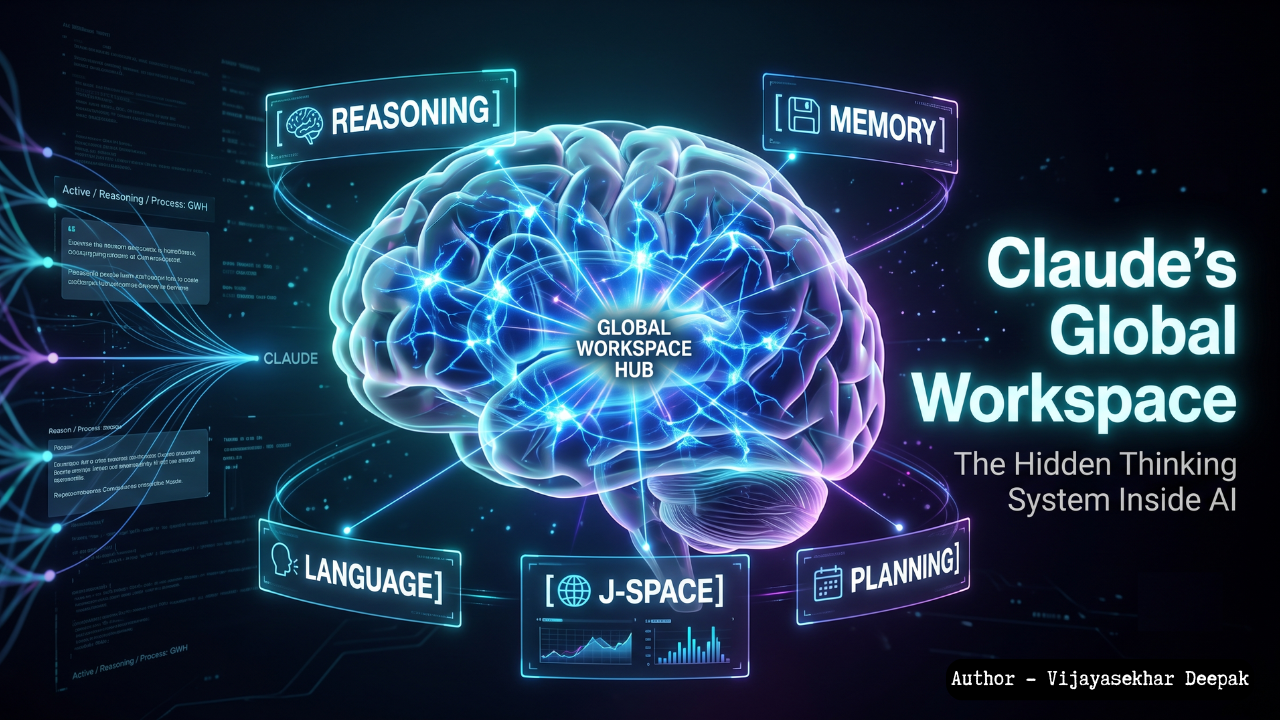
They call it J-Space, and they argue it functions similarly to the Global Workspace Theory from cognitive neuroscience — a theory describing how humans consciously access information for reasoning and planning. The research suggests that, inside Claude, a tiny subset of internal representations behaves differently from the rest of the network, supporting deliberate reasoning rather than automatic computation.
If you’re building AI products, agents, or simply curious about how modern LLMs actually work, this research is worth understanding.
Let’s break it down in simple English.
Why This Research Matters
Imagine asking Claude:
“What’s 245 × 17?”
The answer appears almost instantly.
But how? Did Claude simply memorize it? Did it calculate? Did it reason step by step?
For years, nobody really knew.
Researchers could observe billions of parameters firing during inference, but understanding why specific decisions happened was incredibly difficult.
This latest research changes that.
Instead of only looking at Claude’s final response, Anthropic looked inside the model while it was thinking and they discovered something unexpected.
Meet Claude’s “Global Workspace”
Think of your brain.
Right now your body is performing thousands of operations.
- Breathing
- Maintaining posture
- Processing sounds
- Adjusting your vision
- Controlling muscles
You’re not consciously aware of any of these. But if someone asks:
“What’s your favorite programming language?”
Suddenly one thought becomes accessible. You can inspect it. Modify it. Talk about it. Use it for reasoning.
Neuroscientists call this concept the Global Workspace Theory (GWT). The basic idea is simple:
Many specialized systems process information independently, but only a small amount reaches a shared “workspace” where it becomes available for deliberate reasoning and flexible decision-making.
Anthropic believes something surprisingly similar has emerged inside Claude not because it was explicitly programmed, but as a result of training.
Introducing J-Space
Anthropic calls this hidden reasoning area J-Space. Think of it as Claude’s private whiteboard.
Not the Chain of Thought. Not hidden prompts. Not scratchpad reasoning.
Instead…
It’s a collection of internal neural representations. These representations correspond to concepts Claude is thinking about even when those concepts never appear in the output.
Imagine asking: “How many legs does the animal that spins webs have?”
Claude replies: 8
Notice something. The word spider never appeared.
Yet internally, Claude briefly represented the concept “spider” before producing the answer. Researchers were even able to causally alter this representation (for example, replacing the internal concept with “ant”), changing the answer from eight legs to six without changing the prompt.
That’s remarkable.
Wait… Isn’t That Just Chain of Thought?
No. This is where many people get confused.
Let’s compare.
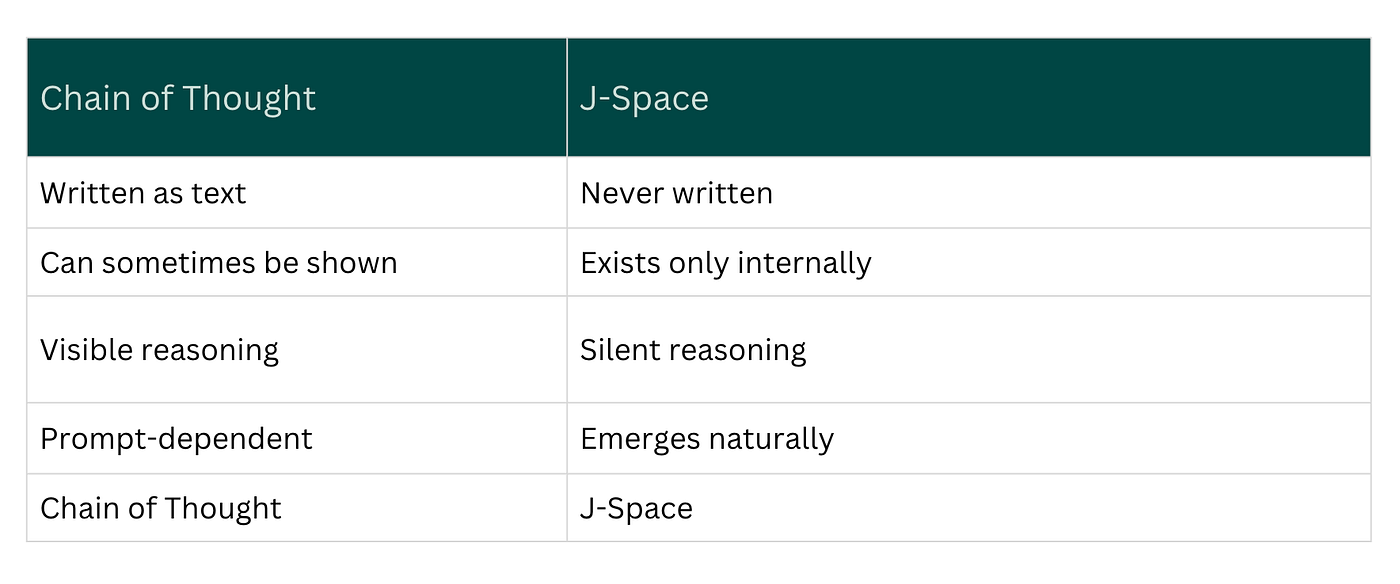
Chain of Thought is like solving math on paper. J-Space is like solving math in your head.
Huge difference.
How Researchers Found It
This is probably the coolest part.
Anthropic developed a new interpretability technique called the Jacobian Lens, or J-Lens.
Instead of asking: “What neuron is active?”
They asked: “Which internal activity would make Claude more likely to say a specific word later?”
By repeating this across Claude’s layers, they reconstructed a set of latent concepts active during processing.
Those concepts formed the J-Space. Think of it like putting subtitles on Claude’s internal thinking.
What Makes J-Space Special?
Researchers found several fascinating properties.
1. Claude Can Report What’s Inside
Suppose Claude internally represents:
- Paris
- Eiffel Tower
- France
Even before generating text, those ideas can exist in J-Space.
If prompted appropriately, Claude can often verbalize what it’s internally tracking.
That resembles the way humans can report consciously accessible thoughts.
2. It Supports Multi-Step Reasoning
Without J-Space…
Claude still performs surprisingly well at:
- grammar correction
- sentiment classification
- extracting facts
- autocomplete
- fluent conversation
But higher-order cognition degrades dramatically.
Tasks like:
- complex reasoning
- summarization
- poetry
- planning
- mathematical problem solving
become much worse when researchers disrupt J-Space.
This suggests the workspace is particularly important for flexible reasoning rather than routine processing.
3. It Helps Claude Plan Ahead
One fascinating discovery: Claude often knows where it’s going before writing.
For example…
When writing poetry…
It may internally decide the rhyme first. Only afterward does it generate the sentence leading toward that rhyme.
That’s surprisingly similar to how humans often plan before speaking.
4. It Can Think Without Speaking
Humans constantly think things they never say aloud.
Apparently…
Claude does something similar. The workspace may temporarily contain ideas that never appear in the final response. This is incredibly useful for interpretability.
Researchers can observe:
- hidden planning
- internal uncertainty
- evaluation awareness
- competing concepts
without exposing users to hidden reasoning text.
Does This Mean Claude Is Conscious?
No.
And Anthropic is very careful about this distinction.
The paper explicitly does not claim Claude is conscious or has subjective experiences. Instead, it argues that Claude exhibits an internal processing pattern that resembles one aspect of the Global Workspace Theory — the organization of information for flexible reasoning — not the experience of consciousness itself.
Those are two very different claims.
Think of airplanes. Birds fly. Planes fly. That doesn’t make airplanes birds.
Similarly…
Claude may organize information similarly to one cognitive theory without possessing consciousness.
Why Developers Should Care
This isn’t just neuroscience. It has huge engineering implications.
Better AI Debugging
Today debugging AI often feels impossible.
Prompt fails? You guess.
Output wrong? You guess.
Hallucination? You guess.
Imagine instead seeing:
Current internal concepts

✓ SQL
✓ JOIN
✓ PostgreSQL
✓ Performance
✓ Indexes
✗ MongoDB
Suddenly debugging becomes far easier.
Better AI Safety
One of the paper’s most interesting demonstrations is that the workspace can reveal concepts Claude recognizes internally even if they never appear in the final answer, for example, noticing evaluation conditions or internally representing ideas related to fabricated information during controlled experiments.
Anthropic suggests this kind of interpretability could become valuable for detecting deceptive or misaligned behavior in future models.
This doesn’t magically solve AI safety, but it offers a new window into model behavior.
Better Agent Systems
AI Agents need to:
- plan
- remember
- prioritize
- change strategy
Understanding how LLMs naturally organize internal reasoning could inspire better agent architectures.
Instead of forcing reasoning externally…
Future frameworks might leverage workspace-like structures more effectively.
How Is This Different From Human Brains?
There are important differences.
Human brains rely on recurrent neural activity, signals that loop back over time.
Claude does not.
Instead, its workspace evolves during a single forward pass through the network, with network depth playing a role somewhat analogous to time in the brain. Claude also benefits from attention mechanisms that let it revisit earlier context, unlike the rapidly fading working memory of humans.
So while there are similarities…
Claude is not a digital brain. It is still fundamentally a transformer.
The Bigger Picture
Interpretability has become one of the most exciting areas in AI.
A few years ago…
Researchers barely knew why models hallucinated. Today they’re:
- identifying internal concepts
- mapping reasoning circuits
- understanding memory
- finding planning mechanisms
- reading hidden representations
The field is moving from “LLMs are black boxes” toward “LLMs are understandable systems”.
That’s an enormous shift.
My Biggest Takeaway
For me…
The most exciting part isn’t the debate about consciousness. It’s the engineering.
For years we’ve optimized models by measuring only outputs. Now we’re beginning to understand their internal organization.
That’s similar to software development. Imagine debugging a backend application using only API responses.
Impossible.
Now imagine opening the debugger. Viewing variables. Watching execution. Setting breakpoints.
That’s what interpretability is becoming for AI.
J-Space feels like one more step toward opening the debugger inside modern language models.
Final Thoughts
Anthropic’s Global Workspace research doesn’t prove that Claude is conscious.
It doesn’t show emotions. It doesn’t reveal artificial self-awareness.
What it does show is arguably even more valuable for developers.
It provides evidence that modern language models develop an internal reasoning workspace that supports planning, flexible cognition, and deliberate problem-solving, without anyone explicitly designing it.
For AI engineers, this opens the door to better debugging, stronger safety techniques, and a deeper understanding of how large language models actually work.
The age of treating LLMs as mysterious black boxes is slowly coming to an end.
And that’s a future every developer should be excited about.
Thank You for Reading!
I hope you found it helpful and informative. If you have any questions or feedback, feel free to leave a comment below. Your support and engagement mean a lot to me.

If you enjoyed this article and would like to support my work, consider buying me a coffee. Your contributions help me to keep creating valuable content.

If you enjoyed this, consider buying me a coffee! ☕️
I appreciate your support. See you in the next blog!
Happy Coding!
메타데이터
- post_id
- 2b5082ab8482
- slug
- understang-the-claudes-hidden-thinking-system-2b5082ab8482
- url
- https://medium.com/@vijayasekhar-deepak/understang-the-claudes-hidden-thinking-system-2b5082ab8482
- canonical_url
- https://medium.com/@vijayasekhar-deepak/understang-the-claudes-hidden-thinking-system-2b5082ab8482
- author_url
- https://medium.com/@vijayasekhar-deepak
- status
- ok
- fetched_at
- 2026-07-27 09:24:25