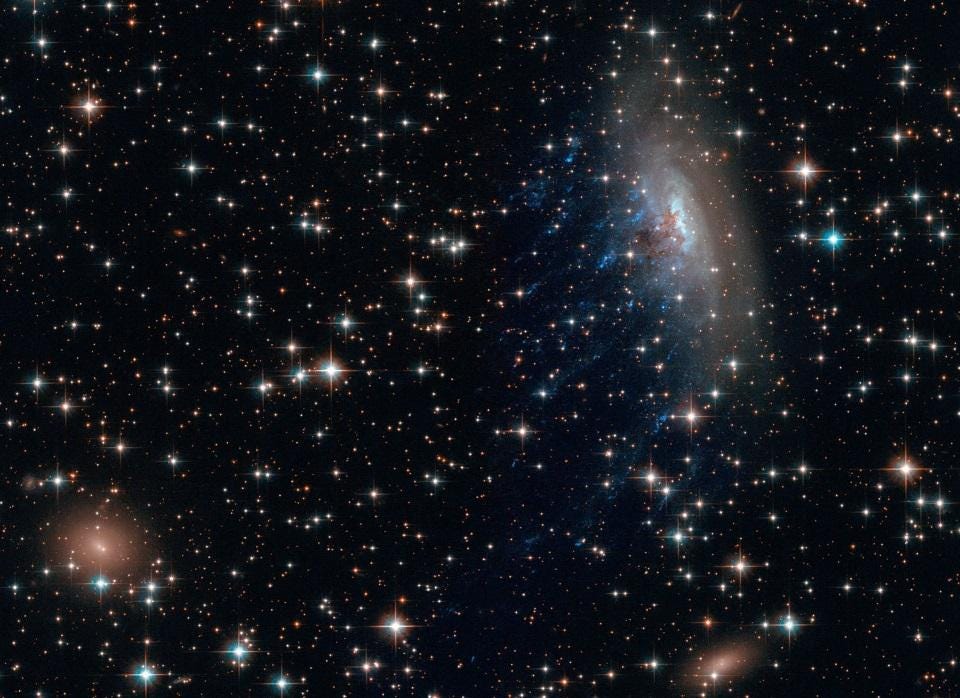
Spiral Galaxies as Cosmic Orientation Instruments: ICM, Spin, Polarity and the Cosmic Medium
Spiral Galaxies May Be Natural Instruments of Cosmic Orientation
A conceptual ICM note on whether galaxy spin, arms, and multi-wavelength structures can reveal hidden orientation and polarity in the cosmic medium.
Author: Artur Chindyaskin Relation to Core Model: Extension of Structural Orientation / Interlayer Medium Layer Status: Preliminary conceptual note
Core ICM framework: **Interlayer Circulation Model**
Previous updates:
The Interlayer Circulation Model (ICM): Visual Evidence and Structural Analysis of Messier 51
Gaia and the Reality of Outward Redistribution
“This article is part of the Interlayer Circulation Model (ICM) update series.
The core idea is simple: a spiral galaxy may not only be an object moving through space. It may also be a natural instrument that reveals the structure, orientation, and polarity of the medium around it.
This update explores whether galaxy spin, spiral arms, magnetic-field-related structures, and multi-wavelength observations can be interpreted as environmental information rather than only internal morphology.”
1. Scope
Previous ICM updates focused on several structural features of galactic systems:
- axial organization
- non-radial geometry
- outward redistribution
- large-scale coherence
- interpretation gaps between observation and explanation
This update introduces a broader interpretive layer:
a spiral galaxy may not be only an object moving inside space. It may also be an instrument revealing the structure of the space around it.
The central question is:
can the spin, shape, arm coherence, jet geometry, and multi-wavelength interaction zones of galaxies reveal the orientation, density, and polarity of the surrounding cosmic medium?
This update does not claim a final mechanism.
It establishes a possible new reading:
galactic morphology as environmental information.
A galaxy is not only something to be measured.
It may itself be a measuring structure.
2. Background: A Galaxy Does Not Rotate in Nothing
The common visual habit is to imagine galaxies as bright objects suspended inside emptiness.
But multi-wavelength astronomy already shows that this image is incomplete.
Centaurus A is a useful example.
In visible light, one sees the galaxy, the dust structure, and the central region. But in radio and X-ray wavelengths, a much larger environment becomes visible: jets, lobes, extended plasma regions, and interaction structures surrounding the galaxy. NASA describes Centaurus A as a system where the dusty core is apparent in visible light, while the jets are best viewed in X-ray and radio light. ESA similarly notes that multi-wavelength observations of Centaurus A reveal complex interaction between powerful jets from the core and the diffuse medium surrounding the galaxy.
This matters because visible light alone can make the galaxy appear isolated.
Radio, X-ray, infrared, and other observational layers reveal something different:
the galaxy is embedded in a medium. That medium has density, structure, boundaries, and response.
This is not a decorative point.
It changes the interpretation.
A galactic disk does not rotate inside an empty geometric background.
It rotates inside a structured environment.
In the ICM framework, that environment is not passive.
It may participate in the formation, constraint, orientation, and long-range behavior of the galactic system.
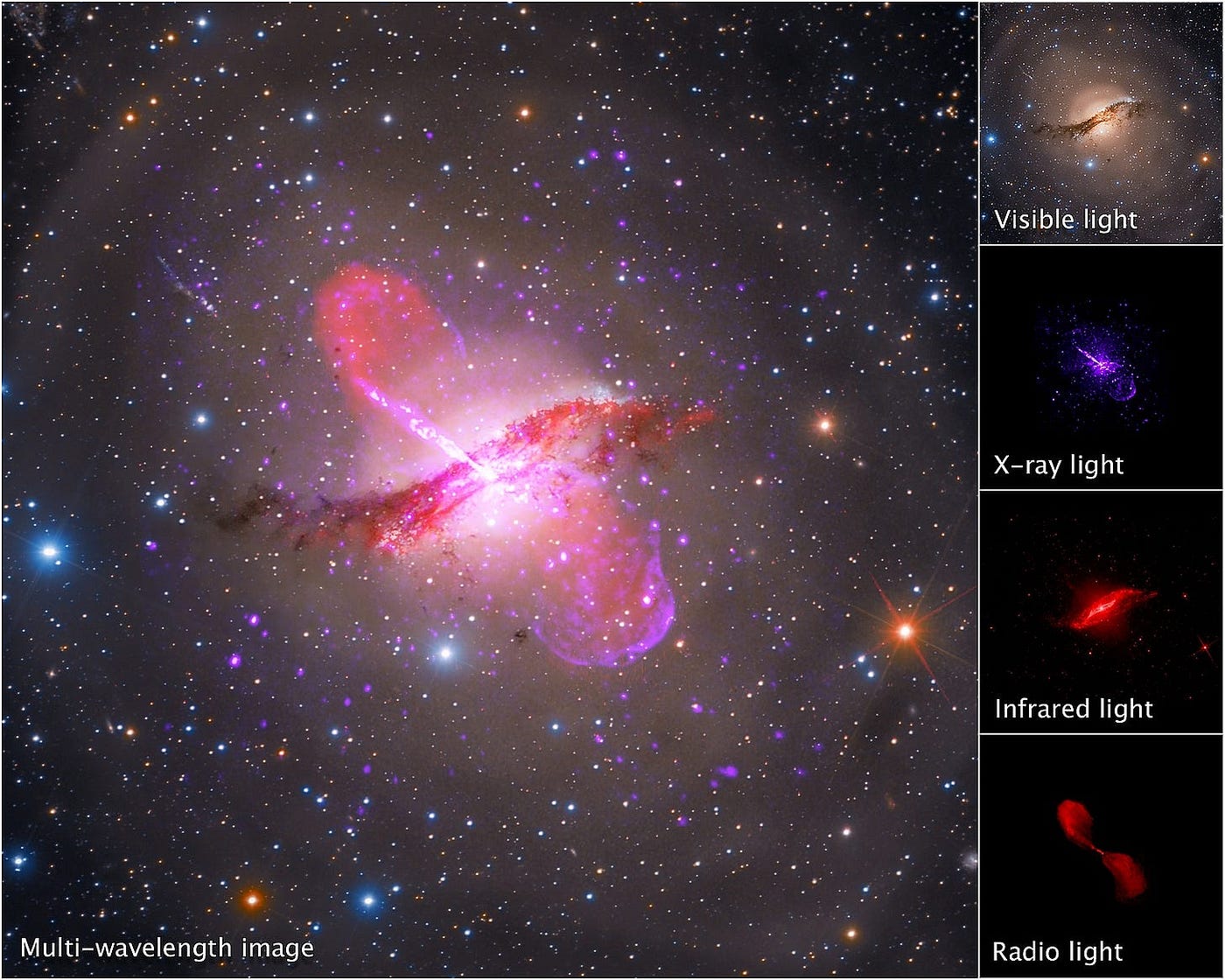
Figure 1. Centaurus A in visible, X-ray, infrared, and radio light. The multi-wavelength view shows that a galaxy is not an isolated object in empty space: different wavelengths reveal jets, extended energetic structures, dust, plasma, and surrounding interaction zones. In the ICM framework, Centaurus A is used as a visual example of why galactic morphology should be read as interaction with a structured cosmic medium.
***Image credit:* NASA, CXC, SAO, Astrophotography by Rolf Olsen, NASA-JPL, Caltech, NRAO, AUI, NSF, UOH, M. Hardcastle. Source: NASA Science.
3. The Interlayer Interpretation
If a galaxy is embedded inside a structured medium, then its disk may be understood as a rotating interface between larger surrounding regions.
In a simplified ICM reading:
- the galactic disk is not isolated;
- the regions above and below the disk may not be equivalent;
- surrounding layers may differ in density, field orientation, and energetic state;
- boundaries between regions may create pressure-like and field-like constraints;
- these constraints may influence how the disk rotates, ejects, absorbs, and stabilizes matter.
In engineering terms:
the galactic disk may operate as a shear-layer interface between distinct environmental vector regimes.
This does not mean the galaxy is pressed between mechanical plates.
It means that the disk may exist at the boundary between different states of the cosmic medium.
If those states have different density, field orientation, or energetic behavior, then the galaxy may preserve a visible record of that environment.
In this reading, the galaxy becomes less like an isolated object and more like an active plate embedded between structured regions.
This is a crucial shift.
The disk is no longer interpreted only as a self-contained rotating mass.
It becomes part of an interlayer system.
4. Spin Handedness as a Polarity Readout
Several studies have examined whether spiral galaxies are randomly distributed in their apparent spin handedness, or whether large-scale asymmetries exist.
This remains a debated field.
However, the question itself is important.
If the distribution of clockwise and counterclockwise spiral galaxies is not random across large regions of the sky, then spin direction may carry information beyond local morphology.
Lior Shamir’s analysis of DESI Legacy Survey spiral galaxies reported that, in a sample approaching 1.3 million spiral galaxies, the northern and southern hemispheres showed opposite excesses of spin handedness, with a dipole-axis fit reported at high statistical significance. The paper also notes that previous studies have disagreed, meaning the effect requires careful treatment of classification bias, survey geometry, image mirroring, and statistical robustness.
This is exactly where ICM introduces a different question:
what if spin handedness is not only a property of the galaxy, but a readout of the environment in which the galaxy is embedded?
In that case, a spiral galaxy’s visible rotation may function as a polarity readout.
Not merely:
which way does this galaxy rotate?
But:
what does this rotation reveal about the surrounding structural regime?
A galaxy may behave like a natural indicator of:
- field orientation;
- polarity domains;
- structural layering;
- directional regimes;
- transitions between cosmic regions.
This does not mean every galaxy is a simple electromagnetic device.
It means something more careful and more powerful:
galactic morphology may preserve environmental information that has not yet been fully extracted.
5. The Faraday-Disk Analogy
A simple laboratory analogy is useful, though it must be used carefully.
In electromagnetic rotation systems such as a Faraday disk, rotational response depends on the relation between current direction, magnetic field orientation, and the resulting Lorentz force.
The analogy does not claim that a galaxy is literally a laboratory disk.
A galaxy is vastly more complex.
The analogy identifies a relevant class of physical behavior:
conductive medium + current or charge transport + magnetic field orientation → rotational response
The key point is polarity.
In electromagnetic rotation systems, reversing field orientation can reverse rotational response.
By analogy, if galactic disks are embedded in large-scale field environments, then opposite spin domains may indicate opposite environmental orientation rather than purely random initial conditions.
This does not prove the mechanism.
But it gives a useful conceptual bridge.
It shows that in systems involving conductive media, field orientation, and charge transport, the direction of rotation is not arbitrary.
It is linked to the sign and orientation of the surrounding field structure.
In ICM terms:
spin handedness may be a visible expression of interlayer field orientation.
5.1 Dynamic Coupling at the Shear-Layer Interface
The dynamic coupling at the shear-layer interface should not be understood as simple mechanical contact or rapid dissipation into thermal waste. In highly ionized and diffuse cosmic media, momentum exchange can be mediated through magnetohydrodynamic (MHD) wave propagation, field-aligned currents, and large-scale magnetic tension.
Within this interpretation, environmental constraint is not merely lost as heat. Part of it may be transferred into organized motion, angular-momentum redistribution, plasma-gas channeling, and the long-range structuring of star-forming material. Over time, such coupling could contribute to the stabilization of the galactic disk by converting interlayer stress into coherent rotational and spiral organization.
6. Plasma, Arms, and Structural Coherence
Spiral arms are not merely visual curves.
They are coherent structures extending across enormous distances.
A purely hydrodynamic outward flow would tend to disperse and lose structure. In a plasma-rich environment, however, fields and currents can provide organizing constraints.
This is where plasma physics becomes relevant.
A galactic disk contains ionized gas, magnetic fields, cosmic rays, and field-sensitive transport processes.
Magnetic fields in spiral galaxies are directly studied through radio synchrotron emission, polarization, and Faraday rotation. Beck’s review notes that these are powerful tools for studying the strength and structure of galactic magnetic fields, and that such fields are dynamically important for gas flows and central inflow processes.
Within ICM, spiral arms may therefore be examined as possible field-guided transport structures.
They may not be only passive luminous morphology.
They may be regions where matter, plasma, field orientation, and long-range structure remain coupled.
This does not require saying that stars themselves are directly confined like charged particles.
That would be too crude.
A stronger and more precise formulation is:
the plasma-gas framework that shapes star-forming regions may be organized by large-scale electromagnetic and pressure constraints, while the visible stellar pattern records the long-term structure produced by that organized medium.
In this reading, a spiral arm is not merely a trail.
It is a constrained pathway.
A visible line where matter, field, and motion remain structurally coupled over large scale.
7. Arms as Field-Guided Transport Channels
In ICM language, spiral arms can be treated as possible channels of structured transfer.
Their coherence may reflect more than local density.
It may reflect a deeper coupling between:
- radial redistribution;
- plasma transport;
- magnetic orientation;
- surrounding pressure;
- long-range field alignment;
- and the rotating disk itself.
This gives the arms a different meaning.
They are not only the result of material distribution.
They may be readable traces of how the galactic system exchanges structure with its environment.
If current-bearing or field-aligned plasma pathways exist along the arms, then the arm becomes something closer to a cosmic transport channel.
Not a rigid cable.
Not a mechanical pipe.
But a guided region where plasma, field, gas, and future star-forming structure remain coupled.
This interpretation also helps explain why spiral arms can remain visually coherent across scales where an unconstrained flow would tend to lose form.
The arm is not only matter.
It is matter under structural guidance.
8. Polarity Reversal and Opposite Galactic Spins
If galactic disks are embedded between structured regions, then opposite spin domains may reflect opposite environmental orientation.
This creates a possible explanation for large-scale handedness asymmetry.
In one region, a dominant field orientation may produce or preserve one spin signature.
In another region, the surrounding orientation may reverse.
The embedded galactic disks may then acquire, preserve, or reveal the corresponding opposite spin signature.
This possibility transforms the meaning of a spin map.
A spin map would no longer be only a catalog of galaxy morphology.
It could become a polarity map.
The question changes from:
which galaxies rotate clockwise or counterclockwise?
to:
where does the surrounding cosmic environment change sign, orientation, or structural regime?
This is why spin handedness matters.
If non-random spin domains are real, they may point to boundaries, gradients, and large-scale orientation fields in the cosmic medium.
9. Observational Anchors
This proposal connects with several existing observational directions.
9.1 Galaxy spin handedness studies
Several analyses by Lior Shamir report large-scale asymmetry in galaxy spin directions across different sky surveys.
One DESI Legacy Survey analysis reported a non-random distribution of spiral galaxy spin directions in a very large sample, including opposite excesses in different hemispheres and a fitted dipole axis. Other papers by Shamir compare data from DES, SDSS, DESI Legacy Survey, Pan-STARRS, and HST, arguing that several independent surveys show related large-scale patterns.
These results remain debated.
That caution is important.
But they provide a direct observational framework for asking whether galaxy spin carries large-scale orientation information.
9.2 Galactic magnetic field studies
Magnetic fields in spiral galaxies are already an established observational topic.
Radio synchrotron emission, polarization, and Faraday rotation are used to measure the strength and structure of galactic fields. Beck’s review states that unpolarized synchrotron emission traces turbulent fields, while polarization and Faraday rotation help reveal regular field structure; it also notes that galactic magnetic fields can be dynamically important.
This means that ICM is not inventing the relevance of fields from nothing.
The question is not whether galactic magnetic fields exist.
They do.
The question is whether their structural role has been fully extracted from morphology, spin, arms, and environmental interaction.
9.3 Multi-wavelength environmental evidence
Centaurus A shows why a galaxy should not be interpreted only through visible light.
Multi-wavelength views reveal jets, lobes, and interaction with surrounding diffuse material. ESA explicitly describes these observations as highlighting the interaction between jets and the diffuse medium around the galaxy.
For ICM, this is important because it supports the broader interpretive principle:
the environment around a galaxy is not empty background. It is part of the system.
9.4 Large-scale orientation anomalies
There are also debated large-angle anomalies in cosmology, including alignments in the cosmic microwave background sometimes referred to as the “Axis of Evil.” The topic is controversial; later studies have argued both for and against the significance of these alignments, and no consensus makes them a settled proof of global anisotropy.
ICM does not claim here to explain those anomalies.
But their existence as a debated mainstream topic matters.
They show that large-scale orientation questions already exist inside cosmology.
The ICM spin-polarity layer belongs to this broader class of questions:
does the universe contain orientation information that has not yet been fully decoded?
10. Toward a Cosmic Navigation Layer
If spin handedness, field orientation, and cosmic structure correlate, then galaxies could become natural markers of direction.
This would introduce a new kind of cosmic navigation.
Not navigation by local stars.
Not navigation by constellations.
Not navigation by human coordinate labels.
A deeper navigation:
- spin domains;
- polarity regions;
- field reversals;
- interlayer gradients;
- large-scale axes;
- structural north / structural south;
- transition boundaries between cosmic regimes.
A future cosmic map would not only ask:
where are the galaxies?
It would also ask:
what orientation are they reading from the medium?
In such a framework, a galaxy becomes similar to a compass.
Not an artificial compass.
A natural one.
Its structure may point toward the hidden orientation of the environment in which it exists.
This is the larger implication.
If spiral handedness is spatially organized, then the universe may contain a directional layer that can be read through galactic morphology.
The spin of galaxies may become a coordinate.
11. Testable Direction
This hypothesis creates a research program.
The key question is not whether the idea sounds attractive.
The key question is whether independent data layers align.
Future checks would include:
- Spin handedness maps Do clockwise and counterclockwise galaxies cluster into large-scale domains?
- Faraday rotation maps Do these domains correlate with magnetic field orientation or sign?
- Polarized radio emission Do spiral arms and inter-arm regions show field structures aligned with predicted orientation?
- Cosmic web comparison Do spin domains correlate with filaments, walls, voids, or larger structural boundaries?
- Multi-wavelength morphology Do X-ray, radio, infrared, and optical layers reveal different environmental regimes above, below, or around galactic disks?
- Boundary identification Are there regions where spin preference reverses, and do those regions correspond to transitions in the surrounding medium?
- Bias removal Can the effect survive mirror-image tests, survey geometry controls, classification bias checks, and independent telescope datasets?
If these layers correlate, then the hypothesis becomes much stronger.
If they do not, the idea must be revised or rejected.
That is the correct scientific boundary.
12. Minimal Formulation
Structured cosmic medium
- layered density / field regions
- galactic disks embedded between those regions
- non-random spin handedness
→ spiral galaxy rotation may encode the orientation of the surrounding cosmic environment
13. Strong Formulation
A spiral galaxy may not be only a rotating object.
It may be a visible field response.
Its disk, arms, jets, lobes, spin, and surrounding interaction zones may together reveal the hidden architecture of the medium in which it exists.
If so, galaxies are not merely islands of matter.
They are instruments.
They may be showing us the polarity, layering, density, and directionality of the cosmic environment.
14. Status
This update does not claim that galaxy spin asymmetry is conclusively proven.
It does not claim that electromagnetism alone explains galactic rotation.
It does not claim that Centaurus A directly proves the full ICM framework.
It does not claim that CMB orientation anomalies prove the existence of global cosmic polarity.
It establishes a broader interpretive possibility:
large-scale galaxy morphology may contain environmental information that has not yet been fully extracted.
In this interpretation, the visible galaxy becomes more than a structure.
It becomes a reading device.
A natural instrument of the cosmic medium.
15. Closing Statement
A galaxy does not rotate in empty space.
It rotates inside a structured medium.
If that medium has density, orientation, polarity, and field structure, then galactic morphology may preserve a record of that environment.
In this interpretation, spiral galaxies are not only islands of matter.
They are natural readout instruments of the cosmic medium.
Their arms, spin, jets, lobes, and field-aligned structures may be showing us not only what galaxies are, but what kind of space they are embedded in.
Galaxies may not only occupy cosmic structure. They may reveal it.
Key Formulas
A galaxy does not rotate in nothing. It rotates inside a structured environment.
Spin handedness may be a polarity readout, not merely a morphological label.
Spiral arms may be field-guided transport structures, not only luminous curves.
Galaxy morphology may preserve environmental information.
A galaxy may be a compass of the medium that contains it.
The spin of a galaxy may encode the polarity of the region in which it formed and evolved.
Galaxies may not only occupy cosmic structure. They may reveal it.
Spiral galaxies may be natural instruments showing the hidden orientation of the cosmic environment.
Author: Artur Chindyaskin Independent Researcher
LinkedIn: https://www.linkedin.com/in/artur-chindyaskin/
Full framework, updates, and further developments of the Interlayer Circulation Model (ICM) will continue under the authorship of Artur Chindyaskin.
메타데이터
- post_id
- 2b5cb65f1b85
- slug
- spiral-galaxies-as-cosmic-orientation-instruments-icm-spin-polarity-and-the-cosmic-medium-2b5cb65f1b85
- url
- https://medium.com/@Artur-Chindyaskin/spiral-galaxies-as-cosmic-orientation-instruments-icm-spin-polarity-and-the-cosmic-medium-2b5cb65f1b85
- canonical_url
- https://medium.com/@Artur-Chindyaskin/spiral-galaxies-as-cosmic-orientation-instruments-icm-spin-polarity-and-the-cosmic-medium-2b5cb65f1b85
- author_url
- https://medium.com/@Artur-Chindyaskin
- status
- ok
- fetched_at
- 2026-06-09 15:37:30