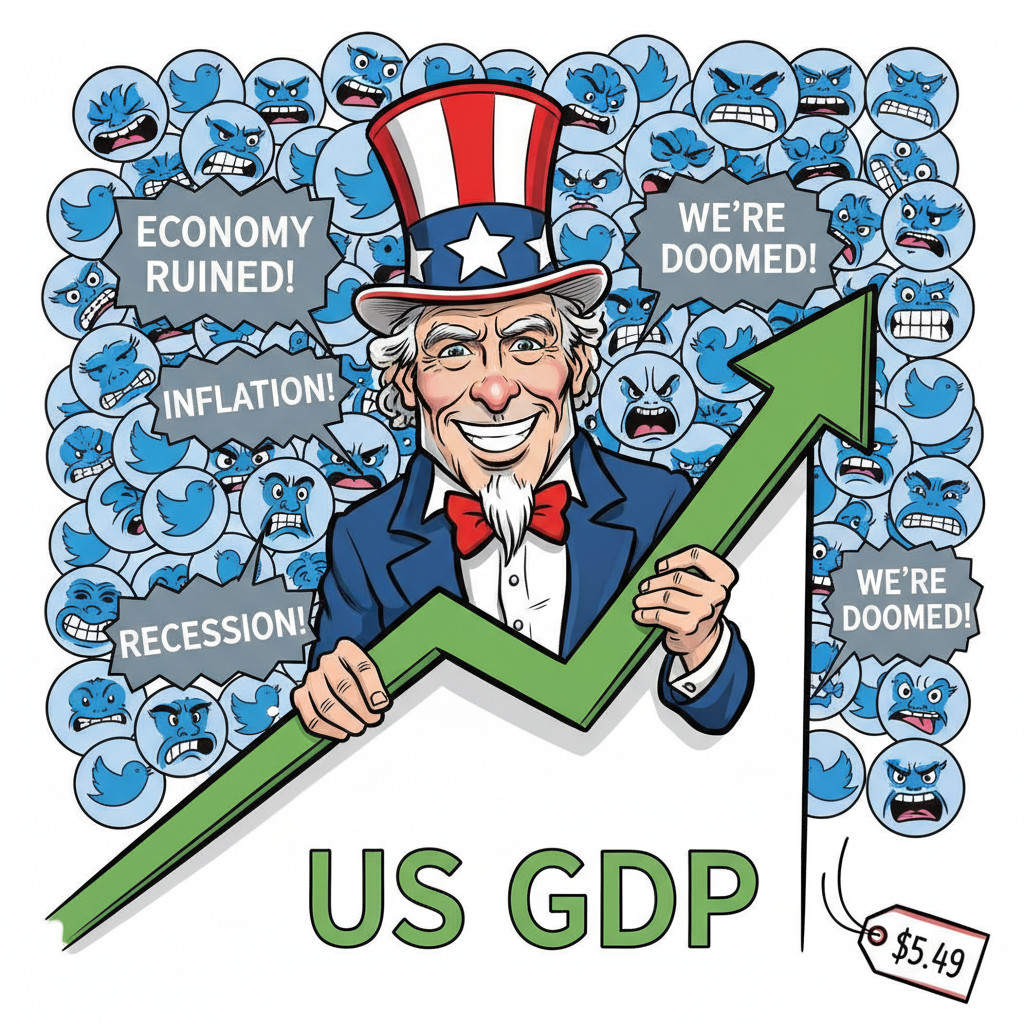
US national debt just passed GDP — and trump’s war made it worse
The last time debt exceeded the whole economy, America had just beaten the Nazis; this time we have a pointless blockade of Iran.
US national debt just passed GDP — and trump’s war made it worse
The last time debt exceeded the whole economy, America had just beaten the Nazis; this time we have a pointless blockade of Iran.
The kind of milestone you don’t want
Here’s a number that should make you put down your coffee: $31.27 trillion. That’s the US national debt as of last week. And here’s another number: $31.22 trillion. That’s US gross domestic product. For the first time since 1946 — the year after we defeated Hitler and started rebuilding Europe — the national debt is larger than the entire American economy.
You want to know what that 1946 moment looked like? A nation that had just spent itself into oblivion winning a world war, with a demobilizing army, a manufacturing sector converting back to consumer goods, and a bipartisan consensus that we needed to invest in things like the GI Bill and the interstate highway system. That debt-to-GDP ratio came down fast, because we grew our way out of it.
This time? We gave billionaires a tax cut in 2017. Then we started a war with Iran. And we’re still waiting for that growth miracle.
Brian Allen, who posted this comparison on X, isn’t wrong. The dots really aren’t that hard to connect.
How we got here — the short, ugly version
Let’s be clear: the debt didn’t explode because of Social Security or Medicare, at least not primarily. The Congressional Budget Office has been pretty explicit about this. The three biggest drivers since 2001 have been: (1) the Bush tax cuts, (2) the Trump tax cuts, and (3) the wars in Iraq, Afghanistan, and now the new adventure in the Persian Gulf.
The 2017 Tax Cuts and Jobs Act alone added roughly $1.9 trillion to the debt over a decade, according to the CBO’s official score. And it didn’t pay for itself. Anyone who told you it would was either lying or had never taken Econ 101. The promised investment boom? Corporate tax receipts fell, stock buybacks soared, and the deficit went up. Shocking.
Then came the pandemic, which was unavoidable. We had to spend trillions to keep the economy from collapsing. That was the right call. But the pandemic spending came on top of a structural deficit that was already baked in by the tax cuts. And then, when we had a chance to start paying down the debt as the economy recovered, what did we do? We cut taxes again — or rather, we made the 2017 cuts permanent for most people while letting the corporate rate stay low.
And then, of course, we decided that the Strait of Hormuz needed a blockade.
The war that’s paid for with a credit card
Gregg Carlstrom’s reporting from the region is worth reading. The short version: Trump got frustrated that Iran wasn’t bending to his nuclear demands, so he ordered a naval blockade of the Strait of Hormuz. It’s been “effective” in the narrow sense that Iranian oil exports have collapsed. But it hasn’t forced Tehran to the negotiating table. It has, however, driven oil prices from about $75 a barrel to well over $110, and it has added somewhere between $500 billion and $800 billion to the national debt in direct military costs alone, depending on whose estimate you use.
And here’s the thing about a war that’s paid for with borrowed money: it doesn’t generate any offsetting economic activity. You’re not building bridges or funding research or educating kids. You’re burning jet fuel over the Persian Gulf and running carrier strike groups that cost $6 million a day to operate. That’s not stimulus. That’s wealth destruction, disguised as patriotism.
Meanwhile, the Iran war has disrupted global supply chains for everything from microchips to fertilizer. The Fed is stuck between fighting inflation — which is now being fueled by energy costs it can’t control — and not wanting to crash the economy. Good luck with that.
The AI mirage
Now, the optimists will point to the latest GDP numbers and say: look, the economy grew 2.8 percent in Q1! And they’re not entirely wrong. But look under the hood. According to recent data, AI-driven tech investment contributed 134 basis points to that growth number. That’s more than half. Without the AI bubble — and I use that word deliberately — the economy would have grown at barely 1 percent.
This is not 1999. In 1999, the dot-com boom was fueled by actual internet adoption, fiber-optic cable being laid, and a genuine productivity revolution that, yes, eventually materialized. But even then, the Nasdaq crash wiped out $5 trillion in market value. Today’s AI investment is concentrated in a handful of companies — Nvidia, Microsoft, a few others — and a lot of it is speculative spending by firms that are essentially buying GPUs and hoping the revenue shows up later.
Milton Tapbit, the economist who flagged the 134-basis-point number, called this a “paradigm shift.” I’d call it a single-engine plane flying over the Atlantic. When that engine coughs — and it will — the rest of the economy doesn’t have much to fall back on.
The immigrant irony
One more thing. Rakesh Krishnan Simha pointed out that lifetime contribution per Indian immigrant to the US economy is $1.7 million — the highest of any group. That’s not an opinion; it’s from the National Foundation for American Policy. Indian immigrants are disproportionately likely to be doctors, engineers, and tech founders. They start companies. They pay taxes. They create jobs.
And the current administration has made it harder for them to come here, harder for them to stay, and harder for them to bring their families. Because it doesn’t “fly with the MAGA crowd.”
So let’s summarize: we’re borrowing money to fight a war that’s driving up oil prices, we’re betting the entire growth story on a speculative AI boom, and we’re simultaneously deporting the people who are most likely to start the next big company. And the national debt just passed GDP for the first time since Harry Truman was president.
But sure, tell me again about how critical race theory is the real threat.
What this actually means
Debt-to-GDP of 100 percent isn’t an automatic crisis. Japan has been above 200 percent for years and hasn’t collapsed. But Japan borrows in its own currency, has a captive domestic savings pool, and isn’t fighting a war. The US still borrows in dollars, which gives us enormous flexibility. But that flexibility isn’t infinite.
The real risk isn’t a sudden default. It’s a slow erosion of confidence, a gradual rise in interest costs, a crowding out of productive investment. Every dollar spent on debt service is a dollar not spent on infrastructure, education, or climate adaptation. Right now, net interest on the debt is running at about $800 billion a year — more than we spend on Medicaid. That number goes up as rates stay higher for longer.
And the political system shows no signs of addressing any of this. The Republicans want more tax cuts. The Democrats want to spend more on social programs. Neither party wants to talk about the math. The war with Iran has made everything worse, but the underlying trajectory was bad before the first shot was fired.
We’ve been here before — sort of. After World War II, we had a debt-to-GDP ratio of 106 percent. But we also had a growing economy, a manufacturing base that dominated the world, and a political class that understood fiscal reality. Today we have a financialized economy, a hollowed-out industrial base, and a Congress that can barely pass a budget.
The dots aren’t hard to connect. The question is whether anyone in Washington wants to look at them.
메타데이터
- post_id
- 2b5ea86320b8
- slug
- us-national-debt-just-passed-gdp-and-trumps-war-made-it-worse-2b5ea86320b8
- url
- https://medium.com/@dipduckdivedodge/us-national-debt-just-passed-gdp-and-trumps-war-made-it-worse-2b5ea86320b8
- canonical_url
- https://medium.com/@dipduckdivedodge/us-national-debt-just-passed-gdp-and-trumps-war-made-it-worse-2b5ea86320b8
- author_url
- https://medium.com/@dipduckdivedodge
- status
- ok
- fetched_at
- 2026-06-09 15:37:30