Bicycle Accident Claims in Los Angeles: How Insurers Reduce Payouts
An insider guide for LA cyclists on recorded statements, fast settlements, medical records, and insurance tactics after a crash.
Bicycle Accident Claims in Los Angeles: How Insurance Companies Turn a Crash Against the Rider
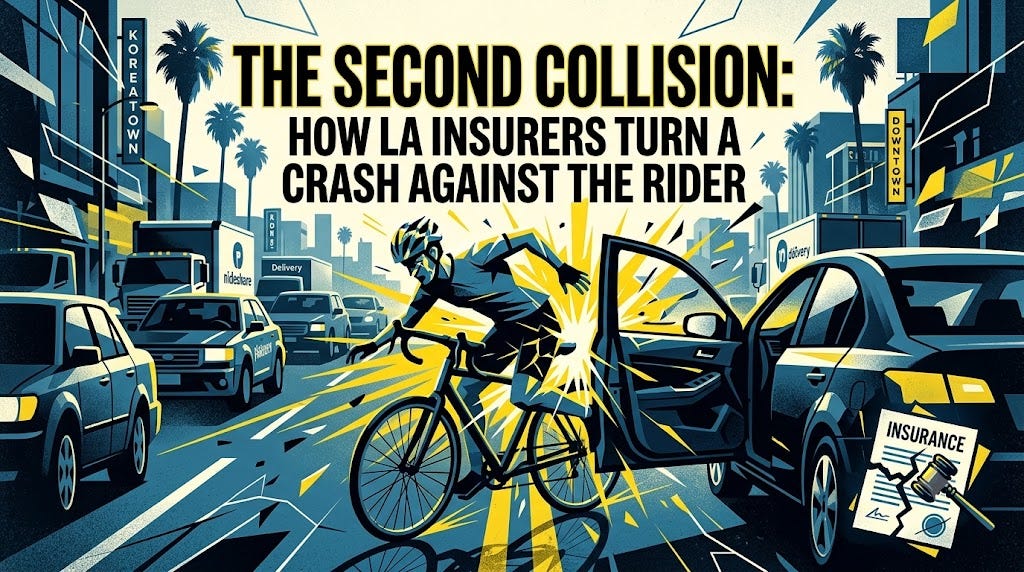
You are on your bike, doing everything right.
Maybe you are riding to work through Koreatown. Maybe you are rolling down Venice Boulevard after a grocery run. Maybe you are in a painted bike lane, watching traffic the way every Los Angeles cyclist learns to do — half rider, half defensive-driving expert.
Then a driver cuts across you, opens a door, turns right without looking, or clips you while passing too close.
The police report gets written. The driver says, “I didn’t see them.” The insurance adjuster calls a few days later with a friendly voice and a promise to “take care of everything.”
That is usually the moment the second collision begins.
Not the one with the car. The one with the insurance company.
The Insurance Company Is Not Investigating for You
This is the first thing injured cyclists need to understand: the adjuster may sound calm, helpful, and sympathetic, but their job is not to build your claim.
Their job is to control risk for the insurance company.
That means the insurer is looking for any reason to:
- Pay less than the claim is worth
- Shift blame onto the cyclist
- Minimize injuries as “minor”
- Pressure an early settlement
- Use your own words against you
- Close the file before the full medical picture is clear
In a bicycle crash, this matters even more because riders are often blamed before the facts are fully developed. A driver can say, “They came out of nowhere,” and suddenly the cyclist is treated like the problem instead of the person who got hit.
The “Friendly Call” Is Often a Recorded Statement Trap
One of the most common moves after a bike crash is the quick recorded statement.
The adjuster may say something like:
“We just need your side of the story so we can move the claim forward.”
That sounds reasonable. It may even feel like cooperation. But recorded statements are rarely neutral.
The problem is not that you are lying. The problem is that you are injured, stressed, medicated, sleep-deprived, and still trying to understand what happened.
You may say:
- “I’m okay,” because you are trying to be polite.
- “I didn’t see the car until the last second,” because the driver turned suddenly.
- “I might have been going kind of fast,” because you are guessing.
- “I think I had the green,” because everything happened in seconds.
Later, those words can be reframed as uncertainty, exaggeration, or partial fault.
Better approach
Before giving a recorded statement, riders should understand the claim, review the facts, and avoid guessing. If you do speak with an insurer, keep it factual and narrow.
Say what you know. Do not fill in blanks.
“You Were Partly at Fault” Is the Insurance Company’s Favorite Discount Code
California follows comparative fault principles, which means fault can be divided between the parties. In plain English, if an insurer can pin part of the blame on you, they can try to reduce what they pay.
That is why cyclists often hear arguments like:
- “You were riding too fast.”
- “You should have been farther right.”
- “You should have avoided the car.”
- “You were not visible enough.”
- “You did not have lights.”
- “You were not in the bike lane.”
- “You should have anticipated the door opening.”
- “You came from the driver’s blind spot.”
Some of those arguments may be baseless. Some may ignore how Los Angeles streets actually work.
California law also recognizes that bicyclists are not always required to hug the curb. Riders may need to avoid debris, parked cars, unsafe lane widths, opening doors, turning vehicles, or other hazards. The California DMV’s bicycle safety guidance and California road rules make clear that bikes and cars must share the road safely.
That matters because the insurer’s version of “safe riding” may not match the law — or reality.
The Three-Foot Rule Still Matters
California drivers must generally leave at least three feet when passing a bicyclist. If they cannot safely provide that space, they should wait until they can pass safely.
That rule is important in Los Angeles because many crashes happen in the gray zone between “the driver passed” and “the driver passed safely.”
A close pass can cause a cyclist to:
- Swerve into debris
- Clip a parked car
- Lose balance
- Hit a curb
- Crash without the vehicle making direct contact
Do not assume you have no claim just because the car did not physically knock you down. A dangerous maneuver can still be part of the crash story.
The Quick Settlement Offer Is Usually Not a Favor
After a bike crash, the first settlement offer may arrive before you know the full extent of your injuries.
That timing is not random.
Soft tissue injuries, concussions, shoulder damage, wrist fractures, knee injuries, herniated discs, and nerve symptoms can evolve over days or weeks. Some riders feel “lucky” at the scene, then wake up the next morning unable to turn their neck or put weight on a leg.
Insurance companies know this.
An early offer can look attractive because you may be missing work, paying out of pocket, replacing your bike, or dealing with transportation problems. But once you sign a release, the claim is usually over.
That means no second round if your MRI changes the diagnosis. No additional payment if physical therapy lasts longer than expected. No reopening the claim because you later discover the crash affected your ability to work.
Before accepting any settlement, know the full picture
A serious bicycle accident claim should account for:
- Emergency care
- Follow-up treatment
- Imaging and specialist visits
- Physical therapy
- Lost wages
- Reduced earning capacity
- Bike repair or replacement
- Helmet, phone, clothing, and gear damage
- Pain, anxiety, and loss of normal activity
- Future medical care, when supported by evidence
A settlement should not be based only on the first urgent care bill.
Medical Gaps Can Be Used Against You
Cyclists often try to tough it out. That is understandable.
Many people do not want to overreact. Some do not have great health insurance. Others assume soreness is normal after a crash.
But from an insurance perspective, delayed treatment creates an opening.
The insurer may argue:
- “If you were really hurt, you would have gone to the doctor sooner.”
- “Your symptoms must have come from something else.”
- “There is no proof the crash caused this injury.”
- “You made your injuries worse by waiting.”
This is why documentation matters.
You do not need to exaggerate. You do need a clear medical record that connects the crash, symptoms, diagnosis, treatment, and recovery timeline.
What Riders Should Document Immediately
After a bicycle crash, evidence disappears fast.
Skid marks fade. Vehicles get repaired. Camera footage gets overwritten. Witnesses forget details. Road debris gets swept away. The driver’s story may become more polished over time.
If you are physically able, document as much as possible.
At the scene
Take photos or video of:
- The vehicle position
- Your bike position
- Damage to the bike
- Damage to the car
- The intersection or roadway
- Traffic signals and signs
- Bike lane markings
- Debris, potholes, gravel, or uneven pavement
- Your helmet and clothing
- Visible injuries
- Driver’s license plate
- Insurance card
- Driver’s license
- Witness names and contact information
After the scene
Save:
- Medical records
- Visit summaries
- Prescriptions
- Work absence notes
- Repair estimates
- Receipts for rideshare or transit
- Photos of bruising as it develops
- Screenshots of missed work or canceled commitments
- A daily pain and limitation journal
The goal is not to create drama. The goal is to preserve reality before the insurance company rewrites it.
Common Insurance Tactics After a Bicycle Crash
Insurance companies rarely announce their strategy directly. Instead, the tactic often sounds routine, helpful, or procedural. Here are the patterns riders should recognize.
Quick recorded statement
What it sounds like: “We just need your version.”
What may really be happening: They are locking you into early wording before you know the evidence, the medical details, or the full crash timeline.
Early settlement offer
What it sounds like: “We can resolve this now.”
What may really be happening: They may be trying to close the claim before your injuries are fully diagnosed or before future treatment costs are known.
Blaming the cyclist
What it sounds like: “You were not visible.”
What may really be happening: They are building a comparative fault argument to reduce the amount they have to pay.
Minimizing treatment
What it sounds like: “That seems like a lot of therapy.”
What may really be happening: They are questioning the medical value of your claim and trying to make your recovery look excessive or unrelated.
Delay
What it sounds like: “We are still reviewing.”
What may really be happening: They may be waiting for financial pressure to build so you become more likely to accept less.
Requesting broad medical history
What it sounds like: “We need your records.”
What may really be happening: They may be searching for old injuries, prior complaints, or unrelated medical history they can use to blame something other than the crash.
Do Not Give the Insurer Unlimited Access to Your Medical History
After a crash, insurers often ask for medical authorization forms.
Some requests are legitimate. Others are too broad.
A broad authorization may allow the insurance company to dig through years of medical history looking for anything they can use against you — an old back complaint, a prior sports injury, a previous concussion, or a note from years ago that has little to do with the crash.
A smarter approach is targeted documentation.
The insurer needs records relevant to the injuries claimed. That does not automatically mean they need unlimited access to your entire medical life.
The Police Report Helps, But It Is Not the Whole Case
Police reports matter, but they are not perfect.
Officers often arrive after the crash. They may not see the impact, may not interview every witness, and may rely heavily on the driver’s version if the cyclist is injured or transported for medical care.
A police report may contain:
- Helpful witness statements
- Driver admissions
- Insurance information
- Diagram of the crash
- Vehicle code references
- Officer observations
But it may also contain mistakes.
If the report is incomplete or inaccurate, it should not be treated as the final word. Photos, camera footage, medical records, road design, vehicle damage, and witness testimony can all matter.
Los Angeles Bike Crashes Are Not Just “Accidents”
The word “accident” can make a crash sound unavoidable.
Many bicycle collisions are not unavoidable. They are the result of choices:
- A driver checks a phone.
- A rideshare vehicle stops in a bike lane.
- A delivery driver swings open a door.
- A left-turning driver rushes through a gap.
- A motorist passes too closely.
- A city leaves a dangerous roadway condition unfixed.
- A commercial vehicle driver fails to check mirrors.
Los Angeles cyclists already understand this. The danger is not abstract. It is built into daily routes through Hollywood, Downtown, Westlake, Pico-Union, South LA, Santa Monica, East LA, Culver City, Pasadena, Glendale, Long Beach, and the Valley.
A claim should investigate what actually caused the crash — not just whether the cyclist survived it.
When a Government Entity May Be Involved
Some bicycle crashes involve more than a careless driver.
A dangerous road condition may also play a role, such as:
- Broken pavement
- Poor lighting
- Missing signage
- Defective traffic signals
- Unsafe bike lane design
- Construction hazards
- Unmarked road work
- Drain grates or utility covers
- Poorly maintained public property
When a public entity may be responsible, the timeline can be much shorter than a typical personal injury lawsuit. In California, certain government claims may require action within six months.
That is one reason cyclists should not wait too long to get the crash reviewed. The deadline issue can become just as important as the injury itself.
What a Strong Bicycle Accident Claim Usually Needs
A strong claim is not built on outrage alone. It is built on proof.
The strongest bicycle accident claims usually connect four things:
1. Liability
Who caused the crash, and why?
This may involve driver negligence, unsafe passing, failure to yield, dooring, distraction, speeding, unsafe turns, road hazards, or commercial vehicle conduct.
2. Causation
How did the crash cause the injuries?
This is where medical records, imaging, symptoms, and treatment timelines matter.
3. Damages
What did the crash cost the rider?
This includes financial losses and human losses: pain, mobility problems, missed work, anxiety, sleep disruption, and loss of independence.
4. Collectability
What insurance coverage or responsible party is available?
This may include the driver’s insurance, commercial policies, rideshare coverage, uninsured/underinsured motorist coverage, or potential public-entity liability.
What Cyclists Should Avoid After a Crash
Here is the practical list.
Avoid:
- Saying “I’m fine” before being medically evaluated
- Guessing about speed, distance, or fault
- Giving a recorded statement too early
- Posting crash details on social media
- Accepting the first settlement offer
- Signing broad medical authorizations
- Repairing or discarding the bike before documenting it
- Throwing away damaged helmet or gear
- Waiting weeks to get medical care
- Assuming the police report is automatically correct
None of this means you should be paranoid. It means you should be strategic.
The Real Problem: The Insurance Company Has a System. Most Riders Don’t.
Insurance companies handle claims every day. They have scripts, software, adjusters, defense lawyers, medical reviewers, and settlement ranges.
Most cyclists are handling one crash — their own — while injured, stressed, and trying to get back to normal life.
That imbalance is the point.
A rider does not need to be aggressive. A rider needs to be prepared. The more serious the injury, the more important it becomes to treat the claim like evidence, not paperwork.
Final Thought: Do Not Let the Insurance Company Write the Story First
After a bicycle crash, the insurer may try to make the case about everything except the driver’s conduct.
They may focus on your clothing, your speed, your route, your medical history, your delay in treatment, your bike position, or one sentence you said during a recorded call.
Your job is to bring the claim back to the facts.
What did the driver do? What did the road conditions show? What injuries were caused? What losses followed? What evidence supports it?
That is how a bicycle accident claim becomes more than a file number. It becomes a clear, documented account of what happened — and why the cyclist should not be left paying the price for someone else’s mistake.
About the Author
Akhavan Law Firm APC provides legal guidance for injured cyclists, pedestrians, and accident victims throughout Southern California. The firm helps riders understand their rights after serious crashes, including claims involving negligent drivers, unsafe road conditions, disputed liability, and insurance company tactics.
For educational resources about bicycle accident claims or to learn what steps may protect your case after a crash, visit this guide on legal guidance after a bike crash.
This article is for general educational purposes only and does not create an attorney-client relationship.
메타데이터
- post_id
- 2b6251a77fcc
- slug
- bicycle-accident-claims-in-los-angeles-how-insurers-reduce-payouts-2b6251a77fcc
- url
- https://medium.com/@akhavan-law-firm-apc/bicycle-accident-claims-in-los-angeles-how-insurers-reduce-payouts-2b6251a77fcc
- canonical_url
- https://medium.com/@akhavan-law-firm-apc/bicycle-accident-claims-in-los-angeles-how-insurers-reduce-payouts-2b6251a77fcc
- author_url
- https://medium.com/@akhavan-law-firm-apc
- status
- ok
- fetched_at
- 2026-08-01 03:22:41