Beyond Static Pixels: The Realities of Physical AI and Sensor Fusion at CVPR 2026
Just back from the CVPR 2026 floor in Denver, and the shift in the industry’s focus is palpable. Over the last decade of engineering and…
Beyond Static Pixels: The Realities of Physical AI and Sensor Fusion at CVPR 2026
Just back from the CVPR 2026 floor in Denver, and the shift in the industry’s focus is palpable. Over the last decade of engineering and deploying computer vision systems, I’ve watched the community chase incremental accuracy on static datasets. But this year, the message was loud and clear: human-level accuracy for static tasks has largely been solved by foundational models like SAM and Nvidia’s recent zero-shot segmentation releases.
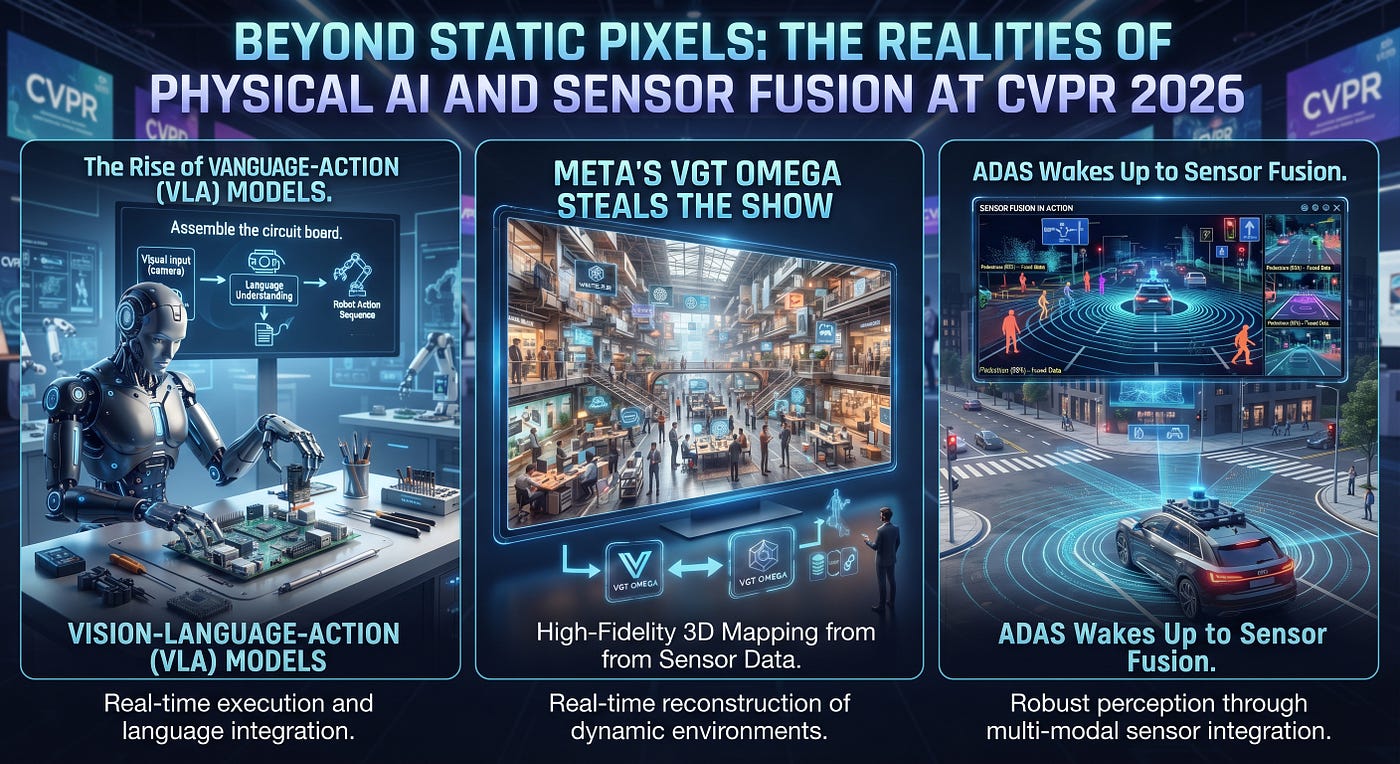
The new frontier isn’t just seeing the world; it’s physically interacting with it.
Here are my major takeaways from the conference and where the next wave of computer vision is heading.
The Rise of Vision-Language-Action (VLA) Models
During a standout keynote, Professor Thomas from Brown University hammered home that the immediate future lies in Vision-Action Systems (VAS) and reinforcement learning. The community is moving away from purely descriptive models and struggling with state-level estimation — understanding short versus long context and tracking which physical actions have already been completed.
To bridge this gap, researchers are getting creative with exogenic data. One project even involved strapping cameras to six-month-old babies to natively capture how humans learn to interact with their environments to get egocentric view of human interation . The goal is no longer just evaluation metrics; it’s about making models function as naturally as humans when deployed in the wild.
3D Reconstruction: Meta’s VGT Omega Steals the Show
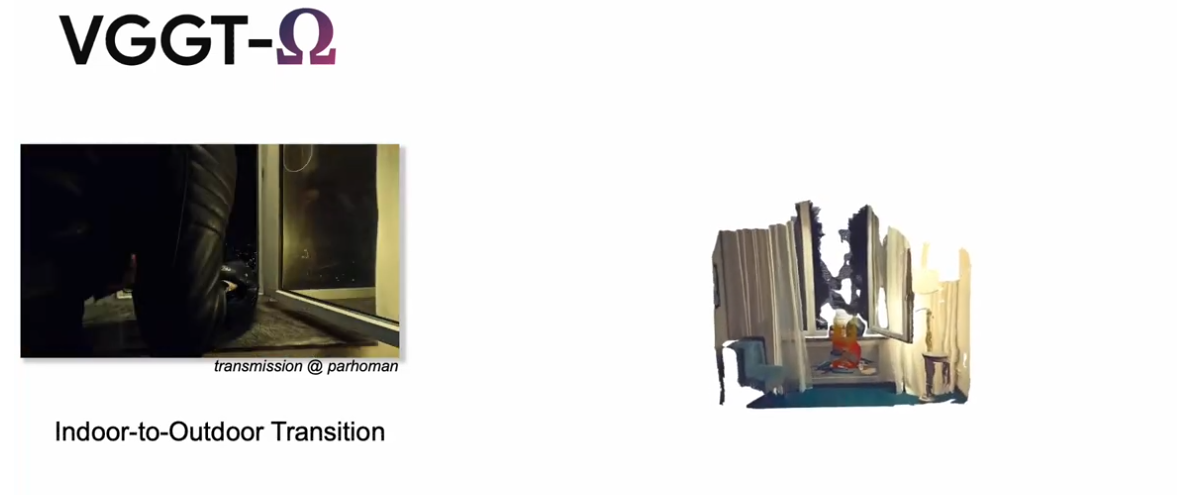
My primary focus has always been 3D reconstruction and Vision-Language Models, and this year did not disappoint. Meta showcased a foundational model update called VGGT Omega that was nothing short of incredible. By passing standard video through a transformer , it can output a complete 3D point cloud for both static and dynamic scenes.
The days of traditional, hardware-heavy studio camera calibration seem numbered. Even engineers I spoke with from Netflix noted they have abandoned older calibration methods in favor of Vision Transformers to generate point clouds and manipulate camera positions dynamically.
ADAS Wakes Up to Sensor Fusion
Remember the 2020 promises of fully autonomous vehicles running on a single camera or lidar? The industry has officially walked that back.
The autonomous driving space is now embracing massive sensor fusion to combat drift and calibration issues. I saw rigs from companies like Torque featuring an astounding 14 cameras, 6 lidars, and 4 radars on a single truck. The consensus is clear: we need more robust data, and we need a lot of it.
The Disconnect in Academic Medical Imaging
While the commercial leaps were thrilling, some of the academic posters left much to be desired, particularly in medical imaging. Too many papers relied entirely on public datasets (like NIH data) and complex software architectures — such as Mixture of Experts or VLM agents — without any foundational domain knowledge of hardware.
Working in this field requires a marriage of optics engineering and machine learning. Relying solely on cell phone data or public sets leaves incredible performance on the table, and it was a stark reminder of the gap between academic research optimized for graduation metrics and systems engineered for real-world deployment.
Global Shifts: Compute Optimization Wins
Finally, it was impossible to ignore the sheer dominance of Chinese companies and researchers, particularly in robotics. While western models often rely on brute-force compute, teams operating under compute constraints have been forced to relentlessly optimize their architectures. The result? Chinese robotics are currently far ahead of the curve, with soccer-playing robots that made competitors look entirely rudimentary by comparison.
Final Thoughts
We are entering an era where theoretical architecture is being violently tested against the physical realities of the world. Moving forward, robust vision systems will require hyper-optimized hardware-software integration.
As I continue to take on freelance consulting projects and build out Neuron Voxel AI, I’m incredibly excited to help bridge this gap between foundational models and real-world 3D environments. The static image is conquered; now, we build for the physical world.
메타데이터
- post_id
- 2b64ff85dee0
- slug
- beyond-static-pixels-the-realities-of-physical-ai-and-sensor-fusion-at-cvpr-2026-2b64ff85dee0
- url
- https://medium.com/@avithaljunk/beyond-static-pixels-the-realities-of-physical-ai-and-sensor-fusion-at-cvpr-2026-2b64ff85dee0
- canonical_url
- https://medium.com/@avithaljunk/beyond-static-pixels-the-realities-of-physical-ai-and-sensor-fusion-at-cvpr-2026-2b64ff85dee0
- author_url
- https://medium.com/@avithaljunk
- status
- ok
- fetched_at
- 2026-06-25 07:00:49