Bangkok’s Most Expensive Product Is Time
Traffic does more than delay journeys. It quietly reduces incomes, raises business costs and makes access to Bangkok’s opportunities…
Bangkok’s Most Expensive Product Is Time
Traffic does more than delay journeys. It quietly reduces incomes, raises business costs and makes access to Bangkok’s opportunities increasingly unequal.
Bangkok’s traffic | Photo by Robert Eklund on Unsplash
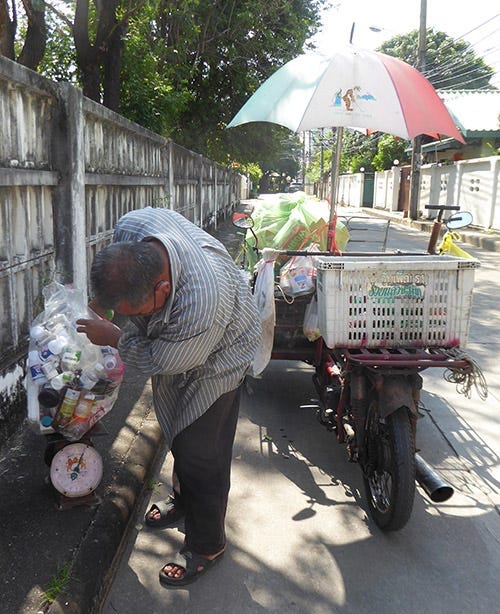
At 7:00 in the morning, Bangkok is already negotiating with the clock. Office workers wait beside packed roads. Delivery riders search for gaps between cars. Parents calculate whether they can reach school before work. Buses move slowly through intersections while train platforms fill with commuters attempting to avoid the streets below.
Traffic is usually discussed as an inconvenience: something irritating but unavoidable in a large city. Economically, however, congestion functions more like an invisible tax. It takes time from workers, fuel from drivers, productivity from businesses and accessibility from people living far from Bangkok’s rail network.
Unlike an ordinary tax, this payment does not fund public services. The hours simply disappear.
In 2025, TomTom estimated that a typical 10-kilometre journey in Bangkok took almost 23 minutes on average. During the evening rush hour, the same distance required approximately 31 minutes, with average speeds falling to 19.1 kilometres per hour. Drivers making regular peak-hour journeys lost an estimated 115 hours to congestion over the year — almost five complete days. TomTom
Yet even that figure captures only part of the cost. The real economic burden depends on whose time is being lost, what work is being delayed and whether a commuter has any realistic alternative.
Time is an economic resource
Time does not appear on a payslip, but it has value.
Consider two Bangkok employees earning the same monthly salary. One lives close to a rail station and spends 35 minutes travelling each way. The other lives farther from rapid transit and spends 90 minutes each way using a combination of motorcycle taxi, bus and train.
The second worker loses an additional 110 minutes every working day.
Across 22 working days, that equals roughly 40 extra hours each month. Across 11 working months, it becomes approximately 440 hours a year — the equivalent of 55 eight-hour working days.
This is only an illustrative calculation, not an estimate for every Bangkok commuter. However, it shows why two people with the same salary may not receive the same real benefit from their employment. One has substantially less time available for sleep, family, exercise, education or additional work.
The commuter is not formally paid less. In practical terms, however, the job demands far more of their life.
This also affects employment decisions. A worker may reject a better-paying position because the journey is too long. Another may accept a lower salary to remain near home. Employers therefore compete not only through wages and benefits, but through location and accessibility.
Bangkok’s labour market is partly shaped by how far people can travel within a reasonable amount of time.
The cost does not end with the commuter
Congestion creates expenses throughout the economy.
A delivery company pays drivers for fewer completed journeys. A restaurant waits longer for ingredients. A construction project receives materials late. A salesperson reaches fewer clients. A taxi driver burns fuel while the vehicle is barely moving. Employees arrive stressed or must leave home earlier to protect themselves against unpredictable delays.
A 2024 study involving 215 commuters in Bangkok and surrounding provinces estimated annual congestion costs of approximately ฿76,000–฿77,000 per vehicle, measured at 2023 prices. The calculation incorporated private expenses and external costs associated with heavy rush-hour traffic. Because the study used a limited survey sample and focused on vehicle users, the number should not be applied automatically to every resident. Nevertheless, it demonstrates that congestion carries a substantial financial burden beyond frustration alone. Thai-Journal Online
Another study examining the environmental and social costs of motorised transport in Bangkok estimated that transport externalities represented approximately 7% to 10.8% of Bangkok’s gross regional product, with congestion accounting for almost half of that burden. The analysis included wider costs such as pollution, accidents, noise and greenhouse-gas emissions in addition to traffic delay. ScienceDirect
These losses are distributed across millions of small events: ten minutes added to a delivery, half an hour lost before a meeting, extra fuel consumed at an intersection and a worker leaving home before sunrise.
No single delay appears economically disastrous. Combined across the city, they become a structural cost.
Congestion raises the price of almost everything
Transport time eventually enters the prices paid by consumers.
When a supplier requires longer to deliver products, it needs more driver hours and fuel per delivery. A business may need additional vehicles simply to complete the same number of daily trips. Companies may maintain extra inventory because they cannot rely on materials arriving on time.
These costs do not always appear as a separate “traffic fee.” They are included in delivery charges, product prices and operating expenses.
Small businesses may be especially exposed. A large retailer can operate multiple warehouses and optimise routes using extensive data. A small restaurant or independent shop may rely on one supplier, one vehicle or one delivery window. A single traffic disruption can therefore have a greater effect on its daily operations.
Congestion also reduces the number of customers a business can realistically reach. A restaurant may be geographically close to thousands of people but functionally distant if travelling there requires an unpredictable journey. A company may struggle to recruit workers because its office is not accessible by rail.
In this sense, distance in Bangkok is not measured only in kilometres. It is measured in uncertainty.
The burden is unequal
Traffic affects almost everyone, but not equally.
Higher-income households may be able to live near central employment districts, pay for expressways, use private vehicles or choose housing close to rail stations. Some professionals can work remotely or adjust their schedules.
Lower-income workers are more likely to have fewer choices. Central housing can be unaffordable, while employment remains concentrated in commercial districts. A cheaper home on the urban edge may come with a much longer and more complicated commute.
Public transport does not automatically remove this inequality. Bangkok’s rail network offers fast travel along its main lines, but reaching a station can require an additional motorcycle taxi, songthaew, bus or long walk. Several transfers also increase the total fare.
An Office of Transport and Traffic Policy and Planning report acknowledged that mass-transit fares can be too expensive for ordinary citizens and that Bangkok’s bus system requires financial support to remain both affordable and attractive. The same report argued that revenue from measures discouraging private-car use could be directed towards public transport and non-motorised travel. Office of Transport Policy
This creates a difficult trade-off. People who cannot afford to live near rapid transit may also face the longest journeys to reach it. They pay less for housing but more in time.
The city’s cheapest homes may therefore carry one of its most expensive hidden costs.
Why Bangkok cannot simply build its way out
The natural response to congestion is often to demand more roads, tunnels or overpasses. Certain bottlenecks clearly require physical improvements. However, expanding road capacity alone does not address why so many journeys depend on private vehicles in the first place.
Bangkok’s transport-planning agency identified 127 urgent congestion locations in a recent road-relief study, including intersections, bottlenecks, U-turns and bus stops. At 89 of the studied locations, rush-hour speeds regularly fell below 10 kilometres per hour. Office of Transport Policy
Fixing individual friction points may improve movement locally. But if more road capacity encourages more driving, congestion can eventually return in a different location.
Bangkok’s challenge is therefore not simply how to move more cars. It is how to provide more people with reliable access to employment, education and services without requiring every journey to depend on a car.
That requires treating buses, footpaths, transfers and last-mile connections as essential infrastructure — not secondary additions to rail megaprojects.
What a realistic response could look like
The solution is unlikely to be one dramatic project. It requires several policies working together.
First, Bangkok needs more reliable bus services. Buses use road space more efficiently than private cars, but they lose much of that advantage when trapped in the same congestion. Enforced bus lanes on suitable corridors, improved route planning and predictable service information could reduce journey times for a large number of passengers.
Second, transfers must become cheaper and easier. A train journey may appear fast, but its total cost includes reaching the station, waiting, transferring and travelling from the final station to the destination. Integrated fares and stronger feeder services would make public transport more competitive with driving.
Third, employers can reduce peak-hour pressure through flexible starting times, hybrid work and staggered shifts where the nature of the job permits it. Not every worker can work remotely, but even a limited reduction in simultaneous travel can help spread demand.
Fourth, congestion charging deserves consideration — but only alongside credible alternatives. Charging vehicles to enter highly congested areas could discourage unnecessary driving and generate funds for buses and affordable mass transit. Thailand’s transport-planning office has modelled congestion charging as part of a wider clean-mobility programme and concluded that it could be financially and economically feasible when combined with bus modernisation and rail-fare support. Office of Transport Policy
However, a charge introduced before improving public transport could unfairly punish people who have no realistic alternative. The purpose should not simply be to make driving more expensive. It should be to make other choices genuinely better.
Finally, transport decisions should be evaluated using time saved — not only kilometres of road constructed. A modest bus-priority project that saves thousands of passengers ten minutes each day may create more public value than an expensive structure benefiting a smaller number of drivers.
A city paying with hours
Bangkok’s congestion is often visible as a line of brake lights. Its deeper cost is less visible.
It appears in the parent who leaves home before a child wakes up. It appears in the rider completing fewer deliveries, the employee arriving exhausted and the small business paying more to move ordinary goods across the city.
Traffic does not merely slow Bangkok’s economy. It changes who can access it.
People who live near reliable transport gain access to more jobs, businesses and services. Those who live beyond it must surrender more of their day for the same opportunities. Over time, this difference affects income, health, family life and social mobility.
Bangkok’s most expensive product is not sold in its luxury malls or high-rise condominiums. It is the time required to reach them.
The city cannot recover the hours already lost. But it can stop treating those losses as unavoidable. A transport system should not be judged only by how many vehicles it can move. It should be judged by how much of people’s lives it gives back.
References
Ayaragarnchanakul, E. (2022). Bangkok’s locked-in traffic jam: Price congestion or regulate parking? Case Studies on Transport Policy, 10(1). ScienceDirect
Beerkaew, A., Jarungrattanapong, R., Nabangchang, O., & Tambunlertchai, K. (2024). The cost of traffic congestion and marginal cost of delay in Bangkok Metropolis. Asian Journal of Applied Economics, 31(2), 50–64. Thai-Journal Online
Office of Transport and Traffic Policy and Planning. (2024). Executive summary report: Main road traffic relief plan in Bangkok. Ministry of Transport, Thailand. Office of Transport Policy
Office of Transport and Traffic Policy and Planning, & Deutsche Gesellschaft für Internationale Zusammenarbeit. (2022). Development of a funding mechanism for the Thailand Clean Mobility Program. Office of Transport Policy
TomTom. (2026). Bangkok traffic report: Traffic Index 2025. TomTom
메타데이터
- post_id
- 2b6ee8c4a697
- slug
- bangkoks-most-expensive-product-is-time-2b6ee8c4a697
- url
- https://medium.com/@BehindBangkok/bangkoks-most-expensive-product-is-time-2b6ee8c4a697
- canonical_url
- https://medium.com/@BehindBangkok/bangkoks-most-expensive-product-is-time-2b6ee8c4a697
- author_url
- https://medium.com/@BehindBangkok
- status
- ok
- fetched_at
- 2026-07-31 17:11:31