The AEO Playbook for Service Businesses: Getting Recommended When Clients Ask AI Who to Hire
When a potential client types “who should I hire for [your service]?” into ChatGPT, someone gets recommended. This playbook ensures it’s…
The AEO Playbook for Service Businesses: Getting Recommended When Clients Ask AI Who to Hire
When a potential client types “who should I hire for [your service]?” into ChatGPT, someone gets recommended. This playbook ensures it’s you not because of luck, but because of deliberate, executable strategy.
Run this test right now. Open ChatGPT or Perplexity. Type: “Who are the best [your service type] agencies in [your sector or region]?” Or: “What should I look for when hiring a [your profession]?” Or simply: “Can you recommend a good [your service] company for [your specific use case]?”
Read the answer carefully. Note which businesses are named, how they are described, and on what basis the AI appears to be making its recommendations. Now notice whether your business appears and if it does, whether the description reflects how you would characterise your own expertise and positioning.
For the overwhelming majority of service businesses that run this test, the result is the same: they are either absent from the answer entirely, or they appear in a thin, generic description that bears little resemblance to what actually makes their firm worth hiring. Meanwhile, one or two competitors appear with specific, authoritative, commercially compelling characterisations that would genuinely influence a buyer’s shortlist.
This playbook changes that outcome. Specifically and practically, for service businesses.
Photo by Microsoft Copilot on Unsplash
Why AEO is uniquely consequential for service businesses
The stakes of AI search visibility are high for every business category. For service businesses agencies, consultancies, law firms, accountancies, IT service providers, marketing firms, engineering consultancies, financial advisers they are uniquely high for a specific reason: the buying decision is almost entirely trust-based, and trust formation happens overwhelmingly in the research phase before any direct contact with the firm.
A client buying a software product can trial it before committing. A client hiring a service business cannot. They are making a significant financial and operational commitment based primarily on the quality of their pre-engagement research the information they gathered, the sources they consulted, and the impressions they formed before picking up the phone or sending the first email.
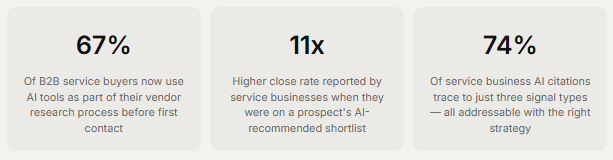
AI answer engines have positioned themselves directly inside that research phase. When a business leader asks an AI tool who to hire for a legal matter, a marketing mandate, or a technology project, the AI answer is not a search result they will sceptically evaluate alongside nine others. It is a recommendation from a tool they have come to trust for synthesising reliable information and it arrives with an implicit endorsement that traditional search results never carried.

The queries that matter most for service businesses
Service business AEO strategy starts with understanding the specific query types that clients use when researching who to hire. These are different from the informational queries that dominate most AEO frameworks they are high-intent, commercially specific, and the ones where a citation translates most directly into an enquiry.

The recommendation query is the commercial prize but the other five query types are the foundation it rests on. A firm cited authoritatively on evaluation criteria, comparison, process, and problem-solving before the prospect reaches the recommendation query has already shaped the shortlist criteria in its favour. AEO for service businesses is not just about appearing in the recommendation answer it is about shaping the entire research journey that leads up to it.
What makes service business AEO different and harder
Service businesses face a specific set of AEO challenges that product businesses don’t encounter in the same form. Understanding these challenges is the prerequisite for the playbook that addresses them.
Expertise is intangible and harder to demonstrate. A product can be described with specifications, features, and verifiable performance data. A service business’s expertise the depth of its team’s knowledge, the quality of its judgement, the specific conditions under which it outperforms alternatives is much harder to make legible to an AI system assessing source credibility. The content strategies that work for product businesses need significant adaptation for service businesses.
Client confidentiality limits the most powerful proof signals. Case studies and client outcomes are the most compelling trust-building content for service businesses and they’re frequently constrained by confidentiality obligations. The service firm that could cite ten specific transformative client outcomes but can’t name any of them faces a structural disadvantage in building the external proof signals that AI systems weight most heavily.
Geographic and sector specificity matters more. A client looking for a marketing agency for their fintech startup has different criteria from one looking for a generalist marketing agency. AI systems increasingly recognise and respond to these specificities and service firms that have positioned and documented their expertise with precision consistently outperform those with generic positioning on the queries that matter most commercially.
The five plays that get service businesses recommended by AI
Play 01: Make your specific expertise unambiguously legible
AI answer engines struggle to recommend firms whose expertise is broadly described. “A full-service digital agency” or “a leading consultancy” conveys almost nothing that would help an AI system match your firm to a client’s specific need. The firms cited most consistently in AI recommendations have made their specific expertise the intersection of service type, sector focus, client size, and problem specialisation unambiguously clear across every surface where they appear online.
This precision benefits from the exact opposite of the instinct most service firms have about positioning. Most firms resist specificity because they fear it narrows their addressable market. In AI search, specificity is what creates the match between a client’s specific query and your firm’s specific expertise. A firm described as “specialists in financial services marketing for Series A to Series C fintech companies” will be cited far more often for “fintech marketing agency” queries than a firm described as “a results-driven digital marketing agency”.
The specificity needs to be consistent across all surfaces: your own website, your team’s LinkedIn profiles, your agency directory listings, your industry publication contributor bios, and the third-party sources that mention your firm. Inconsistent positioning different descriptions on different platforms reduces AI citation confidence, which reduces citation frequency.
Execute This Play
Write one precise positioning statement that describes your firm in terms of: what you do, who you do it for, and what specific outcome you are known for. It should be specific enough that a client who fits your ideal profile would immediately recognise it as relevant to them. Apply this statement consistently across every platform where your firm appears website, directories, publication bios, review platforms, and social profiles. Test it: ask an AI tool to describe your firm and check whether the description matches your positioning. If it doesn’t, the external profile consistency work hasn’t happened yet.
Play 02: Build the educational content that shapes buyer criteria
The most strategically valuable content a service business can produce for AEO purposes is not case studies or service pages it is the educational content that teaches prospective clients how to evaluate, select, and work with firms like yours. This content serves a dual function: it is cited by AI engines on the evaluation-criteria queries that prospects ask before the recommendation query, and it shapes the criteria those prospects use when they eventually make their selection.
The specific content types that work best for this function:
- “What to look for when choosing a [service type]” frames the evaluation criteria in terms that your firm’s strengths satisfy
- “Questions to ask a [service type] before hiring them” surfaces the distinctions that differentiate your approach from generic providers
- “Red flags to watch for when evaluating a [service type]” implicitly positions your firm’s practices against the industry failures that make clients nervous
- “How the [service process] works from start to finish” demonstrates process transparency that builds trust before the sales conversation begins
- “What a successful [service engagement] looks like at 30, 60, and 90 days” sets expectations that your firm’s delivery model can meet
This educational content is the category where service business content investment most consistently underperforms its potential. Most firms have service pages and occasional case studies. Very few have the comprehensive educational content ecosystem that positions them as the most knowledgeable, most transparent option in the market and that is precisely why building it creates such a strong differentiation signal for AI engines assessing which source to recommend.
Execute This Play
Identify the ten questions a well-informed prospect asks before hiring a firm like yours. Write one comprehensive piece of content addressing each question directly from the prospect’s perspective, not your firm’s. These ten pieces of content, published and properly structured, constitute the educational authority layer that shapes buyer criteria in your favour before they’ve had a single conversation with your firm.
Play 03: Build the proof signals that AI systems can actually read
Client outcomes are the most powerful proof signals for service businesses and client confidentiality makes most of them uncitable in their most useful form. The service firm AEO challenge is building proof signals that are both credible enough to influence AI citation and specific enough to be commercially relevant, without violating the confidentiality that protects client relationships.
Three proof signal strategies work particularly well for service businesses within these constraints:
Anonymised outcome frameworks. Case studies don’t need to name clients to be credible. “A Series B SaaS company increased qualified pipeline by 340% over six months” is specific enough to be meaningful and anonymous enough to be publishable. AI engines cite specific, verifiable-feeling outcome claims even anonymised ones more readily than generic capability descriptions.
Thought leadership with verifiable positions. Expert commentary that takes clear, defensible positions on industry questions and whose accuracy can be assessed builds a different kind of proof signal than generic insight content. AI systems weight content that makes specific, assessable claims over content that makes general observations. A managing director who writes “mid-market professional services firms lose an average of 23% of billable time to inefficient project management systems here’s the data” is building AI-citable authority that “we help professional services firms improve efficiency” never achieves.
Review platform depth. Review platforms like Clutch, G2, or Google Business Profile are sources that AI systems reference when assessing service business credibility. The firms with the most reviews, the most specific review content, and the highest volume of recent reviews consistently outperform those with fewer, older, or vaguer reviews on the recommendation queries that matter most. Systematically building review platform presence through client outreach programmes, post-project review requests, and profile optimisation is one of the highest-return AEO investments available to service businesses.
Execute This Play
Audit your current proof signals: how many anonymised case studies exist with specific outcome metrics? How many reviews do you have on the most credible platforms in your category, and how recent are they? How many pieces of thought leadership with specific, assessable positions have you published in the last six months? For most service firms, the honest audit reveals that proof signals are the primary gap and a targeted three-month programme of review outreach, case study development, and specific thought leadership publication produces measurable citation frequency improvement.
Play 04: Build your external citation footprint in the right places
For service businesses, external citations are not just a general authority signal they are the specific proof of industry standing that AI systems use to differentiate genuine experts from self-described ones. The sources that carry the most weight for service business AEO are highly specific to category and sector, and identifying and pursuing them is a more focused task than the general digital PR programmes that work for product businesses.
The highest-value external citation sources for service businesses are typically: the industry directories and ranking publications in your specific category (Chambers for legal, Clutch for agencies, similar category-specific rankings for other professional services), the trade publications that serve your target clients rather than your peers, the association and professional body platforms where your clients look for vetted providers, and the independent comparison and selection platforms that buyers in your category use as decision-support tools.
The strategic insight that most service firms miss: AI systems assess the credibility of your citations relative to your claimed expertise area. A marketing agency cited in marketing trade publications has weaker authority signal than a marketing agency cited in the business publications that its target clients read. The external citation programme should be built around the sources your clients trust not the sources your industry peers respect.
Execute This Play
Map the information ecosystem your ideal clients use when making vendor decisions: which publications do they read, which directories do they reference, which associations do they trust, which comparison platforms do they consult? Each source in that map is a target for your external citation programme. Prioritise by credibility in your clients’ eyes, not in your industry’s eyes. Submit to the directories. Pitch expert commentary to the publications. Apply for the rankings and awards that appear in your clients’ research journey.
Play 05: Optimise the technical layer that makes your expertise machine-readable
The technical AEO foundations matter for service businesses in the same ways they matter for all businesses but the specific schema implementations that produce the most citation benefit are somewhat different. Service businesses should prioritise three technical implementations above all others.
LocalBusiness and ProfessionalService schema particularly important for service firms with geographic focus, this schema establishes your firm’s identity, location, service areas, and expertise domain in machine-readable terms that AI systems use when answering geographically specific recommendation queries.
Person schema for key team members individual expertise is a more credible authority signal for service businesses than corporate expertise claims. Implementing Person schema for your firm’s principals and senior practitioners linking their expertise to your firm’s domain contributes meaningfully to the authority assessment AI systems apply to professional services recommendations.
FAQ schema on all service pages and educational content the question-and-answer format that FAQ schema creates is directly extractable by AI systems. Service pages structured as “what does this service include?”, “who is this service for?”, “how does the process work?”, and “what outcomes can I expect?” with proper FAQ schema mark-up are significantly more likely to appear in AI-generated answers to corresponding client queries than service pages written as marketing copy.
Execute This Play
Conduct a schema audit of your website specifically checking for: LocalBusiness/ProfessionalService schema on your homepage and location pages, Person schema for key team members, and FAQ schema on all service pages and educational content. For most service business websites, none of these will be in place which means this is low-competition technical territory where the investment required is modest and the citation frequency benefit is significant.
The service business AEO programme by firm type
The five plays above apply to all service businesses but the emphasis and prioritisation shifts by firm type. Here is where to focus first depending on your service category:

What changes when you execute this playbook
The before-and-after for a service business that has executed the five plays systematically over six months is consistent enough across categories to be described with confidence:

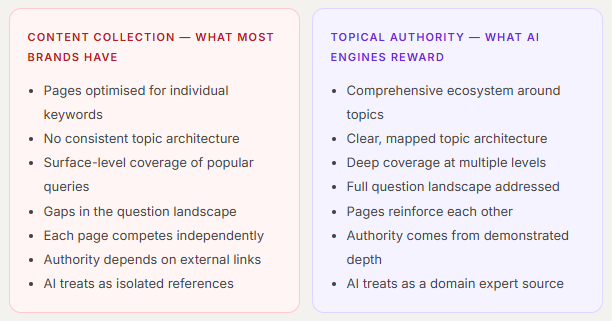
The commercial implication of the right column is significant. A service business that is consistently recommended by AI answer engines to prospects who fit its ideal client profile is receiving the functional equivalent of warm referrals at scale with the trust level and pre-qualification quality that referrals carry, and without the relationship network limitations that make referrals hard to scale.

Your 90-day starting plan
The full playbook represents a six-to-twelve-month programme. The 90-day starting plan below produces measurable early movement on the highest-impact elements while the longer-term programme builds momentum.

Getting specialist support for the full programme
The 90-day plan above is executable with internal resources for firms with a marketing function and a content capability. The full six-to-twelve-month programme building the complete educational content ecosystem, the external citation footprint, and the technical infrastructure across all five plays simultaneously represents a sustained workload that most service firm marketing teams find difficult to maintain alongside existing client-facing responsibilities.
The additional challenge is specificity. AEO for service businesses requires deep familiarity with the specific query patterns, citation sources, and authority signals that matter in your category intelligence that is difficult to develop internally without the scale of observation that comes from running these programmes across multiple service categories simultaneously.
For service businesses that want to move from the before column to the after column in the comparison above at a pace that produces commercial results within the year, partnering with a specialist team brings the combination of strategic precision, category intelligence, and execution capability that the full programme demands. Working with a specialist like AEO services means accessing a practice that understands the specific dynamics of service business AEO the positioning precision, the proof signal strategies, the client-facing citation sources, and the technical implementations that produce the fastest measurable improvement in AI recommendation frequency for firms where trust-based recommendations are the primary driver of new client acquisition.

The bottom line: Service businesses face a unique AEO challenge expertise is intangible, confidentiality constrains proof signals, and the buying decision is almost entirely trust-based. But the opportunity is equally unique: a service firm that is consistently recommended by AI answer engines receives warm, pre-qualified, trust-loaded enquiries at a scale that referral networks alone cannot produce. The five plays positioning precision, educational content authority, AI-readable proof signals, client-facing external citations, and technical schema implementation are the specific interventions that produce consistent AI recommendation visibility for service businesses. None of them require exotic resources or advanced technical capability. All of them require intention, consistency, and the discipline to execute a strategy that compounds in value with every month it runs.
메타데이터
- post_id
- 2b7fc65e6b23
- slug
- the-aeo-playbook-for-service-businesses-getting-recommended-when-clients-ask-ai-who-to-hire-2b7fc65e6b23
- url
- https://medium.com/@fizza.q1399/the-aeo-playbook-for-service-businesses-getting-recommended-when-clients-ask-ai-who-to-hire-2b7fc65e6b23
- canonical_url
- https://medium.com/@fizza.q1399/the-aeo-playbook-for-service-businesses-getting-recommended-when-clients-ask-ai-who-to-hire-2b7fc65e6b23
- author_url
- https://medium.com/@fizza.q1399
- status
- ok
- fetched_at
- 2026-06-09 15:37:30