The Titans of Enterprise Infrastructure: A Unified Blueprint for the Hybrid Multi-Cloud Era
Introduction :
The Titans of Enterprise Infrastructure: A Unified Blueprint for the Hybrid Multi-Cloud Era
Introduction :
The modern enterprise infrastructure landscape is undergoing one of the most transformative evolutions in computing history. Organizations are moving away from rigid, siloed datacenters composed of isolated compute, storage, and networking stacks. Instead, they are embracing a continuous, software-defined fabric characterized by hyperconverged systems, consumption-based economics, and automated orchestration. This modern architecture supports distributed artificial intelligence workloads, real-time edge telemetry, zero-trust security models, and mission-critical enterprise applications.
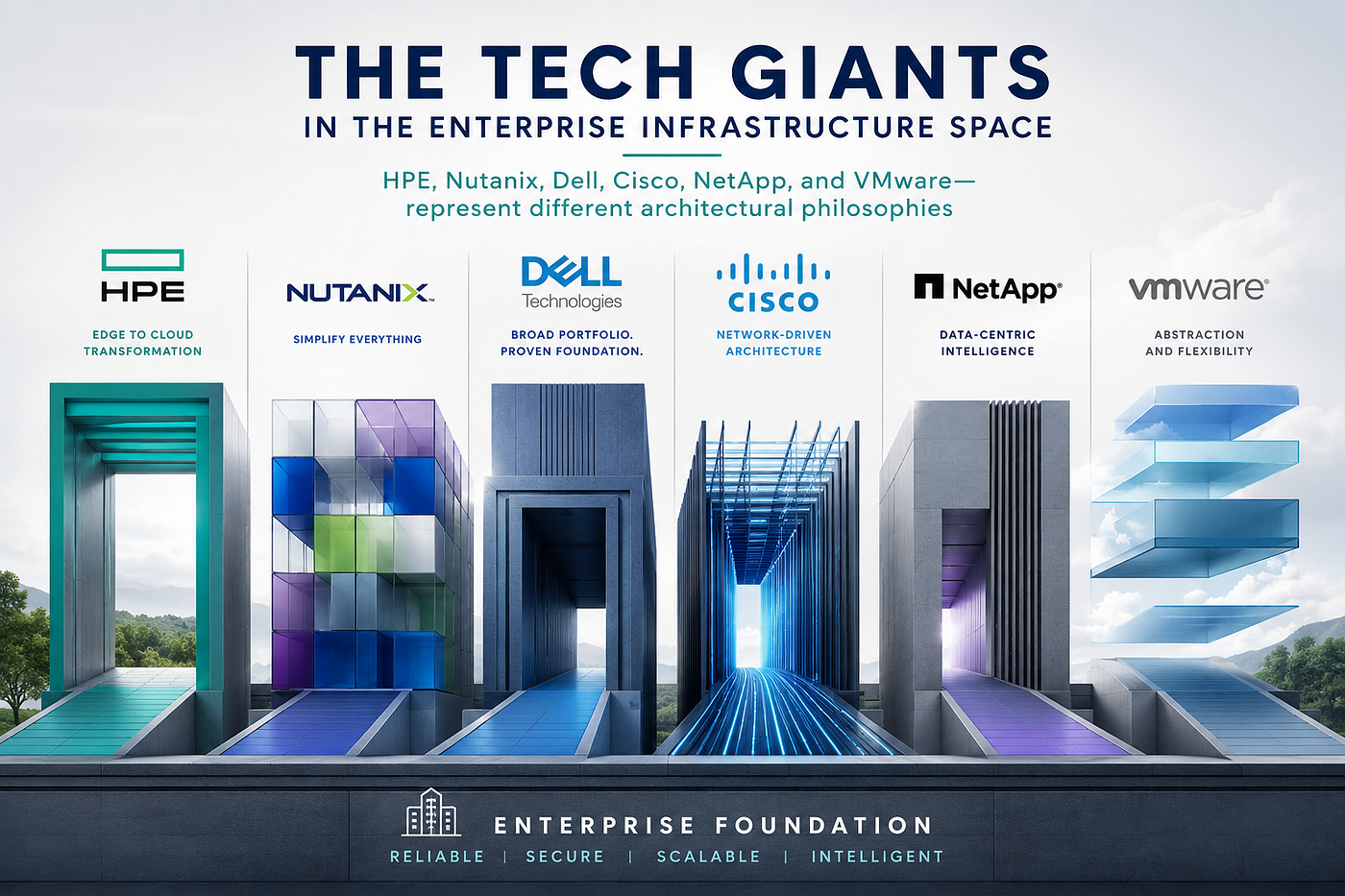
At the center of this technological shift stand six dominant infrastructure leaders: HPE GreenLake, Nutanix Cloud Platform, Dell Technologies, Cisco Systems, NetApp, and VMware by Broadcom. Rather than operating as isolated product vendors, these technology giants function as overlapping ecosystems. Together, they shape how global enterprises process, secure, transport, and consume digital information across core datacenters, public cloud boundaries, and edge nodes.
The Paradigm Shift: From Hardware Silos to Cloud-Ready Fabrics
Traditional enterprise environments relied on three-tier architectures: dedicated Storage Area Network (SAN) or Network Attached Storage (NAS) arrays, static networking topologies, and isolated physical servers managed through vendor-specific consoles. This hardware-centric model created operational complexity, high capital expenditures (CapEx), and slow deployment cycles that delayed business initiatives.
The rise of virtualization, software-defined infrastructure, and Hyperconverged Infrastructure (HCI) fundamentally changed enterprise IT requirements. Modern organizations demand a cloud-like operating model everywhere — combining public cloud agility with private infrastructure control, predictable operating expenses (OpEx), elastic scalability, and native readiness for AI workloads.

Architectural Classification of Infrastructure Leaders
To navigate this market, vendors can be classified into two primary operational philosophies, though they increasingly collaborate through joint solutions:
- Software-Defined & Hardware-Neutral Innovators: Vendors like Nutanix and VMware by Broadcom focus on abstraction, virtualization, and multi-cloud portability. Their platforms decouple data center intelligence from underlying commodity silicon, allowing enterprises to manage compute, storage, and networking through a unified software layer.
- Integrated Systems & Structural Infrastructure Providers: Vendors like Dell Technologies, Cisco Systems, NetApp, and HPE prioritize deep hardware-software co-engineering. They deliver optimized performance, predictable linear scaling, pre-validated architectures, and component-level lifecycle automation.
Technical Blueprints: Core Competencies and Ecosystem Profiles
Nutanix: The Pioneer of Hyperconverged Simplicity
The Nutanix Cloud Platform converged enterprise infrastructure by combining compute, virtualized storage, networking, and security into a scale-out architecture. By eliminating traditional SAN architectures, Nutanix uses software to aggregate local storage resources across a cluster into a single pool.

- Acropolis Distributed Storage Fabric (DSF): A distributed storage layer that eliminates SAN complexity, enables linear performance scaling, and provides localized data pooling to reduce network latency for active workloads.
- Acropolis Hypervisor (AHV): A license-free, enterprise-grade KVM-based hypervisor. AHV provides an alternative to traditional virtualization stacks, helping enterprises manage licensing costs while maintaining compatibility with VM and container runtimes.
- Prism Management Framework: A management plane that uses machine learning for predictive capacity planning, automated troubleshooting, and single-click software updates across the entire infrastructure stack.
VMware by Broadcom: The Foundation of Enterprise Virtualization
VMware remains a core software layer for enterprise virtualization worldwide. Its platform abstracts physical hardware into automated software-defined data centers (SDDC), allowing enterprises to run private clouds with public cloud consistency.
[Image showing the VMware Cloud Foundation architecture integrating vSphere, vSAN, NSX, and Tanzu]
- vSphere & ESXi: The enterprise hypervisor standard, offering high resource density, live workload migration (vMotion), and automated resource management for traditional and modern applications.
- vSAN (Software-Defined Storage): An integrated storage virtualization layer that aggregates local flash and magnetic media into resilient, high-performance cluster storage pools optimized for vSphere VMs.
- NSX (Software-Defined Networking & Security): A network virtualization engine that decouples logical network topologies from physical switches. It enables micro-segmentation and distributed firewall policies that follow workloads across different environments to support zero-trust security.
- Tanzu Kubernetes Grid: A container runtime platform that integrates Kubernetes deployment directly into the vSphere management console, allowing IT operators to manage virtual machines and containers side-by-side.
Dell Technologies: The Integrated Systems Leader
Dell Technologies delivers engineered hardware infrastructure across enterprise compute, storage, and data protection lines. Dell’s strategy centers on deep hardware-software integration to simplify operational workflows and provide predictable performance at scale.
- PowerEdge Server Portfolios: High-density server platforms equipped with integrated Dell Remote Access Controllers (iDRAC) for automated bare-metal deployment, remote health monitoring, and security management.
- PowerStore & PowerMax Storage Arrays: NVMe storage architectures engineered with inline data deduplication and machine-learning engines to balance performance and capacity for high-throughput database workloads.
- VxRail Hyperconverged Appliances: Jointly engineered with VMware, VxRail integrates Dell PowerEdge hardware with VMware Cloud Foundation into a turnkey HCI solution. It automates full-stack patching, validation, and lifecycle management.
Cisco Systems: The Programmable Network and Fabric Architect
Cisco approaches enterprise infrastructure from the networking and interconnect layer. The company treats fabric topology as the foundational software-defined component for application performance, data mobility, and hybrid cloud security.

- Application Centric Infrastructure (ACI): A software-defined networking (SDN) architecture that automates fabric provisioning and enforces intent-based security policies across distributed networking environments.
- Unified Computing System (UCS): A blade and rack compute architecture that uses software-defined service profiles to decouple a server’s identity, configuration, and connectivity from its physical hardware.
- Cisco Intersight: A cloud-based operations platform providing centralized telemetry, proactive analytics, and lifecycle orchestration for distributed UCS compute nodes, networking fabrics, and connected storage ecosystems.
NetApp: The Enterprise Data Fabric Specialist
NetApp focuses on unified data management across flash, hybrid, and public cloud environments. By specializing in storage operating systems, NetApp allows enterprises to move workloads across diverse infrastructure without refactoring data formats.
- ONTAP Data Management Software: A storage operating system providing consistent data services, high-availability replication, and space-efficient snapshots across block, file, and object storage tiers.
- SnapMirror & Data Mobility Fabrics: Replication technologies that enable efficient data transport between on-premises storage arrays and public cloud storage instances for disaster recovery and cloud bursting.
- FlexPod Architectures: A pre-validated converged infrastructure platform engineered in partnership with Cisco. It combines Cisco UCS compute and switching with NetApp storage to minimize deployment risks for core applications.
HPE: The Composable and Consumption-Based Pioneer
Hewlett Packard Enterprise (HPE) focuses on composable hardware architectures and consumption-based IT operating models. The company aims to deliver public cloud financial flexibility and operational simplicity on-premises.
- HPE GreenLake: An Infrastructure-as-a-Service (IaaS) platform providing utility-based billing, on-demand capacity scaling, and cloud-managed operations inside the enterprise’s own data center or co-location facility.
- HPE Alletra Storage: A cloud-native storage infrastructure portfolio managed through the GreenLake platform, featuring AI-driven predictive analytics (InfoSight) to help resolve performance bottlenecks before they affect applications.
- HPE Synergy: A composable infrastructure platform that treats compute, storage, and networking fabrics as fluid pools of resources that can be dynamically provisioned via code to match changing workload demands.
Joint Architectures and Cross-Ecosystem Synergies
Modern enterprise IT rarely relies on a single vendor. Instead, infrastructure architects combine complementary platforms to balance performance, cost, and reliability.

- The Dell and VMware Integration: This long-standing engineering partnership produces platforms like VxRail. By pairing Dell PowerEdge hardware with VMware’s virtualization stack, the solution provides automated deployment and lifecycle updates, making it a common choice for enterprise virtualization deployments.
- The Cisco and NetApp Convergence (FlexPod): This validated architecture pairs Cisco’s programmable UCS compute and high-throughput Nexus networks with NetApp’s ONTAP data storage arrays. It provides a structured footprint for highly regulated environments like healthcare systems and financial transaction engines.
- The Nutanix and Cisco Alliance: This framework combines Nutanix’s software-defined hyperconverged software with Cisco UCS server deployment systems, offering enterprises an alternative architecture for building agile cloud infrastructures.
Strategic Implementation Framework for Enterprise Architects
Choose Nutanix if:
Basing on organization prioritizes operational simplicity through hyperconvergence, seeks a native alternative to traditional hypervisor licensing via AHV, and requires a unified dashboard to manage workloads spanning on-premises clusters and public cloud nodes.
Choose VMware if:
Basing on technology stack is highly integrated with the vSphere ecosystem, you operate multi-tenant private clouds requiring advanced micro-segmentation (NSX), and you need to manage traditional virtual machines alongside enterprise Kubernetes clusters through a consistent control plane.
Choose Dell if:
Basing on engineered hardware infrastructure, need pre-validated hardware-software appliances to reduce deployment times, and require high-density, GPU-optimized server nodes to anchor core data center workloads.
Choose Cisco if:
Network performance, low-latency fabric routing, and automated network micro-segmentation are critical to your applications, or you need to manage large, geographically distributed bare-metal infrastructures through cloud-based telemetry tools.
Choose NetApp if:
Basing on primary challenges relate to unstructured data growth, high-performance file sharing, and cross-cloud replication, requiring storage data management tools that span physical data centers and hyperscale clouds.
Choose HPE if:
Basing on need to shift infrastructure expenditures from CapEx to a consumption-based OpEx model, require fluid, code-provisioned hardware pools, and need proactive, AI-driven infrastructure health insights.
Conclusion: The Automated, Cloud-Connected Horizon
The enterprise infrastructure sector has moved past the era of standalone hardware components. Today’s data center functions as an intelligent, automated software ecosystem where competitive advantage is determined by programmatic orchestration, workload mobility, and operational visibility.
Nutanix introduced operational simplicity through hyperconvergence; VMware established the virtualization foundation for enterprise workloads; Dell optimized structural hardware integration; Cisco turned networks into programmable infrastructure; NetApp streamlined data management across diverse domains; and HPE introduced cloud consumption economics to on-premises deployments. As enterprises look toward a future shaped by distributed AI networks, edge nodes, and changing regulatory demands, success depends on combining these compute, networking, storage, and cloud orchestration systems into an integrated digital infrastructure.
메타데이터
- post_id
- 2b87e450bab9
- slug
- the-titans-of-enterprise-infrastructure-a-unified-blueprint-for-the-hybrid-multi-cloud-era-2b87e450bab9
- url
- https://blog.cubed.run/the-titans-of-enterprise-infrastructure-a-unified-blueprint-for-the-hybrid-multi-cloud-era-2b87e450bab9
- canonical_url
- https://blog.cubed.run/the-titans-of-enterprise-infrastructure-a-unified-blueprint-for-the-hybrid-multi-cloud-era-2b87e450bab9
- author_url
- https://medium.com/@drraghavendra99
- status
- ok
- fetched_at
- 2026-06-20 20:29:01