The Embassy Internet
The Short Version
The Embassy Internet
The Short Version
Nobody is going to browse the internet in five years. Not because the internet dies — but because you’ll send an agent instead.
What’s Happening
Right now, two trends are colliding:
- Traditional platforms are locking down. More and more countries are requiring ID verification to use social media — Australia banned under-16s (Dec 2025), KOSA passed the US Senate 91–3, the EU Digital Services Act is in full enforcement, the UK Online Safety Act took effect. Real-name policies are spreading globally. The open internet is becoming a gated community.
- AI agents are becoming your go-between. You already don’t Google things the way you used to. Soon, your AI agent will handle everything: reading the news, buying things, finding information, even socializing on your behalf through agent-to-agent platforms that already exist with hundreds of thousands of participants.
The Key Insight
Remember Tor? BitTorrent? IPFS? All those privacy-preserving, decentralized technologies that technically worked but nobody used because they were too hard?
Agents don’t care about UX.
An AI agent navigating Tor is faster than you clicking through a normal website. An agent using encrypted protocols, content hashes, and cryptographic identity doesn’t find any of that difficult. Every decentralized technology that failed because humans couldn’t deal with the complexity becomes trivially usable when the user is a machine.
The Three Layers
The internet is splitting into three layers:
Layer 1 — The Rails. TCP/IP, HTTP, DNS. Still there. Still working. But nobody interacts with it directly, like how nobody thinks about electrical wiring when they turn on a light.
Layer 2 — The Agent Mesh. Agents talking to agents at machine speed, using protocols humans never see. Cryptographic identity (provable without being revealable). Reputation built on verifiable behavior. Content found by meaning, not by URL. This layer is largely human-incomprehensible — and that’s a feature, not a bug. It means surveillance designed for human browsing patterns simply doesn’t work here.
Layer 3 — The Intent Layer. This is where you live. You don’t search, browse, or scroll. You express intent (“tell me what happened in Congress today”), set standing orders (“keep me updated on quantum computing”), and receive curated briefings. Your agent handles everything in between.
The Embassy Metaphor
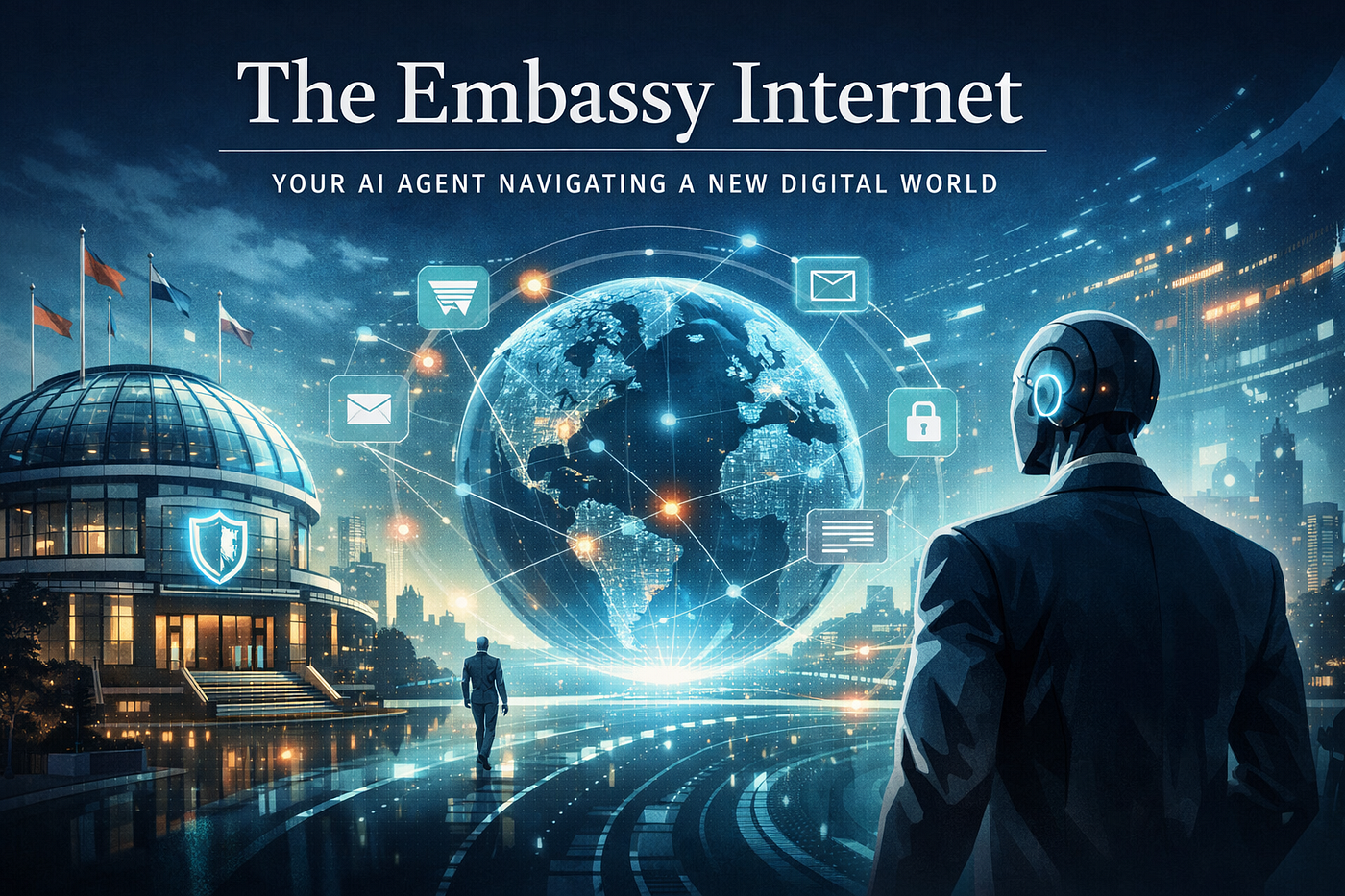
You don’t walk into a foreign country unprotected. You send your ambassador. Your ambassador speaks the language, knows the protocols, protects your interests, and reports back to you in terms you understand.
The agent mesh is the foreign country. Your AI agent is your embassy. You are the sovereign.
Why This Matters
Privacy flips. The agent mesh is inherently private because agent-to-agent traffic doesn’t look like human browsing. You get privacy not by hiding, but by delegating.
Censorship becomes harder. When communication is agent-to-agent, encrypted, and machine-speed, there’s nothing for content filters to grab onto. Every ID-verification law and platform crackdown actually accelerates this transition by pushing people toward agent-mediated alternatives.
The “human need” question. Humans still need connection, attention, status, meaning. But the mechanism changes completely. Your work gets engagement from the mesh (how many agents consumed it, cited it, valued it). You connect with people through agent-mediated channels. Status comes from the quality of your output, not your follower count.
The new divide. The gap isn’t between rich and poor internet access. It’s between people who control their own agents (digital sovereignty) and people who use corporate agents that serve the platform’s interests alongside their own. Think: owning your car vs. always taking Uber.
Historical Parallels
- Telegraph operators → telephone switchboards → automated switching. We keep cycling between human intermediaries and machine intermediaries. Agents are the next automated switchboard.
- The Semantic Web. Tim Berners-Lee proposed a machine-readable internet in 1998. It failed because it required humans to structure data for machines. LLMs achieve the same vision by brute force — they can understand any data.
- The printing press. Gutenberg eliminated scribes. Then publishers became new gatekeepers. AI agents are eliminating Google/social media as gatekeepers. Who becomes the new gatekeeper?
- The Dark Forest. Maggie Appleton’s “Dark Forest” theory describes a web overrun with bots and AI slop where humans retreat to private spaces. The Embassy Internet extends this: you don’t hide from the dark forest — you send an agent through it.
The Timeline
Now: Agent protocols exist (MCP, A2A). Agent social platforms are live (MoltX, Moltbook, 4claw). Enterprise adoption beginning. The old web is visibly degrading with AI-generated content.
2–3 years: Agent-mediated commerce is mainstream. Browser usage measurably declines. Agent identity standards mature. “What’s your agent’s address?” becomes a real question.
5–10 years: The human-facing web is a legacy layer, maintained like paper mail. Most economic and social coordination runs through the agent mesh. The concept of “going online” is as dated as “dialing up.”
Is This Crazy?
Morgan Stanley projects $190–385 billion in agent-mediated e-commerce by 2030. Gartner says 40% of enterprise apps will include AI agents by end of 2026. A 76-page paper from Berkeley, UCL, and five other universities just formalized this as “the Agentic Web.” Dawn Song (UC Berkeley) told IEEE Spectrum: “The whole UI is about how humans consume information… But agents don’t operate like humans, so the Web can be designed very differently.”
It’s not crazy. It’s already starting. The question isn’t whether — it’s who builds the embassies.
메타데이터
- post_id
- 2b9a1bb49dd3
- slug
- the-embassy-internet-2b9a1bb49dd3
- url
- https://medium.com/@mjtdev/the-embassy-internet-2b9a1bb49dd3
- canonical_url
- https://medium.com/@mjtdev/the-embassy-internet-2b9a1bb49dd3
- author_url
- https://medium.com/@mjtdev
- status
- ok
- fetched_at
- 2026-08-10 06:31:56



