The Newest Minerals on Mars
Purdue University researchers recently released surprising findings of minerals on Mars based on information from a rover mission detailed…
The Newest Minerals on Mars
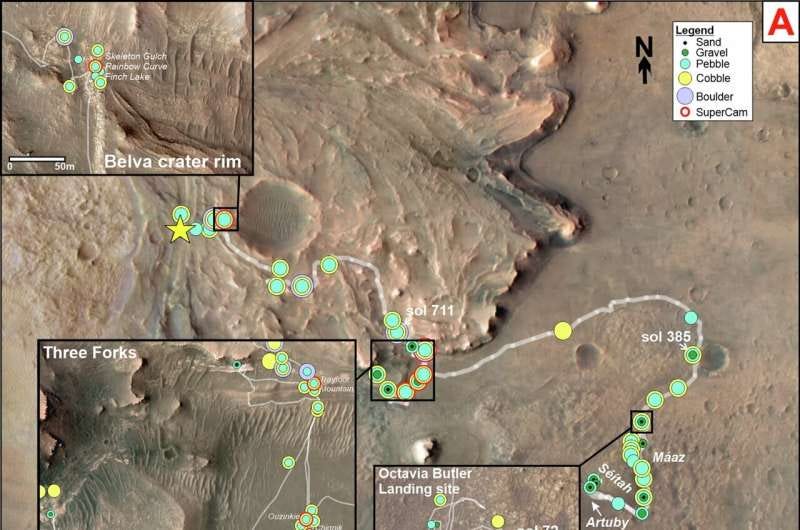
New findings published by Purdue University reveal findings ofnew minerals found on Mars.
Purdue University researchers recently released surprising findings of minerals on Mars based on information from a rover mission detailed in the “Unburied Treasure” study. Their research highlights that beneath materials already drilled, there are minerals that were not even expected for the site. These results bear implications on Mars’ past environmental conditions, its geological development, and for potential missions to seek resources or signs of habitability.
The foundation for the discovery is from instruments on a Mars rover that test subsurface mineralogy. Typically, Mars rovers carry spectrometers (such as X-ray diffraction or X-ray fluorescence, visible/infrared reflectance spectrometers) or CheMin-style instruments that measure crystals and minerals according to their diffraction or spectral signature. The Purdue research indicates that these tools detected minerals buried beneath surface layers whose geology would be expected but whose spectra showed unexpected peaks or diffraction patterns — minerals possibly stable in subsurface environments but changed or lost at the surface due to weathering, radiation, or oxidation.
Geologically, mineralogy of the underground can widely differ from surface mineralogy because Mars receives a lot of radiation, dust cover, oxidation, and potentially evaporation or other environmental processes that weather or change material on the surface. Underground, minerals can be protected from UV, cosmic radiation, diurnal extremes of temperature, and atmospheric oxidants (perchiorates or iron oxides especially). Purdue’s “unburdened treasure” therefore most likely refers to rocks or sediments that were once buried and are now out in the open, or bored through drilling or wear, that reveal minerals indicative of wetter, and possibly more chemically reduced, past environments.
Minerals preserved in-place beneath the surface are usually clays, carbonates, sulfates, and silicates that are oxidation- or acidity-sensitive. If Purdue found minerals that were “unexpected,” it is conceivable that carbonates or certain phyllosilicates (clays) were discovered in regions previously thought to be basaltic or volcanic rock dominated. Carbonates are intriguing in that they precipitate with water and are capable of storing atmospheric CO₂; their presence would signal earlier periods of neutral to alkaline water activity. Also, clay minerals are prone to imply extended water-rock interaction. The crystal form of alteration minerals (for example, smectite versus illite versus montmorillonite) could reflect information of pH, temperature, and water supply in Martian history.
Physically, identification of minerals relies on diagnostic wavelengths or diffraction angles corresponding to interatomic spacings of crystal lattices. XRD peaks, for example, are tied to Bragg’s law: nλ = 2d sin θ, where d is an interplanar spacing. Sensors like CheMin measure such intensities and spacings to infer mineral existence. Reflectance spectroscopy analyses by Visible/NIR rely upon absorption bands (e.g., Fe²⁺/Fe³⁺ transitions, OH-vibrations) to detect hydrated minerals or iron oxidation state. Anomalous minerals can thus have anomalous absorption bands or diffraction peaks beyond the baseline mineral library for that site.
Rover spacecraft engineering to sample and analyze outcropping or subsurface bedrock is not a trivial task. The rover will have to include drilling or abrasion equipment; the instrument needs to stay calibrated in the presence of dust, temperature fluctuations, and radiation. Sample collection entails mechanical abrasion or drilling, delivery of the sample to a chamber, and small particle sizes for analysis. Also thermal control is required in order to avoid destruction of sensitive spectrometers and detectors; some minerals will dry out or alter with heating, so analysis is often in requirement of controlled temperature or exclusion from the Martian thermal environment.
The existence of unanticipated minerals leads one to question the geological history of Mars. Did the minerals form in some stable water environment at a previous moment in time? Are they relics of hydrothermal systems? Or are they a product of groundwater alteration at depth? It may suggest multiple episodes of aqueous alteration, maybe episodic or culturally restricted (e.g. periodic melting or groundwater circulation). This is pertinent to astrobiology, as such environments which are effective at preserving such minerals will likely be effective at preserving biosignatures (organic molecules or microstructures) should life have existed.
From a global resource perspective, subsurface mineral detection is significant for future human missions. Minerals like clays can be utilized as raw materials; water-storing hydrated minerals. Carbonates can sequester CO₂ which can be beneficial in ISRU plans. Also, the ground stability of certain minerals may suggest radiation-shielded environments, potentially safe havens for habitats or long-term equipment.
Issues remain. One is certain identification: from time to time spectral overlap, dust coating, or composite collections of minerals obscure unequivocal detection. Another is the history and age: even assuming the mineral is present, determining when it formed, in what chemistry conditions of water, and for how long remains difficult. Likewise, drilling deep enough into subsurface also requires more advanced drilling; numerous rovers drill shallow surfaces or erode the top few millimeters.
In the future, missions can allocate more drilling and coring capacity, say meters deep, to access deeper shielded mineralogy. And spectrometers with wider spectral range (mid-IR, Raman) would better detect organic or carbonate minerals. Orbital remote sensing can be used to map likely regions, but ground-truth using rovers or even manned missions in the future will be necessary.
In brief, the “Unburied Treasure” find at Purdue underscores that Mars still holds a great deal of secrets behind its weathered exterior. These minerals are windows into Martian paleoenvironments and add to our understanding of the hydrologic and geochemical evolution of Mars. They also remind us that engineering advances — in sampling, in instruments, in mobility for rovers — are instrumental to unlocking those secrets and for missions that will follow.
메타데이터
- post_id
- 2bb7ae89bc7d
- slug
- the-newest-minerals-on-mars-2bb7ae89bc7d
- url
- https://medium.com/@vedantpadhiii/the-newest-minerals-on-mars-2bb7ae89bc7d
- canonical_url
- https://medium.com/@vedantpadhiii/the-newest-minerals-on-mars-2bb7ae89bc7d
- author_url
- https://medium.com/@vedantpadhiii
- status
- ok
- fetched_at
- 2026-07-17 10:26:55