At 54, Broke and Divorced, I Pointed a Bicycle West and Tried to Outrun My Own Life
What riding a bicycle across America taught one middle-aged man about fear, starting over, and whether it is ever really too late.
A Memoir of the Road
At 54, Broke and Divorced, I Pointed a Bicycle West and Tried to Outrun My Own Life
What riding a bicycle across America taught one middle-aged man about fear, starting over, and whether it is ever really too late.
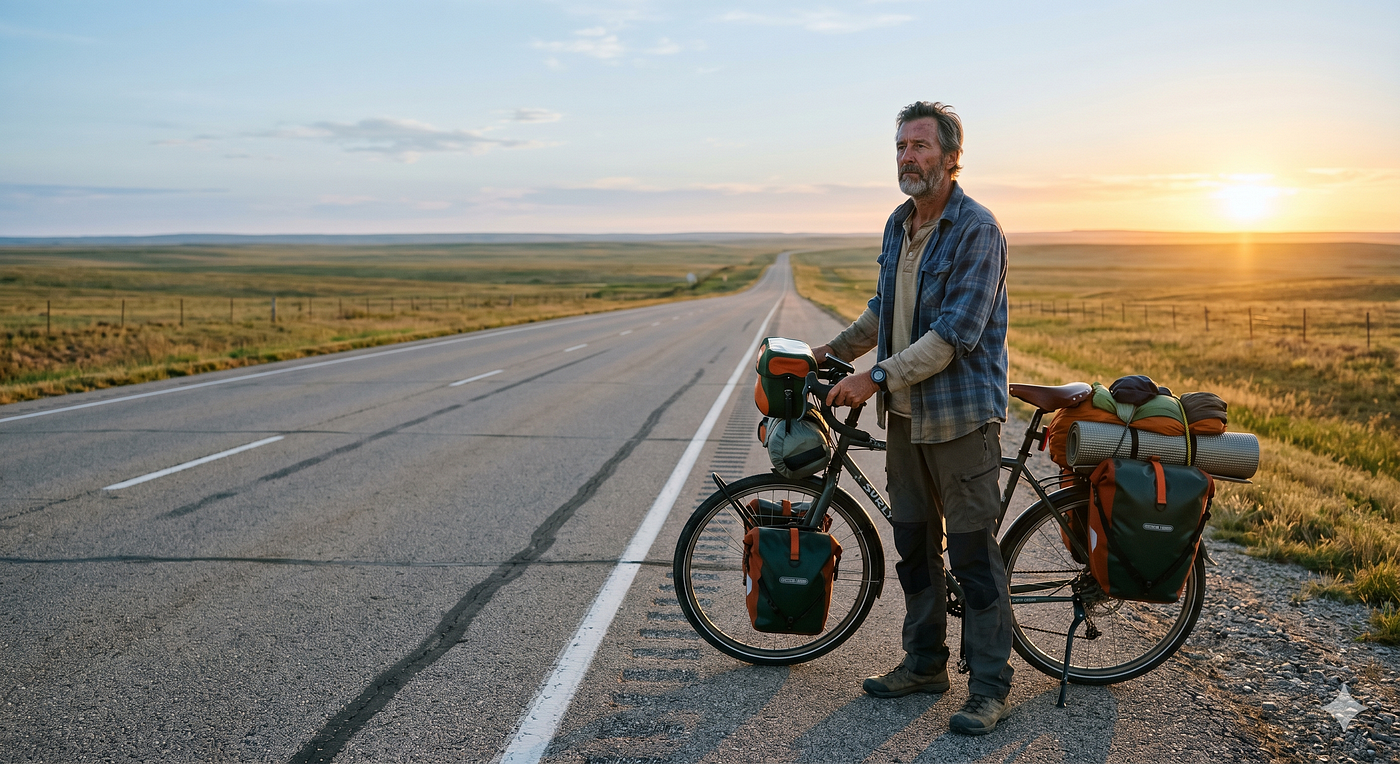
AI image created by author
The kid behind the counter looked at me the way you look at a rumor that walked in off the street. Twenty-two, maybe. Good knees and a whole life he hadn’t spent yet. I told him my plan and he went quiet, the way a room goes quiet when somebody says a dead man’s name.
“Across the whole country,” he said. Flat. Not a question. Just running it back to be sure the old man hadn’t slurred it.
“That’s the plan.”
He nodded. Slow. The nod a man gives when he decides arguing isn’t worth the breath. I knew that nod cold. I’d been wearing it for weeks in a bathroom mirror that had stopped being kind.
I’d like to tell you I felt brave. I didn’t. I felt like a forgery in a helmet I couldn’t clip. A few states back a marriage was finishing the slow paperwork of dying. The house. The driveway. The whole shape of a life I’d carried around like a name I was sick of answering to. I wasn’t riding toward anything. I was riding away. Your body knows the difference even when your mouth plays dumb.
People kept asking why a bike. Why not a car. Why not a plane. Why not a therapist, like a man with sense. I never had a clean answer. The truth went something like this. I’d spent thirty years sitting still and being reasonable. A good provider. A careful man. And one morning, I looked in the glass and couldn’t find anybody back there I knew. So I figured I’d move until I did. Pedal until something came loose.
The first day nearly finished me. Not the spirit. The legs.
Eleven miles. That’s how far I got before my thighs started sending up smoke. I had pictured myself eating the map in long, noble stretches, the wind doing that thing it does in the commercials. Instead, I was bent over a gas station sink at noon, splashing water on a face that looked every one of its fifty-four years and a few it had stolen. A trucker came in, took one look at the spandex, and laughed. Not mean. Surprised, mostly. “You doing one of them rides?” Yeah, I said. Good for you, he said, and walked out, and I stood there feeling about as athletic as a folding chair.
There’s a particular doubt that hunts a man at that age. It doesn’t yell. It reasons. It borrows your own voice and talks low. You don’t have to do this, it says. You’ve got nothing to prove. Go home. Except home was the thing I’d left, so the word just hung in the air with no place to land.
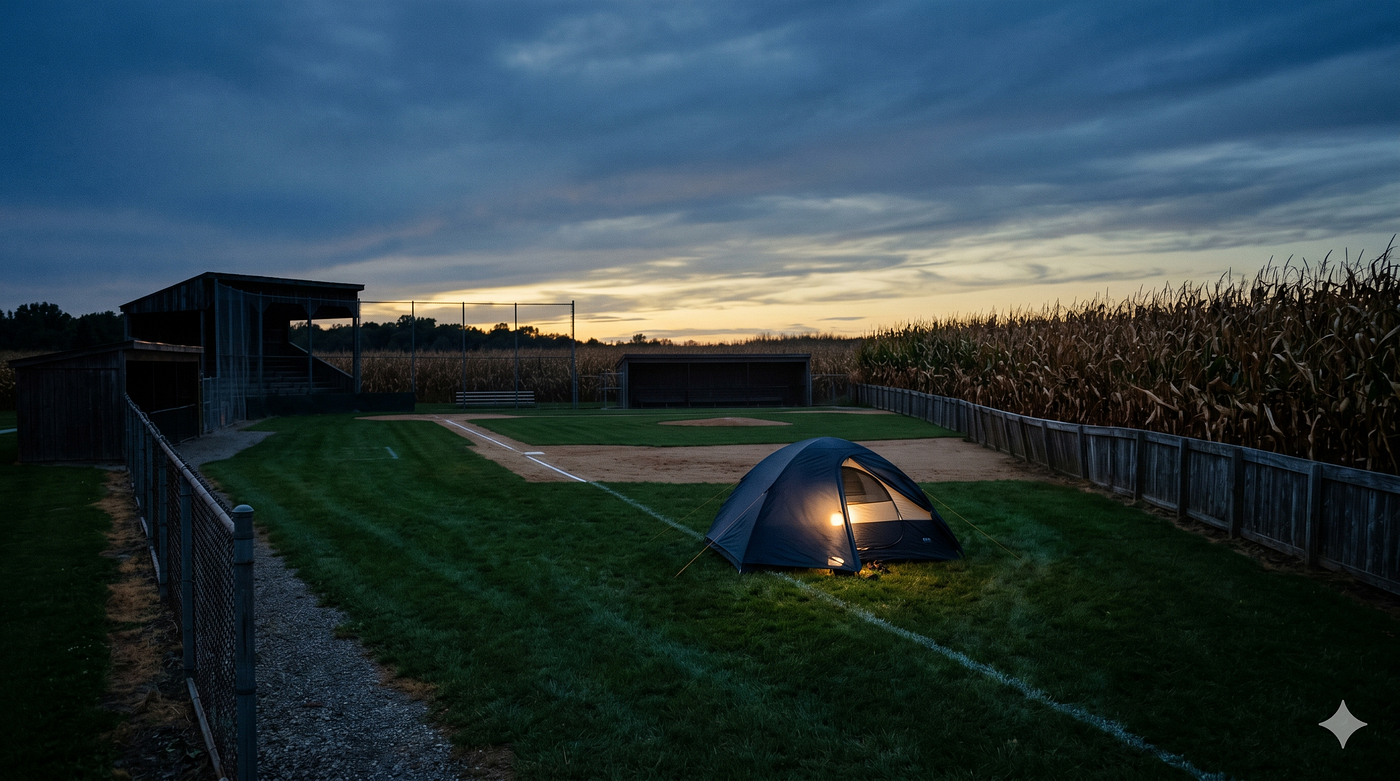
I camped that night in a field behind a church. My knees kept a beat I could’ve set a watch to. I lay in the tent doing arithmetic, which is what a scared man does when he won’t admit he’s scared. Sixty miles a day. Three thousand and change. Months of it. I got winded hauling groceries up the porch. What in God’s name was I doing out here.
I almost quit. I’ll be straight about that, because the stories people tell about trips like this always skip the part where you nearly fold on night one. I had the phone in my hand. A number half dialed to a friend with a truck, a man who’d have come and never said a word about it. My thumb hung there. The doubt stood by, polite as a waiter, laying out my exit like the check.
I didn’t call. Not because I was strong. Because I was stubborn, and because some small, mean piece of me wanted to prove that kid wrong more than I wanted to be comfortable. That’s the truth of it. Spite will carry you further than courage some days. They don’t print that on the posters.
The body learns quicker than the heart. By the end of the first week, eleven miles was thirty. By the second, thirty was fifty and no bathroom drama. My legs quit arguing and started agreeing. I’d wake before light with the world gone blue and soft, and I’d be on the road before the doubt finished its coffee. Somewhere around hour three, a thing happens. Your breathing and your pedaling and your thinking all drop into the same line. The young ones have a fancy word for it. I just called it quiet. First quiet I’d had in years.
The country opens up at fifteen miles an hour in a way it never does behind glass. In a car, the land is scenery, a thing sliding past the window. On a bike, the land is weather and smell and the grade under your wheels. You feel a hill coming in your chest before your eyes catch it. You learn a town by the dogs that run you out of it. You turn into a small, slow animal crossing something enormous, and the enormous thing does not care how old you are. Nobody warned me how free that would feel. To not matter to the landscape at all.
People kept finding me. That surprised me most. I’d pictured a lonely business, a man and his sorrow and a lot of hot asphalt. Instead, there were strangers. A woman who flagged me down with a sandwich because I looked, she said, like I needed feeding. A farmer who let me sleep in his barn and asked me nothing, which is its own brand of mercy. A couple half my age who fixed my chain on the shoulder of a road in the heat, the young man’s hands black with grease, the girl handing me water, both of them treating me like I was doing something fine instead of something foolish.
That last one kept catching me in the ribs. The way the young looked at me out there. Not pity. Closer to permission. Like I’d shown them a door they hadn’t known was in the wall. One of them, maybe thirty, said it plain. “I hope I’m doing something like this when I’m your age.” I didn’t have an answer. I was fifty-four and broke and divorced and sleeping in a tent. From where I sat, it was no kind of dream. But he saw it differently. He saw a man who hadn’t quit. Maybe that’s all the whole thing ever was. A man who hadn’t quit yet.
The age question never fully cleared out. I’d love to tell you I beat it, that somewhere near the Mississippi, I had a vision and felt twenty-five again. I didn’t. My back ached every sunrise. I healed slower than a younger man would. There were climbs that took all I had and then asked for a little more I didn’t own. I’d top out shaking, and some kid would drop past me on the descent like I was nailed to the road, and the doubt would clear its throat just so I didn’t forget the number of years I was hauling.
But here’s the thing I learned, and I still can’t say it clean. The fear of being too old and the fact of being too old are two different animals. The fear is loud. The fact turns out to be quiet, and mostly up for negotiation. My body could do far more than my fear had ever credited it for. It just needed me to quit listening to the part of me that was shopping for a reason to turn back.
A lot of people my age are sitting in some version of that driveway right now. Engine idling. Telling themselves the careful story about how the ship has sailed, how a man doesn’t start over this late. I told myself that one for years. It’s a comfortable story. It asks nothing of you. And it’s a lie, or it was for me, and I had to ride a bicycle across a whole country to find that out, which is a slow and idiotic way to learn anything.
I won’t tie it up neat. The truth is, I’m not sure the crossing fixed me. I was still a divorced man at the end of it, still uncertain, still doing the math some nights about what came next. The ride didn’t hand me a new life with a ribbon on it. What it gave me was smaller and harder to hold. It gave me proof. Proof that the man I couldn’t find in the mirror was still back there somewhere, willing, if I’d only ask him to move.
I’m a good deal older now. People still ask why I did it, and I still don’t have the clean answer they want. Closest I can get is this. I was afraid I was finished. I needed to find out, with my own two legs, whether that was true.
It wasn’t. That’s all I know for sure. It wasn’t.
AUTHOR BIO
Jerry Nelson is an American writer who has lived in Buenos Aires for fourteen years with his Argentine wife, Alejandra. He has crossed the United States twice by bicycle and once on foot, starting that first ride at fifty-four. These days he ghostwrites memoirs for executives and professionals, and writes his own essays about aging, expat life, and starting over when everybody says it’s too late.
CALL TO ACTION
If this one landed, follow me on Medium at @jandrewnelson2. I write about the road, the long way home, and what happens when you point a bicycle west and pedal. New stories every week. Come ride along.
메타데이터
- post_id
- 2bc3bf5f9bcc
- slug
- at-54-broke-and-divorced-i-pointed-a-bicycle-west-and-tried-to-outrun-my-own-life-2bc3bf5f9bcc
- url
- https://medium.com/the-memoirist/at-54-broke-and-divorced-i-pointed-a-bicycle-west-and-tried-to-outrun-my-own-life-2bc3bf5f9bcc
- canonical_url
- https://medium.com/the-memoirist/at-54-broke-and-divorced-i-pointed-a-bicycle-west-and-tried-to-outrun-my-own-life-2bc3bf5f9bcc
- author_url
- https://medium.com/@jandrewnelson2
- status
- ok
- fetched_at
- 2026-06-12 10:20:10