Access Was Never Equal
What One Million Digital Images Reveal About Access in a Visual World
Access Was Never Equal
What One Million Digital Images Reveal About Access in a Visual World
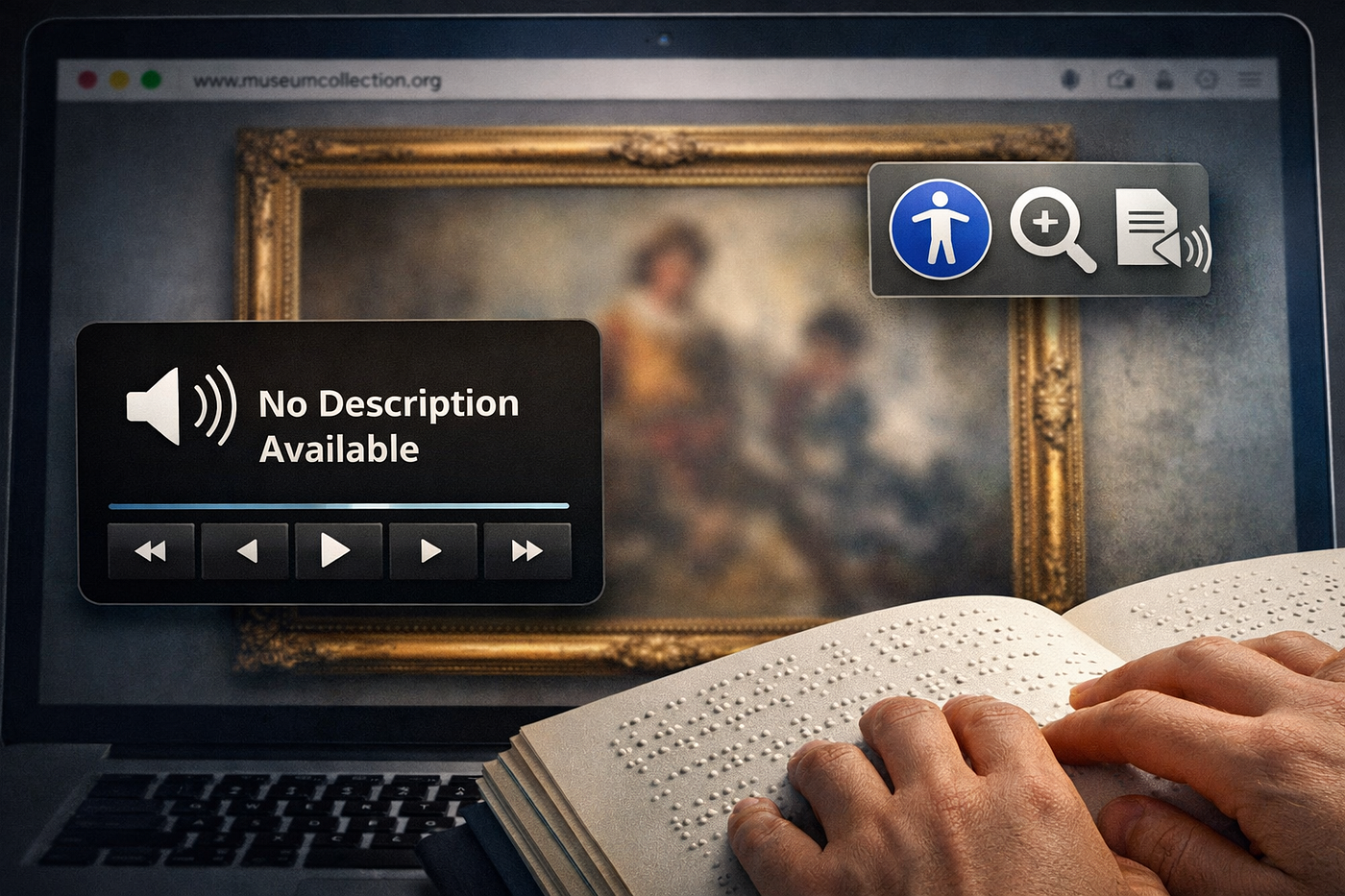
Visibility is not the same as access. Image created by the author using AI tools.
People move through thousands of images every day.
They scroll past them without thinking. Photographs, diagrams, historical records, moments captured and shared across platforms. The assumption is simple. If something is visible, it is accessible.
But that assumption depends on being able to see.
In April 2026, accessibility expectations for blind and low-vision users are becoming harder to sidestep. The Americans with Disabilities Act has always been about access, but for a long time that conversation stayed tied to physical space. Ramps were added. Elevators were installed. Signage improved. The work was visible, and it was contained within the building.
That boundary no longer holds.
As collections have moved online, access has moved with them. What a visitor encounters on a website is not separate from the museum experience. It is often the first experience. In many cases, it is the only one. The expectation has shifted quietly, but it has shifted completely.
We built digital access around images.
Hundreds of thousands of them. In some cases, millions.
They are cataloged, stored, and shared through platforms like Flickr, supported by internal systems such as a digital asset management system (DAMS), and tied, sometimes loosely and sometimes well, to a collections management system (CMS) or an integrated library system (ILS). The infrastructure is substantial. The reach is global. The assumption is that access has expanded simply because the material is available.
And people are using it.
Our museum’s digital collections include more than one million images. Each year, they are viewed over forty million times by a global audience.
That number reflects reach. It reflects interest. It reflects the success of making collections visible beyond the walls of the institution.
It also raises a harder question.
Who, within that audience, can actually access what we have made available?
Because visibility is not the same as usability.
For someone who cannot see the image, very little has changed. A photograph without description offers nothing. A label that only names an object does not explain it. A catalog record written for internal use does not translate into understanding.
It creates the appearance of access without delivering it.
We saw this clearly at our own museum, long before it became part of a broader institutional conversation. One of our docents was blind. He was not casual about the collection. He was a writer and a historian, someone who understood the material at a level that required more than surface access. He did not need simplified content. He needed the same depth that any researcher would expect.
What he did not have were the tools to reach it on his own.
In the library, the material was there. Records were there. Images were there. But without structured descriptions and without systems designed to translate visual information into something usable, access required another person.
He worked with assistance. Someone would sit with him, read through materials, describe images, and help interpret what was on the page. It allowed him to engage with the collection, but only through that added layer.
That is not independent access.
It is access that depends on someone else being present.
The distinction matters.
It is also not something I think about only at work.
Low vision affects my own family. My daughter is blind in one eye. She is not completely blind, but the way she uses her vision is different. When she relies on her stronger eye, it requires more effort. It is not passive. It is something she has to work at, and over time, that strain builds.
That changes how she interacts with the world.
Access is not only about whether something exists. It is about how much effort it takes to use it, and whether that effort becomes a barrier over time.
That understanding did not come from policy. It came from watching what is missed when systems are built without that perspective in mind.
The docent showed it in the museum. My daughter showed it everywhere else.
The issue is the same.
I did not immediately connect that to our digital collections.
It came in pieces.
When I began publishing on Medium, I was asked to include alt text for images. It was a small requirement, easy to overlook at first. A short description attached to an image so that someone using a screen reader could understand what was there.
I had not given it much thought before that.
Then I heard a radio segment discussing updated accessibility expectations under the Americans with Disabilities Act. The focus had shifted toward digital access, not as an add-on, but as part of the core experience.
That is when the connection became harder to ignore.
For more than twenty years, our focus was on digitization. We were working to preserve, to scan, to catalog, and to make collections available. The priority was volume. Moving material into a digital format before it was lost, organizing it so it could be found, and attaching the information we already knew.
We focused on identifying what was in the image. Names, dates, locations, aircraft types, and historical context.
That work is often understood as a single step, but it is not. Digitization requires sustained investment. Systems to store and manage the files. Infrastructure to maintain them over time.
The expense does not end with the scan. It continues as an ongoing commitment to maintain, manage, and preserve what has been created.
The scale of that effort shaped what we focused on.
We did not describe what was happening in the image. How people were positioned. What the landscape looked like. What sat in the background. What detail might matter to someone who could not see it.
We were building access as we understood it at the time, and we were moving quickly.
The result is a collection that is rich in information, but uneven in how it can be experienced. The data is there. The images are there. But the layer that translates visual content into something usable is often missing.
For years, this was not something I thought about.
The focus was on getting the information out. Digitizing, cataloging, and making collections available. The goal was access as we understood it at the time. If the image was online, if the record could be found, that was progress.
And we moved quickly.
By the time I stopped to reconsider it, we had already created more than one million digital images.
The gap was already there.
It was only over the past year that it began to come into focus.
It started with something small. Writing on Medium and being asked to include alt text. Then hearing more about accessibility expectations under the Americans with Disabilities Act. Then reflecting on what that actually meant in practice.
I began to think about what we had already created.
Not what we would do moving forward, but what it would mean to go back.
How do you add meaningful description to a collection of that size?
How do you return to work that was built for visibility and make it usable in a different way?
That question didn’t have an answer.
Until recently.
Over the past year, I have been working with artificial intelligence in a different context. It began with writing. At work, it was used to draft and refine language, to structure policies and documentation. Outside of work, it became part of a broader effort to write and publish more consistently.
At first, it felt like a faster way to produce content.
Over time, it revealed something else.
The speed, the consistency, and the way it could generate large amounts of language in a short time made it possible to approach work that would otherwise take an unmanageable amount of time.
And that is when the question changed.
If this can be done with writing, what could it mean for everything we have already digitized?
What would it look like to go back through a collection of this size and begin adding the kind of description that was never built into it?
I don’t have that fully defined yet.
But for the first time, it feels possible.
And the shift was not only theoretical.
I saw it in another way.
I was contacted by my publisher about one of my photo books, a project that used images from the museum’s collection to tell a local history. They were requesting permission to include it as part of an artificial intelligence training dataset. The offer included a small royalty payment.
I accepted.
Not because of the payment, but because of what it represented.
It was another form of access.
The images, the research, and the interpretation behind that work were no longer limited to the page. They were being used in a way that would allow them to be processed, learned from, and extended into new forms of use.
It was a different kind of distribution.
And it raised the same question from another direction.
If our collections are already being used this way, how do we ensure that what is built from them remains meaningful and accessible?
AI changes that.
It provides a way to move back through what has already been created and begin adding meaningful description at a scale that was not previously realistic. It allows large portions of a collection to be addressed in a structured and consistent way, turning empty or minimal records into something that can be used.
For the first time, the backlog is not fixed.
It is workable.
Just as important, it changes how we move forward.
As new material is digitized, description does not need to be deferred. It can be built into the process. Accessibility becomes part of the workflow rather than something added later.
The shift is not just technical.
It is directional.
We are no longer only creating digital collections. We are responsible for making them usable.
There is a tendency to frame all of this as compliance, as something driven by regulation and risk.
That is the least interesting way to look at it.
Compliance asks whether something meets a requirement.
Accessibility asks whether someone can actually use what has been provided.
The two are not the same.
For public institutions, the legal pressure is becoming more visible. For private nonprofits, it is easier to assume the expectation applies elsewhere. But the distinction is narrowing. The moment collections are placed online, the audience changes. Access is no longer defined by who can walk through the door. It is defined by who can engage with what is made available.
Forty million views a year is not just a measure of reach.
It is a measure of responsibility.
By 2026, the gap is no longer abstract. The collections are already online. The tools to address scale now exist.
What remains is the decision.
Whether access will continue to depend on someone being there to explain what others can see, or whether it will be built into the experience itself.
We built a digital world around what can be seen.
Now we have to decide who it actually works for.
메타데이터
- post_id
- 2bca05cb184a
- slug
- access-was-never-equal-2bca05cb184a
- url
- https://medium.com/activated-thinker/access-was-never-equal-2bca05cb184a
- canonical_url
- https://medium.com/activated-thinker/access-was-never-equal-2bca05cb184a
- author_url
- https://medium.com/@kpescador
- status
- ok
- fetched_at
- 2026-07-07 10:08:12